
If you’re writing an email, completing a school assignment, or sending a professional message, you may wonder whether recieve or receive is the correct spelling. Both forms look similar, and the pronunciation doesn’t make the difference obvious. However, only one follows standard English spelling rules.
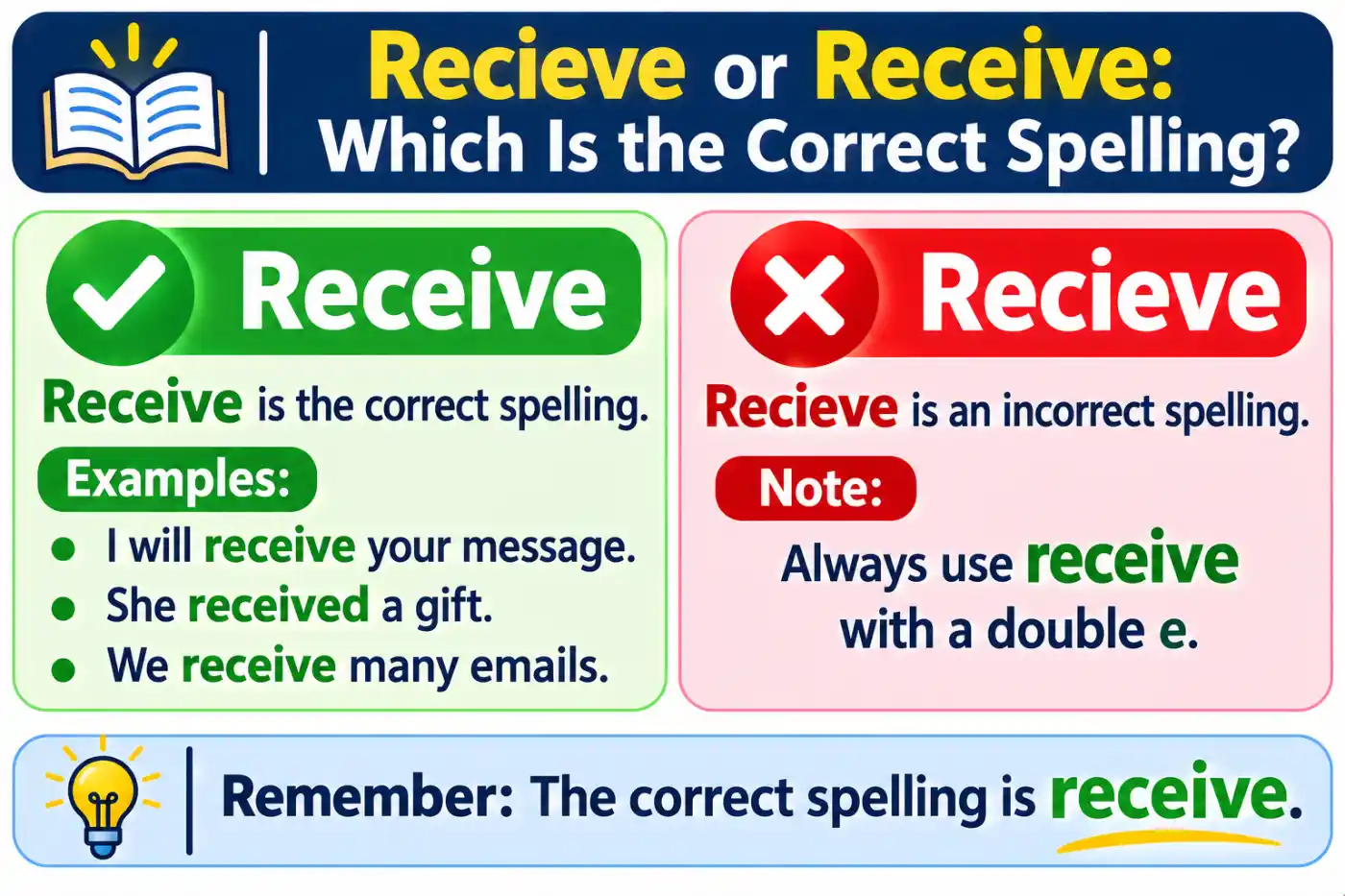
Receive is the correct spelling. Recieve is a common misspelling that you should avoid in formal and informal writing. The correct word follows the spelling rule “I before E, except after C.”
The word receive is a verb that means to get, accept, or be given something. You can use it when talking about packages, messages, payments, information, gifts, or opportunities.
In this article, you’ll learn the difference between recieve and receive, understand the spelling rule, explore practical sentence examples, and discover simple ways to remember the correct spelling.

Recieve or Receive: Which Spelling Is Correct?
Receive is the only correct spelling in standard American English. The spelling recieve is incorrect because the letters E and I appear in the wrong order.
Here’s a quick comparison:
| Word | Correct or Incorrect | Explanation |
|---|---|---|
| Receive | Correct | Standard English spelling |
| Recieve | Incorrect | Common spelling mistake |
For example:
- Correct: I expect to receive your email tomorrow.
- Incorrect: I expect to recieve your email tomorrow.
The difference involves just two letters, but using the correct spelling makes your writing clearer and more professional. If you’re writing a business email, school paper, job application, or social media post, always choose receive.
What Does Receive Mean?
The word receive means to get, accept, or take something that someone gives, sends, or offers. It describes the action of getting something from another person, organization, or source. The word can refer to physical objects as well as information, communication, services, and experiences.
Common Meanings of Receive
Here are some common ways to use the word:
1. To get something
Receive can describe getting an item, package, letter, or payment.
Example: I will receive my new laptop next week.
2. To accept something
It can describe accepting a gift, invitation, award, or offer.
Example: She was happy to receive the scholarship.
3. To get information or communication
You can use receive when someone gets a phone call, text message, email, or announcement.
Example: Did you receive my message?
4. To experience something
Receive can also describe experiencing treatment, support, attention, or recognition.
Example: The volunteers received warm appreciation from the community.
5. To welcome someone
In some situations, receive means to welcome or greet a visitor.
Example: The manager will receive the guests at the entrance.
Why Do People Confuse Receive and Recieve?
Many English learners and native speakers confuse these spellings because the letters E and I can appear in different orders in English words. The pronunciation of receive does not clearly indicate which letter comes first. As a result, writers sometimes place I before E, producing the incorrect spelling recieve. There are several reasons this mistake happens.
1. Confusion About the I Before E Rule
Many students learn the spelling rule:
“I before E, except after C.”
This rule helps explain why receive uses EI rather than IE. However, people sometimes remember only the first part and accidentally write recieve.
2. Similar-Looking English Words
English contains several words with the letter combinations IE and EI.
For example:
| IE Words | EI Words |
|---|---|
| Believe | Receive |
| Friend | Ceiling |
| Chief | Deceive |
| Field | Receipt |
| Piece | Perceive |
Seeing these different patterns can make spelling confusing, especially when writing quickly.
3. Typing Too Quickly
People sometimes make spelling mistakes when typing emails, completing online forms, or sending text messages. Because recieve looks similar to receive, writers may not notice the incorrect letter order.
4. Depending Only on Pronunciation
The pronunciation of receive does not provide a reliable way to remember its spelling. You need to recognize its correct written form rather than rely on how it sounds.
The I Before E Rule Explained
One helpful way to remember the spelling of receive is through the traditional spelling rule:
I before E, except after C.
According to this rule, the letters E and I appear in the order EI when they follow the letter C in words such as:
- Receive
- Deceive
- Perceive
- Ceiling
- Receipt
However, English spelling has many exceptions, so this rule should be treated as a useful guideline rather than an absolute rule.
How the Rule Applies to Receive
Look at the spelling:
R-E-C-E-I-V-E
The letter C comes immediately before the EI combination. Therefore, the correct spelling is receive, not recieve.
You can remember it by thinking:
- After C, use EI.
- Write R-E-C-E-I-V-E.
- Never switch the E and I.
This simple spelling pattern can also help you remember related words such as receipt and deceive.
How to Use Receive in a Sentence
Receive is a regular verb in its base form, but it changes slightly depending on the tense and sentence structure. Understanding its different forms will help you use it correctly in everyday communication.
Forms of Receive
| Verb Form | Spelling | Example |
|---|---|---|
| Base form | Receive | I receive emails daily. |
| Third-person singular | Receives | She receives weekly updates. |
| Simple past | Received | He received the package. |
| Past participle | Received | We have received your payment. |
| Present participle | Receiving | They are receiving assistance. |
Notice that every form keeps the same EI spelling.
Receive in Different Tenses
Present tense:
I receive several notifications every morning.
Past tense:
She received an invitation to the conference.
Future tense:
We will receive the final report next Monday.
Present continuous tense:
The students are receiving their certificates.
Present perfect tense:
The company has received your application.
These examples show how the verb changes according to the tense while maintaining its correct spelling.
15 Examples of Receive in Real Sentences
The best way to understand a word is to see how people use it in everyday situations. Here are 15 original examples featuring different contexts.
| No. | Context | Example Sentence |
|---|---|---|
| 1 | I hope to receive your reply by Friday. | |
| 2 | School | Every student will receive a report card. |
| 3 | Workplace | The employees receive their schedules every Monday. |
| 4 | Shopping | I received my online order yesterday. |
| 5 | Banking | You should receive a payment confirmation shortly. |
| 6 | Family | My grandmother will receive a special gift today. |
| 7 | Technology | Your phone can receive messages even when the screen is locked. |
| 8 | Education | She received an excellent grade on her assignment. |
| 9 | Business | The company received several new customer inquiries. |
| 10 | Travel | Passengers receive their boarding passes at check-in. |
| 11 | Communication | Did you receive the invitation I sent? |
| 12 | Healthcare | The patient received helpful advice from the doctor. |
| 13 | Social media | The video received thousands of views. |
| 14 | Job application | I hope to receive an interview invitation soon. |
| 15 | Everyday life | We received a warm welcome from our neighbors. |
These examples demonstrate that receive works in many situations. You can use it to describe getting objects, information, services, recognition, and other things.
Receive or Receipt: What’s the Difference?
Receive is a verb that describes the action of getting something. Receipt is a noun that usually refers to written or digital proof of a purchase or payment.
| Word | Part of Speech | Meaning | Example |
|---|---|---|---|
| Receive | Verb | To get something | I will receive the order tomorrow. |
| Receipt | Noun | Proof of purchase or payment | Please keep your receipt. |
When Should You Use Receive?
Use receive when describing the action of getting something.
Examples:
- I will receive the documents by email.
- Did you receive the package?
- She received a promotion last month.
When Should You Use Receipt?
Use receipt when referring to proof that someone purchased or paid for something.
Examples:
- The cashier gave me a receipt.
- Please attach the receipt to your expense report.
- I lost the receipt for my new shoes.
Quick tip: Receive is an action, while receipt is usually a document or record.
Receive or Accept: What’s the Difference?
Receive and accept are similar because both can involve getting something from another person. However, they do not always mean the same thing. Receive means to get something, while accept means to agree to take or approve something.
For example:
- Receive: I received a job offer yesterday.
- Accept: I accepted the job offer this morning.
You can receive something without accepting it.
| Word | Meaning | Example |
|---|---|---|
| Receive | To get something | She received an invitation. |
| Accept | To agree to take something | She accepted the invitation. |
When to Use Receive
Use receive when the focus is on getting something.
Example: The school received several applications.
When to Use Accept
Use accept when someone agrees to take something or approve an offer.
Example: The school accepted three applications.

Receive or Get: Which Word Should You Choose?
Receive and get can both describe obtaining something, but their tones are slightly different. Get is more common in casual conversation, while receive often sounds more formal or professional.
| Word | Tone | Example |
|---|---|---|
| Receive | Neutral or formal | I received your email. |
| Get | Casual and conversational | I got your email. |
Examples of Receive
- We received your request this morning.
- The organization received a donation.
- You will receive further instructions by email.
Examples of Get
- I got your message.
- Did you get the package?
- She got a new phone yesterday.
Both words are correct. Choose the one that fits your audience and situation.
Receive or Perceive: What’s the Difference?
Receive and perceive look similar because they share the EI letter combination. However, their meanings are different. Receive means to get something, while perceive means to notice, understand, or become aware of something.
| Word | Meaning | Example |
|---|---|---|
| Receive | To get something | I received a letter. |
| Perceive | To notice or understand something | She perceived a change in his attitude. |
Examples of Receive
- The customer received a confirmation email.
- We received a generous donation.
Examples of Perceive
- Children may perceive situations differently from adults.
- He perceived the comment as criticism.
Remember that both words use EI after C, but they communicate different ideas.
Synonyms and Alternatives for Receive
The word receive has several alternatives, but the best choice depends on the context. Some synonyms describe getting something, while others focus on accepting, collecting, or obtaining it. Here are useful alternatives for different situations.
| Word/Phrase | Meaning | Tone | Example |
|---|---|---|---|
| Get | Obtain something | Casual | I got your message. |
| Obtain | Gain possession of something | Formal | She obtained permission. |
| Acquire | Gain or develop something | Formal | He acquired new skills. |
| Accept | Agree to take something | Neutral | They accepted the offer. |
| Collect | Gather or pick something up | Neutral | I collected my package. |
| Gain | Obtain an advantage or benefit | Neutral | She gained valuable experience. |
| Earn | Receive through effort | Neutral | He earned a promotion. |
| Secure | Successfully obtain something | Professional | The company secured funding. |
| Retrieve | Get something back | Neutral | I retrieved the missing file. |
| Gather | Bring things together | Neutral | We gathered useful information. |
| Welcome | Receive someone positively | Friendly | They welcomed the visitors. |
| Be given | Have something provided | Neutral | She was given an award. |
| Be sent | Have something delivered | Neutral | The documents were sent to me. |
| Take delivery of | Receive delivered goods | Formal | We took delivery of the equipment. |
| Experience | Have something happen to you | Neutral | The business experienced strong growth. |
| Be awarded | Receive an honor or prize | Formal | He was awarded a scholarship. |
| Be presented with | Receive something formally | Formal | She was presented with a certificate. |
| Inherit | Receive property or money from someone | Legal/Formal | He inherited his grandfather’s home. |
| Reap | Receive the results of an action | Literary | They reaped the benefits of their work. |
| Welcome aboard | Greet someone joining a group | Friendly | We welcomed the new employee aboard. |
Choosing the Right Synonym
Not every alternative works in every sentence.
For example:
- Use get in casual conversation.
- Use obtain in formal writing.
- Use accept when someone agrees to take an offer.
- Use collect when picking up an item.
- Use earn when something comes through effort.
- Use retrieve when getting something back.
Choosing the right synonym makes your writing more precise and natural.
Is Receive Formal or Informal?
Receive works in both formal and informal communication. It is a standard English verb that fits professional emails, academic writing, business documents, and everyday conversations. However, its tone can sound slightly more formal than the word get.
Receive in Professional Emails
In workplace communication, receive is useful when discussing documents, payments, applications, and updates.
Examples:
- We have received your application.
- Please confirm whether you received the attached document.
- You will receive an update after the review process.
Receive in Academic Writing
Students can use receive in essays, reports, and research assignments.
Examples:
- The participants received detailed instructions.
- The students received feedback on their projects.
- The organization received additional funding for its research.
Receive in Casual Conversations
You can also use receive in everyday speech.
Examples:
- Did you receive my text?
- I received a birthday gift from my cousin.
- We’ll receive the delivery this afternoon.
For casual conversations, get may sound more natural in some sentences, but receive remains perfectly correct.
Is Receive Different in American and British English?
No. Receive has the same standard spelling in American and British English. Unlike some English words that change spelling between the United States and the United Kingdom, receive does not have a regional spelling variation.
| English Variety | Correct Spelling |
|---|---|
| American English | Receive |
| British English | Receive |
| Canadian English | Receive |
| Australian English | Receive |
Examples:
- American English: I will receive the package tomorrow.
- British English: I will receive the parcel tomorrow.
- Canadian English: She received an email from the office.
- Australian English: They received their results today.
The word itself remains unchanged. Some surrounding vocabulary may differ by region, such as package and parcel, but the spelling of receive stays the same.
Common Spelling Mistakes Related to Receive
Writers sometimes make mistakes with receive because they confuse the letter order or mix it up with related words. Here are some common errors and their corrections.
| Incorrect Form | Correct Form | Explanation |
|---|---|---|
| Recieve | Receive | The E and I are reversed. |
| Receeve | Receive | The ending is spelled with I before V. |
| Receve | Receive | The second E is missing. |
| Receiv | Receive | The final E is missing. |
| Recived | Received | The past-tense ending is incorrect. |
| Recieving | Receiving | The incorrect IE sequence appears again. |
| Reciever | Receiver | The letters are in the wrong order. |
Mistake 1: Writing Recieve Instead of Receive
Incorrect: I hope to recieve your response soon.
Correct: I hope to receive your response soon.
The correct spelling places E before I after C.
Mistake 2: Writing Recieved Instead of Received
Incorrect: We recieved your payment yesterday.
Correct: We received your payment yesterday.
Remember that the past tense adds -d to the correctly spelled base word.
Mistake 3: Writing Recieving Instead of Receiving
Incorrect: The company is recieveing new applications.
Correct: The company is receiving new applications.
To create the present participle, remove the final E and add -ing:
Receive → Receiving.
Mistake 4: Confusing Receiver and Receipt
A receiver is a person or device that receives something. A receipt is proof of a purchase or payment.
Examples:
- The receiver signed for the delivery.
- The cashier printed a receipt.
These words are related but have different meanings.
How to Remember the Correct Spelling of Receive
If you regularly confuse recieve and receive, a few simple memory tricks can help you avoid the mistake.
1. Remember the C Rule
Think of the traditional spelling rule:
I before E, except after C.
Because C comes before the EI combination in receive, write E before I.
2. Break the Word Into Letters
Remember the spelling as:
R-E-C-E-I-V-E
Practicing the letter sequence can help you recognize the correct form.
3. Connect Receive With Deceive
Both receive and deceive follow the same EI spelling pattern.
Remember these examples:
- Receive
- Deceive
- Perceive
Learning these words together can make the spelling pattern easier to recognize.
4. Practice With a Short Sentence
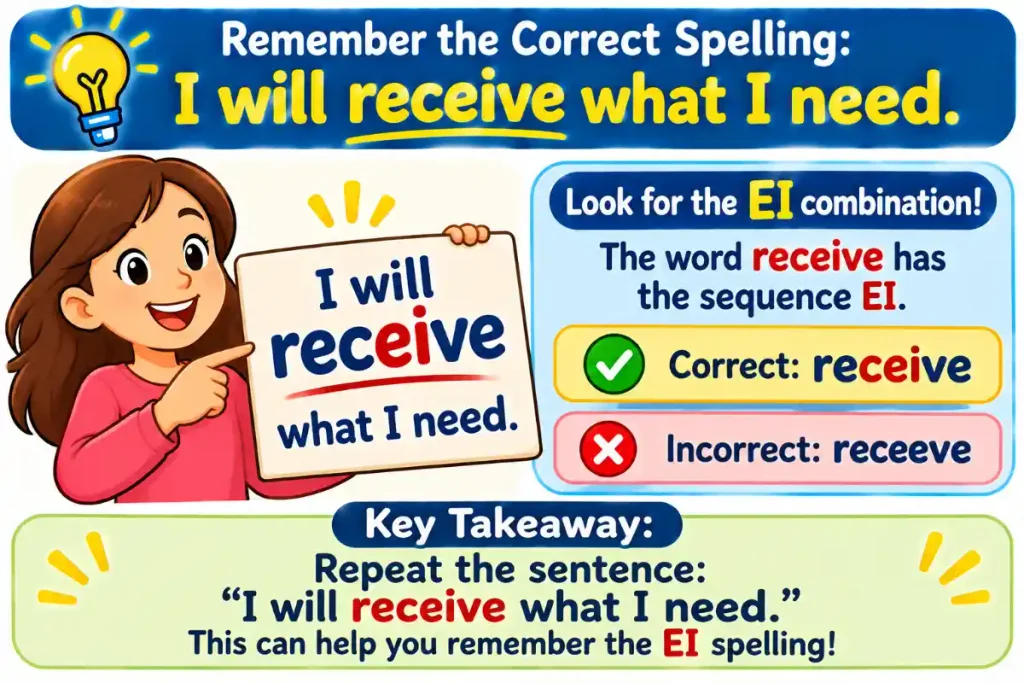
Use this sentence to remember the correct spelling:
“I will receive what I need.”
Repeating the sentence can help you remember the EI combination.
5. Check Before Sending
Before submitting an assignment or sending an important email, review words that are easy to misspell.
Pay special attention to receive, received, receiving, and receiver.
Conclusion
Choosing the correct spelling is important for clear and professional communication. When comparing recieve or receive, remember that only receive is accepted in standard English. The incorrect form recieve comes from reversing the E and I, a common mistake caused by confusion about English spelling patterns.
The easiest way to remember the correct spelling is to use the traditional “I before E, except after C” guideline. You can also connect receive with similar words such as deceive and perceive. Practice using receive in emails, assignments, and everyday sentences to become more confident. Whether you’re writing a professional message or a casual text, always use receive to make your writing accurate, natural, and easy to understand.
Frequently Asked Questions
1. Is Recieve or Receive Correct?
Receive is correct, while recieve is a spelling mistake. Always use receive in standard American English and other major English varieties.
2. How Do You Spell Receive Correctly?
The correct spelling is R-E-C-E-I-V-E. Remember that E comes before I after the letter C.
3. Why Is Receive Spelled With EI?
Receive follows the traditional “I before E, except after C” spelling guideline. The EI combination appears after C in words such as receive, deceive, and perceive.
4. Is Recieved a Correct Spelling?
No, recieved is incorrect. The correct past-tense spelling is received, which adds -d to receive.
5. What Is the Difference Between Receive and Receipt?
Receive is a verb meaning to get something, while receipt is a noun that usually means proof of payment or purchase. For example, you receive a package and keep its receipt.
6. What Is the Present Tense of Receive?
The base form is receive. Its third-person singular form is receives, as in “She receives emails every morning.”
7. Is Receive the Same in American and British English?
Yes. Both American and British English use the spelling receive. There is no standard regional spelling difference for this word.
2 thoughts on “Recieve or Receive: Which Is the Correct Spelling?”