
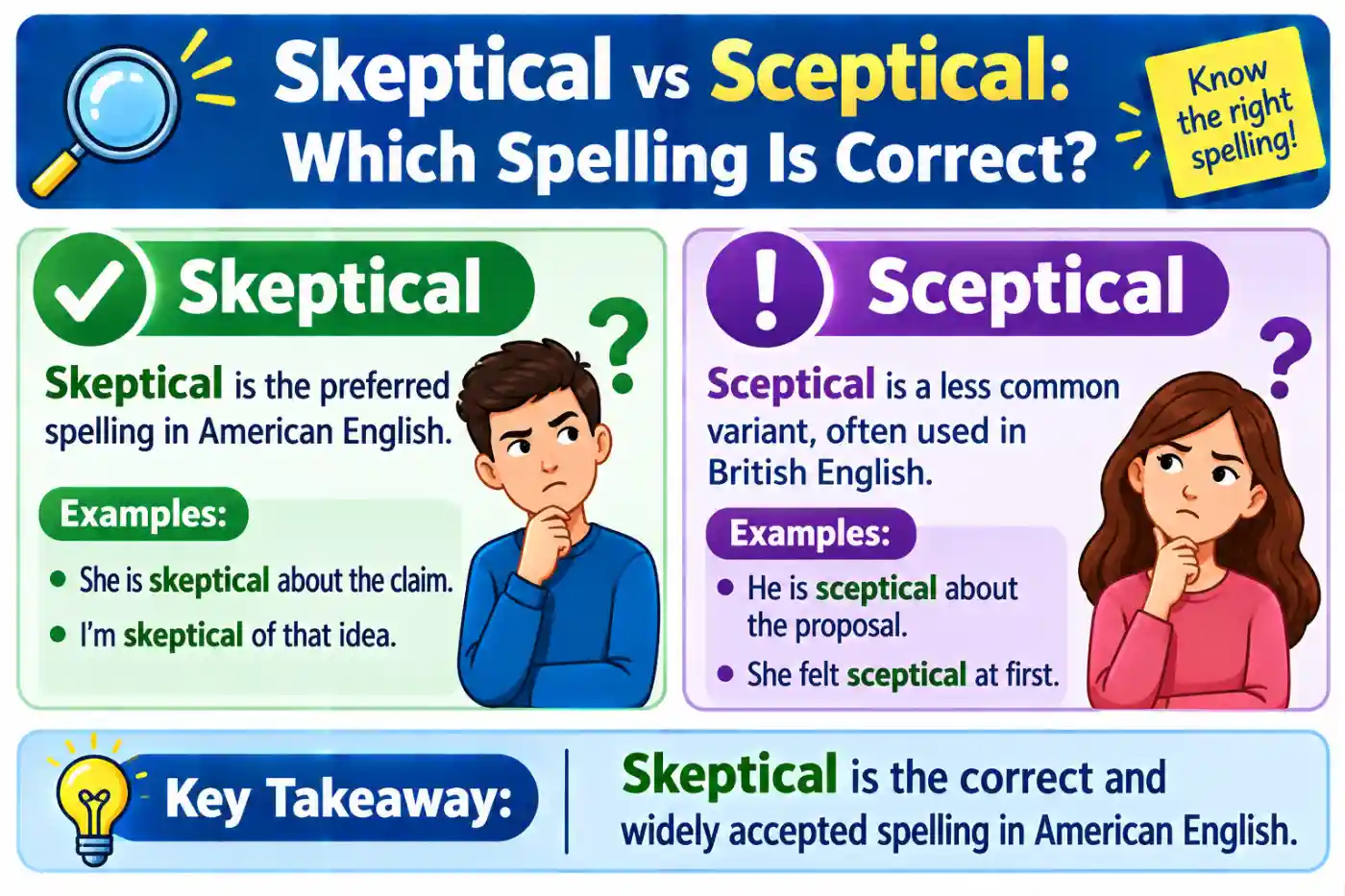
If you’re writing an email, school assignment, business report, or social media post, you may wonder whether skeptical vs. sceptical is the correct spelling. Both words look right, and they have exactly the same meaning. However, the spelling you should choose depends on the type of English you’re using.
Skeptical is the correct and standard spelling in American English, while sceptical is the standard spelling in British English. Both are adjectives that describe someone who questions a claim, doubts information, or wants evidence before believing something.
The difference is mainly regional, not grammatical or meaningful. Neither spelling is universally incorrect, but using the version that matches your audience helps keep your writing consistent.
In this guide, you’ll learn the difference between skeptical and sceptical, understand their meanings, explore American and British usage, and see how to use both spellings correctly in everyday sentences.
What Is the Difference Between Skeptical and Sceptical?
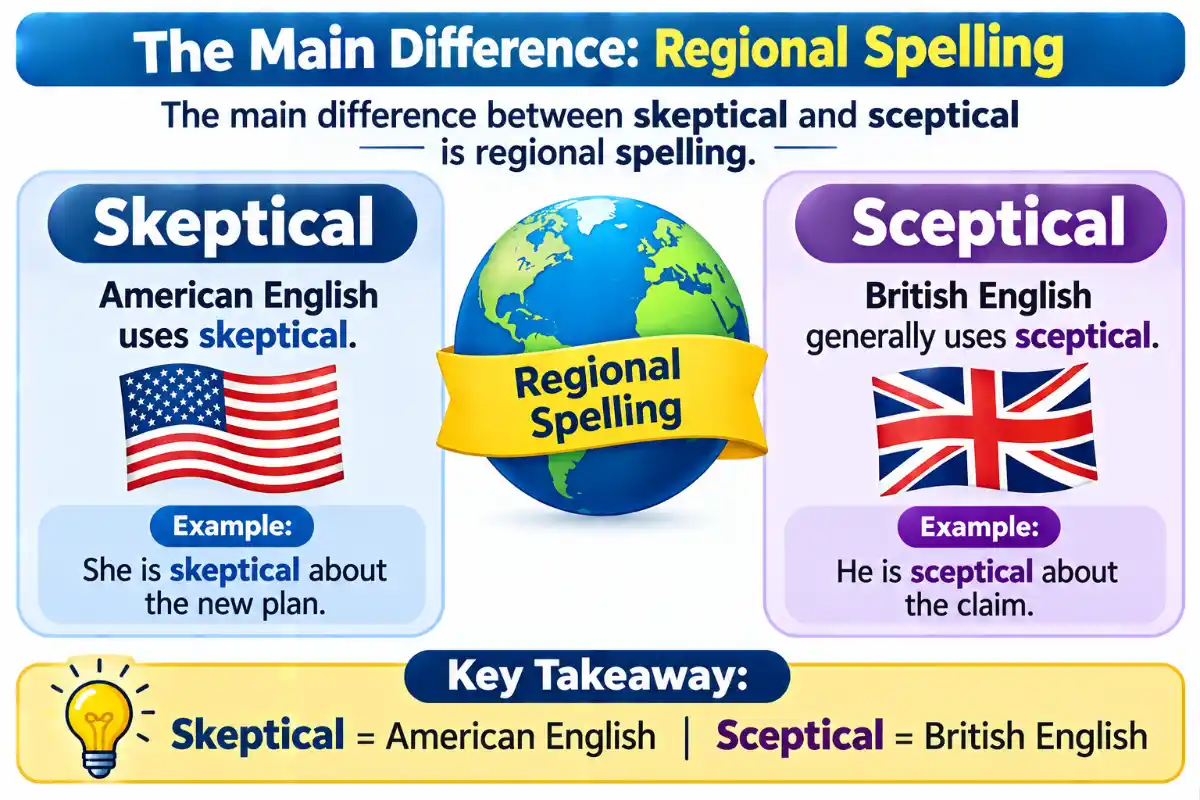
The main difference between skeptical and sceptical is regional spelling. American English uses skeptical, while British English generally uses sceptical. Both words describe a person who questions something or does not immediately accept information as true. They have the same pronunciation, grammatical function, and meaning.
Here’s a quick comparison:
| Word | English Variety | Meaning | Correct Usage |
|---|---|---|---|
| Skeptical | American English | Doubtful or questioning | US writing |
| Sceptical | British English | Doubtful or questioning | UK writing |
For example:
- American English: The customer was skeptical about the company’s promises.
- British English: The customer was sceptical about the company’s promises.
Both sentences are correct. The only difference is the letter c in the British spelling. If you’re writing for an American audience, choose skeptical. If you’re writing for a British audience, use sceptical.
What Does Skeptical Mean?
Skeptical means having doubts about something or questioning whether a statement, idea, or claim is true. A skeptical person usually wants proof, reliable information, or a reasonable explanation before accepting something. People often use this adjective when discussing promises, advertisements, news reports, scientific claims, rumors, and unfamiliar ideas.
For example:
- I was skeptical about the advertisement because it promised unrealistic results.
- The teacher remained skeptical until the students provided evidence.
- My parents were skeptical about the new business idea.
- She felt skeptical after hearing several different explanations.
In each example, the person does not automatically believe what someone else says. Instead, they question the information and look for reasons to trust it.
Is Being Skeptical a Bad Thing?
No, being skeptical is not necessarily negative. Healthy skepticism can help people make thoughtful decisions and avoid accepting misleading information. For example, a person who questions an online advertisement before purchasing a product is using reasonable judgment. Similarly, a student who checks the accuracy of information before including it in an assignment is practicing critical thinking. However, excessive skepticism can sometimes make it difficult to accept reliable information, even when strong evidence supports it. The important distinction is between questioning something reasonably and rejecting everything without considering the available evidence.
What Does Sceptical Mean?
Sceptical has the same meaning as skeptical. It describes someone who doubts a claim, questions information, or wants evidence before believing something. The spelling is commonly used in British English and other varieties that follow British spelling conventions.
For example:
- The residents were sceptical about the proposed changes.
- She remained sceptical until the manager explained the situation.
- Many customers are sceptical of advertisements that make unrealistic claims.
- He sounded sceptical when his friend described the unusual experience.
These sentences communicate the same ideas as their American English versions. Remember that sceptical is not a different word with a separate definition. It is simply a regional spelling variant.
Why Are Skeptical and Sceptical Spelled Differently?
The difference between skeptical and sceptical comes from the spelling conventions that developed in American and British English. English has several words with different spellings depending on the region. For example, American English uses color, while British English uses colour. Similarly, Americans generally write center, while British writers use centre. The same pattern appears with skeptical and sceptical. American English commonly uses the shorter spelling without the letter c before the k. British English generally retains the c. These spelling differences developed through the history of English and the gradual establishment of different regional writing standards.
The American Spelling: Skeptical
American English uses skeptical as its standard spelling. The spelling appears in American newspapers, books, school assignments, professional documents, and everyday communication.
Examples include:
- The journalist was skeptical about the politician’s statement.
- Investors remained skeptical about the company’s financial projections.
- I am skeptical of online reviews that sound too positive.
If your readers are primarily in the United States, skeptical is the appropriate choice.
The British Spelling: Sceptical
British English uses sceptical as its standard spelling. This spelling is common in writing from the United Kingdom and in publications that follow British spelling conventions.
Examples include:
- The journalist was sceptical about the politician’s statement.
- Investors remained sceptical about the company’s financial projections.
- I am sceptical of online reviews that sound too positive.
Both versions communicate the same meaning. The spelling changes to match the regional standard.
Skeptical vs Sceptical: American vs. British English
Understanding regional spelling differences can help you choose the right form for your audience. American English generally favors skeptical, while British English generally favors sceptical. Both spellings are accepted in their respective varieties. Here’s how the words compare across different English-speaking regions:
| Region | Common Spelling | Example |
|---|---|---|
| United States | Skeptical | She was skeptical about the offer. |
| United Kingdom | Sceptical | She was sceptical about the offer. |
| Canada | Skeptical is common | He was skeptical of the proposal. |
| Australia | Sceptical | They were sceptical about the results. |
| New Zealand | Sceptical | The audience seemed sceptical. |
Canadian English often follows American spelling for this word, although individual publications may have their own style preferences. British-style spelling is commonly used in Australia and New Zealand. If you’re unsure which version to use, consider the spelling conventions of your publication, school, workplace, or intended audience.
How to Use Skeptical in American English
If you’re writing for readers in the United States, use skeptical in formal and informal situations. It works naturally in academic writing, business communication, personal conversations, news reporting, and everyday messages. Here are some common situations where the word fits.
1. Academic Writing
Students and researchers often use skeptical when discussing evidence, arguments, theories, and research findings.
Examples:
- The researchers were skeptical of the initial findings.
- Students should remain skeptical when evaluating unreliable sources.
- The professor was skeptical about the argument because it lacked supporting evidence.
2. Professional Emails
Skeptical can also describe concerns about a proposal, business decision, or workplace suggestion.
Examples:
- I am skeptical about the proposed timeline because several tasks remain unfinished.
- The finance team was skeptical of the budget estimates.
- Our manager seemed skeptical about the new marketing strategy.
The word communicates doubt without necessarily sounding rude or disrespectful.
3. Everyday Conversations
People commonly use skeptical in conversations when they are unsure whether something is true.
Examples:
- I’m skeptical about his explanation.
- She sounded skeptical when I told her the news.
- My brother was skeptical about the movie recommendation.
4. Online Reviews and Social Media
Skeptical is useful when discussing advertisements, product claims, online information, and social media posts.
Examples:
- I’m skeptical of reviews that don’t explain the customer’s experience.
- Many people are skeptical about viral health claims.
- She posted that she was skeptical of the company’s announcement.
In these situations, the word suggests that someone wants more information before forming an opinion.
How to Use Sceptical in British English
The word sceptical follows the same grammatical rules as skeptical. The only difference is its spelling. British writers use sceptical in the same contexts, including professional communication, academic assignments, journalism, and everyday conversations.
Examples:
- The committee was sceptical about the proposed changes.
- I am sceptical of claims that sound too good to be true.
- The students remained sceptical until they reviewed the evidence.
- She was sceptical about the company’s explanation.
If you’re writing for a British publication, using sceptical helps maintain consistent British English spelling.
15 Examples of Skeptical and Sceptical in Sentences
The following examples show how both spellings work in different situations. The American and British versions have the same meanings.
| No. | American English | British English |
|---|---|---|
| 1 | I am skeptical about the offer. | I am sceptical about the offer. |
| 2 | She was skeptical of the results. | She was sceptical of the results. |
| 3 | The manager seemed skeptical. | The manager seemed sceptical. |
| 4 | They were skeptical about the announcement. | They were sceptical about the announcement. |
| 5 | My parents are skeptical of the plan. | My parents are sceptical of the plan. |
| 6 | The audience remained skeptical. | The audience remained sceptical. |
| 7 | He sounded skeptical during the meeting. | He sounded sceptical during the meeting. |
| 8 | Customers were skeptical of the advertisement. | Customers were sceptical of the advertisement. |
| 9 | The teacher was skeptical about the explanation. | The teacher was sceptical about the explanation. |
| 10 | I became skeptical after reading the reviews. | I became sceptical after reading the reviews. |
| 11 | Investors were skeptical about the proposal. | Investors were sceptical about the proposal. |
| 12 | She remained skeptical until she saw the proof. | She remained sceptical until she saw the proof. |
| 13 | The reporter was skeptical of the politician’s claims. | The reporter was sceptical of the politician’s claims. |
| 14 | We were skeptical about the unexpected announcement. | We were sceptical about the unexpected announcement. |
| 15 | He is naturally skeptical of unfamiliar ideas. | He is naturally sceptical of unfamiliar ideas. |
Additional Real-Life Examples
Here are more original examples showing how the American spelling works in different situations.
- Work: The supervisor was skeptical about the new schedule because it gave employees very little time to complete their tasks.
- School: Sarah remained skeptical of the historical claim until she found reliable information in her textbook.
- Email: I am somewhat skeptical about the proposal and would appreciate more details before approving it.
- Shopping: The customer was skeptical of the product because the seller offered no return policy.
- Technology: Many users are skeptical about applications that request unnecessary personal information.
- News: The editor was skeptical of the report because several important facts were missing.
- Family: My father was skeptical when I told him that the old car could still be repaired.
- Business: The investors were skeptical about the company’s plans to expand into new markets.
- Travel: We were skeptical about the hotel advertisement because the pictures looked different from recent customer reviews.
- Conversation: “I’m a little skeptical,” Mark said after hearing his friend’s unusual explanation.
These examples demonstrate that skeptical fits naturally into many types of writing and conversation.
Skeptical vs Doubtful: What’s the Difference?
Skeptical describes someone who questions whether something is true or reliable. Doubtful describes uncertainty or a lack of confidence about something. A skeptical person often wants evidence before accepting a claim. A doubtful person may simply feel uncertain about an outcome or possibility.
| Word | Meaning | Example |
|---|---|---|
| Skeptical | Questioning a claim or its reliability | I am skeptical of the advertisement. |
| Doubtful | Uncertain or lacking confidence | I am doubtful that we will finish today. |
Examples of Skeptical
- The scientist was skeptical about the unusual results.
- She was skeptical of the company’s promises.
- I am skeptical about the accuracy of that report.
Examples of Doubtful
- He was doubtful that the team could finish the project.
- I am doubtful about the chances of success.
- She felt doubtful about making such an important decision.
Which should you choose?
Use skeptical when someone questions information or asks for evidence. Use doubtful when someone feels uncertain about a situation, result, or possibility.
Skeptical vs Suspicious: What’s the Difference?
Skeptical means questioning whether something is true or reliable. Suspicious means believing that something may be dishonest, unusual, or potentially harmful.
For example:
- Skeptical: I am skeptical of the company’s promises.
- Suspicious: I am suspicious of the person who keeps asking for my bank details.
The first sentence expresses doubt about a claim. The second suggests concern that someone may have dishonest intentions.
| Word | Main Meaning | Common Context |
|---|---|---|
| Skeptical | Questioning information or claims | Evidence, research, promises |
| Suspicious | Distrusting someone or something | Dishonesty, unusual behavior, possible wrongdoing |
Use skeptical when you want to question the accuracy of information. Use suspicious when you have concerns about someone’s intentions or behavior.
Skeptical vs Cynical: What’s the Difference?
Skeptical and cynical are sometimes confused because both words can describe a person who does not easily believe something. However, their meanings are different. Skeptical describes someone who questions information and wants evidence. Cynical describes someone who tends to believe that people act mainly out of selfishness or personal interest.
Consider these examples:
- Skeptical: The customer was skeptical about the company’s new promises.
- Cynical: The customer was cynical and believed the company only wanted to increase its profits.
A skeptical person may accept a claim after reviewing convincing evidence. A cynical person may be more likely to question the motives behind that claim.
| Word | Meaning | Example |
|---|---|---|
| Skeptical | Questioning whether something is true | She was skeptical about the announcement. |
| Cynical | Expecting selfish motives or dishonest behavior | He was cynical about the politician’s promises. |
Use skeptical for reasonable questioning and cynical when describing a generally distrustful attitude toward people’s motives.
Skeptical vs Critical: What’s the Difference?
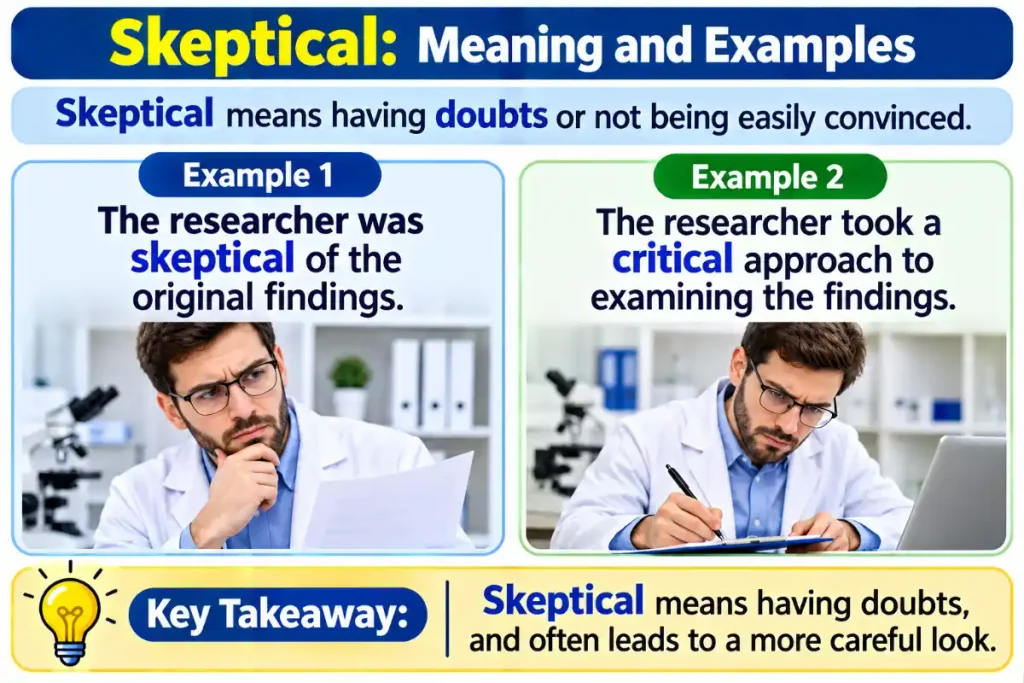
Skeptical and critical can overlap, especially when someone evaluates information carefully. However, they are not interchangeable in every situation. Skeptical means questioning whether something is true or trustworthy. Critical means carefully examining or evaluating something. It can also mean expressing disapproval.
Examples:
- The researcher was skeptical of the original findings.
- The researcher took a critical approach to examining the findings.
The first sentence focuses on doubt. The second focuses on careful evaluation.
Critical can also have a negative meaning:
- The manager was critical of the employee’s performance.
This sentence means the manager expressed disapproval, not simply that the manager questioned something.
Is Skeptical an Adjective?
Yes. Skeptical is an adjective that describes a person’s attitude, reaction, or approach to information. It usually appears before a noun or after a linking verb.
1. Before a Noun
An adjective can describe a noun directly.
Examples:
- A skeptical customer requested more information.
- The skeptical audience questioned the speaker.
- A skeptical student checked the source.
2. After a Linking Verb
Skeptical can also follow linking verbs such as is, was, seems, feels, and remains.
Examples:
- The customer is skeptical.
- She seemed skeptical about the explanation.
- They remained skeptical after the presentation.
3. In Comparative and Superlative Forms
The adjective can also be compared using more and most.
Examples:
- My brother is more skeptical than I am.
- She is the most skeptical member of the team.
- The audience became more skeptical after the announcement.
What Are the Different Forms of Skeptical?
The word skeptical belongs to a family of related words. Understanding these forms helps you use the correct part of speech in different sentences.
| Word | Part of Speech | Meaning | Example |
|---|---|---|---|
| Skeptical | Adjective | Doubtful or questioning | She is skeptical about the claim. |
| Skeptic | Noun | A person who questions claims | He is a skeptic about unusual promises. |
| Skepticism | Noun | An attitude of doubt or questioning | Her skepticism was reasonable. |
| Skeptically | Adverb | In a doubtful or questioning way | He looked at the offer skeptically. |
| Skepticalness | Noun | The quality of being skeptical | His skepticalness was noticeable. |
The most commonly used forms are skeptical, skeptic, skepticism, and skeptically.
Skeptic
A skeptic is someone who questions information or does not easily accept claims without evidence.
Example: The skeptic asked several questions before accepting the explanation.
Skepticism
Skepticism is the attitude or practice of questioning whether something is true.
Example: Healthy skepticism encourages people to examine information carefully.
Skeptically
Skeptically is an adverb that describes how someone does something.
Example: She looked skeptically at the advertisement.
British Spelling of Related Words
The regional spelling difference also appears in related forms.
| American English | British English |
|---|---|
| Skeptical | Sceptical |
| Skeptic | Sceptic |
| Skepticism | Scepticism |
| Skeptically | Sceptically |
For consistent American English, use the forms in the first column.
What Is the Origin of Skeptical and Sceptical?
The words skeptical and sceptical come from the Greek word skeptikos, which is associated with inquiry, examination, and careful consideration. The word entered English through Latin and later French influences. Its history is connected with the idea of examining information instead of accepting it immediately. Over time, different English-speaking regions developed different spelling preferences. American English adopted skeptical, while British English generally retained sceptical. The difference reflects regional spelling conventions rather than a difference in meaning or pronunciation.
What Are Some Synonyms for Skeptical?
Several words can express ideas similar to skeptical. However, the best alternative depends on the situation and the degree of doubt you want to communicate. Here are useful alternatives with their meanings and examples.
| Word/Phrase | Meaning | Tone | Example |
|---|---|---|---|
| Doubtful | Uncertain about something | Neutral | I am doubtful about the results. |
| Questioning | Asking whether something is true | Neutral | She has a questioning attitude. |
| Unconvinced | Not persuaded by an explanation | Neutral | The manager remained unconvinced. |
| Disbelieving | Not accepting something as true | Neutral | He gave a disbelieving response. |
| Suspicious | Feeling that something may be wrong | Stronger | They were suspicious of the offer. |
| Wary | Careful because of possible risks | Neutral | She was wary of the unusual request. |
| Distrustful | Lacking confidence or trust | Strong | He was distrustful of the company. |
| Dubious | Having doubts about truth or quality | Formal | The committee considered the claim dubious. |
| Uncertain | Not completely sure | Neutral | I am uncertain about the decision. |
| Hesitant | Unsure about taking action | Neutral | She was hesitant to accept the offer. |
| Cautious | Careful about possible problems | Neutral | The team took a cautious approach. |
| Disbelieving | Showing a lack of belief | Neutral | Her disbelieving expression surprised him. |
| Critical | Carefully examining something | Neutral/Formal | The reviewer took a critical approach. |
| Cynical | Expecting selfish motives | Negative | He was cynical about the promise. |
| Incredulous | Unwilling or unable to believe something | Strong | She gave him an incredulous look. |
| Questioning | Showing doubt or curiosity | Neutral | The reporter asked a questioning follow-up. |
| Guarded | Careful about trusting information | Neutral | He gave a guarded response. |
| Noncommittal | Not expressing a definite opinion | Formal | The director remained noncommittal. |
| Unpersuaded | Not convinced by an argument | Formal | The audience remained unpersuaded. |
| Discerning | Showing good judgment | Positive | A discerning reader checks the evidence. |
Which Synonym Should You Choose?
Not every synonym has exactly the same meaning as skeptical.
- Doubtful: Use it when someone is uncertain about a result or possibility.
- Unconvinced: Use it when an explanation has failed to persuade someone.
- Suspicious: Use it when someone thinks something may be dishonest.
- Wary: Use it when someone is careful because of possible risks.
- Dubious: Use it when something seems questionable or unreliable.
- Cynical: Use it when someone expects selfish motives.
- Incredulous: Use it when someone finds something extremely difficult to believe.
- Critical: Use it when someone carefully evaluates information.
For everyday writing, skeptical is often the clearest choice when describing someone who questions a claim.
What Are the Antonyms of Skeptical?
Antonyms are words with opposite or contrasting meanings. Since skeptical describes doubt or questioning, its antonyms generally express belief, confidence, or trust.
| Antonym | Meaning | Example |
|---|---|---|
| Trusting | Willing to believe others | She is trusting of her close friends. |
| Credulous | Too willing to believe things | A credulous person may accept unsupported claims. |
| Confident | Certain about something | He was confident about the results. |
| Convinced | Fully persuaded | I am convinced that the explanation is correct. |
| Believing | Accepting something as true | She was believing in the team’s success. |
| Trustful | Having or showing trust | The child was trustful of his teacher. |
| Assured | Feeling certain or confident | The manager sounded assured. |
Some of these words are only partial opposites.
For example, credulous can describe someone who believes information too easily, while skeptical describes someone who questions it. A person can also be confident about one subject and skeptical about another.
Common Mistakes When Using Skeptical and Sceptical
Although both spellings are correct, writers sometimes make mistakes when choosing between them or using the word in a sentence. Here are some common problems to avoid.
1. Using the British Spelling in American Writing
If you’re following American English conventions, use skeptical rather than sceptical.
Incorrect for standard American spelling: The audience was sceptical about the results.
Correct: The audience was skeptical about the results.
The British spelling is not universally wrong. It simply does not follow standard American spelling conventions.
2. Assuming the Two Words Have Different Meanings
Some writers think skeptical and sceptical describe different attitudes.
That is incorrect. Both words have the same meaning and grammatical function.
Correct: She was skeptical about the proposal.
Also correct: She was sceptical about the proposal.
The appropriate choice depends on regional spelling.
3. Writing Skeptikal or Sceptikal
Adding an unnecessary letter can create an incorrect spelling.
Incorrect: He was skeptikal about the announcement.
Incorrect: She was sceptikal of the results.
Correct: He was skeptical about the announcement.
Correct: She was sceptical of the results.
Remember the standard endings: -ical.
4. Confusing Skeptical With Skeptic
Skeptical is an adjective, while skeptic is a noun.
Incorrect: He is a skeptical about the offer.
Correct: He is skeptical about the offer.
Also correct: He is a skeptic about the offer.
Use skeptical to describe someone and skeptic to identify a person who questions claims.
5. Using Skepticism as an Adjective
Skepticism is a noun, not an adjective.
Incorrect: She gave a skepticism response.
Correct: She gave a skeptical response.
Also correct: Her response showed skepticism.
Choose the form that matches the grammatical role you need.
6. Using Skeptically Incorrectly
Skeptically is an adverb. It describes an action rather than directly describing a person or thing.
Incorrect: He was skeptically about the offer.
Correct: He was skeptical about the offer.
Also correct: He looked skeptically at the offer.
These differences help make your sentences grammatically accurate.
Should You Use Skeptical or Sceptical in Professional Writing?
Your choice should depend on the style guide and audience of your workplace or publication. For American businesses, academic institutions, and professional publications, skeptical is generally the preferred spelling. For British organizations and publications, sceptical is generally appropriate.
In Resumes and Cover Letters
You may use skeptical when describing your ability to evaluate information, but consider whether the word communicates the quality you want employers to notice.
For example:
- I take a skeptical approach to evaluating unfamiliar information.
- I carefully review claims and question unsupported conclusions.
The second sentence may sound more direct in a resume because it describes a specific skill.
In Business Reports
Skeptical works well when discussing concerns about a proposal, forecast, or business decision.
Example:
The finance department remained skeptical about the projected revenue because the estimates lacked supporting data.
In Professional Emails
You can use skeptical when expressing concerns politely.
Example:
I am somewhat skeptical about the proposed deadline and would like to review the remaining tasks before confirming it.
Adding a brief explanation makes your concern clearer and more constructive.
In Academic Writing
Skeptical is appropriate in American academic writing, particularly when discussing research, evidence, and arguments.
Example:
Researchers should remain skeptical of conclusions that rely on limited evidence.
British academic publications generally use sceptical instead.

How to Remember the Correct Spelling
Remembering the difference between skeptical and sceptical is simple once you connect each spelling with its regional variety.
Here are a few practical tips.
1. Remember the American K: American English uses skeptical with a k after the s.
2. Remember the British C: British English uses sceptical with a c before the k.
3. Think about your audience: If you’re writing for American readers, choose skeptical. If you’re writing for British readers, choose sceptical.
4. Stay consistent: Avoid switching between American and British spellings in the same document unless you’re discussing the spelling differences themselves.
5. Check your style guide: If your school, employer, or publisher has a preferred spelling standard, follow it.
A simple rule makes the choice easy: skeptical for American English and sceptical for British English.
Conclusion
The difference between skeptical vs. sceptical comes down to regional spelling, not meaning or grammar. Both words describe someone who questions information, doubts a claim, or wants evidence before accepting something as true.
For American English, skeptical is the correct standard spelling. For British English, sceptical is the preferred form. Both are accepted, so neither should be treated as universally incorrect.
If you’re writing a school assignment, professional email, business report, or article for American readers, choose skeptical. For British readers, use sceptical. The most important thing is to follow the spelling conventions of your audience and remain consistent throughout your writing.
Frequently Asked Questions
1. Which Is Correct, Skeptical or Sceptical?
Both spellings are correct. Skeptical is the standard American English spelling, while sceptical is the standard British English spelling. They have exactly the same meaning.
2. Is Skeptical American or British?
Skeptical is the standard American English spelling. It is commonly used in US books, newspapers, academic assignments, business documents, and everyday writing.
3. Is Sceptical the British Spelling?
Yes. Sceptical is the standard British English spelling. It is also commonly used in countries such as Australia and New Zealand.
4. Do Skeptical and Sceptical Mean the Same Thing?
Yes. Both words mean doubtful, questioning, or unwilling to accept something without evidence. The only difference is regional spelling.
5. How Do You Spell Skeptical in American English?
The correct American English spelling is skeptical, with a k and without the additional c. For example: I am skeptical about the company’s claims.
6. Is Skeptical a Positive or Negative Word?
Skeptical is generally neutral. It can describe healthy questioning and careful thinking, although excessive skepticism may sometimes suggest an unwillingness to accept reliable information.
7. What Is the Difference Between Skeptic and Skeptical?
Skeptic is a noun that describes a person who questions claims or beliefs. Skeptical is an adjective that describes a doubtful or questioning attitude. For example, “He is a skeptic” and “He is skeptical” are both correct.
1 thought on “Skeptical vs Sceptical: Which Spelling Is Correct?”