
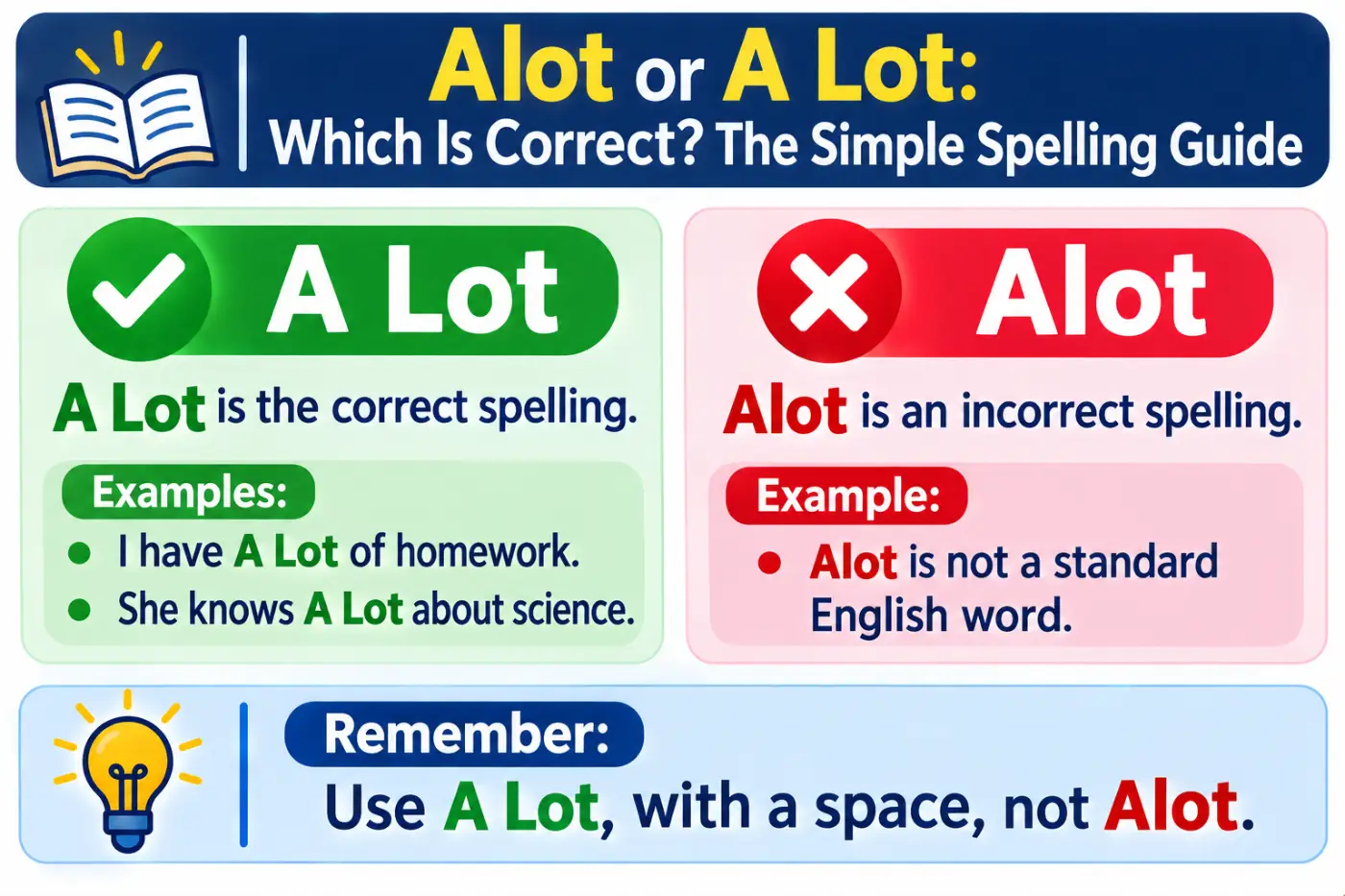
If you’re writing an email, school assignment, social media post, or professional message, you may wonder whether alot or a lot is the correct spelling. Both forms look similar, and many people use them interchangeably in informal writing. However, only one is accepted in standard American English.
A lot is the correct spelling. It is a two-word expression that means a large amount, a great number, or very often, depending on the sentence. Alot is a common spelling mistake and should not appear in standard writing.
For example, you should write, “I have a lot of work to finish today,” rather than “I have alot of work to finish today.”
Although the expression sounds like one word when spoken, English spelling keeps it separate. Understanding how to use it, recognizing similar expressions, and learning a few simple memory tricks can help you avoid this mistake. This guide explains the meaning, grammar, examples, alternatives, and common errors associated with this expression.
Is It Alot or A Lot?
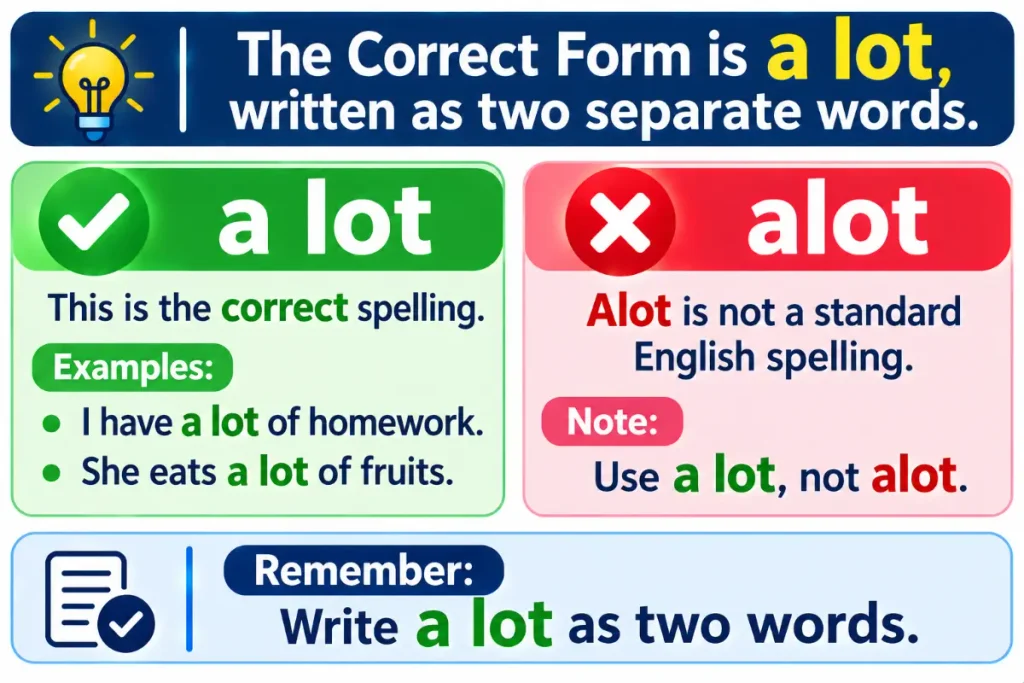
The correct form is a lot, written as two separate words. The word alot is not a standard English spelling. Here is a quick comparison:
| Spelling | Correct or Incorrect | Explanation |
|---|---|---|
| A lot | Correct | Standard two-word expression |
| Alot | Incorrect | Common spelling error |
| Lots | Correct | Informal plural form |
| A lot of | Correct | Used before a noun |
| Allot | Correct | A different verb with a different meaning |
The confusion happens because people often pronounce the expression as one continuous sound. However, pronunciation does not determine how English words should be written.
Why Is A Lot Correct?
The expression contains two separate words: the article a and the noun lot. Together, they express a large quantity or number.
Examples:
- We have a lot of homework this week.
- She spends a lot of time reading.
- There were a lot of people at the concert.
- I learned a lot from that experience.
In each example, the two words work together to express quantity or degree.
Why Is Alot Incorrect?
Alot combines the article and noun into one word. Standard American English does not recognize this spelling as a correct form of the expression. You might see it in text messages, online comments, or informal social media posts. However, its frequent appearance does not make it grammatically correct.
For example:
Incorrect: I have alot of questions about the assignment.
Correct: I have a lot of questions about the assignment.
The corrected sentence separates the article from the noun and follows standard English spelling.
What Does A Lot Mean?
A lot generally means a large amount, a large number, or a high degree. Its exact meaning depends on how you use it in a sentence. It is a common expression in everyday American English and works in conversations, emails, school assignments, and many other types of writing. Here are its main meanings.
1. A Large Amount
A lot can describe a large quantity of something, especially when discussing uncountable nouns.
Examples:
- We need a lot of water for the garden.
- She has a lot of patience with children.
- The company spent a lot of money on new equipment.
- I have a lot of information to review before the meeting.
In these examples, the expression describes a substantial quantity.
2. A Large Number
You can also use a lot with plural countable nouns to describe many people, objects, or things.
Examples:
- A lot of students joined the science club.
- We received a lot of applications this month.
- A lot of customers visited the store.
- There were a lot of cars on the highway.
Here, the expression refers to a large number rather than an uncountable quantity.
3. Very Much or To a Great Degree
A lot can also function as an adverbial expression that describes the degree or frequency of an action.
Examples:
- I enjoy traveling a lot.
- She studies a lot before exams.
- My brother talks a lot during dinner.
- We appreciate your support a lot.
In these sentences, it adds emphasis to the verb or describes how frequently something happens.
How Do You Use A Lot in a Sentence?
You can use a lot in several grammatical patterns. The most common pattern is a lot of + noun. However, it can also appear after verbs and at the end of sentences.
A Lot of + Noun
Use a lot of before a noun when you want to describe a large quantity or number.
Examples:
- There is a lot of traffic near the airport.
- She bought a lot of groceries for the weekend.
- We have a lot of opportunities to improve our skills.
- The teacher assigned a lot of reading.
Remember that the noun following the expression can be singular and uncountable or plural and countable.
A Lot After a Verb
You can place a lot after a verb to describe the amount or degree of an action.
Examples:
- He travels a lot for work.
- I exercise a lot during the week.
- They communicate a lot with their customers.
- My parents helped me a lot.
In these sentences, a lot does not directly introduce a noun.
A Lot With Comparative Adjectives
A lot can also strengthen comparisons. It means much or considerably in this context.
Examples:
- This computer is a lot faster than my old one.
- The new office is a lot brighter.
- Today’s assignment was a lot easier.
- Her presentation was a lot more detailed than mine.
This construction is common in everyday American English.
A Lot or Alot: What’s the Difference?
The main difference between a lot and alot is that one is standard English and the other is a spelling mistake.
| Feature | A Lot | Alot |
|---|---|---|
| Spelling | Two words | One word |
| Standard English | Yes | No |
| Meaning | Large amount or number | No standard meaning |
| Grammar | Article + noun expression | Incorrect spelling |
| Formal writing | Acceptable | Avoid |
| Everyday writing | Correct | Incorrect |
Examples of the Difference
| Incorrect Sentence | Correct Sentence |
|---|---|
| I learned alot today. | I learned a lot today. |
| She has alot of friends. | She has a lot of friends. |
| We need alot of time. | We need a lot of time. |
| He travels alot. | He travels a lot. |
| There are alot of choices. | There are a lot of choices. |
The simplest rule is to keep the words separate whenever you mean a large amount, number, or degree.
15 Examples of A Lot in Real Sentences
Seeing the correct expression in different situations can make its spelling and usage easier to remember. Here are 15 natural examples from everyday American English.
| Context | Example Sentence |
|---|---|
| Work | Our team has a lot of projects to complete this month. |
| School | I learned a lot during my history class. |
| Thank you a lot for sharing the updated information. | |
| Family | My grandparents have a lot of interesting stories. |
| Shopping | This store offers a lot of affordable options. |
| Travel | We took a lot of pictures during our vacation. |
| Technology | This application uses a lot of storage space. |
| Health | Getting enough sleep helps a lot with concentration. |
| Conversation | My sister talks a lot about her new job. |
| Social media | That video received a lot of positive comments. |
| Job applications | I gained a lot of experience through my previous position. |
| Cooking | You don’t need a lot of ingredients to make this recipe. |
| Business | The company invested a lot in employee training. |
| Weather | We haven’t received a lot of rain this summer. |
| Entertainment | I enjoyed the movie a lot. |
These examples show that the expression works with different subjects and situations. The spelling stays the same regardless of the context.
Is A Lot One Word or Two Words?
A lot is always written as two words when it means a large amount, number, or degree. The expression contains the article a and the noun lot. They work together but retain their separate spelling.
Consider these examples:
- Correct: We have a lot of books.
- Incorrect: We have alot of books.
- Correct: She practices a lot.
- Incorrect: She practices alot.
This rule applies to standard American English and other major varieties of English.
What About Allot?
There is another English word that looks similar: allot. However, allot is a separate word with a different meaning. It is a verb that means to distribute, assign, or give something to someone for a particular purpose.
Examples:
- The manager will allot extra time for the presentation.
- The school decided to allot more funds to its library.
- Each participant will receive an allotted amount of time.
Notice that allot does not mean a large amount.
| Expression | Meaning | Example |
|---|---|---|
| A lot | A large amount or number | We have a lot of work. |
| Allot | To assign or distribute | They will allot each student a desk. |
| Alot | Incorrect spelling of a lot | Avoid this spelling. |
Understanding the difference between a lot and allot is especially useful because both expressions sound similar.
A Lot or Lots: What’s the Difference?
A lot is commonly used with the preposition of before a noun or independently after a verb. Lots can also appear before a noun with of, usually giving the sentence a slightly more casual tone.
| Expression | Meaning | Example |
|---|---|---|
| A lot of | A large amount or number | We have a lot of time. |
| Lots of | A large amount or number | We have lots of time. |
| A lot | Very much or frequently | I travel a lot. |
| Lots | A large number or quantity | Lots of people attended. |
When Should You Use A Lot?
Use a lot when you want a natural expression that works in everyday and many professional situations.
Example: I appreciate your help a lot.
When Should You Use Lots?
Use lots when you want a slightly more casual expression.
Example: We have lots of exciting activities planned for Saturday.
Both forms are correct, but a lot is often the more neutral choice.
A Lot or Much: Which Should You Use?
A lot of commonly appears in affirmative sentences with countable and uncountable nouns. Much is particularly common in questions, negative statements, and formal expressions.
Examples:
- We have a lot of time.
- We don’t have much time.
- Did you spend much money?
- She has a lot of experience.
The following table explains their differences.
| Expression | Typical Usage | Example |
|---|---|---|
| A lot of | Affirmative sentences | I have a lot of work. |
| Much | Questions | How much time do we have? |
| Much | Negative sentences | I don’t have much money. |
| A lot | After verbs | She travels a lot. |
You can use a lot in many everyday situations where much might sound less natural in an affirmative sentence.

A Lot or Many: Understanding the Difference
A lot and many both express large quantities, but they do not follow exactly the same grammatical rules. Use many with plural countable nouns. Use a lot of with both plural countable nouns and uncountable nouns.
| Expression | Noun Type | Example |
|---|---|---|
| A lot of | Countable plural | We have a lot of books. |
| A lot of | Uncountable | She drinks a lot of water. |
| Many | Countable plural | Many students attended. |
| Much | Uncountable | We don’t have much information. |
For example:
- Correct: There are a lot of restaurants in this area.
- Correct: There are many restaurants in this area.
- Correct: I have a lot of information.
- Incorrect: I have many information.
The word information is uncountable in standard English, so many is not appropriate in that last example.
What Are the Best Alternatives to A Lot?
Although a lot is correct and widely used, you may sometimes want another expression to make your writing more precise or professional. The best alternative depends on the sentence, the type of noun, and the tone you want to create. Here are useful alternatives grouped by context.
Simple and Everyday Alternatives
| Word/Phrase | Meaning | Tone | Example |
|---|---|---|---|
| Many | A large number | Neutral | Many people attended. |
| Much | A large amount | Neutral | We don’t have much time. |
| Lots of | A large quantity | Casual | There are lots of options. |
| Plenty of | More than enough | Neutral | We have plenty of supplies. |
| Several | More than two, but not many | Neutral | She visited several stores. |
| Numerous | A large number | Formal | Numerous customers responded. |
| A great deal of | A large amount | Neutral/Formal | We spent a great deal of time preparing. |
| Tons of | A very large amount | Casual | I have tons of homework. |
| Loads of | A large quantity | Casual | They brought loads of snacks. |
| A bunch of | A group or collection | Casual | I bought a bunch of flowers. |
Formal and Professional Alternatives
| Word/Phrase | Meaning | Tone | Example |
|---|---|---|---|
| Substantial | Large or considerable | Formal | The project requires substantial funding. |
| Considerable | Fairly large or important | Formal | We made considerable progress. |
| Significant | Important or noticeable in amount | Professional | The company experienced significant growth. |
| Extensive | Covering a wide range | Formal | She has extensive experience. |
| Abundant | Available in large quantities | Formal | The region has abundant natural resources. |
| Ample | Enough or more than enough | Professional | We have ample time to prepare. |
| A multitude of | A very large number | Formal | The event attracted a multitude of visitors. |
| A wide range of | Many different types | Professional | We offer a wide range of services. |
| A large number of | Many | Neutral/Formal | A large number of applications arrived. |
| A considerable amount of | A large quantity | Formal | The project requires a considerable amount of research. |
Casual Alternatives
| Word/Phrase | Meaning | Tone | Example |
|---|---|---|---|
| Heaps of | A large quantity | Casual | We have heaps of time. |
| A whole bunch of | A large collection | Casual | She brought a whole bunch of books. |
| A pile of | A large quantity | Casual | I have a pile of assignments. |
| A ton of | A very large amount | Casual | We have a ton of things to do. |
| Loads and loads of | A very large quantity | Informal | There were loads and loads of people. |
| Plenty | More than enough | Neutral | Don’t worry; there’s plenty. |
Not all these alternatives fit every sentence. For example, numerous and many generally work with countable plural nouns, while much and a great deal of work with uncountable nouns. Choose an alternative based on the meaning you want to communicate rather than replacing a lot automatically.
Is A Lot Formal or Informal?
A lot is a neutral expression, but it often sounds more conversational than some formal alternatives. You can use it in everyday conversations, emails, schoolwork, and many workplace messages. However, academic or highly formal writing may benefit from more precise wording.
A Lot in Everyday Conversation
A lot is completely natural in spoken English.
Examples:
- I learned a lot from that class.
- We had a lot of fun at the party.
- She works a lot during the holidays.
A Lot in Professional Emails
You can use a lot in professional emails, particularly when the message has a friendly or conversational tone.
Example:
“Thank you for your help. I learned a lot from your feedback.”
For a more formal message, you could write:
“Thank you for your guidance. Your feedback provided valuable insight.”
A Lot in Academic Writing
A lot is grammatically correct in academic writing, but it may be too vague in some situations.
Instead of writing:
“The experiment produced a lot of results.”
Consider:
“The experiment produced numerous results.”
Or, if you have exact figures:
“The experiment produced 125 results.”
Specific wording helps readers understand exactly what you mean.
A Lot in Resumes
A lot is usually not the strongest choice for a resume because resumes benefit from clear, specific descriptions of skills and achievements.
Instead of:
“I have a lot of experience in customer service.”
Write:
“I have extensive experience in customer service.”
You can also improve the statement by adding relevant details:
“I have five years of experience in customer service and client support.”
The more specific statement communicates your qualifications more clearly.
Common Mistakes to Avoid When Using A Lot
Even though the spelling rule is simple, several mistakes can appear in everyday writing. Here are some common problems and their corrections.
1. Combining the Two Words
Incorrect: I have alot of assignments.
Correct: I have a lot of assignments.
Always separate the article and noun when using this expression.
2. Using Alot After a Verb
Incorrect: He complains alot about his schedule.
Correct: He complains a lot about his schedule.
The spelling rule applies whether the expression appears before a noun or after a verb.
3. Confusing A Lot With Allot
Incorrect: The teacher will a lot extra time for the project.
Correct: The teacher will allot extra time for the project.
Allot is a verb meaning to assign or distribute something.
4. Using Many With Uncountable Nouns
Incorrect: We have many information about the topic.
Correct: We have a lot of information about the topic.
Information is uncountable, so a lot of information is the correct construction.
5. Using Too Much Instead of Too Many
Incorrect: There are too much people in the room.
Correct: There are too many people in the room.
People is a plural countable noun, so many is appropriate.
6. Using A Lot of Without a Noun When One Is Needed
Incorrect: We have a lot of.
Correct: We have a lot.
When the noun is omitted, remove of if you are using the expression independently.
For example:
- We have a lot of work.
- We have a lot to discuss.
Both sentences are correct, but their grammatical structures differ.
Is A Lot Correct in American and British English?
Yes. A lot is the standard spelling in both American and British English. There is no regional spelling difference between the two varieties.
| English Variety | Correct Form | Incorrect Form |
|---|---|---|
| American English | A lot | Alot |
| British English | A lot | Alot |
| Canadian English | A lot | Alot |
| Australian English | A lot | Alot |
The same spelling rule applies across these major varieties of English. You may notice differences in vocabulary, punctuation, or other spelling conventions between countries, but this expression remains unchanged.
Why Do People Commonly Write Alot?
There are several reasons why people make this spelling mistake.
1. Pronunciation Makes It Sound Like One Word
When people speak quickly, a lot often sounds like a single word. This can make it easy to combine the two words when writing. However, spoken pronunciation does not change the standard spelling.
2. Familiarity With Similar Words
English contains many compound words and expressions that look similar.
For example:
- Already
- Always
- Almost
- Alone
Because these are written as single words, some writers assume that a lot follows the same pattern.
It does not.
3. Frequent Typing Errors
People often type quickly when sending messages or posting online. As a result, they may combine words without noticing the mistake. Spell-checking tools can help, but learning the correct form makes it easier to catch errors independently.
4. Repeated Exposure to Incorrect Spelling
Seeing alot in online comments or informal messages can make the spelling appear familiar. However, frequent use does not make an incorrect form standard. The best approach is to remember that a lot always has a space between the two words.
Quick Tips to Remember the Correct Spelling
If you frequently confuse alot and a lot, these simple tips can help.
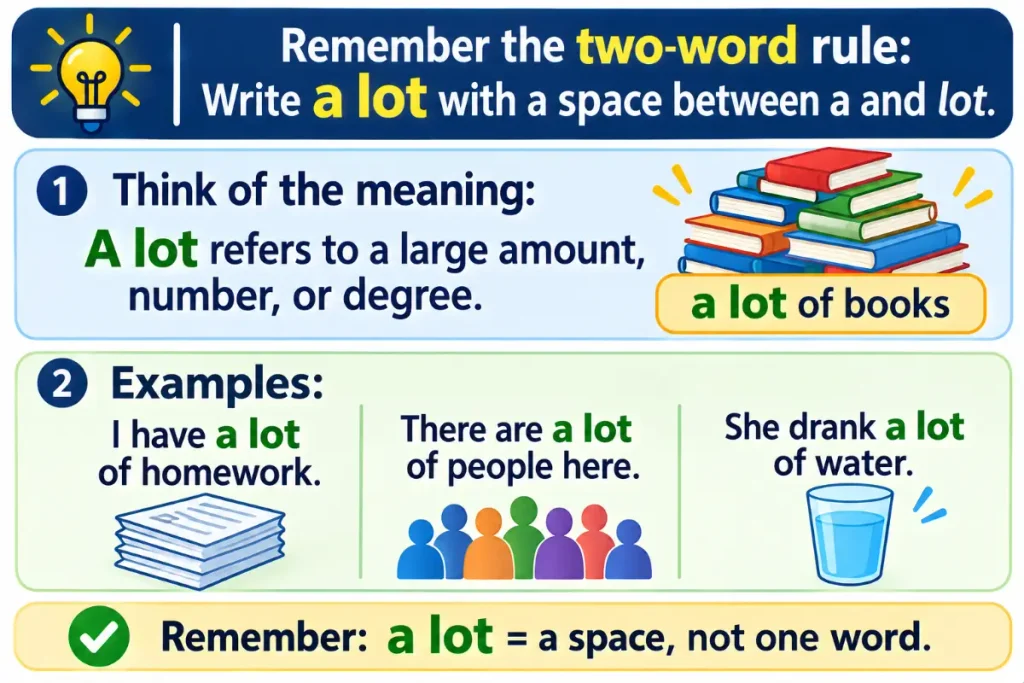
- Remember the two-word rule: Write a lot with a space between a and lot.
- Think of the meaning: A lot refers to a large amount, number, or degree.
- Check the sentence: If you mean many or much, you probably need a lot or a more precise alternative.
- Remember allot: Allot is a real word, but it means to assign or distribute.
- Read your writing aloud: Reviewing your sentences can help you notice missing spaces and other errors.
- Use a spell-checker: Run a quick spelling check before submitting important writing.
Conclusion
The correct spelling is a lot, not alot. Although the expression may sound like one word when spoken, standard English requires a space between the article a and the noun lot. It describes a large amount, a high number, or a great degree and appears frequently in everyday conversations and written communication.
Remember that a lot works with both countable and uncountable nouns, while expressions such as many, much, and lots of have their own grammatical uses. If you’re writing a professional email, academic assignment, or casual message, keeping the two words separate will help you avoid a common spelling mistake. Whenever you are unsure about alot or a lot, choose the two-word form. It is the correct choice in American, British, and other major varieties of English
Frequently Asked Questions
Is alot one word or two words?
A lot is always written as two words when it means a large amount, number, or degree. Alot is an incorrect spelling in standard English.
Which is correct, alot or a lot?
A lot is correct. Use the two-word expression in American English when describing a large quantity or number.
Is a lot grammatically correct?
Yes, a lot is grammatically correct and widely used in everyday English. You can use it with countable and uncountable nouns, as well as after verbs.
Can I use a lot in formal writing?
Yes, but more precise alternatives may work better in highly formal or academic writing. Depending on the sentence, you can use considerable, numerous, substantial, or a significant amount.
What is another word for a lot?
Common alternatives include many, much, plenty of, numerous, considerable, substantial, and lots of. The best choice depends on whether you are describing a number, quantity, or degree.
What is the difference between a lot and allot?
A lot means a large amount or number, while allot is a verb meaning to assign or distribute something. For example, “We have a lot of work” and “The manager will allot the tasks.”
Is a lot the same in American and British English?
Yes. American and British English both use a lot as the correct spelling. Alot is not standard in either variety.
2 thoughts on “Alot or A Lot: Which Is Correct? The Simple Spelling Guide”