
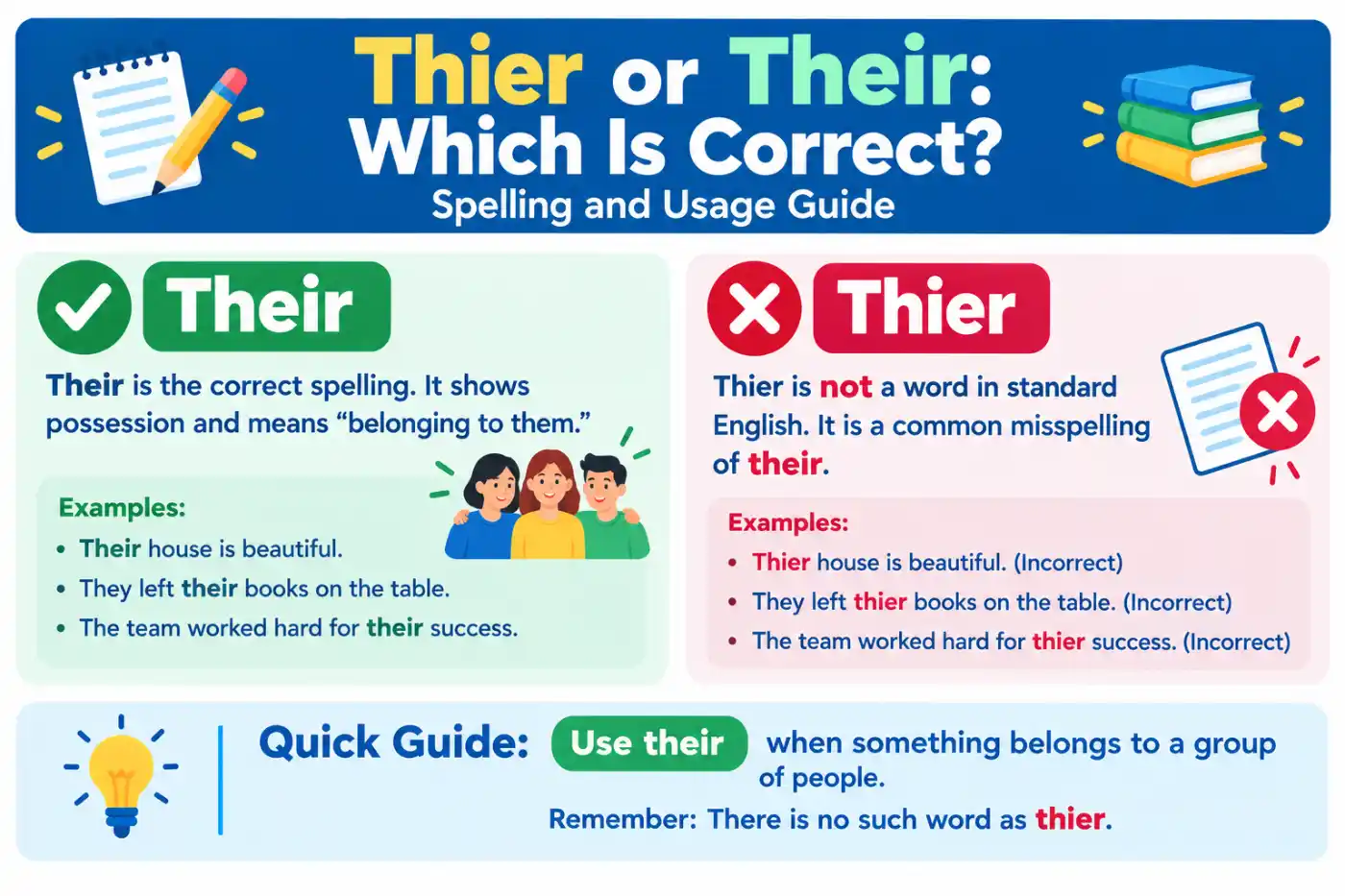
If you’re writing an email, completing a school assignment, or posting on social media, you may wonder whether thier or their is the correct spelling. The two words look almost identical, so it’s easy to mix up their letters. However, only one is accepted in standard English.
Their is the correct spelling. Thier is a common misspelling and should not appear in standard American English writing. Their is a possessive pronoun that shows ownership or a relationship between people, animals, or things.
For example, you can write, “The students forgot their books at school.” The word their shows that the books belong to the students.
Although the spelling difference involves only two letters, choosing the correct form makes your writing clearer and more professional. This guide explains the meaning of their, why people misspell it, how to use it in sentences, and how it differs from other commonly confused words.
Thier or Their: Which Spelling Is Correct?
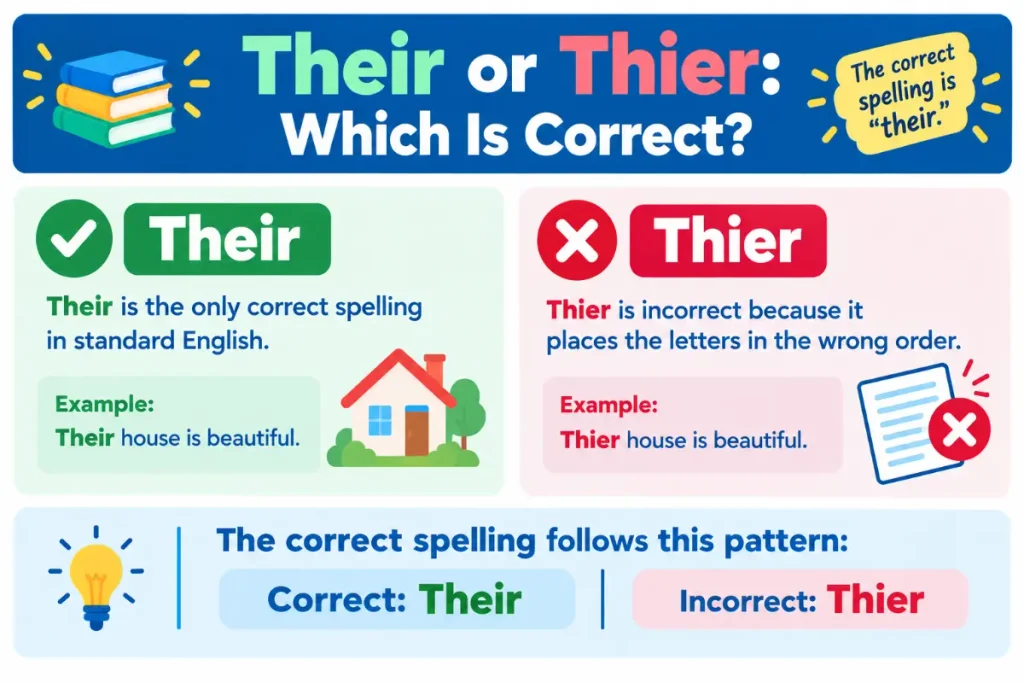
Their is the only correct spelling in standard English. Thier is incorrect because it places the letters in the wrong order. The correct spelling follows this pattern:
- Correct: Their
- Incorrect: Thier
The word their contains the letters T-H-E-I-R. A common mistake is switching the positions of the E and I, producing thier.
Here is a quick comparison:
| Word | Correct or Incorrect? | Explanation |
|---|---|---|
| Their | Correct | Standard possessive pronoun |
| Thier | Incorrect | Common spelling mistake |
Use their whenever you want to show that something belongs to someone or is associated with a group of people. Example: The employees returned to their offices after lunch. In this sentence, their connects the offices with the employees.
What Does Their Mean?
Their is a possessive pronoun and possessive determiner that indicates ownership, association, or a relationship. It commonly refers to something belonging to two or more people, animals, or things. It can also refer to one person when that person’s gender is unknown, irrelevant, or when they use singular they pronouns.
Consider these examples:
- The children packed their lunches before leaving.
- The teachers shared their lesson plans.
- Every student should bring their notebook.
- Someone left their jacket in the classroom.
In each example, their identifies a connection between a person or group and something associated with them.
Their as a Possessive Determiner
A possessive determiner appears before a noun to show who owns or is associated with something.
Examples:
- Their house is near the park.
- We enjoyed their performance.
- The company updated their website.
- Their decision surprised everyone.
In these sentences, their comes before a noun: house, performance, website, and decision.
Their as a Singular Gender-Neutral Possessive
English speakers also use their to refer to one person. This usage is called singular they. It is especially useful when the person’s gender is unknown or when someone uses they/them pronouns.
Examples:
- Every applicant must submit their resume.
- Someone forgot their phone on the table.
- Jordan brought their laptop to class.
- Each employee received their schedule.
Singular their is widely accepted in modern American English and helps writers avoid awkward or unnecessary gender-specific wording.
Why Do People Confuse Thier and Their?
The confusion between these spellings mainly comes from letter order. Both forms contain the same five letters, but their arrangement differs. People sometimes write thier because they remember the sounds of the word but not the correct sequence of letters. Here are the main reasons for this mistake.
1. The Letter Order Is Easy to Forget
The word their contains the letter combination E-I. Some writers accidentally reverse these letters and type I-E instead.
Incorrect: The students completed thier homework.
Correct: The students completed their homework.
The difference is small, but the correct spelling matters.
2. Typing Too Quickly
Fast typing can lead to spelling mistakes, especially when two letters appear next to each other.
For example, someone writing a quick email might type:
“Please ask the customers to bring thier receipts.”
The corrected sentence is:
“Please ask the customers to bring their receipts.”
A quick proofreading check can catch this error.
3. Confusion With Other English Words
English contains many words with similar letter combinations, including friend, receive, and piece. Remembering their spelling patterns can sometimes make writers second-guess the spelling of their. The best approach is to learn the correct spelling as a complete word rather than trying to apply a rule that may not work for every English word.
How to Use Their Correctly in a Sentence
Use their when you need to show possession or a relationship. It normally appears before a noun, although the noun can sometimes be understood from the surrounding context.
Follow these simple steps:
- Identify the person or group connected to something.
- Determine what belongs to or is associated with them.
- Use their before the relevant noun.
- Check that you have spelled it T-H-E-I-R.
For example:
- The neighbors painted their front door.
- The players celebrated their victory.
- My parents invited their friends to dinner.
- The students submitted their assignments online.
Each sentence uses their to connect an object or idea with its owner or associated person.
Can You Use Their for One Person?
Yes. You can use their for one person when the gender is unknown, unspecified, or when that person uses they/them pronouns.
Examples:
- The customer left their wallet at the counter.
- Every visitor should show their identification.
- Alex said their presentation was ready.
- Someone needs to collect their package.
This usage is natural in everyday American English, workplace communication, and academic writing.
15 Examples of Their in Real Sentences
The following examples show how to use their in different situations.
| Situation | Example Sentence |
|---|---|
| School | The students organized their notes before the exam. |
| Workplace | Employees should check their schedules every Monday. |
| Family | My cousins brought their children to the party. |
| Shopping | Customers received their orders yesterday. |
| Travel | The tourists collected their bags at the airport. |
| Sports | The players celebrated their team’s success. |
| Technology | Users should protect their personal information. |
| Education | Teachers prepared their classrooms for the new semester. |
| Conversation | Everyone shared their opinion during the meeting. |
| Please send the clients their updated documents. | |
| Social media | They shared their vacation pictures online. |
| Healthcare | Patients should follow their doctor’s instructions. |
| Business | The managers discussed their quarterly goals. |
| Everyday life | The neighbors planted flowers in their garden. |
| Community | Residents expressed their concerns at the meeting. |
More Examples With Their
Here are five additional examples that demonstrate different sentence structures.
- The children were excited to show their artwork to the teacher.
- Both companies announced their plans for the coming year.
- My friends invited us to their graduation celebration.
- Each participant received their certificate after the workshop.
- The dogs returned to their beds after playing outside.
Notice that their works with plural nouns and singular references when the context supports it.
Thier or Their: Correct and Incorrect Examples
Understanding the difference between correct and incorrect spelling helps prevent repeated mistakes. The following table shows how to correct common writing errors.
| Incorrect Sentence | Correct Sentence |
|---|---|
| They forgot thier homework. | They forgot their homework. |
| The workers finished thier project. | The workers finished their project. |
| We visited thier house. | We visited their house. |
| The children cleaned thier room. | The children cleaned their room. |
| Everyone should bring thier ticket. | Everyone should bring their ticket. |
| The students shared thier ideas. | The students shared their ideas. |
| They changed thier plans. | They changed their plans. |
| The customers received thier packages. | The customers received their packages. |
Remember: Never use thier in formal or informal standard English writing. Always write their.
Their or There or They’re: What’s the Difference?
One of the most common spelling and grammar problems in English involves their, there, and they’re. These three words sound alike in most varieties of American English, but they have different meanings and grammatical functions.
| Word | Meaning | Part of Speech | Example |
|---|---|---|---|
| Their | Shows possession | Possessive determiner | They brought their books. |
| There | Refers to a place or introduces a statement | Adverb or pronoun | Your keys are over there. |
| They’re | Short for they are | Contraction | They’re coming tomorrow. |
1. Their: Shows Ownership
Use their to indicate that something belongs to or is associated with someone.
Examples:
- The students brought their backpacks.
- The neighbors repaired their fence.
- They finished their work early.
2. There: Refers to a Place or Existence
Use there when referring to a location or introducing a statement about something that exists.
Examples:
- Your shoes are over there.
- There is a new restaurant downtown.
- We went there last weekend.
3. They’re: Means They Are
They’re is a contraction formed by combining they and are.
Examples:
- They’re waiting outside.
- They’re excited about the trip.
- I think they’re ready for the meeting.
Easy Way to Remember the Difference
Try replacing the word with a simple phrase.
- Their: Ask whether it shows ownership.
- There: Ask whether it refers to a place or introduces existence.
- They’re: Replace it with “they are.”
For example:
“They’re bringing their chairs over there.”
This sentence uses all three words correctly:
- They’re = They are.
- Their = The chairs belong to them.
- There = A location.

Their or His or Her: How Are They Different?
Their, his, and her are possessive determiners. They show who owns or is associated with something, but they refer to different people or pronouns.
| Word | Usage | Example |
|---|---|---|
| Their | Plural owners or singular gender-neutral reference | They brought their lunch. |
| His | A person who uses he/him pronouns | Daniel forgot his keys. |
| Her | A person who uses she/her pronouns | Maria found her notebook. |
When Should You Use Their?
Use their for a group or a person who uses they/them pronouns.
Example: The students submitted their assignments.
When Should You Use His?
Use his when referring to someone who uses he/him pronouns.
Example: Michael parked his car outside.
When Should You Use Her?
Use her when referring to someone who uses she/her pronouns.
Example: Sarah finished her presentation.
Choosing the correct word helps readers understand who owns something without creating confusion.
Is Their Formal or Informal?
Their is appropriate in both formal and informal English. It is a standard word that works in professional, academic, and everyday communication. You do not need to replace it with another expression to make your writing sound more professional.
Their in Academic Writing
Use their when discussing students, researchers, participants, or people in general.
Examples:
- Researchers presented their findings at the conference.
- Each student should include their name on the assignment.
- Participants provided their responses anonymously.
Singular their can also help avoid unnecessary gender assumptions.
Their in Professional Emails
Their is completely appropriate in workplace emails and business documents.
Examples:
- Please ask the employees to update their contact information.
- The clients submitted their feedback yesterday.
- Each manager should review their department’s budget.
Using the correct possessive word makes your message clear and professional.
Their in Text Messages and Social Media
In casual communication, their works just as naturally.
Examples:
- They’re bringing their own food.
- I love their new pictures.
- My friends shared their travel plans.
Although casual writing sometimes includes abbreviations and shortened forms, the standard spelling of their does not change.
Common Mistakes to Avoid When Using Their
Writers sometimes make mistakes beyond simply spelling their incorrectly. Understanding these problems can improve sentence structure and clarity.
Mistake 1: Writing Thier Instead of Their
This is the most direct spelling error.
Incorrect: The children put away thier toys.
Correct: The children put away their toys.
Tip: Remember that E comes before I in their.
Mistake 2: Using Their Instead of There
These words serve different purposes.
Incorrect: Their is a grocery store near my house.
Correct: There is a grocery store near my house.
The second sentence uses there to introduce the existence of a grocery store.
Mistake 3: Using Their Instead of They’re
Do not use the possessive word their when you mean they are.
Incorrect: Their going to the library.
Correct: They’re going to the library.
A simple test is to replace the word with “they are.” If the sentence still makes sense, they’re is the correct choice.
Mistake 4: Using Their Without a Clear Reference
Readers should understand who their refers to.
Unclear: The manager spoke with the employee after their meeting. Depending on the intended meaning, their meeting could refer to the manager’s meeting, the employee’s meeting, or a meeting involving both.
Clearer alternatives:
- The manager spoke with the employee after the employee’s meeting.
- The manager spoke with the employee after their meeting together.
Choose wording that makes the relationship clear.
Mistake 5: Adding an Apostrophe to Their
Do not write their’s to show possession.
Incorrect: That car is their’s.
Correct: That car is theirs.
Theirs is a possessive pronoun that does not take an apostrophe.
Their or Theirs: What’s the Difference?
Both their and theirs show possession, but they function differently in a sentence. Their normally appears before a noun, while theirs stands alone without a noun immediately following it.
| Word | Grammatical Function | Example |
|---|---|---|
| Their | Possessive determiner | Their house is beautiful. |
| Theirs | Possessive pronoun | The beautiful house is theirs. |
Examples of Their
- Their dog is friendly.
- I borrowed their car.
- Their presentation was excellent.
Examples of Theirs
- The blue backpack is theirs.
- That responsibility is theirs.
- The final decision was theirs.
Quick rule: Use their before a noun and theirs when the possessive word stands alone.
What Is the Difference Between Their and Its?
Their and its both show possession, but they generally refer to different types of owners.
- Their: Refers to people, groups, or other plural entities.
- Its: Refers to a singular thing, animal, organization, or other entity when using the pronoun it.
Examples:
- The company changed its policy.
- The employees changed their schedules.
- The dog wagged its tail.
- The dogs wagged their tails.
Remember that its does not have an apostrophe when showing possession.
The form it’s means “it is” or “it has.”
The History and Origin of the Word Their
The word their developed from Old Norse and entered English through the influence of Scandinavian languages. Before their became common, English speakers used other possessive forms, including hiera, which came from Old English. As English developed through the Middle English period, their became established as the standard possessive form associated with plural pronouns.
Today, the word serves several purposes:
- It indicates possession by multiple people.
- It identifies something associated with a group.
- It provides a gender-neutral possessive form for one person.
- It helps writers avoid repeating names or nouns.
Although its spelling and usage have developed over time, its central purpose remains showing possession or association.
Quick Tips to Remember the Correct Spelling
If you regularly confuse thier and their, a few simple techniques can help you remember the correct form.
1. Remember the E Before I
The correct spelling is T-H-E-I-R.
Think of the letter sequence:
T + H + E + I + R = THEIR
Never reverse the E and I.
2. Connect Their With Ownership
Remember that their answers the question “Whose?”
For example:
- Whose books? Their books.
- Whose house? Their house.
- Whose ideas? Their ideas.
This connection makes it easier to choose the right word.
3. Practice With Short Sentences
Writing a few sentences can help reinforce the correct spelling.
Try these examples:
- They cleaned their room.
- The students shared their notes.
- My friends brought their cameras.
- The employees finished their tasks.
4. Proofread Before Submitting
Before sending an email, submitting an assignment, or publishing a post, check for common spelling errors.
Pay special attention to thier, because spell-checking tools may not always catch every typing mistake.
5. Learn the Difference Between Similar Words
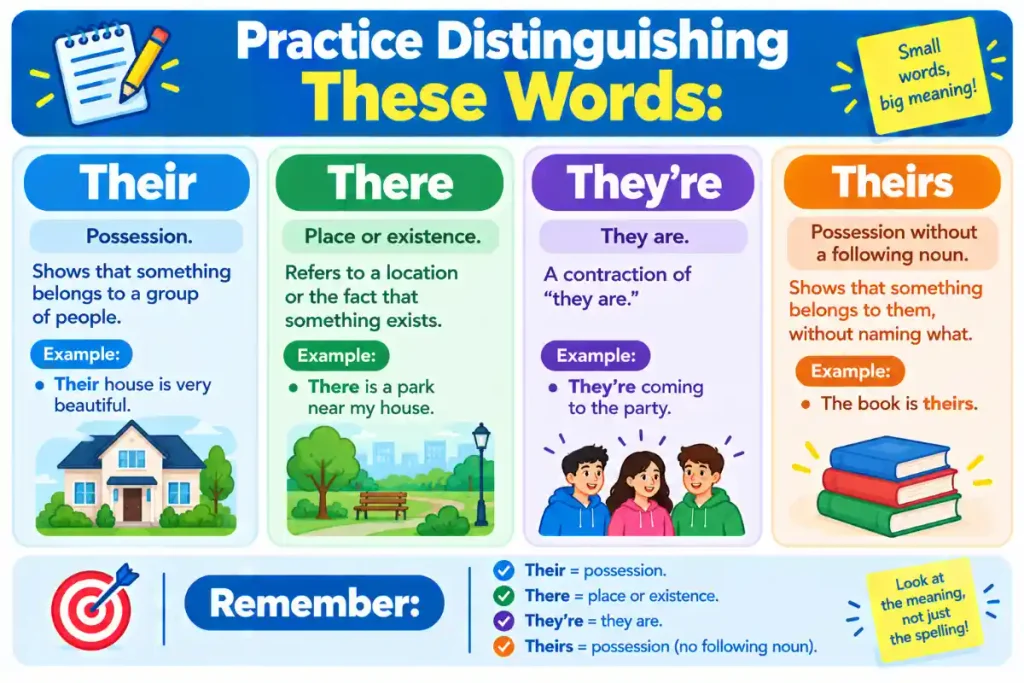
Practice distinguishing these words:
- Their = Possession.
- There = Place or existence.
- They’re = They are.
- Theirs = Possession without a following noun.
Learning these distinctions helps prevent several common English mistakes at once.
Conclusion
Choosing between thier or their is simple once you remember the correct letter order. Their is the standard English spelling and works as a possessive determiner to show ownership or association. It can refer to multiple people or one person when using singular they. On the other hand, thier is an incorrect spelling that you should avoid in school assignments, professional emails, social media posts, and everyday writing.
Also, remember the differences between their, there, they’re, and theirs. Each word has a separate meaning and grammatical purpose. A helpful way to avoid mistakes is to remember that their contains E before I and usually answers the question “Whose?” With regular practice and careful proofreading, you’ll find it easier to use the correct spelling every time.
Frequently Asked Questions
1. Is Thier or Their Correct?
Their is correct, while thier is a misspelling. Use their to show ownership or association, as in “The children packed their bags.”
2. How Do You Spell Their Correctly?
The correct spelling is T-H-E-I-R. Remember that E comes before I. The spelling thier reverses these two letters and is incorrect.
3. What Does Their Mean?
Their is a possessive determiner that shows ownership or association. For example, “They brought their lunch” means the lunch belongs to them.
4. Can Their Refer to One Person?
Yes. Singular their refers to one person when their gender is unknown, unspecified, or when they use they/them pronouns. For example, “Every student should bring their notebook.”
5. What Is the Difference Between Their and They’re?
Their shows possession, while they’re is a contraction of “they are.” For example, “Their house is large” and “They’re going home” use both words correctly.
6. Is Thier Ever an Acceptable Spelling?
No. Thier is not an accepted standard English spelling of their. It is generally treated as a typing or spelling error.
7. How Can I Remember the Difference Between Thier and Their?
Remember the correct letter order: T-H-E-I-R. You can also connect their with ownership by asking, “Whose item is it?”
2 thoughts on “Thier or Their: Which Is Correct? Spelling and Usage Guide”