
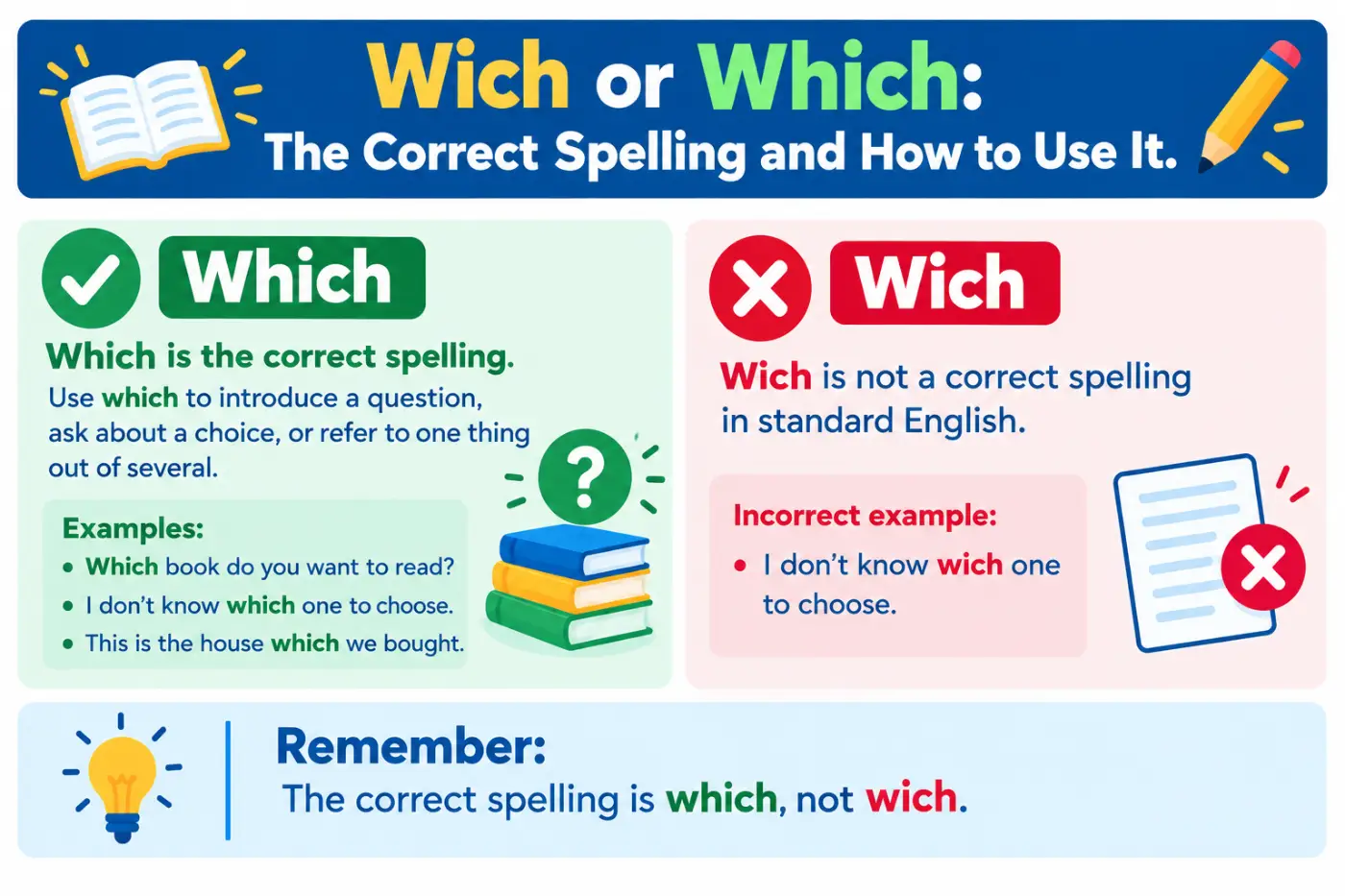
If you’re writing an email, completing a school assignment, or sending a text, you may wonder whether wich or which is the correct spelling. Both forms look similar, and the missing letter can be easy to overlook when typing quickly. However, only one is accepted as the standard spelling in modern English.
Which is the correct spelling. The word wich is generally a misspelling of which, although it can appear in certain historical names and place names. Use which when asking about a choice, identifying something, or adding information about a noun.
Understanding the difference will help you avoid spelling mistakes and write more clearly in everyday and professional situations.
In this guide, you’ll learn what which means, how to use it in questions and sentences, why people confuse the two spellings, and how it differs from similar words such as what, that, and who.
Wich or Which: Which Spelling Is Correct?
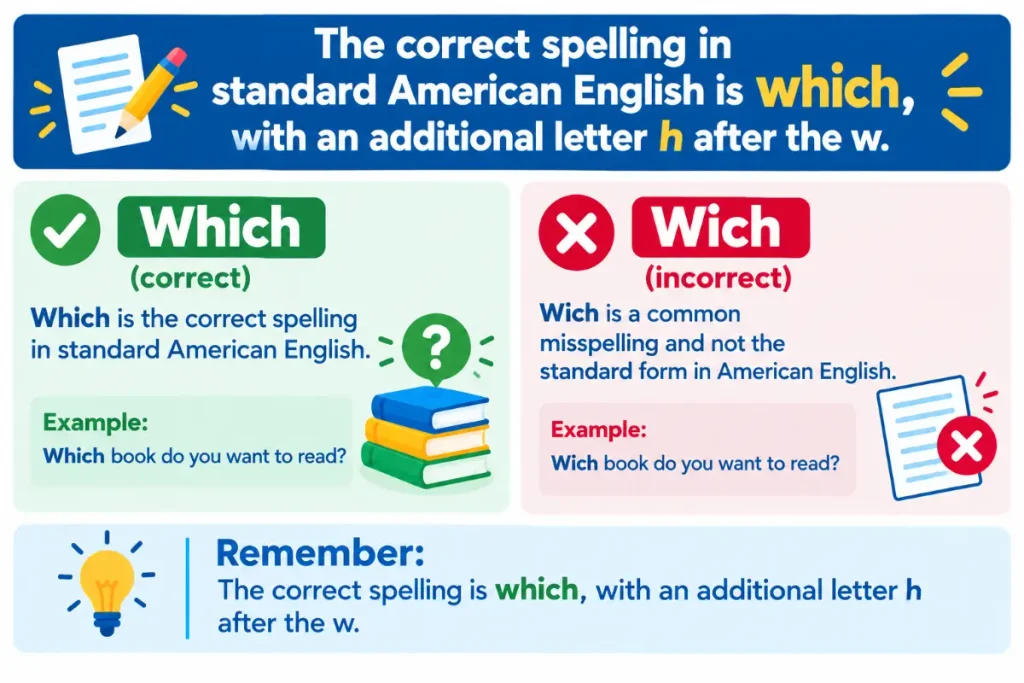
The correct spelling in standard American English is which, with an additional letter h after the w.
| Spelling | Correct or Incorrect? | Meaning |
|---|---|---|
| Which | Correct | Used to ask about a choice or identify something |
| Wich | Incorrect in ordinary writing | Usually a misspelling of which |
The word which is a standard English word that appears in questions, statements, instructions, and descriptions.
For example:
- Correct: Which restaurant would you like to visit?
- Incorrect: Wich restaurant would you like to visit?
- Correct: I don’t know which book she borrowed.
- Incorrect: I don’t know wich book she borrowed.
The difference is just one letter, but that letter matters. Whenever you need the standard English word, write which, not wich.
What Does Which Mean?
Which is a word used to identify a particular person, thing, or choice from a group. It helps readers and listeners understand exactly what someone is asking about or referring to. nIt commonly functions as a pronoun, determiner, or relative pronoun. Here are its main meanings and uses.
1. Which as an Interrogative Pronoun
An interrogative pronoun helps ask a question. Use which when asking someone to identify a particular person or thing from a known or understood group.
Examples:
- Which is your favorite movie?
- Which belongs to you?
- Which would you choose for the project?
- Which of these answers is correct?
- Which looks better for the presentation?
In each example, which asks someone to identify a specific option.
2. Which as an Interrogative Determiner
Which also appears before a noun to ask about a particular choice.
Examples:
- Which car do you want to buy?
- Which teacher is leading the workshop?
- Which phone has the better camera?
- Which route should we take?
- Which subject do you enjoy most?
In these sentences, which comes directly before a noun and helps identify the intended choice.
3. Which as a Relative Pronoun
A relative pronoun connects additional information to a noun or noun phrase. Which commonly introduces a relative clause about things or animals.
Examples:
- The laptop, which I purchased last week, works perfectly.
- She found the document, which contained the updated schedule.
- We visited the museum, which opened several decades ago.
- He repaired the bicycle, which had a damaged wheel.
Here, which introduces additional information about something already mentioned.
Why Do People Confuse Wich and Which?
People often confuse wich and which because their pronunciation and appearance are similar. When speaking, the letter h does not create a separate syllable. As a result, someone may understand the word correctly but accidentally leave out the letter when typing. Several factors contribute to this spelling mistake.
1. Fast Typing
People often type quickly when sending messages, writing comments, or completing online forms. They may accidentally leave out a letter without noticing.
For example:
- Incorrect: Wich color do you prefer?
- Correct: Which color do you prefer?
2. Unfamiliar Spelling Patterns
English spelling includes many words that contain unusual letter combinations. Someone who has not memorized the spelling of which may forget the letter h. Learning the complete spelling helps prevent this mistake.
3. Pronunciation
In American English, which is commonly pronounced /wɪtʃ/. The letter h does not have a separate sound in the word. Because speakers hear the same basic sound regardless of whether they remember the spelling, they may accidentally write wich.
4. Autocorrect and Typing Habits
Spell-checking tools usually identify wich as an error in ordinary English sentences. However, autocorrect may not catch every mistake, especially when a word appears in a name or specialized context. It is always helpful to proofread important writing rather than depending entirely on automatic corrections.
How to Use Which Correctly in a Sentence
The easiest way to use which correctly is to understand what information your sentence needs. Here are the most common sentence patterns.
Use Which to Ask About Choices
Use which when someone must select or identify an option.
Examples:
- Which dress would you like to wear?
- Which restaurant serves vegetarian meals?
- Which student submitted the assignment?
- Which computer should we use?
- Which day works best for your appointment?
Use Which to Refer to Something Already Mentioned
You can use which to add information about a noun or an entire statement.
Examples:
- The new office, which opened in September, has a larger meeting room.
- I received your email, which included the updated documents.
- The team won the competition, which surprised everyone.
- She bought a new tablet, which she uses for schoolwork.
Use Which in Indirect Questions
An indirect question reports or expresses a question without necessarily using a direct question structure.
Examples:
- I don’t know which bus goes downtown.
- Can you tell me which department handles applications?
- She asked which restaurant we had selected.
- We need to decide which option offers the best value.
Notice that indirect questions do not usually use the word order of direct questions.
Compare:
- Direct: Which bus goes downtown?
- Indirect: I don’t know which bus goes downtown.
15 Examples of Which in Real Sentences
The following examples demonstrate how Americans commonly use which in different situations.
| Context | Example Sentence |
|---|---|
| Everyday conversation | Which movie should we watch tonight? |
| School | Which chapter do we need to read before class? |
| Workplace | Which employee prepared the monthly report? |
| Please confirm which documents you need. | |
| Shopping | Which jacket is available in your size? |
| Technology | Which application should I install? |
| Travel | Which airport is closest to the hotel? |
| Food | Which dessert would you recommend? |
| Social media | Which picture should I post first? |
| Education | Which answer did you select on the test? |
| Job application | Which position are you applying for? |
| Family | Which relative is hosting the gathering? |
| Sports | Which team won the final match? |
| Entertainment | Which television series are you watching? |
| Personal decisions | Which option makes the most sense? |
These examples show that which works in many situations. It can introduce questions, identify choices, and provide additional details.
Which or What: What’s the Difference?
Which usually asks someone to select or identify something from a known or limited group. What generally asks for information without necessarily referring to a specific set of options.
| Word | Meaning | Example |
|---|---|---|
| Which | Asks about a particular choice | Which shirt do you prefer, the blue one or the black one? |
| What | Asks for general information | What color do you prefer? |
When Should You Use Which?
Use which when the available choices are known or limited.
Examples:
- Which subject do you prefer, math or science?
- Which entrance should we use?
- Which of these restaurants is open?
When Should You Use What?
Use what when asking a more general question.
Examples:
- What is your favorite subject?
- What should we cook for dinner?
- What kind of music do you enjoy?
Can Which and What Be Interchanged?
Sometimes, yes. The difference depends on the context and the choices available.
For example:
- Which book did you buy?
- What book did you buy?
Both sentences are grammatically acceptable. However, which often suggests a more limited selection, while what can sound more open-ended.
Which or That: What’s the Difference?
Which and that can both introduce relative clauses, but they often serve different grammatical purposes. In American English, traditional grammar guidance generally uses:
- That for restrictive clauses, which identify essential information.
- Which for nonrestrictive clauses, which add extra information and are usually separated by commas.
| Word | Main Function | Example |
|---|---|---|
| That | Introduces essential information | The phone that I bought yesterday is already broken. |
| Which | Introduces additional information | My phone, which I bought yesterday, is already broken. |
Examples With That
- The book that you recommended was interesting.
- The employee that handled my request was helpful.
- The restaurant that opened nearby serves Italian food.
Examples With Which
- The book, which I borrowed from the library, is about history.
- The employee, which surprised the manager, arrived early.
- The restaurant, which opened last month, has already become popular.
One important point: which normally refers to things or animals, not people. Also, the second example above is unnatural because an employee is a person; a better version would be:
– The employee, who surprised the manager, arrived early.
The comma distinction is a useful traditional rule, but actual usage can vary by sentence structure and writing style.
Which or Who: What’s the Difference?
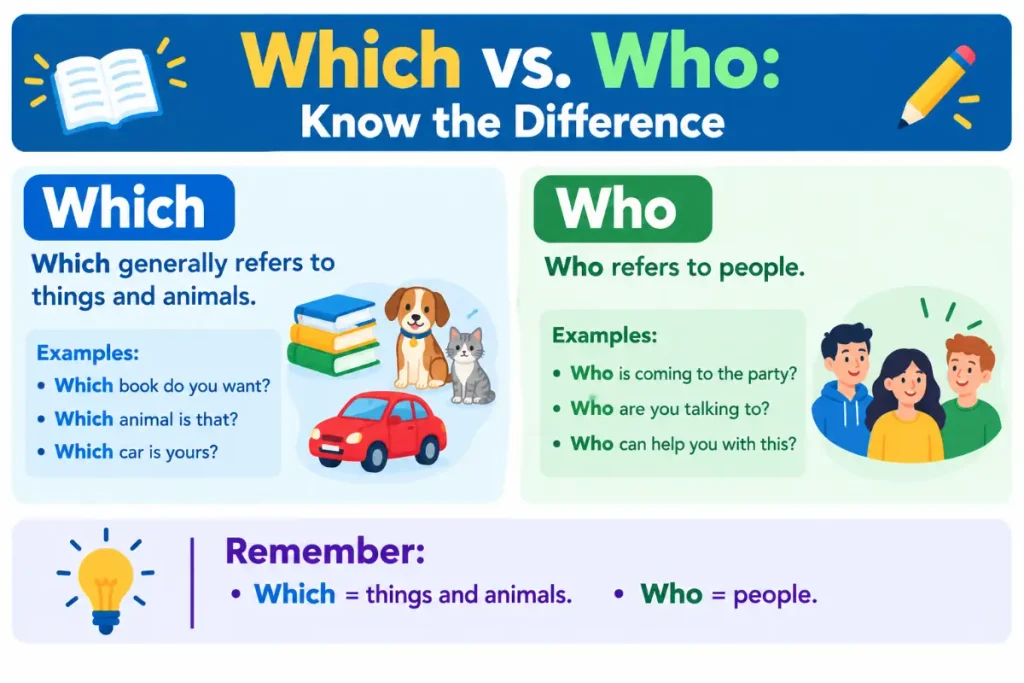
Which and who both help identify someone or something, but they refer to different types of nouns.
- Which generally refers to things and animals.
- Who refers to people.
| Word | Used For | Example |
|---|---|---|
| Which | Things or animals | Which dog belongs to your neighbor? |
| Who | People | Who is your new neighbor? |
Examples:
- Which student received the award?
- Who received the award?
- Which employee completed the project?
- Who completed the project?
In the first and third examples, which identifies a person from a particular group. Who asks about the person’s identity more generally.
Which or Witch: What’s the Difference?
Which is used to ask questions or introduce additional information. Witch refers to a person associated with magic or supernatural traditions.
| Word | Meaning | Example |
|---|---|---|
| Which | Identifies a choice | Which book should I read? |
| Witch | A person associated with magic | The story featured a mysterious witch. |
Examples:
- Which character is your favorite?
- The witch appeared in the fantasy story.
- Which costume should I wear for the party?
- The witch wore a traditional black hat.
These words are homophones because they share the same pronunciation but have different spellings and meanings.
Is Wich Ever a Correct Word?
In ordinary modern English writing, wich is not the standard spelling of which. However, the letter combination can appear in certain proper nouns, historical words, and place names. For example, some English place names contain the ending -wich. This element appears in historical place names such as Norwich and Sandwich. The historical element has connections to settlements and specialized place-name meanings. Its exact origin and meaning can vary depending on the name. This does not make wich an acceptable alternative spelling of the everyday word which.
| Context | Is Wich Acceptable? |
|---|---|
| Ordinary questions | No |
| Standard American writing | No |
| Professional emails | No |
| School assignments | No |
| Historical place names | Yes, in established names |
| Proper nouns containing Wich | Yes, when correctly spelled as a name |
For everyday communication, always use which.
Is Which Used Differently in American and British English?
The spelling of which is the same in American and British English. Unlike words such as color and colour, which have regional spelling variations, which does not have a standard American and British spelling difference.
| Language Variety | Correct Spelling | Example |
|---|---|---|
| American English | Which | Which school do you attend? |
| British English | Which | Which school do you attend? |
| Canadian English | Which | Which school do you attend? |
| Australian English | Which | Which school do you attend? |
The word also serves the same basic grammatical functions across these varieties. Therefore, if you are writing for an American audience, use which just as you would in British, Canadian, or Australian English.
How to Use Which in Different Writing Situations
Knowing the spelling is important, but understanding where to use the word makes your writing more effective. Here are practical examples from common writing situations.
1. Which in Academic Writing
In academic writing, which helps introduce questions, identify research topics, and add information to statements.
Examples:
- Which factors influence student performance?
- The experiment, which lasted three weeks, produced consistent results.
- Researchers examined which methods improved reading comprehension.
Use the word according to the structure of your sentence.
2. Which in Professional Emails
Professional emails often require readers to choose between options or confirm specific information.
Examples:
- Could you confirm which documents are required?
- Please let me know which meeting time works best.
- I would appreciate clarification on which department handles this request.
These sentences are clear and appropriate for workplace communication.
3. Which in Text Messages
In casual conversations, which helps people ask direct questions without adding unnecessary words.
Examples:
- Which movie are we watching?
- Which one do you want?
- Which store are you going to?
- Which time works for you?
The spelling remains the same in formal and informal communication.
4. Which in Job Applications and Resumes
You may use which when explaining your work experience, asking about positions, or discussing qualifications.
Examples:
- Which position best matches my experience?
- I developed a reporting system, which improved communication between departments.
- Could you clarify which qualifications are required for this role?
These examples show how the word can help create clear professional sentences.
5. Which in Social Media Posts
People commonly use which when asking followers to choose between pictures, products, ideas, or activities.
Examples:
- Which photo should I upload?
- Which outfit do you like best?
- Which destination would you visit first?
- Which caption sounds better?
There is no special social media spelling. Always write which.
Common Spelling and Grammar Mistakes With Which
Even though which is a common word, writers sometimes make mistakes with its spelling, punctuation, or sentence structure.
Here are some errors to watch for.
Mistake 1: Leaving Out the Letter H
This is the most common spelling problem.
- Incorrect: Wich restaurant is your favorite?
- Correct: Which restaurant is your favorite?
Remember to include the letter h after w.
Mistake 2: Using Which Instead of Who
Use who when referring to a person’s identity rather than selecting someone from a group.
- Incorrect for the intended meaning: Which called you yesterday?
- Correct: Who called you yesterday?
However, which is correct when asking someone to identify a person from a defined group.
– Correct: Which of your friends called you yesterday?
Mistake 3: Confusing Which With Witch
These words sound alike, but their meanings are different.
- Incorrect: The which appeared in the story.
- Correct: The witch appeared in the story.
Use witch for the person associated with magic and which for questions or additional information.
Mistake 4: Forgetting Necessary Commas
When which introduces a nonrestrictive relative clause, use commas to separate the extra information.
- Incorrect: My car which I purchased last year needs repairs.
- Correct: My car, which I purchased last year, needs repairs.
The commas show that the clause adds information rather than identifying which car you mean.
Mistake 5: Using Which in an Indirect Question With Incorrect Word Order
Indirect questions use statement word order rather than direct-question word order.
- Incorrect: I don’t know which is the correct answer.
- Correct: I don’t know which answer is correct.
The first sentence is actually grammatical, but it has a different structure and meaning from the second. A clearer example of the actual word-order mistake is:
- Incorrect: I don’t know which answer is it.
- Correct: I don’t know which answer it is.
Mistake 6: Replacing Which With What Without Considering Context
Both words can ask questions, but they do not always communicate the same meaning.
- Less suitable for a limited selection: What of these two options do you prefer?
- Correct: Which of these two options do you prefer?
Use which when asking someone to select from a specific group.
Quick Tricks to Remember the Correct Spelling
If you frequently type wich instead of which, a few simple techniques can help you remember the correct form.
1. Remember the WH Combination
The word which begins with the letters WH.
Other familiar words with this combination include:
- What
- When
- Where
- While
- Whose
- Why
Remembering this spelling pattern can make it easier to write which correctly.
2. Associate Which With Choice
Think of this simple reminder:
Which = What choice?
Whenever you ask someone to identify or select something, remember to include the h.
For example:
- Which shirt should I buy?
- Which answer is correct?
- Which road leads to the airport?
3. Read Your Sentence Again
Before submitting an assignment or sending an important email, check whether you accidentally typed wich. A quick spelling check can prevent a small typing error from appearing in your final work.
4. Practice With Short Sentences
Writing a few sentences with which can help reinforce the correct spelling.
Try these:
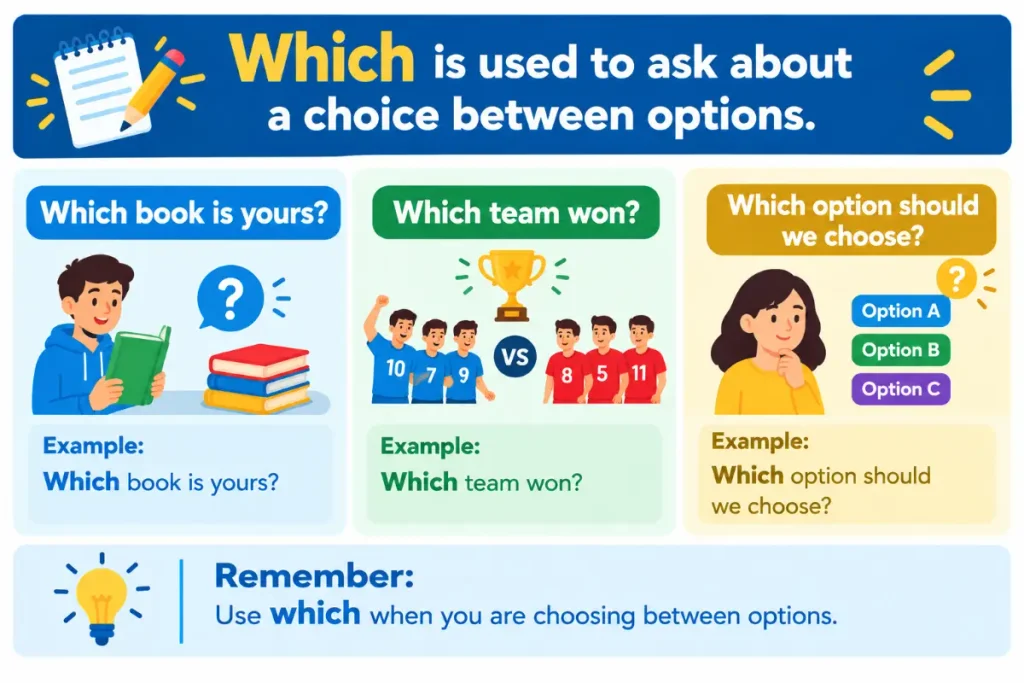
- Which book is yours?
- Which team won?
- Which option should we choose?
- Which restaurant serves breakfast?
Repeated exposure to the correct form helps make it easier to recognize.
Conclusion
Choosing the correct spelling makes your writing clearer and helps you avoid common mistakes. Between wich or which, the correct choice for standard English is always which. The extra letter h is essential, even though it does not create a separate sound when you pronounce the word.
Remember that which helps identify a choice, ask a question, or introduce additional information about something already mentioned. You can use it in school assignments, professional emails, text messages, and everyday conversations. Although wich may appear in certain historical names and place names, it is not an acceptable replacement for which in ordinary writing. Practice using the correct spelling in different sentences, and check your writing before submitting important work.
Frequently Asked Questions
1. Which Is Correct, Wich or Which?
Which is the correct spelling in standard English. Wich is generally a misspelling when used as a replacement for which.
2. How Do You Spell Which Correctly?
Spell the word as W-H-I-C-H. Remember to include the letter h after the first letter w.
3. What Does Which Mean?
Which is used to ask about a choice, identify something from a group, or introduce additional information about a noun. For example, “Which book do you want?”
4. Is Wich a Real English Word?
Wich is not the standard spelling of the everyday word which. However, it can appear in established historical names and place names.
5. What Is the Difference Between Which and What?
Which generally asks someone to choose from a known or limited group, while what asks for more general information. For example, “Which dress do you prefer?” and “What is your favorite color?”
6. Is Which the Same in American and British English?
Yes. Both American and British English use the spelling which. There is no standard regional spelling difference.
7. Is Which a Pronoun or a Preposition?
Which can function as an interrogative pronoun, an interrogative determiner, or a relative pronoun. It is not a preposition.
2 thoughts on “Wich or Which: The Correct Spelling and How to Use It”