

If you’re writing a school essay, professional email, business report, or social media post, you may wonder whether publically or publicly is the correct spelling. Both forms may look reasonable because many English adverbs end in -ally. However, only one is the standard spelling in modern American English.
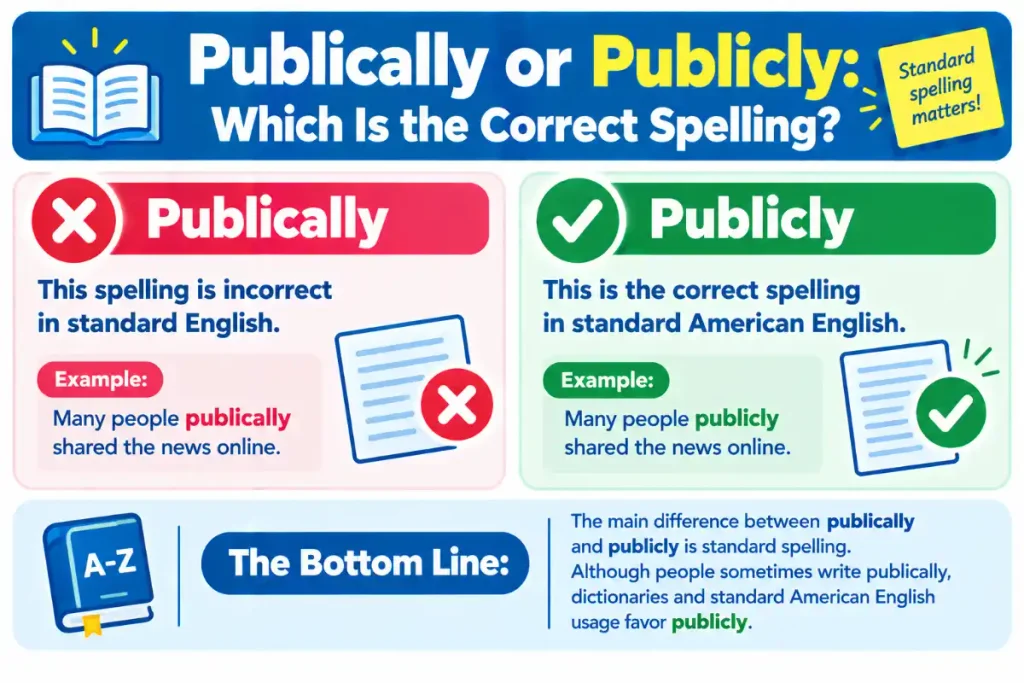
Publicly is the correct spelling in standard American English. Publically is a common misspelling that you should avoid in formal and professional writing.
The word publicly means something is done openly, in front of other people, or in a way that is available for the public to see or know. For example, a company may publicly announce a new product, or a person may publicly apologize for a mistake.
Understanding why publicly is correct can help you avoid spelling errors and communicate more clearly. This guide explains the meaning, spelling rules, sentence examples, common mistakes, and related words to help you use the word confidently.
Publically or Publicly: What’s the Difference?
The main difference between publically and publicly is standard spelling. Although people sometimes write publically, dictionaries and standard American English usage favor publicly.
| Word | Is It Correct? | Explanation | Example |
|---|---|---|---|
| Publicly | Yes | The standard spelling of the adverb | The mayor publicly addressed the concerns. |
| Publically | No, in standard usage | A common misspelling of publicly | The mayor publically addressed the concerns. |
The correct sentence is: The mayor publicly addressed the concerns. The incorrect version uses publically, which adds an unnecessary letter sequence to the standard spelling. When writing for an American audience, use publicly in academic assignments, business documents, news articles, professional emails, and everyday communication.
What Does Publicly Mean?
Publicly means openly, openly before other people, or in a way that the public can see, hear, or know about. It describes an action that takes place in public or is made known to a wider audience. The exact meaning depends on the context. The word can describe an announcement, a statement, an apology, a disagreement, or information shared with others. Here are several common uses of publicly.
1. In an Open or Visible Way
When an action happens publicly, other people can observe it.
Examples:
- The students publicly presented their science projects.
- The organization publicly celebrated its volunteers.
- The artist publicly thanked everyone who attended the event.
In these examples, the actions take place openly rather than privately.
2. In Front of Other People
The word can describe something said or done before an audience.
Examples:
- The speaker publicly recognized the team’s achievements.
- She publicly defended her decision during the meeting.
- The coach publicly praised the players after the game.
Here, publicly emphasizes that other people witnessed the action.
3. Through an Official Announcement
Businesses, government offices, schools, and other organizations often share information publicly.
Examples:
- The company publicly announced its new hiring policy.
- The school publicly released the dates for the upcoming event.
- The city publicly shared its plans for the new park.
In these sentences, the word indicates that information was made available to people outside a private discussion.
4. In a Way That Makes Information Known
Sometimes, publicly refers to information or opinions that people share with a wider audience.
Examples:
- The author publicly discussed the inspiration behind her book.
- The organization publicly explained its position on the issue.
- The athlete publicly addressed the rumors about the team.
The central idea is that information is shared openly rather than kept private.
Why Is Publicly the Correct Spelling?
The spelling publicly follows the established form of the word public when it becomes an adverb. The base word is public, an adjective that describes something related to people in general or available to the community. Adding the adverb ending creates publicly.
- Public: The library is a public facility.
- Publicly: The library publicly announced its new hours.
The standard spelling does not require an extra a before the -ly ending. People may write publically because they associate it with words such as typically, basically, and automatically. Those words have different spelling patterns, and their forms do not establish how every adjective ending in -ic should be changed into an adverb.
For public, the accepted adverb is publicly.
Is Publically Ever Correct?
Publically appears in some writing, but it is not the accepted standard spelling in modern American English. Readers may understand what the writer means, yet the form can still be marked as a spelling error. For schoolwork, professional communication, and published material, choose publicly.
How to Remember the Correct Spelling
A simple way to remember the spelling is to start with the base word:
Public + ly = Publicly
You do not need to insert an extra a.
Another useful trick is to remember the phrase public announcement. If you want to describe how someone makes that announcement, write:
- The announcement was made publicly.
- The decision was publicly announced.
- The results were publicly available.
Each example uses the same spelling: publicly. When you are unsure, check whether your sentence needs the adverb publicly. If it does, avoid adding an extra syllable or letter sequence simply because another adverb follows a similar pattern.
Publicly in Different Types of Writing
The word publicly works in casual and formal contexts. Its meaning remains the same, but the surrounding sentence may change according to the audience and purpose.
Publicly in Academic Writing
Students can use publicly in essays, research assignments, and classroom presentations when discussing actions or information shared with an audience.
Examples:
- The scientist publicly presented the findings at the conference.
- The school publicly recognized students who completed the project.
- The author publicly challenged the interpretation of the historical event.
In academic writing, use the word when public visibility or open communication matters to your point.
Publicly in Professional Emails
In workplace communication, publicly can describe official statements, announcements, or recognition.
Examples:
- The company publicly announced the updated policy.
- Our department publicly thanked the volunteers for their support.
- The manager publicly acknowledged the team’s contribution.
If you are writing an email, make sure the word accurately describes the situation. For example, an announcement shared with all employees may be public within the organization, but it may not be public to the general population.
Publicly in Business Reports
Businesses often use publicly when discussing company announcements, financial information, official commitments, or communication with customers.
Examples:
- The organization publicly disclosed the results of its review.
- The retailer publicly announced the opening of its new location.
- The company publicly committed to improving customer service.
The word can also appear in discussions about publicly traded companies. In that context, publicly traded describes a company whose shares are available for trading on a public market.
Publicly on Social Media
People often use publicly when discussing posts, comments, apologies, or statements that a wider audience can view.
Examples:
- She publicly thanked her followers for their support.
- The creator publicly corrected the information in the original post.
- The organization publicly shared its response to customer feedback.
A public social media post can be seen by people beyond the writer’s immediate circle, depending on the platform’s settings.
Publicly in Everyday Conversation
The word also fits naturally into ordinary conversations.
Examples:
- He apologized publicly after the misunderstanding.
- I don’t want to discuss that matter publicly.
- They publicly supported the local school fundraiser.
You do not need a formal setting to use publicly. Any situation involving open communication or an audience may call for it.
12 Correct Examples of Publicly in Sentences
The following examples show how to use publicly in different situations.
| No. | Example Sentence | Context |
|---|---|---|
| 1 | The mayor publicly announced the new community program. | Government |
| 2 | The teacher publicly praised the students for their hard work. | Education |
| 3 | The company publicly shared its updated privacy policy. | Business |
| 4 | She publicly apologized for the misunderstanding. | Personal communication |
| 5 | The athlete publicly thanked the fans after the game. | Sports |
| 6 | The author publicly discussed the ideas behind her latest book. | Literature |
| 7 | The school publicly recognized the winning science team. | School |
| 8 | The organization publicly explained its decision. | Public relations |
| 9 | He publicly supported the proposal during the meeting. | Workplace |
| 10 | The museum publicly displayed the newly restored painting. | Arts and culture |
| 11 | The candidate publicly addressed questions about the proposal. | Civic discussion |
| 12 | The nonprofit publicly announced its fundraising goal. | Community service |
These sentences demonstrate that publicly can modify many different verbs. It does not have to appear only with words such as announce or apologize. The key is that the action involves openness, public visibility, or communication beyond a private setting.
Publicly vs Public: What’s the Difference?
Although publicly and public come from the same base word, they serve different grammatical roles.
| Word | Part of Speech | Meaning | Example |
|---|---|---|---|
| Public | Adjective or noun | Related to the community; people in general | The public library opens at nine. |
| Publicly | Adverb | In an open or public manner | The library publicly announced its new hours. |
Use public to describe a person, place, service, or thing. Use publicly to explain how an action happens.
Compare these sentences:
- Correct: The company issued a public statement.
- Correct: The company publicly explained its decision.
In the first sentence, public describes the statement. In the second, publicly describes how the company explained its decision. The two words are related, but they cannot always replace each other.
Publicly or Privately: What’s the Difference ?
| Word | Meaning | Example |
|---|---|---|
| Publicly | Openly or before a wider audience | The director publicly announced the changes. |
| Privately | Away from public view or with limited access | The director privately discussed the changes with staff. |
Consider these examples:
- The student publicly thanked the teacher.
- The student privately thanked the teacher.
Both sentences are grammatically correct. However, they describe different situations. The first suggests that the thanks were shared openly, while the second suggests a private interaction. These words are useful when describing the difference between public statements and confidential conversations.

Publicly or Openly: What’s the Difference?
Publicly emphasizes an audience or access to information. Openly emphasizes honesty, transparency, or a lack of secrecy.
| Word | Main Emphasis | Example |
|---|---|---|
| Publicly | An audience or public access | The company publicly announced the results. |
| Openly | Transparency or a lack of concealment | The manager openly discussed the team’s concerns. |
A person can speak openly in a private meeting if they are honest with the other participants. Likewise, a statement can be made publicly without providing every detail.
Choose the word that best reflects the meaning you intend.
Publicly or Officially: What’s the Difference?
The words publicly and officially can appear in similar sentences, but they describe different aspects of an action. Publicly means that something is shared openly or with an audience. Officially means that something is formally recognized, authorized, or established.
Examples:
- The school publicly announced the schedule.
- The school officially approved the schedule.
The first sentence focuses on sharing information. The second focuses on formal approval. A school might officially approve a schedule in a private meeting before publicly announcing it. Therefore, the two words are not interchangeable in every context.
Publicly vs Publically: Common Mistakes to Avoid
The most common mistake is adding an extra a to publicly. However, writers can also make errors by choosing the wrong part of speech or using the word when another term would be more precise.
Mistake 1: Adding an Extra A
Incorrect: The organization publically announced the event.
Correct: The organization publicly announced the event.
The standard spelling is publicly. Remember the base word public and add -ly.
Mistake 2: Using Publicly Instead of Public
Incorrect: The city opened a publicly library.
Correct: The city opened a public library.
In the incorrect sentence, the writer uses an adverb where an adjective is needed. The adjective public describes the library.
Mistake 3: Confusing Publicly With Officially
Incorrect for the intended meaning: The board publicly approved the budget, when the writer means that the board formally authorized it.
Clearer: The board officially approved the budget.
The word publicly may be appropriate if the board announced or approved the budget in an open meeting. However, officially is more precise when formal authorization is the main point.
Mistake 4: Using Publicly When Privately Is Intended
Incorrect for the intended meaning: The counselor publicly discussed the student’s confidential records.
Clearer: The counselor privately discussed the student’s records with authorized staff.
The correct word depends on the situation. If the discussion is confidential, privately may express the intended meaning more accurately.
Mistake 5: Assuming Every Adverb Uses the Same Pattern
English spelling patterns vary. Words such as basic become basically, but that does not mean public should become publically.
Learn common adverb forms individually rather than applying one spelling pattern to every word.
What Is the Part of Speech of Publicly?
Publicly is an adverb. An adverb can modify a verb, an adjective, or another adverb. In most everyday uses of publicly, it modifies a verb by explaining how an action occurs.
Examples:
- The company publicly announced the merger.
- The speaker publicly apologized.
- The organization publicly recognized the volunteers.
In each sentence, publicly modifies the verb: announced, apologized, or recognized. The word can also appear in established phrases, including publicly available, publicly funded, and publicly traded.
Publicly Available
Publicly available means that information, material, or a service can be accessed by the public.
Example: The city made the meeting schedule publicly available on its website.
Publicly Funded
Publicly funded describes something supported by government funding or public money.
Example: The museum received support for its publicly funded education program.
Publicly Traded
Publicly traded describes a company whose shares are available for trading on a public securities market.
Example: The investor researched the publicly traded company before making a decision.
These expressions use the standard spelling publicly.
Is Publicly Used in American and British English?
Yes. Publicly is the standard spelling in both American and British English.
Unlike some words that have different spellings across English-speaking regions, this word does not normally change between US and UK usage.
| English Variety | Standard Spelling | Example |
|---|---|---|
| American English | Publicly | The company publicly announced its plans. |
| British English | Publicly | The company publicly announced its plans. |
| Canadian English | Publicly | The organization publicly shared the information. |
| Australian English | Publicly | The council publicly released its report. |
Regional differences may affect other words in the same sentence, but publicly remains the preferred standard form. For American readers, use publicly in school assignments, workplace documents, publications, and online writing.
What Are Some Alternatives to Publicly?
The best alternative depends on what you want to communicate. Although publicly can mean openly or before an audience, no single synonym works in every situation. Here are useful alternatives and the contexts in which they fit.
| Alternative | Meaning | Example |
|---|---|---|
| Openly | Without hiding something | The director openly discussed the issue. |
| Publicly | In front of others or available to the public | The director publicly addressed the issue. |
| Officially | In a formal or authorized way | The agency officially announced the decision. |
| Formally | Following an established process or convention | The speaker formally introduced the guests. |
| Transparently | In a clear and open manner | The organization transparently explained its spending. |
| Out loud | So that others can hear | She read the statement out loud. |
| In public | In a place or setting where others can observe | They discussed the proposal in public. |
| To the public | For people in general to receive or access | The agency released the information to the public. |
| Publicly announced | Announced for a wider audience | The company publicly announced the opening date. |
| Publicly disclosed | Made information known | The organization publicly disclosed the findings. |
| Publicly acknowledged | Recognized or admitted openly | The manager publicly acknowledged the mistake. |
| Publicly recognized | Honored or identified before others | The team was publicly recognized for its work. |
Some alternatives are phrases rather than single-word synonyms. That is useful because a phrase may communicate your meaning more clearly than a single adverb. For example, in public may be a natural choice when describing where someone speaks, while transparently is often better when emphasizing openness about decisions or processes.
Can You Use Publicly in Formal Writing?
Yes. Publicly is appropriate in formal writing because it is a standard English adverb.
You can use it in:
- Academic essays and research papers
- Professional emails and business reports
- News articles and public statements
- Government communications
- Résumés and professional profiles
- School newsletters and announcements
However, the word should serve a clear purpose. If your sentence is about a formal decision, officially may be more precise. If you are emphasizing honesty, openly or transparently may work better.
Publicly in a Résumé
Use publicly when describing a presentation, announcement, or recognition that genuinely involved a public audience.
Example: Presented project findings publicly to an audience of community partners.
For a résumé, it is often better to describe the action and result directly rather than add words that do not provide useful information.
Publicly in a Professional Email
Example: The company will publicly announce the updated schedule after management approves the final details.
This sentence is clear because it distinguishes the announcement from the earlier approval process.
Publicly in an Academic Essay
Example: The author publicly challenged the policy during a televised interview.
The adverb helps establish that the author’s criticism was expressed openly and reached an audience.
Does Publicly Have an Antonym?
Yes. The most direct antonym of publicly is privately.
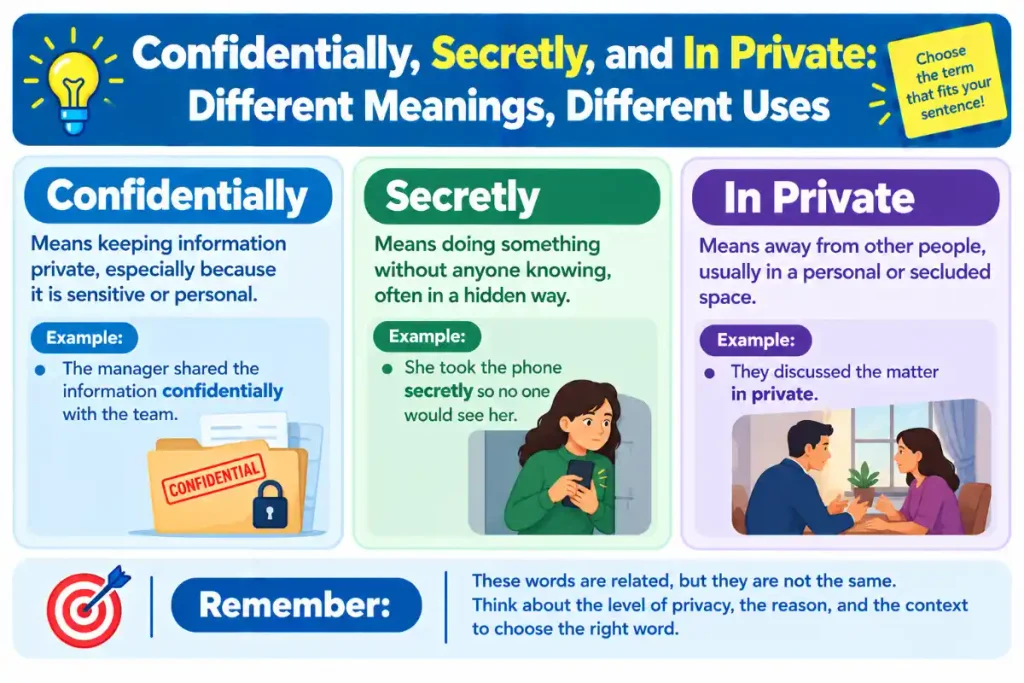
Other words may express contrasting ideas in specific contexts, including confidentially, secretly, and in private. Their meanings are not identical, so select the term that fits your sentence.
| Word | Meaning | Example |
|---|---|---|
| Publicly | Openly or before an audience | The group publicly announced its decision. |
| Privately | Away from public view or with limited access | The group privately discussed its decision. |
| Confidentially | In a way intended to protect private information | The manager spoke confidentially with the employee. |
| Secretly | Without others knowing | They secretly planned a surprise party. |
| In private | Away from other people | The two colleagues spoke in private. |
For most direct comparisons, publicly and privately are the clearest opposites.
Conclusion
Choosing between publically or publicly is simple once you know the standard spelling. Publicly is the correct form in American English and is also preferred in British, Canadian, and Australian English. The spelling publically is a common error that you should avoid in polished writing.
Use publicly when describing something shared openly, announced to an audience, or made available for the public to see or know. The word works well in school essays, professional emails, business reports, news articles, and everyday conversations. Remember the simple rule: public + ly = publicly. You can also choose alternatives such as openly, officially, or transparently when they express your meaning more precisely. By learning the correct spelling and understanding the word’s usage, you can write more clearly and avoid a common spelling mistake.
Frequently Asked Questions
Is publically or publicly correct?
Publicly is correct in standard American English. Publically is a common misspelling, so use publicly in formal, academic, and professional writing.
How do you spell publicly?
Spell it p-u-b-l-i-c-l-y. Start with public and add -ly without inserting an extra a.
Why do people spell publicly as publically?
People may add an a because they associate the word with adverbs such as basically and typically. However, the standard spelling of the adverb formed from public is publicly.
What does publicly mean?
Publicly means openly, before an audience, or in a way that makes something available for the public to see or know. For example, a company may publicly announce a new policy.
Is publicly correct in British English?
Yes. Publicly is the standard spelling in both American and British English. The spelling does not normally change between these varieties.
What is another word for publicly?
Depending on the context, alternatives include openly, officially, transparently, and in public. Each has a slightly different meaning, so choose the one that best expresses your intended message.
Is publicly an adjective or an adverb?
Publicly is an adverb. It usually modifies a verb by explaining how an action happens, as in “The organization publicly announced its plans.”
1 thought on “Publically or Publicly: Which Spelling Is Correct?”