
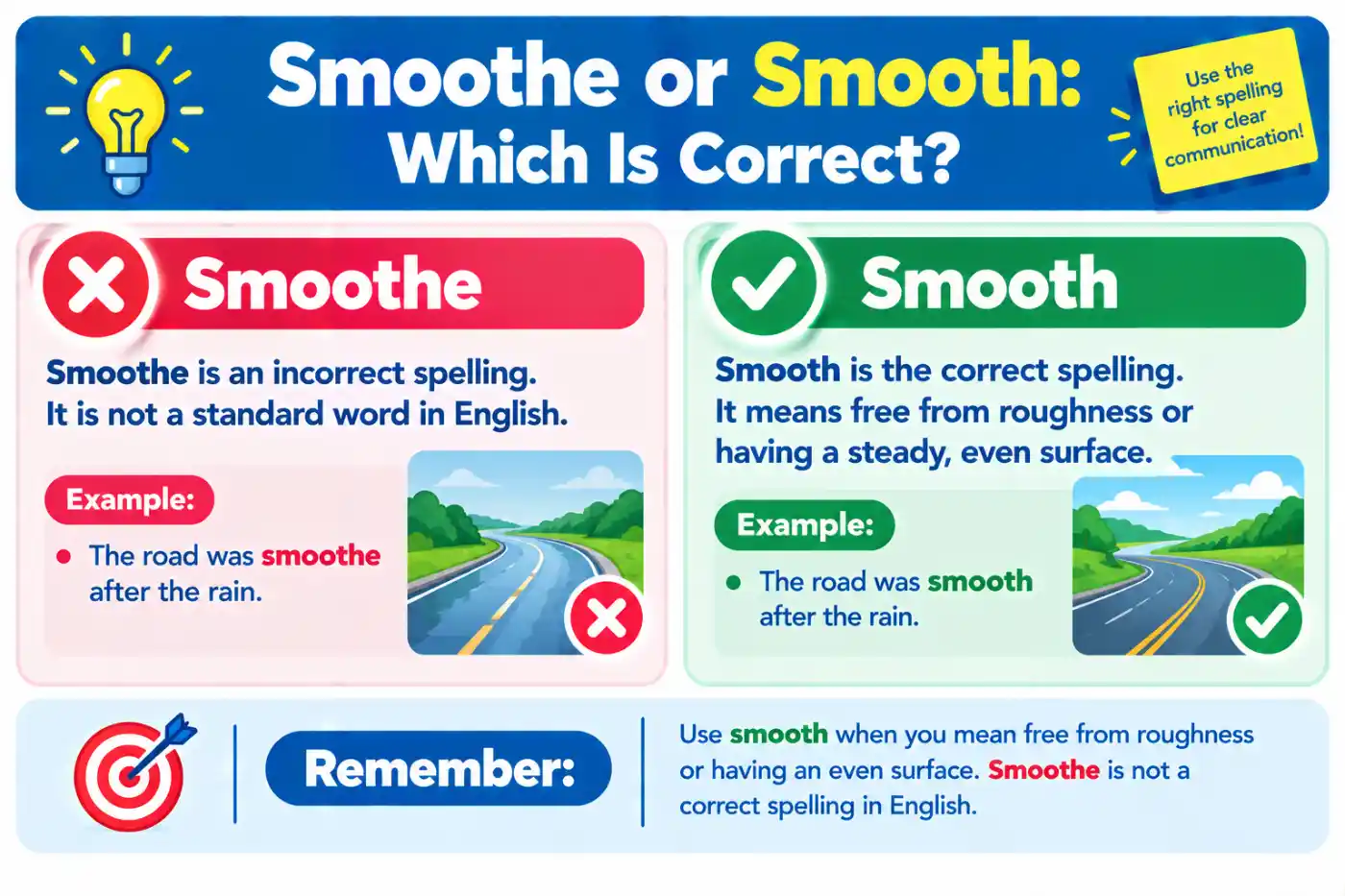
If you are writing an email, completing a school assignment, or describing a smooth surface, you may wonder whether smoothe or smooth is the correct spelling. Both forms look similar, but only one is standard in modern American English.
Smooth is the correct spelling. It can function as an adjective, verb, and noun, depending on the context. Smoothe is a common misspelling of smooth and should generally be avoided in formal and informal writing.
The confusion often comes from English spelling patterns. Many verbs end in -e, such as breathe, close, and shine, so adding an e to smooth may seem reasonable. However, the standard spelling does not require it.
This article explains the difference between smoothe and smooth, defines the word, provides practical examples, compares related terms, and answers common questions about its spelling and usage.
Smoothe or Smooth: What’s the Difference?
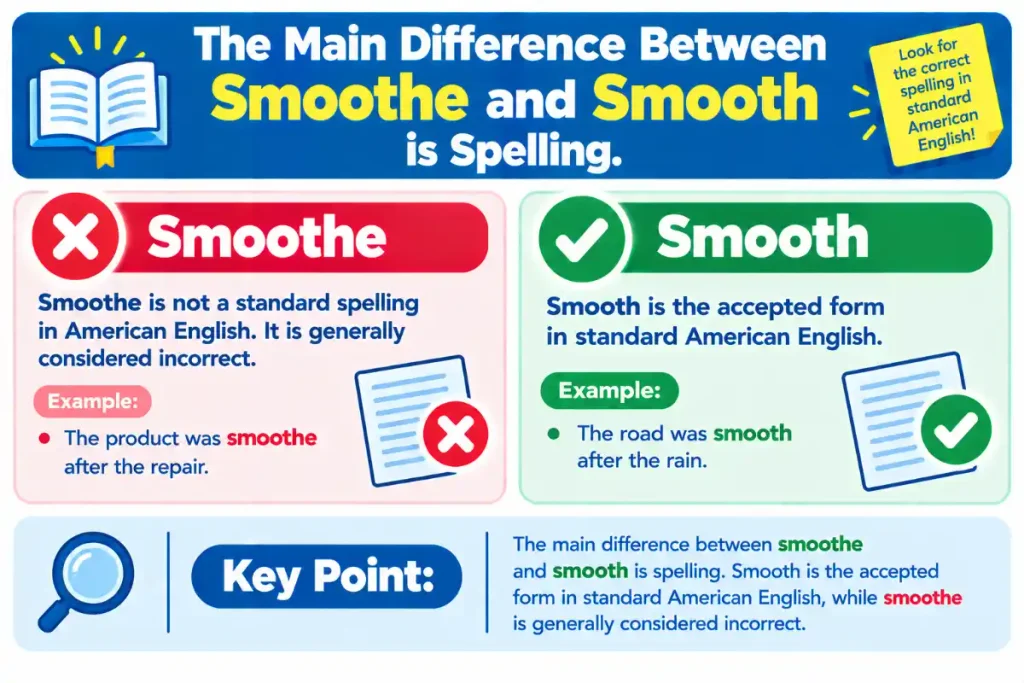
The main difference between smoothe and smooth is spelling. Smooth is the accepted form in standard American English, while smoothe is generally considered incorrect.
| Word | Correctness | Meaning | Example |
|---|---|---|---|
| Smooth | Correct | Having an even surface, moving easily, or making something even | The painter created a smooth finish. |
| Smoothe | Incorrect in standard modern English | Usually intended to mean smooth | The painter created a smoothe finish. |
Use smooth in schoolwork, business documents, emails, creative writing, and everyday conversations. Although readers may understand smoothe, the extra e is unnecessary and can make your writing look less polished.
Why Do People Confuse Smoothe and Smooth?
Several factors make this spelling confusing.
- Familiar spelling patterns: English contains many verbs that end in e, which may lead writers to add the letter to smooth.
- Verb usage: When people use smooth as an action word, they may assume it needs a different spelling.
- Pronunciation: Smooth and smoothe are generally intended to represent the same pronunciation, so hearing the word does not reveal the spelling difference.
- Typing habits: A writer may accidentally add a letter when typing quickly or relying on an incorrect spelling they have seen before.
The easiest solution is to remember that the standard word is always spelled smooth, regardless of whether you use it as an adjective or a verb.
What Does Smooth Mean?
Smooth has several related meanings. It can describe a surface without roughness, an action performed evenly, a process without difficulties, or a person who communicates confidently. The exact meaning depends on how you use it in a sentence.
1. Smooth as an Adjective
As an adjective, smooth describes something that feels even, looks uniform, or happens without interruption or difficulty.
Examples include:
- The table has a smooth wooden surface.
- Her skin felt smooth after applying lotion.
- We enjoyed a smooth flight to Chicago.
- The presentation went smoothly from beginning to end.
In these examples, smooth describes a physical quality or an experience without significant problems.
2. Smooth as a Verb
As a verb, smooth means to make something even, flat, neat, or less rough. It can also mean to reduce tension or resolve a problem.
Examples include:
- Please smooth the paper before folding it.
- She smoothed her hair before taking the photograph.
- The manager tried to smooth tensions between the two teams.
- He used a brush to smooth the paint over the surface.
Notice that the spelling remains smooth even when the word describes an action. You do not need to write smoothe to turn it into a verb.
3. Smooth as a Noun
Smooth can also appear as a noun in specialized contexts, particularly in mathematics, computing, and technical discussions. In everyday English, however, it is much more common as an adjective or verb. For example, a technical writer might discuss the smooth of a mathematical curve in a specialized context, although more standard wording would usually refer to the curve’s smoothness or a smooth function. For ordinary writing, focus on the adjective and verb uses because they cover most situations.
How Do You Spell Smooth Correctly?
The correct spelling is S-M-O-O-T-H.
The word contains six letters and ends with th, not the. Adding an e at the end creates the nonstandard spelling smoothe.
| Spelling | Status | Explanation |
|---|---|---|
| Smooth | Correct | Standard spelling in American English |
| Smoothe | Incorrect for standard usage | Adds an unnecessary final e |
| Smoothly | Correct | Adverb formed by adding -ly |
| Smoothness | Correct | Noun formed by adding -ness |
| Smoother | Correct | Comparative form of the adjective |
| Smoothest | Correct | Superlative form of the adjective |
These related forms follow ordinary English word-building patterns. The base word remains smooth, and the ending changes according to the grammatical function.
Is Smooth a Verb or an Adjective?
Smooth can be both a verb and an adjective.
As an adjective, it describes a quality: The road is smooth.
As a verb, it describes an action: Please smooth the fabric.
It can also appear in expressions such as smooth operation, smooth transition, and smooth finish. The spelling stays the same in each case.
Ten Examples of Smooth in Real Sentences
The following examples show how to use smooth naturally in different everyday situations.
| Context | Example sentence |
|---|---|
| Home | The carpenter sanded the table until the surface was smooth. |
| School | The student practiced reading aloud to develop a smooth speaking style. |
| Workplace | Our team planned the project carefully to ensure a smooth launch. |
| I hope your move to the new office goes smoothly. | |
| Travel | The train ride was smooth despite the long distance. |
| Cooking | Stir the sauce until it becomes smooth and creamy. |
| Beauty | She used a conditioner to make her hair feel smooth. |
| Technology | The software update made the application run more smoothly. |
| Conversation | He gave a smooth explanation that everyone could understand. |
| Home improvement | Apply the plaster evenly to create a smooth wall. |
| Social media | The video editor created a smooth transition between scenes. |
| Everyday life | We left early so the morning routine would go smoothly. |
Each example uses the standard spelling. In some sentences, smooth describes a physical surface; in others, it describes a process, experience, or action.
Examples of Smooth as an Adjective
Use smooth when describing the quality or condition of something.
- The baby slept peacefully on the smooth cotton blanket.
- The lake looked smooth before the wind picked up.
- The new employee made a smooth transition into the role.
- This lotion leaves my hands feeling smooth.
- The road became smooth after the repairs.
Examples of Smooth as a Verb
Use smooth when someone or something makes a surface even or reduces a problem.
- She smoothed the bedsheet before placing the pillows.
- The artist smoothed the clay with a wet sponge.
- He smoothed his jacket before entering the meeting.
- The supervisor helped smooth the disagreement between coworkers.
- Use a spatula to smooth the frosting over the cake.
These examples demonstrate an important rule: the spelling does not change to smoothe when the word functions as a verb.
What Is the Difference Between Smooth, Smoothly, and Smoothness?
Smooth, smoothly, and smoothness share the same root, but they perform different grammatical roles.
| Word | Part of speech | Meaning | Example |
|---|---|---|---|
| Smooth | Adjective or verb | Even, effortless, or to make even | The surface is smooth. |
| Smoothly | Adverb | In an even or trouble-free manner | The event ran smoothly. |
| Smoothness | Noun | The quality of being smooth | The smoothness of the fabric impressed her. |
When Should You Use Smoothly?
Use smoothly when describing how an action happens.
Correct: The new system operates smoothly.
Incorrect: The new system operates smooth.
In casual speech, you may hear people use smooth where standard written English calls for smoothly. In formal writing, choose the adverb when it modifies a verb.
When Should You Use Smoothness?
Use smoothness when referring to the quality or condition of being smooth.
Examples:
- The smoothness of the polished floor impressed the guests.
- The designer focused on the smoothness of the fabric.
- The engineer tested the smoothness of the machine’s movement.
Do not confuse the noun smoothness with the adjective smooth. They are related, but they are not interchangeable in every sentence.
Smooth or Smoother or Smoothest
These three forms describe different degrees of the same quality.
- Smooth: The basic form.
- Smoother: The comparative form, used to compare two things.
- Smoothest: The superlative form, used to identify the highest degree among three or more things.
| Form | Example |
|---|---|
| Smooth | This road is smooth. |
| Smoother | This road is smoother than the old one. |
| Smoothest | This is the smoothest road in the area. |
The word smooth does not need an extra e in any of these forms. For example, smoothe, smootheer, and smootheest are not standard spellings of these words.
Smooth or Soft: What’s the Difference?
Smooth and soft can describe how something feels, but they refer to different qualities. Soft describes something that yields easily to pressure or feels gentle to the touch.
| Word | Meaning | Example |
|---|---|---|
| Smooth | Even or free from roughness | The stone has a smooth surface. |
| Soft | Gentle or easy to press | The pillow is soft. |
Something can be smooth without being soft. For example, a glass tabletop may be smooth but hard. Likewise, a soft towel may have a slightly rough texture. Choose the word that describes the quality you mean rather than treating these words as exact synonyms.
Smooth or Silky: What’s the Difference?
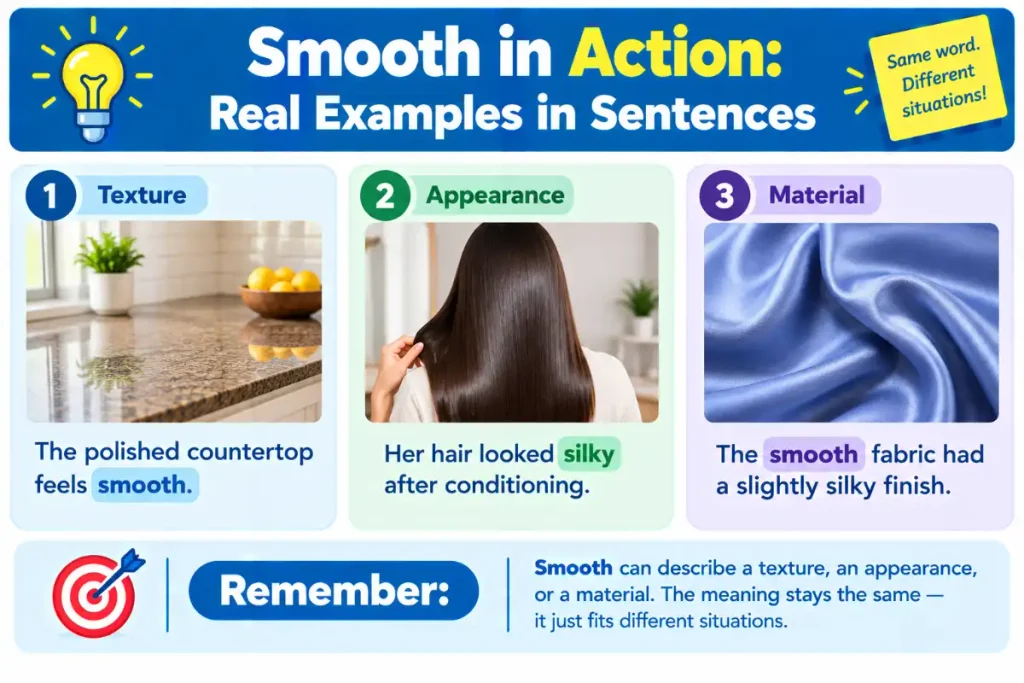
Smooth and silky overlap in meaning, particularly when describing hair, fabric, or texture. However, silky often suggests a soft, fine, luxurious texture similar to silk.
Examples:
- The polished countertop feels smooth.
- Her hair looked silky after conditioning.
- The smooth fabric had a slightly silky finish.
Use smooth when you mean even or free from roughness. Use silky when you want to emphasize softness, fineness, or a silk-like texture.
Smooth vs Sleek: What’s the Difference?
Smooth describes an even texture or an action without difficulty. Sleek usually describes something with a polished, streamlined, or elegant appearance.
For example:
- The stone has a smooth surface.
- The new car has a sleek design.
- She styled her hair into a sleek ponytail.
A car can have a sleek appearance because of its streamlined shape, while its paint may also have a smooth finish. The words describe different aspects of the same object.
Smooth or Effortless: What’s the Difference?
Smooth and effortless can both describe an experience that happens without obvious problems, but they emphasize different ideas. Effortless suggests that something requires little apparent effort.
Examples:
- The meeting went smoothly because everyone followed the agenda.
- Her performance looked effortless after months of practice.
- The application process was smooth and easy to follow.
A process may be smooth even when it requires considerable work behind the scenes. An effortless-looking performance may also require extensive preparation.
What Are Some Synonyms for Smooth?
The best synonym depends on what you are describing. A word that fits a physical surface may not fit a business process or a person’s speaking style. The following alternatives can help you choose more precise wording.
| Word | Meaning | Tone | Example |
|---|---|---|---|
| Even | Level or uniform | Neutral | The surface is even. |
| Flat | Without raised areas | Neutral | The board is flat. |
| Polished | Made smooth and often shiny | Descriptive | The polished table looked elegant. |
| Silky | Fine and soft in texture | Descriptive | The fabric felt silky. |
| Sleek | Smooth-looking and streamlined | Modern | The phone has a sleek finish. |
| Satin-like | Soft and smooth in appearance or feel | Descriptive | The material had a satin-like texture. |
| Glossy | Shiny and reflective | Descriptive | The glossy paper looked professional. |
| Fine | Having a delicate or small texture | Neutral | The powder had a fine texture. |
Synonyms for a Smooth Process or Experience
| Word or phrase | Meaning | Tone | Example |
|---|---|---|---|
| Easy | Not difficult | Everyday | The setup was easy. |
| Effortless | Requiring little apparent effort | Positive | The transition looked effortless. |
| Seamless | Without noticeable interruptions | Professional | The transfer was seamless. |
| Trouble-free | Without problems | Neutral | We had a trouble-free trip. |
| Uninterrupted | Continuing without breaks | Neutral | The presentation was uninterrupted. |
| Efficient | Working well with little waste | Professional | The team developed an efficient process. |
| Orderly | Organized and controlled | Formal | The event followed an orderly schedule. |
| Straightforward | Simple to understand or complete | Everyday | The application process was straightforward. |
Synonyms for Smooth Communication or Behavior
| Word | Meaning | Tone | Example |
|---|---|---|---|
| Fluent | Expressed easily and clearly | Neutral | She gave a fluent presentation. |
| Articulate | Able to express ideas clearly | Professional | He is an articulate speaker. |
| Polished | Refined and well-prepared | Professional | Her speech was polished. |
| Tactful | Careful not to offend others | Positive | He offered a tactful response. |
| Diplomatic | Skilled at handling sensitive situations | Professional | The manager gave a diplomatic answer. |
| Persuasive | Able to influence others | Neutral | She delivered a persuasive argument. |
| Graceful | Elegant or skillful | Descriptive | He made a graceful transition between topics. |
| Natural | Unforced or relaxed | Everyday | Their conversation felt natural. |
These alternatives are not interchangeable in every context. For example, fluent is suitable for language or speech, while polished often describes presentation quality. Seamless is useful for processes, but it may sound excessive when a simple word such as easy would communicate the idea more clearly.
What Are the Antonyms of Smooth?
Antonyms are words with opposite or contrasting meanings. The best opposite of smooth depends on whether you are describing texture, movement, communication, or a process.
| Antonym | Meaning | Example |
|---|---|---|
| Rough | Uneven or coarse | The rough stone scratched the surface. |
| Bumpy | Covered with bumps | The road was bumpy. |
| Uneven | Not level or uniform | The floor was uneven. |
| Coarse | Rough in texture | The fabric felt coarse. |
| Difficult | Not easy to complete | The process was difficult. |
| Disjointed | Lacking smooth connection or flow | The speech felt disjointed. |
| Awkward | Uncomfortable or lacking ease | The conversation became awkward. |
| Abrupt | Sudden or unexpected | The meeting came to an abrupt end. |
| Choppy | Irregular or interrupted | His presentation sounded choppy. |
| Clumsy | Lacking ease or coordination | The transition seemed clumsy. |
For a physical surface, rough is often the clearest opposite of smooth. For a process, difficult or interrupted may communicate the intended contrast more accurately.
Is Smooth American or British English?
Smooth is standard in both American and British English. There is no spelling difference between the two varieties for this word.
| English variety | Standard spelling | Example |
|---|---|---|
| American English | Smooth | The road has a smooth surface. |
| British English | Smooth | The road has a smooth surface. |
| Canadian English | Smooth | The fabric feels smooth. |
| Australian English | Smooth | The machine runs smoothly. |
Unlike words such as color and colour, smooth does not have separate standard American and British spellings. If you are writing for a US audience, use smooth, smoothly, and smoothness as appropriate. The same spellings work for readers in the UK, Canada, Australia, and other English-speaking regions.
Common Mistakes to Avoid When Using Smooth
The most common mistake is adding an unnecessary e to the end of the word. However, writers can also misuse its related forms or choose the wrong part of speech.
1. Adding an Extra E
Incorrect: The painter created a smoothe finish.
Correct: The painter created a smooth finish.
Remember that smooth already ends with the letters th. It does not need another letter.
2. Using Smooth Instead of Smoothly
Incorrect: The computer runs smooth after the update.
Correct: The computer runs smoothly after the update.
When you describe how an action happens, smoothly is usually the appropriate choice in standard written English.
3. Confusing Smoothness With Smooth
Incorrect: The smoothness surface made the table easy to clean.
Correct: The smooth surface made the table easy to clean.
Use smooth to describe the surface. Use smoothness when referring to the quality itself, as in The smoothness of the surface made it easy to clean.
4. Using Smooth When You Mean Soft
Incorrect: The blanket is smooth, so it feels warm and fluffy.
Better: The blanket is soft, so it feels warm and fluffy.
Smooth may describe the blanket’s texture, but soft more directly describes a gentle feel. Choose the word that matches your intended meaning.
5. Assuming Every Similar Word Follows the Same Pattern
English spelling varies across words. Some end in e, while others do not. The existence of words such as breathe and bathe does not mean that smooth should be spelled smoothe.
The safest approach is to learn the standard spelling of each word rather than applying one pattern to every word that sounds similar.

How to Remember the Correct Spelling
If you regularly confuse smoothe and smooth, use a few simple techniques to reinforce the correct form.
- Remember the ending: Smooth ends in th, not the.
- Use a short phrase: Repeat “smooth surface, smooth spelling” when checking your work.
- Learn related words: Smoothly, smoothness, smoother, and smoothest all begin with smooth.
- Check formal writing: Use a dictionary or spell-checker if you are unsure.
- Read your sentence aloud: This can help you notice awkward wording, although it will not reveal an extra e because the intended pronunciations are generally the same.
The most useful tip is to memorize smooth as the base form. Once you know the correct spelling, you can build related forms without adding an unnecessary letter.
Conclusion
Choosing between smoothe or smooth is straightforward once you remember the standard spelling. Smooth is correct, while smoothe is generally a misspelling that you should avoid in regular writing. The word can describe an even surface, an easy process, or the action of making something level or less rough.
You can also use related forms such as smoother, smoothest, smoothly, and smoothness, depending on the sentence. These words serve different grammatical purposes, but each retains the correct base spelling.
For school assignments, professional emails, business documents, and everyday communication, use smooth whenever you need the adjective or verb. If you are unsure, remember the simple rule: smooth ends in “th,” not “the.” This small spelling check will help you write more clearly and confidently.
Frequently Asked Questions
Is smoothe or smooth correct?
Smooth is correct in standard modern English. Smoothe is generally considered a misspelling and should be avoided in professional, academic, and everyday writing.
How do you spell smooth?
Spell it S-M-O-O-T-H. The word has six letters and ends with th, without a final e.
Is smoothe ever an acceptable spelling?
Smoothe is not the standard spelling in modern American English. Although you may encounter it as a typo, a nonstandard form, or a deliberate stylistic choice, smooth is the appropriate spelling for ordinary writing.
Is smooth a verb or an adjective?
Smooth can be both a verb and an adjective. For example, The surface is smooth uses it as an adjective, while Please smooth the paper uses it as a verb.
What is the difference between smooth and smoothly?
Smooth is usually an adjective or verb, while smoothly is an adverb. You might say, “The surface is smooth” and “The machine operates smoothly.”
What is another word for smooth?
Possible synonyms include even, polished, silky, seamless, effortless, fluent, and sleek. The best choice depends on whether you are describing a surface, process, appearance, or communication style.
Is smooth spelled differently in British English?
No. Smooth is spelled the same way in standard American and British English. Both varieties also use the forms smoothly and smoothness.
2 thoughts on “Smoothe or Smooth: Which Is Correct?”