

If you’ve ever searched for a cute stuffed animal online, you may have noticed both “plushie” and “plushy.” They look almost identical, but they do not always serve the same grammatical purpose.
“Plushie” is usually a noun for a soft stuffed toy, while “plushy” is usually an adjective meaning soft, padded, or plush-like. In casual English, especially online, the two can sometimes overlap.
The difference becomes much clearer once you look at how each word functions in a sentence. This guide explains plushie vs plushy, including spelling, meaning, pronunciation, examples, and the best choice for different contexts.
Plushie vs Plushy: Quick Answer
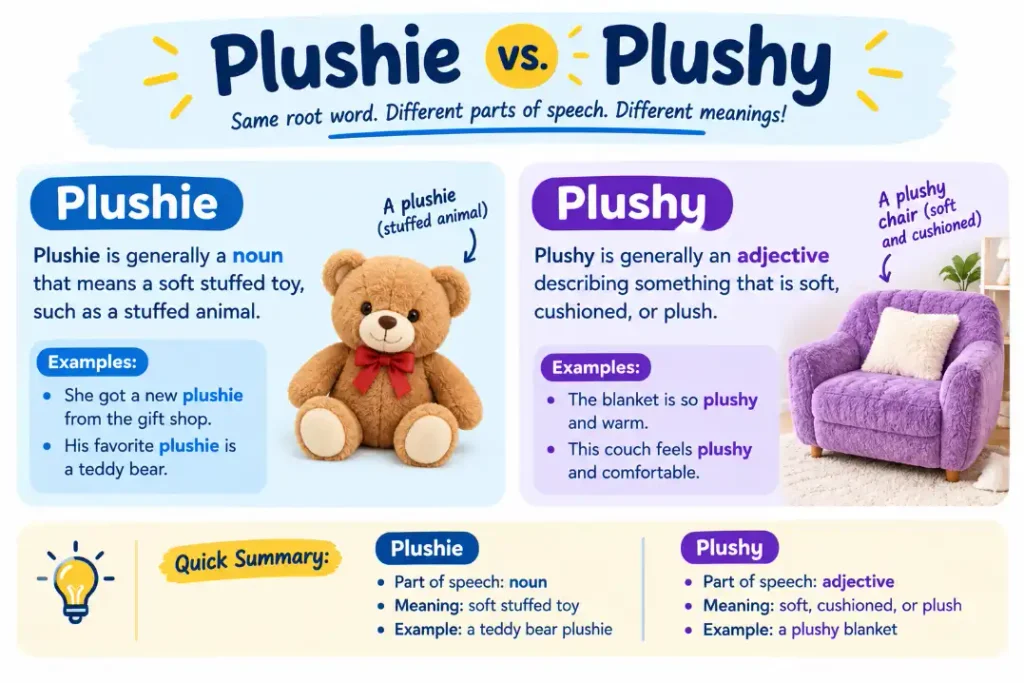
Plushie is generally a noun that means a soft stuffed toy, such as a stuffed animal. Plushy is generally an adjective describing something that is soft, cushioned, or plush.
| Word | Part of Speech | Main Meaning | Example |
|---|---|---|---|
| Plushie | Noun | A soft stuffed toy | “I bought a cat plushie.” |
| Plushy | Adjective | Soft, padded, or luxurious | “The chair feels plushy.” |
So, if you’re naming the toy itself, use plushie. If you’re describing something as soft or plush-like, plushy is usually the better choice.
What Does “Plushie” Mean?
Plushie is an informal noun for a soft stuffed toy, especially a stuffed animal or character.
For example:
- “She got a panda plushie for her birthday.”
- “My little brother sleeps with his favorite plushie.”
- “That plushie looks adorable.”
The word is closely related to plush, which refers to a soft fabric or a soft, stuffed item. The ending -ie gives the word a cute, informal feel. “Plushie” is common in casual conversation, online communities, social media, and product descriptions involving stuffed toys.
Is “Plushie” a Real Word?
Yes. Plushie is a commonly used informal noun for a stuffed or plush toy. It is especially popular in casual American English and internet language. It isn’t normally the word you’d choose for highly formal writing, but there’s nothing inherently incorrect about it.
For example:
“I bought a plushie for my niece.”
That sentence is natural and clear.
What Does “Plushy” Mean?
Plushy is generally an adjective meaning soft, thick, cushioned, or plush-like. It can describe furniture, fabric, bedding, carpets, toys, or other objects that have a soft and comfortable quality.
Examples include:
- “The hotel had plushy carpets.”
- “This blanket has a plushy texture.”
- “The sofa is soft and plushy.”
- “The toy has a plushy feel.”
The word comes from plush plus the adjective-forming ending -y.
Is “Plushy” a Noun?
Usually, no.
Plushy normally works as an adjective rather than the name of the stuffed toy itself.
For example:
- Correct: “The plushie is on the bed.”
- Correct: “The plushie has a plushy texture.”
In the second sentence, plushie identifies the object, while plushy describes its texture.
Plushie vs Plushy: What’s the Difference?
The simplest way to remember the difference is:
Plushie = the thing.
Plushy = a description of the thing.
Compare these sentences:
- “I bought a plushie.”
- “I bought a plushy toy.”
In the first sentence, plushie is the noun—the stuffed toy itself. In the second sentence, plushy describes the toy.
| Feature | Plushie | Plushy |
|---|---|---|
| Typical role | Noun | Adjective |
| Refers to | A stuffed toy | A soft or plush quality |
| Common use | Casual | Casual |
| Example | “My plushie is cute.” | “The toy is plushy.” |
| Meaning | Stuffed toy | Soft, padded, plush-like |
When Should You Use “Plushie”?
Use plushie when you’re talking about a stuffed toy as an object.
Examples
- “I bought a new plushie at the store.”
- “Her favorite plushie is a small rabbit.”
- “He keeps his plushie on his bed.”
- “That penguin plushie would make a great gift.”
- “My sister collects character plushies.”
- “The website sells handmade plushies.”
- “She gave me a cute plushie for my birthday.”
- “I found a dinosaur plushie at the toy store.”
Notice that plushie can also have a plural form: plushies.
Singular and Plural Forms
| Singular | Plural |
|---|---|
| plushie | plushies |
For example:
- “I have one plushie.”
- “I have several plushies.”
The plural follows the usual English spelling pattern in which a word ending in consonant + y changes to -ies.
When Should You Use “Plushy”?
Use plushy when you’re describing something that feels or looks soft, thick, cushioned, or plush-like.
Examples:
- “The blanket is wonderfully plushy.”
- “We sat on a plushy couch.”
- “The hotel room had plushy towels.”
- “I like the plushy texture of this fabric.”
- “The carpet feels soft and plushy.”
Here, plushy describes another noun.
You can think of it as similar to adjectives such as:
- soft
- cushioned
- fluffy
- padded
- velvety
- comfortable
However, these words aren’t perfect synonyms in every situation. Plushy specifically suggests a plush or soft, padded quality.
Is “Plushie” or “Plushy” Correct?
Both plushie and plushy can be correct, but they usually have different meanings. Use plushie for a stuffed toy:
“I bought a new plushie.”
Use plushy to describe something soft or plush:
“The blanket is plushy.”
The mistake is treating the two words as interchangeable in every sentence. For example, if you mean “stuffed toy,” saying “I bought a plushy” may sound unusual or unclear to many readers because plushy is normally understood as a description rather than the toy’s name.
Why Are “Plushie” and “Plushy” Confusing?
The confusion comes from their similar spelling and their shared connection to the word plush.
Both words can appear in discussions about soft toys:
- plush toy
- plushie
- plushy toy
- plush fabric
- plush texture
Online language also tends to be flexible. People sometimes use informal spellings creatively, especially when discussing toys, games, characters, collectibles, and fandoms. As a result, you may see plushy used in ways that overlap with plushie. That doesn’t mean the two words have exactly the same standard function.
The clearest distinction is still:
plushie = noun
plushy = adjective
Plushie vs Plush Toy
Plush toy is the more neutral and broadly recognized term. Plushie is more informal and often sounds cute or friendly.
| Term | Meaning | Tone |
|---|---|---|
| Plushie | Soft stuffed toy | Informal, cute |
| Plush toy | Soft stuffed toy | Neutral |
| Stuffed animal | Usually a stuffed animal character | Everyday |
| Stuffed toy | Soft toy filled with stuffing | Neutral |
For a product listing, plush toy may sound more descriptive and professional, while plushie can feel warmer and more conversational.
Plushie vs Stuffed Animal
These terms overlap, but they’re not always identical. A stuffed animal usually represents an animal, such as a bear, dog, cat, or rabbit. A plushie can represent almost anything:
- animals
- fictional characters
- food
- objects
- fantasy creatures
- cartoon characters
For example, a stuffed dragon can be called a plushie, even though a dragon isn’t a real animal.
So plushie is often the broader casual term.
Plushie vs Plushy in Everyday Conversation
In casual conversation, plushie is generally the natural choice when you mean a stuffed toy.
For example:
“Look at this cute plushie!”
That sounds natural in a casual conversation.
If you’re describing the toy’s texture, plushy works better:
“It’s really plushy and soft.”
The two can even appear in the same sentence:
“This plushie is super plushy.”
Here, the first word names the toy and the second describes its texture.
10+ Examples of “Plushie” and “Plushy”
Here are natural examples showing the difference.
Examples With “Plushy”
- “This blanket feels warm and plushy.”
- “The couch has a plushy surface.”
- “These towels are thick and plushy.”
- “The rug feels soft and plushy under your feet.”
- “The stuffed toy has a plushy texture.”
- “The hotel bed had a plushy comforter.”
Examples Using Both
- “The plushie is small but very plushy.”
- “I found a cute plushie with a soft, plushy texture.”
- “This plushie has an especially plushy body.”
These examples show why the two spellings shouldn’t automatically be treated as interchangeable.
Is “Plushy” a Correct Spelling?
Yes, plushy is a valid adjective formed from plush.
For example:
“The material feels plushy.”
However, if you are talking about a stuffed toy, plushie is usually the clearer noun. It’s also worth remembering that English spelling can vary in informal language. You may encounter people using words creatively online, but the most useful approach is to choose the form that clearly communicates your intended meaning.
Is “Plushie” Formal or Informal?
Plushie is informal.
It’s well suited to:
- Text messages
- Social media
- Casual conversations
- Online communities
- Personal blogs
- Informal product discussions
- Conversations about toys and collectibles
For more formal writing, plush toy or stuffed toy may be preferable.
For example:
Casual:
“She bought an adorable plushie.”
More neutral:
“She purchased a plush toy.”
Neither is inherently wrong. The choice depends on the tone you want.
Is “Plushy” Formal or Informal?
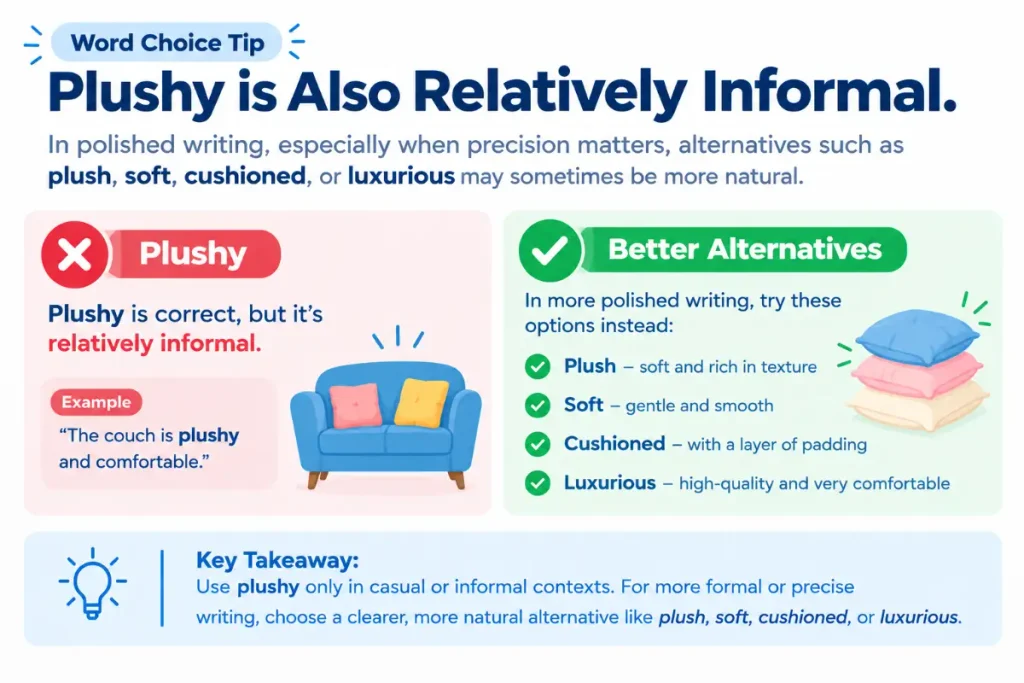
Plushy is also relatively informal.
In polished writing, especially when precision matters, alternatives such as plush, soft, cushioned, or luxurious may sometimes be more natural.
Compare:
- “The sofa has a plushy surface.” — casual
- “The sofa has a plush surface.” — more standard
- “The sofa has a soft, cushioned surface.” — precise
For everyday communication, however, plushy is understandable and useful.
“Plushie” vs. “Plushies”
If you’re talking about more than one plushie, the plural is plushies.
Examples
- “I own one plushie.”
- “I own three plushies.”
- “The store sells plushies.”
- “She collects Pokémon plushies.”
The spelling changes from y to ies in the plural:
plushie → plushies
This is the same general spelling pattern found in words such as:
- baby → babies
- puppy → puppies
- city → cities
“Plushy” vs. “Plush”
The difference between plushy and plush is more subtle. Plush can function as a noun, adjective, and sometimes part of a compound expression. It commonly describes something soft, thick, or luxurious. Plushy is an adjective that emphasizes the quality of being plush-like or soft.
Compare:
- “The hotel has plush towels.”
- “The towels feel plushy.”
Both can work, but plush is often the more established and concise choice.
Which Is Better?
For professional or polished writing, plush is often preferable:
“The chair has plush upholstery.”
For casual writing:
“The chair feels really plushy.”
Common Mistakes With Plushie and Plushy
Mistake 1: Using “plushy” as the default noun
If you’re referring to a stuffed toy, plushie is usually clearer.
Less clear:
“I bought a plushy.”
Clearer:
“I bought a plushie.”
Mistake 2: Assuming “plushie” describes texture
Plushie normally names the object rather than describing its softness.
Instead of:
“The blanket is plushie.”
Use:
“The blanket is plushy.”
Or simply:
“The blanket is plush.”
Mistake 3: Confusing “plushie” with “plush”
These words are related, but they’re not interchangeable in every sentence.
- “I bought a plushie.” — stuffed toy
- “I bought a plush toy.” — soft toy
- “The fabric is plush.” — soft/thick fabric
Mistake 4: Assuming informal words are automatically incorrect
Words such as plushie are informal, but informal doesn’t mean incorrect. The important question is whether the word fits the context.
Which Word Should You Use in Different Situations?
Texting
Use plushie when you mean a stuffed toy.
“Look at the plushie I got!”
Social Media
Plushie is a natural choice for posts about stuffed toys.
“My new plushie finally arrived!”
Product Descriptions
Both can work, depending on what you’re describing.
“Cute plushie for kids and collectors.”
or:
“Soft, plushy material makes this toy comfortable to hold.”
School Essays
For formal school writing, plush toy or stuffed toy may be better than plushie unless you’re discussing the word itself.
Professional Writing
Use plush toy, stuffed toy, or plush when a more neutral tone is appropriate.
Everyday Conversation
Plushie is perfectly natural when talking about a stuffed toy.
A Simple Memory Trick
Remember the endings:
-ie = thing
-y = describing word
So:
- plushie → the stuffed toy
- plushy → describing something soft or plush-like
This isn’t a universal rule for every English word, but it works well for distinguishing these two terms.
What Are Some Alternatives to “Plushie”?
If you need a different word for a stuffed toy, the best choice depends on context.
| Word/Phrase | Meaning | Tone | Example |
|---|---|---|---|
| Plush toy | Soft stuffed toy | Neutral | “She bought a plush toy.” |
| Stuffed toy | Toy filled with soft material | Neutral | “The child has a stuffed toy.” |
| Stuffed animal | Toy representing an animal | Everyday | “He has a stuffed animal.” |
| Soft toy | Soft toy, especially in British usage | Neutral | “The child chose a soft toy.” |
| Plush | A plush toy or plush item | Casual/retail | “The character is available as a plush.” |
| Stuffie | Informal term for stuffed toy | Very casual | “My dog has a stuffie.” |
| Cuddly toy | Soft toy meant for comfort or play | Casual | “She took her cuddly toy to bed.” |
| Teddy bear | Stuffed bear | Everyday | “He received a teddy bear.” |
| Plush collectible | Collectible plush item | Retail/collector | “The plush collectible sold out.” |
Not every alternative is an exact synonym. Teddy bear, for example, specifically refers to a bear, while plushie can describe many different characters and shapes.
What Are Some Alternatives to “Plushy”?
When describing something soft or comfortable, you can use different words depending on the exact meaning.
| Word | Meaning | Tone | Example |
|---|---|---|---|
| Plush | Soft and thick | Neutral | “The chair has plush fabric.” |
| Soft | Pleasantly gentle to touch | Everyday | “The blanket is soft.” |
| Cushioned | Having padding | Neutral | “The seat is cushioned.” |
| Padded | Filled or covered with padding | Neutral | “The jacket has padded sections.” |
| Fluffy | Light and soft | Casual | “The blanket is fluffy.” |
| Fuzzy | Covered with soft fibers | Casual | “The fabric feels fuzzy.” |
| Velvety | Smooth and soft like velvet | Descriptive | “The fabric feels velvety.” |
| Comfortable | Pleasant to sit or lie on | Everyday | “The chair is comfortable.” |
| Luxurious | Rich, comfortable, or high-quality | Formal | “The room has luxurious furnishings.” |
Choose based on what you actually mean. Soft is broader than plushy, while cushioned focuses more on padding.
US Usage of “Plushie” and “Plushy”
For American readers, plushie is a familiar informal term for a stuffed or plush toy. It’s especially common in casual speech and online communities. Plushy is primarily useful as a descriptive adjective. American English doesn’t require a different spelling of these words compared with British English. However, related terms may vary by region. For example, soft toy is particularly common in British English, while American speakers often say stuffed animal or stuffed toy. These regional preferences don’t make one form universally right or wrong.
Plushie vs Plushy Pronunciation
The two words are pronounced differently enough to make their grammatical roles easier to remember. Plushie is commonly pronounced like “PLUSH-ee.” Plushy is commonly pronounced like “PLUSH-ee” as well. Because their pronunciation is essentially the same for many speakers, spelling and context become especially important. That similarity in sound is one reason people can confuse the two forms when writing.
Is “Plushie” the Same as “Stuffie”?
Plushie and stuffie can both refer to soft stuffed toys, but they have slightly different associations. Plushie is connected directly to plush and often refers to collectible or character-based plush toys. Stuffie is a casual shortening of stuffed animal or stuffed toy.
For example:
“She keeps her favorite stuffie on her bed.”
and:
“She keeps her favorite plushie on her bed.”
Both can sound natural in casual American English.
Is “Plushie” Better Than “Plushy”?
If you’re asking which word is better for a stuffed toy, plushie is usually the better choice. If you’re describing the toy’s texture, plushy can work.
Compare:
- Toy: “I bought a plushie.”
- Texture: “The plushie is plushy.”
If you want a neutral term suitable for most readers, plush toy is another excellent option.
Quick Tips for Remembering Plushie vs Plushy
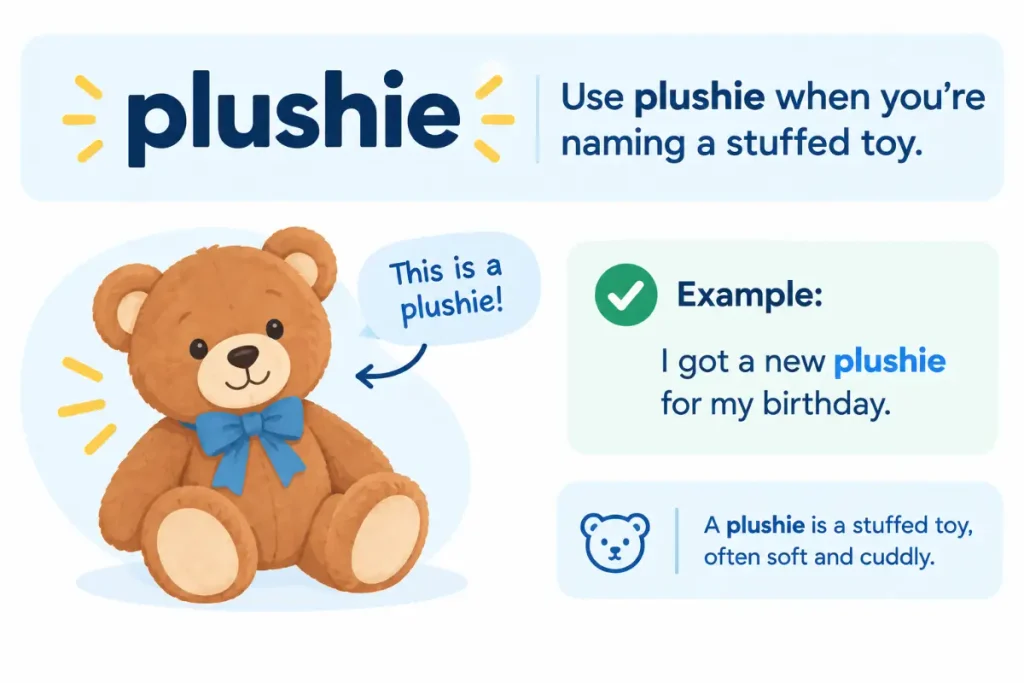
- Use plushie when you’re naming a stuffed toy.
- Use plushy when you’re describing softness or texture.
- Plushie is a noun.
- Plushy is generally an adjective.
- The plural of plushie is plushies.
- For formal writing, consider plush toy or stuffed toy.
- If you’re unsure, ask yourself: Am I naming the toy or describing it?
Conclusion
The main difference between plushie vs plushy is their usual grammatical role. Plushie is an informal noun for a soft stuffed toy, while plushy is generally an adjective describing something soft, thick, cushioned, or plush-like. Because the two words are closely related and often pronounced similarly, they can be easy to mix up.
For everyday conversations, social media, and casual writing, plushie is the natural choice when you’re talking about the toy itself. Use plushy when you’re talking about how something feels or looks. If you need a more neutral or formal term, plush toy or stuffed toy is often a better option. The simple rule is easy to remember: plushie is the thing; plushy describes the thing.
Frequently Asked Questions
Is “plushie” or “plushy” correct?
Both can be correct, but they usually have different functions. Plushie is normally a noun meaning a stuffed toy, while plushy is normally an adjective describing something soft or plush-like.
Which is correct, “plushie” or “plushy”?
For the name of a stuffed toy, plushie is generally the better choice. Use plushy when you’re describing softness or a plush texture.
Is “plushie” a real word?
Yes. Plushie is a widely used informal word for a soft stuffed toy, particularly a stuffed animal or character toy.
What does “plushy” mean?
Plushy means soft, thick, padded, or plush-like. For example, you might describe a blanket or sofa as plushy.
Is “plushie” formal English?
No, plushie is generally informal. In formal or professional writing, plush toy, stuffed toy, or stuffed animal may be more appropriate.
Is “plushy” a noun or an adjective?
Plushy is generally an adjective. It describes something that has a soft, padded, or plush quality.
What’s another word for “plushie”?
Common alternatives include plush toy, stuffed toy, stuffed animal, stuffie, and cuddly toy. The best choice depends on the type of toy and the level of formality.
2 thoughts on “Plushie vs Plushy: What’s the Difference?”