

If you’re writing about a royal title, a noblewoman, or someone associated with a duke, you may wonder about dutchess vs duchess. The two spellings look almost identical, but only one is the standard English spelling.
Duchess is the correct spelling for the feminine title corresponding to duke. Dutchess is generally an incorrect spelling when you mean the title, although it appears as a proper name in some places and organizations.
The difference is easy to remember once you connect duchess with duke. This guide explains the meaning, spelling, pronunciation, examples, common mistakes, and the limited situations where “Dutchess” may appear legitimately.
Dutchess vs Duchess: Which Is Correct?
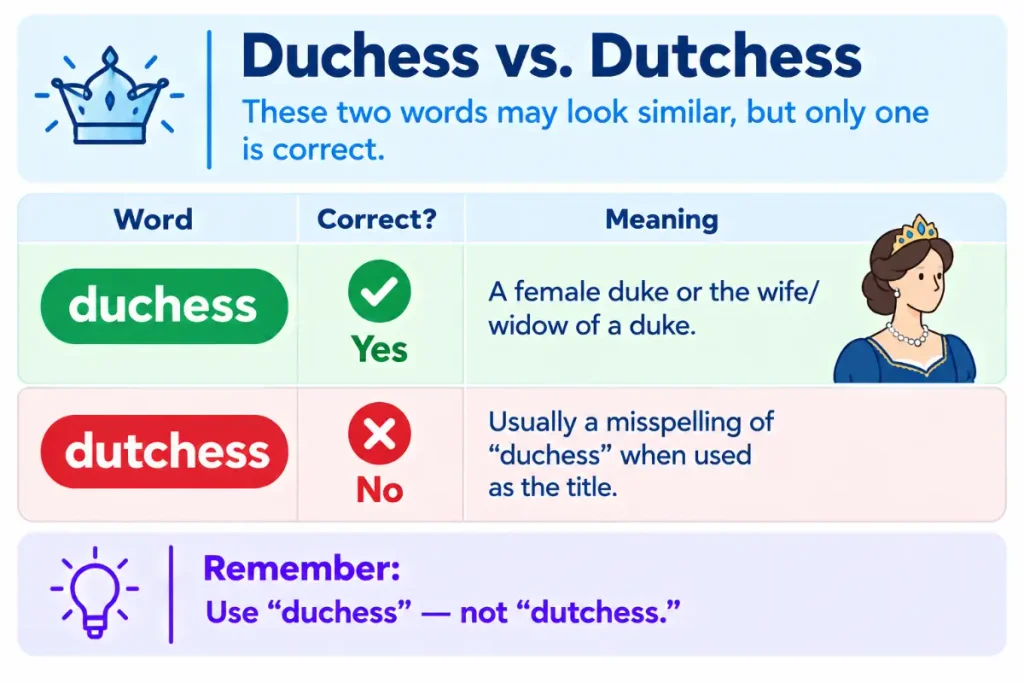
Duchess is the correct spelling when referring to a woman who holds the title of duke or is the wife of a duke.
| Spelling | Correct for the title? | Meaning |
|---|---|---|
| duchess | Yes | A female duke or the wife/widow of a duke |
| dutchess | No | Usually a misspelling of “duchess” when used as the title |
For example:
- Correct: The duchess attended the ceremony.
- Incorrect: The dutchess attended the ceremony.
The extra t in dutchess does not belong in the title.
What Does Duchess Mean?
A duchess is a woman who has the rank or title corresponding to a duke. Depending on the system of nobility, she may hold the title herself or be married to a duke.
The word is a noun.
Examples of “duchess”
- The duchess arrived at the palace.
- Everyone waited for the duchess to speak.
- The young duchess became known for her charitable work.
- The duke and duchess attended the formal dinner.
- The duchess wore an elegant gown to the ceremony.
In these examples, duchess refers to a woman associated with the rank of duke.
How Do You Spell Duchess?
The correct spelling is: D-U-C-H-E-S-S The word contains no T. A common incorrect version is: D-U-T-C-H-E-S-S That spelling can be tempting because the word begins with a sound that some people associate with “Dutch.” However, duchess and Dutch are unrelated words in modern English usage.
A simple spelling pattern
Think of the relationship: duke → duchess The spelling changes from duke to duchess, but there is no t added.
Why Is “Dutchess” Confusing?
The confusion comes mainly from the similarity between the words duchess and Dutch. Dutch is associated with the Netherlands, its people, language, and culture. Duchess, on the other hand, is connected with the title duke. The words may sound somewhat similar at the beginning, especially in quick speech, but they have different meanings and spellings.
Compare:
- Dutch → related to the Netherlands
- duke → a noble title
- duchess → the feminine title associated with a duke
Because Dutchess looks like it combines “Dutch” with the ending “-ess,” people sometimes use it accidentally when trying to spell duchess.
Duchess vs Dutchess: The Main Difference
The easiest way to understand dutchess vs duchess is to focus on meaning.
Duchess
Duchess is a title or noun referring to a woman who holds the rank of duke or is associated with a duke through marriage.
Example:
The duchess greeted the guests at the reception.
Dutchess
Dutchess is not the standard spelling of the title. However, it can appear legitimately as part of a proper name, such as the name of a place, organization, business, or other named entity. That means you should not automatically change every occurrence of Dutchess to duchess without checking the context. For ordinary writing about the noble title, use duchess.
Is “Dutchess” a Word?
Dutchess is not the standard English spelling for the female title “duchess.” If you are referring to the noble title, duchess is the correct choice. However, Dutchess can occur as a proper name. For example, Dutchess County is the name of a county in New York. This distinction matters because proper names preserve their official spelling.
So:
- The duchess visited the city. ✅
- The dutchess visited the city. ❌
- Dutchess County is in New York. ✅
The third example uses Dutchess as part of a proper name, not as the title of a noblewoman.
When Should You Use “Duchess”?
Use duchess when the word refers to the title. Common contexts include:
- British royalty and nobility
- European aristocratic titles
- Historical writing
- Biographies
- News reports
- Books and essays
- Formal descriptions of titled people
For example:
The Duchess of Edinburgh attended the event.
Here, Duchess is capitalized because it forms part of a specific title. But when the title is used generally, lowercase is normally appropriate:
The duchess attended the event.
When Should “Duchess” Be Capitalized?
Capitalization depends on how the title is being used.
Before or as part of a person’s name
A title may be capitalized when it is used as a formal title or as part of a specific title.
Example:
The Duchess of Cambridge attended the ceremony.
Used generally
When referring to the person simply as a duchess, lowercase is normally used.
Example:
The duchess spoke with the guests.
A useful rule is to distinguish a specific formal title from a general noun.
Duchess in American English
American English uses duchess with the same standard spelling. The word is less common in everyday American conversation because the United States does not have a hereditary aristocratic system like the British peerage. Still, Americans regularly encounter the word in:
- History books
- British news
- Royal biographies
- Literature
- Movies and television
- Discussions of European history
There is no American spelling that replaces duchess with dutchess.
Duchess in British English
British English also uses duchess. In fact, the word is especially common in British contexts because the United Kingdom has a long-established system of royal and aristocratic titles. The spelling remains:
duchess
Not:
dutchess
So there is no US-versus-UK spelling difference here.
| English variety | Correct spelling |
|---|---|
| American English | duchess |
| British English | duchess |
| Canadian English | duchess |
| Australian English | duchess |
The spelling is consistent across these varieties of English.
Duchess and Duke: The Connection
One of the best ways to remember the spelling is to learn the masculine and feminine forms together.
| Title | Gender |
|---|---|
| duke | Traditionally male |
| duchess | Traditionally female |
For example:
The duke and duchess arrived together.
The pair is duke and duchess, not “duke and dutchess.”The relationship between the two words also explains why the spelling of duchess does not follow the spelling of “Dutch.”
Is Duchess a Noun?
Yes. Duchess is a noun. It names a person who holds the relevant title.
Singular
The duchess attended the meeting.
Plural
The plural is duchesses.
Several duchesses attended the celebration.
Notice that the plural adds -es to the singular form.
duchess → duchesses
It does not become “dutchesses.”
How Do You Pronounce Duchess?
Duchess is commonly pronounced approximately: DUCH-iss The first syllable rhymes closely with the beginning of words such as “much,” and the second syllable sounds like “iss.” The pronunciation does not contain a separate t sound. That can help explain why adding a t when spelling the word is unnecessary.
10 Examples of “Duchess” in Sentences
Here are natural examples showing how duchess works in different contexts.
- The duchess attended the charity event.
- The duke and duchess welcomed their guests.
- The historian wrote a book about the famous duchess.
- The duchess spoke to reporters after the ceremony.
- The young duchess inherited the title after her family’s succession.
- Students learned about the duchess during their history lesson.
- The duchess visited the museum during her trip.
- The newspaper published a photograph of the duchess.
- The novel features a duchess who lives in a country estate.
- The duchess thanked everyone for attending the reception.
Each example uses duchess as a noun referring to a woman with the relevant title.
Common Mistakes With Duchess
Mistake 1: Adding a T
Incorrect:
The dutchess arrived at noon.
Correct:
The duchess arrived at noon.
The word has no t.
Mistake 2: Confusing Duchess With Dutch
Incorrect idea:
Assuming that “duchess” is related to “Dutch.”
Correct idea:
Duchess is associated with duke, while Dutch relates to the Netherlands.
Mistake 3: Treating Dutchess as the Standard Variant
Some writers assume that duchess and dutchess are two acceptable spellings. They are not interchangeable when referring to the title. Duchess is the standard spelling.
Mistake 4: Changing a Proper Name
It is also possible to make the opposite mistake by changing an official name from Dutchess to Duchess. For example, Dutchess County is a proper name. Its spelling should be preserved. The general rule is simple: Use “duchess” for the title, but preserve “Dutchess” when it is part of an official proper name.
Duchess vs Princess: What’s the Difference?
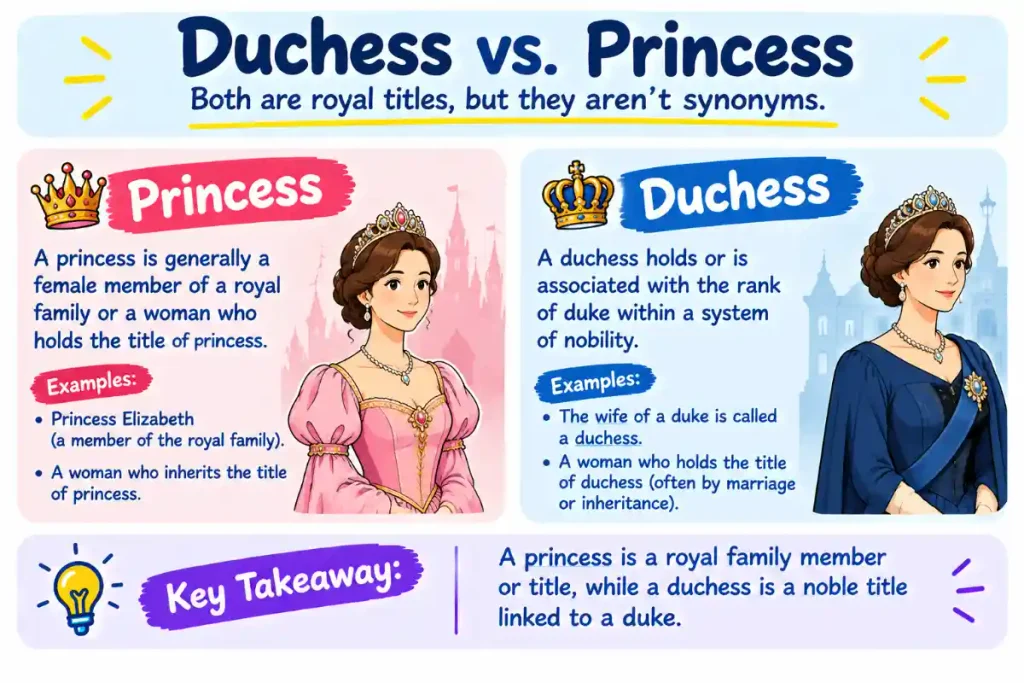
Duchess and princess are both titles, but they aren’t synonyms. A princess is generally a female member of a royal family or a woman who holds the title of princess. A duchess holds or is associated with the rank of duke within a system of nobility.
| Word | General meaning | Example |
|---|---|---|
| duchess | Female holder or spouse of a duke | The duchess attended the ceremony. |
| princess | Female royal title | The princess greeted the crowd. |
A woman can sometimes hold more than one title, depending on her family, marriage, and position.
Duchess vs Countess: What’s the Difference?
A countess is a female title associated with a count or, in British usage, an earl. A duchess has a higher-ranking noble title in the traditional European hierarchy.
| Title | Associated masculine title |
|---|---|
| duchess | duke |
| countess | count or earl |
| baroness | baron |
| viscountess | viscount |
These words all refer to female titles, but they are not interchangeable.
Duchess vs Lady: Are They the Same?
No. Duchess and lady are not equivalent titles. Lady can be used in several ways in British titles and social conventions. It may refer to certain women of the nobility or to the daughter of a duke, marquess, or earl under particular naming conventions. Duchess specifically refers to the feminine form associated with duke.
For example:
The duchess attended the dinner.
Replacing duchess with lady can change the meaning and title.
What Is the Feminine Form of Duke?
The traditional feminine form of duke is duchess. This is one of the most useful facts to remember:
duke → duchess
Just as some other titles have corresponding feminine forms, the title duchess is associated with duke.
What Is the Plural of Duchess?
The plural of duchess is duchesses.
Examples:
- One duchess
- Two duchesses
- Several duchesses
Example:
The exhibition featured portraits of several duchesses.
The plural ending is -es because the singular word ends in -ss.
Is Duchess Formal or Casual?
Duchess is a formal title and noun. It is mainly used in formal, historical, literary, or news-related contexts. You would not normally use it in casual conversation unless you are actually discussing a person with that title, a historical figure, a fictional character, or the word itself.
For example:
Formal/history:
The duchess hosted the royal reception.
Everyday language:
I read an article about a duchess in a history magazine.
The word itself does not have a common casual replacement.
Is Duchess a Proper Noun?
Usually, duchess is a common noun when used by itself.
The duchess entered the room.
When it is part of a formal title or a specific title, capitalization may be appropriate:
The Duchess of Sussex
The capitalization depends on the title’s grammatical and editorial context.
A Quick Memory Trick for Duchess
If you often confuse dutchess and duchess, use this simple connection:
DUKE → DUCHESS
The word duchess is tied to duke, not Dutch.
You can also remember:
Duchess has no T.
If you’re describing a female noble title, leave the t out.
Another easy trick
Think of the word pair:
Duke and Duchess
This familiar pairing makes the correct spelling easier to remember.
Correct vs. Incorrect Examples
| Incorrect | Correct | Why? |
|---|---|---|
| The dutchess arrived. | The duchess arrived. | “Duchess” is the standard spelling. |
| She became a dutchess. | She became a duchess. | The title has no T. |
| The duke and dutchess spoke. | The duke and duchess spoke. | The feminine form is “duchess.” |
| Several dutchesses attended. | Several duchesses attended. | “Duchesses” is the correct plural. |
| The Dutchess attended the palace. | The Duchess attended the palace. | If referring to the title, use “Duchess.” |
One important exception remains: Dutchess can be correct when it is part of an official proper name.
When Is “Dutchess” Actually Correct?
Although Dutchess is usually an error when someone means the noble title, it can be correct in a proper name. A well-known example is Dutchess County, a county in New York. In that context, changing the spelling to Duchess County would be incorrect because proper names have their own established spellings. This gives you a useful context test:
Are you talking about a female noble title?
→ Use duchess.
Are you reproducing an official name that is spelled “Dutchess”?
→ Keep Dutchess.
Context determines which spelling is appropriate.
Duchess vs Dutchess: Quick Comparison
| Feature | Duchess | Dutchess |
|---|---|---|
| Standard title spelling | ✅ Yes | ❌ No |
| Refers to a female duke/title | ✅ Yes | ❌ No |
| Contains a T | ❌ No | ✅ Yes |
| Related to “duke” | ✅ Yes | ❌ No |
| Can appear in proper names | Yes | Yes |
| Example | The duchess arrived. | Dutchess County |
How to Choose the Right Spelling
When you’re unsure about dutchess vs duchess, follow these steps:
- Identify the meaning. Are you talking about a noble title?
- Connect the title to duke. The feminine form is duchess.
- Remove the T. The standard title contains no t.
- Check for a proper name. If “Dutchess” is part of an official name, preserve that spelling.
- Check capitalization. Capitalize a formal title when required by context or style.
For most ordinary sentences, the answer will be duchess.
Do You Say “The Duchess” or Just “Duchess”?
Both forms can be grammatically possible depending on the context. When referring to a specific woman, English commonly uses the definite article:
The duchess attended the ceremony.
When using a formal title directly with a name, the article may not be used:
Duchess of Edinburgh
The exact construction depends on whether the title is being used as a general noun, formal title, or part of a person’s name.
Does Duchess Have a Synonym?
There isn’t a perfect everyday synonym for duchess because it is a specific title. Words such as noblewoman, aristocrat, or peeress may describe related concepts, but they do not always mean exactly the same thing.
| Word | Meaning | Tone | Example |
|---|---|---|---|
| Duchess | Female title associated with a duke | Formal | The duchess attended the event. |
| Noblewoman | Woman belonging to the nobility | Formal | The noblewoman supported the project. |
| Aristocrat | Member of an aristocratic class | Formal | The aristocrat lived on a large estate. |
| Peeress | Woman who is a member of the peerage | Formal | The peeress addressed the committee. |
| Lady | A title or polite term with several uses | Formal/general | The lady arrived at the reception. |
These alternatives should not be treated as exact replacements in every sentence.
What Is the Opposite of Duchess?
There is no true antonym for duchess because it is a title rather than a descriptive quality. If you’re comparing titles by gender, the corresponding masculine title is duke.
So the useful pair is:
duke ↔ duchess
This is better understood as a masculine/feminine title relationship rather than an antonym relationship.
Why the Spelling Matters
Correct spelling matters because duchess is a specific title. Using dutchess in a formal article, school assignment, biography, or professional document can make the writing look careless.
For example:
The duchess visited the museum.
is correct.
Writing:
The dutchess visited the museum.
introduces a spelling error.
The exception is when Dutchess is part of a proper name. In that case, changing it may create a different or incorrect name.
Quick Tips to Remember the Difference
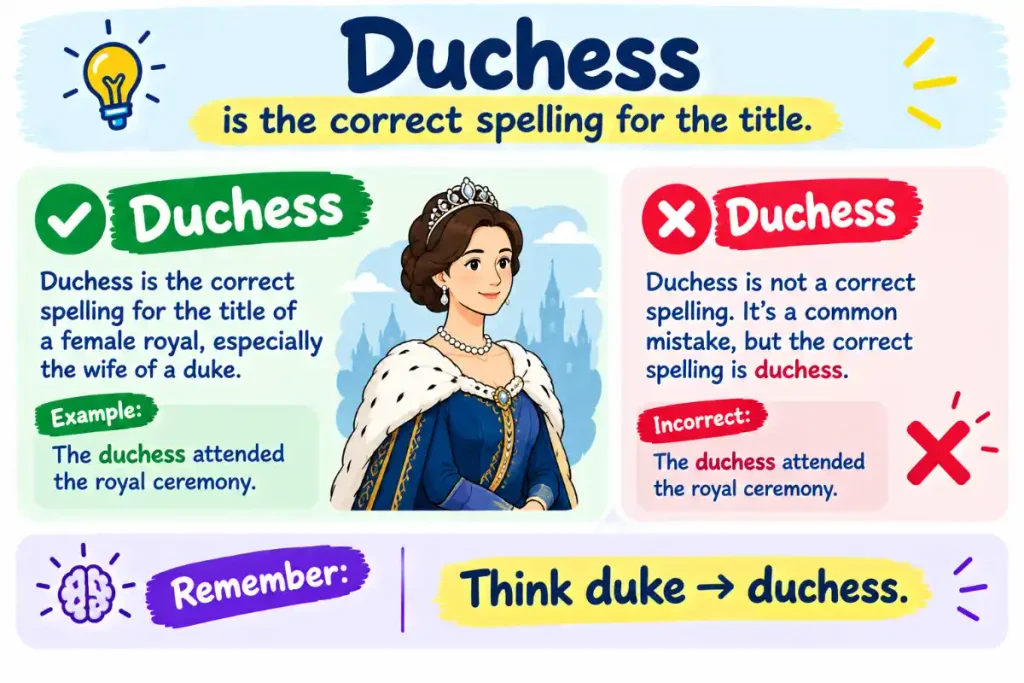
- Duchess is the correct spelling for the title.
- Think duke → duchess.
- Duchess has no T.
- Dutch relates to the Netherlands; duchess relates to duke.
- Dutchess can be correct when it is part of a proper name.
- The plural of duchess is duchesses.
- American and British English both use duchess.
Conclusion
The key difference in dutchess vs duchess is simple: duchess is the correct standard spelling for the female title associated with a duke. It is used in historical, royal, aristocratic, literary, and formal contexts. The spelling dutchess should not be used as an alternative spelling of the title.
The easiest way to remember the correct form is to connect duchess with duke. There is no t in either part of that title relationship. At the same time, don’t automatically “correct” Dutchess when it appears in a proper name, because names can have their own established spelling.
If you’re writing about a noblewoman, the safe choice is duchess.
Frequently Asked Questions
Which is correct, Dutchess or Duchess?
Duchess is correct when referring to the female title associated with a duke. Dutchess is generally a misspelling in that context, although it can be correct as part of a proper name such as Dutchess County.
How do you spell duchess?
The correct spelling is duchess: D-U-C-H-E-S-S. It does not contain a t.
Is Dutchess a misspelling of Duchess?
Usually, yes, when Dutchess is being used to mean the noble title. However, Dutchess can be correct when it appears in an official proper name.
What is the feminine form of duke?
The traditional feminine form of duke is duchess. For example, “the duke and duchess” is the standard pairing.
Is Duchess the same as Princess?
No. Duchess is a noble title associated with a duke, while princess is generally a royal title. The two titles have different meanings and positions.
What is the plural of duchess?
The plural is duchesses. For example: “Several duchesses attended the ceremony.”
Is Duchess spelled differently in British and American English?
No. Both American and British English use duchess for the title. There is no standard US spelling “dutchess” for this word.
1 thought on “Dutchess vs Duchess: The Correct Spelling Explained”