
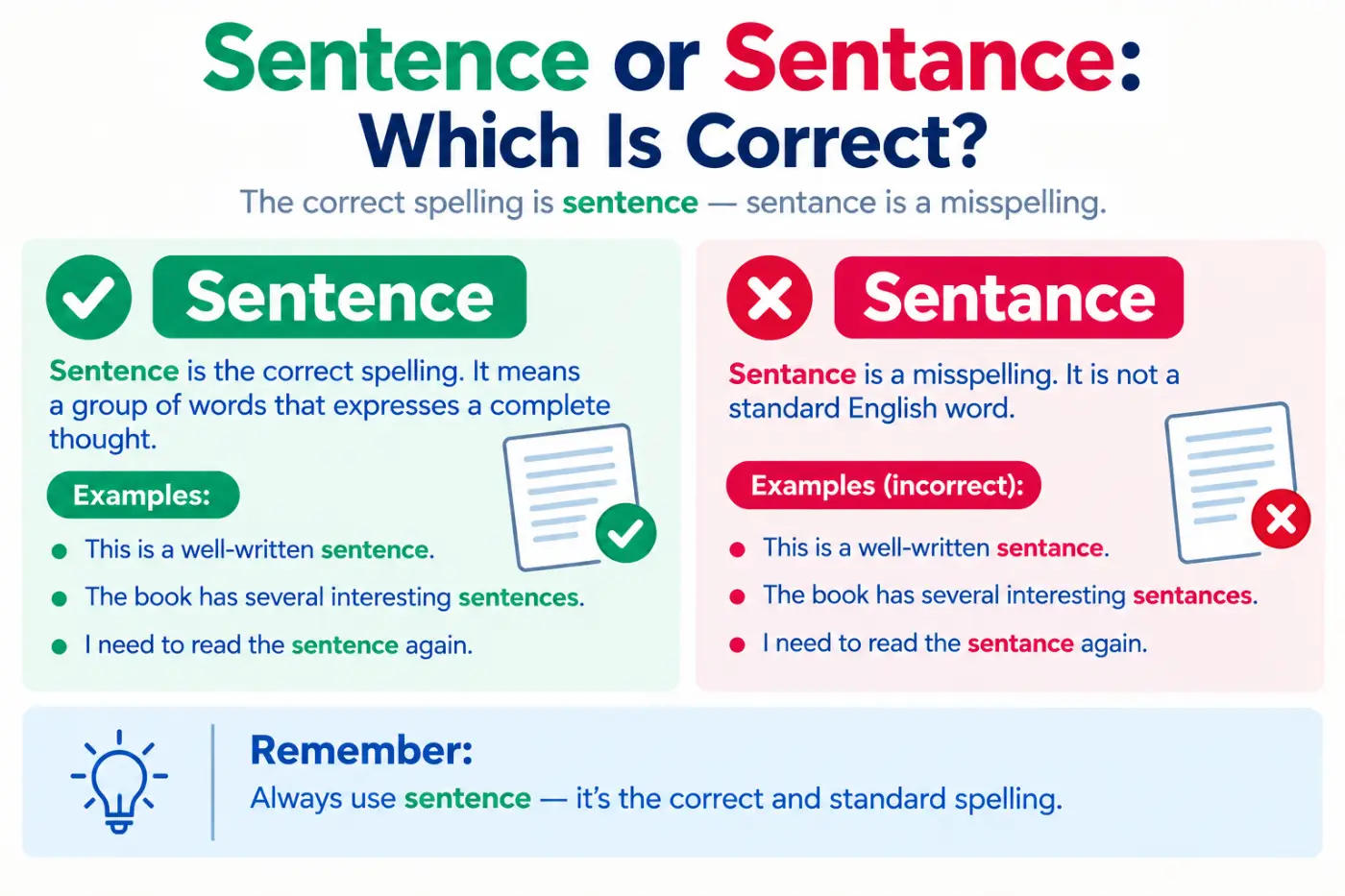
If you’re writing an email, school assignment, article, or text and aren’t sure whether to use sentence or sentance, the correct spelling is sentence. Sentance is a common misspelling and is not considered correct in standard American English. Knowing the difference can help you avoid a simple spelling mistake in both formal and everyday writing.
Sentence is the standard spelling for a group of words that expresses a complete thought. It can also refer to a judgment or punishment given by a court. Because the word is pronounced differently from how some people expect it to be spelled, it is easy to confuse sentence with the incorrect form sentance.
In this guide, you’ll learn why sentence is the correct spelling, why sentance is commonly written by mistake, and how to remember the difference. You’ll also see clear examples that show how to use sentence correctly in different types of writing.
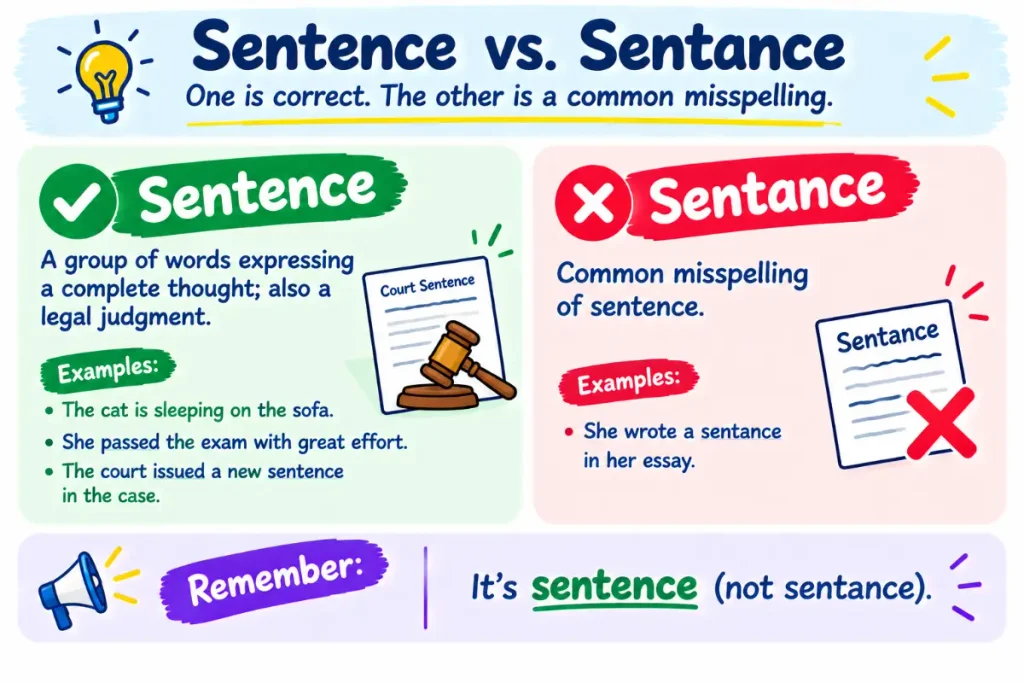
Sentence or Sentance: Which Is Correct?
The correct spelling is sentence. The spelling sentance is incorrect.
| Spelling | Correct? | Meaning |
|---|---|---|
| Sentence | ✅ Yes | A group of words expressing a complete thought; also a legal judgment |
| Sentance | ❌ No | Common misspelling of sentence |
For example:
- Correct: Please write a complete sentence.
- Incorrect: Please write a complete sentance.
If you’re deciding between sentence or sentance, always choose sentence in standard English.
What Does Sentence Mean?
Sentence is primarily a noun that refers to a group of words arranged to communicate a complete thought.
For example:
The dog ran across the yard.
This is a sentence because it communicates a complete idea. The word can also have a legal meaning. In law, a sentence is a punishment or legal judgment given to someone who has been convicted of a crime.
For example:
- The judge gave him a five-year sentence.
- She received a suspended sentence.
So, sentence has more than one meaning, but the spelling stays the same.
How Do You Spell Sentence Correctly?
The correct spelling is:
S-E-N-T-E-N-C-E
The word contains -ence at the end:
sentence
Not:
sentance
A useful way to remember it is to focus on the ending:
sent + ence = sentence
The pronunciation can make the spelling confusing because the final vowel sound may sound closer to an “uh” sound in everyday speech. However, the written form uses -ence, not -ance.
Why Is Sentance a Common Misspelling?
The mistake sentance is understandable because English contains many words ending in -ance, such as:
- appearance
- distance
- importance
- performance
- acceptance
Because of these familiar patterns, writers may incorrectly assume that sentence follows the same spelling pattern. Another reason is pronunciation. The unstressed vowel in sentence isn’t always pronounced clearly in casual speech. That can make it harder to remember whether the word ends in -ence or -ance.
The important rule is simple:
Sentence is spelled with -ence.
Sentence or Sentance
It can describe:
- A grammatical unit expressing a complete thought.
- A legal punishment or judgment.
- A statement or expression in some specialized contexts.
Examples:
- I wrote a short sentence.
- This sentence needs a period.
- The judge announced the sentence.
Sentance
Sentance is not the standard spelling of the word. If you see sentance in an essay, email, article, or other formal writing, it should normally be corrected to sentence.
Quick comparison
| Feature | Sentence | Sentance |
|---|---|---|
| Standard English | ✅ | ❌ |
| Correct spelling | ✅ | ❌ |
| Used in American English | ✅ | ❌ |
| Used in British English | ✅ | ❌ |
| Refers to a group of words | ✅ | ❌ |
There is no standard American English situation in which sentance should replace sentence.
10 Examples of Sentence Used Correctly
Here are natural examples showing how sentence works in everyday English:
- Please read the first sentence of the paragraph.
- I made a spelling mistake in the last sentence.
- The teacher asked us to write a complete sentence.
- That sentence is difficult to understand.
- She added another sentence to explain her point.
- The article begins with a short sentence.
- Can you correct this sentence for me?
- Every paragraph should communicate its main idea clearly through its sentences.
- He received a ten-year sentence after being convicted.
- The judge announced the sentence in court.
These examples show why context matters. The word can relate to grammar or law, but its spelling remains sentence.
How Is Sentence Used in Grammar?
In grammar, a sentence is a group of words that expresses a complete thought. A basic sentence often contains a subject and a verb.
For example:
- Maria studies.
- The children played outside.
- My brother cooked dinner.
Longer sentences can contain multiple clauses:
- I finished my homework because I wanted to watch a movie.
Sentences can also serve different purposes.
Declarative Sentences
A declarative sentence makes a statement.
Example:
The store closes at nine.
Interrogative Sentences
An interrogative sentence asks a question.
Example:
What time does the store close?
Imperative Sentences
An imperative sentence gives a command or instruction.
Example:
Please close the door.
Exclamatory Sentences
An exclamatory sentence expresses strong emotion.
Example:
What a beautiful view!
Regardless of the type, the correct spelling is sentence, not sentance.
Sentence as a Noun
Sentence is a noun.
In grammatical contexts, it refers to a complete written or spoken unit.
Examples:
- That is a long sentence.
- The sentence contains two clauses.
- Please rewrite the sentence.
It is also a noun when referring to a legal punishment:
- The court imposed a prison sentence.
- His sentence was reduced.
Sentence as a Verb
Sentence can also function as a verb, particularly in legal contexts. It means to officially give someone a legal punishment after conviction.
For example:
- The judge sentenced him to five years in prison.
- The court sentenced the defendant after the trial.
The related forms include:
- sentence
- sentences
- sentenced
- sentencing
None of these forms use the spelling sentance.
Sentence or Sentance in American English
In American English, sentence is the correct spelling.
For example:
Please check the sentence before submitting your assignment.
Sentance is considered a spelling error.
The same distinction applies in other major varieties of English. British English also uses sentence, so this isn’t a case of American and British spelling being different.
American English or British English
| Meaning | American English | British English |
|---|---|---|
| Group of words expressing a complete thought | sentence | sentence |
| Legal punishment | sentence | sentence |
| Incorrect spelling | sentance | sentance |
Unlike words such as color/colour or center/centre, there is no standard regional spelling difference here.
Sentence or Sentance in Formal Writing
Use sentence in all forms of standard formal writing.
This includes:
- School assignments
- College essays
- Business emails
- Resumes
- Reports
- Research papers
- Professional documents
- Articles
- Applications
For example:
Correct:
Please review the final sentence before submitting the report.
Incorrect:
Please review the final sentance before submitting the report. A spelling checker may catch sentance, but it’s better to recognize the correct spelling yourself.
Sentence or Sentance in Casual Writing
The correct spelling is still sentence in casual communication.
For example:
- “That sentence made me laugh.”
- “Can you fix this sentence?”
- “I don’t understand the last sentence.”
Texting and social media may contain informal spelling mistakes, but sentance doesn’t become correct simply because the writing is casual.
Common Mistakes With Sentence
1. Writing Sentance Instead of Sentence
This is the most common spelling mistake.
Incorrect:
Write one complete sentance.
Correct:
Write one complete sentence.
2. Confusing the Ending
The incorrect spelling uses -ance:
sentance
The correct spelling uses -ence:
sentence
Remember:
sentence = -ence
3. Changing the Spelling Based on Pronunciation
English spelling doesn’t always match pronunciation perfectly. Don’t change sentence to sentance because the vowel sound isn’t obvious when the word is spoken.
4. Using Sentance in Professional Writing
A spelling mistake in an email or resume can make the writing look less polished. Before sending important writing, check for:
- sentence, not sentance
- Correct punctuation
- Complete sentences
- Clear word choice
How to Remember the Correct Spelling
A simple memory trick is:
Sentence ends in ENCE.
Think:
sent + ence = sentence
You can also connect it with another familiar word ending in -ence, such as:
- difference
- reference
- experience
- evidence
The exact word pattern isn’t a universal spelling rule, but remembering sentence = -ence can help prevent the common sentance error. Another useful trick is to write the word slowly:
SENT-ENCE
rather than trying to spell it from the way it sounds.
Sentence or Other Similar Words
The spelling issue is simple, but sentence can also be confused with several related terms.
Sentence or Clause
A sentence can contain one or more clauses. A clause is a grammatical unit that generally contains a subject and a verb.
For example:
I went home because I was tired.
This is one sentence containing two clauses.
Sentence vs. Phrase
A phrase is a group of words that functions together but doesn’t normally express a complete thought by itself.
For example:
- after the meeting — phrase
- We left after the meeting. — sentence
Sentence or Statement
A statement is an expression of information or an idea. A sentence is a grammatical structure. The two concepts can overlap, but they aren’t identical.
For example:
The meeting starts at noon.
This is both a sentence and a statement.
When Should You Use Sentence?
Use sentence whenever you mean a grammatical unit or a legal judgment.
In school
Write three sentences about your favorite book.
In an email
Please review the second sentence in the introduction.
At work
The final sentence of the report needs clarification.
In everyday conversation
I didn’t understand that sentence.
In legal contexts
The judge reduced the sentence.
In every case, sentence is the correct spelling.
Is Sentance Ever Correct?
No, sentance is not the standard spelling of the English word sentence. if you intend to refer to a grammatical sentence or a legal sentence, use sentence.
For example:
Correct:
This sentence has a spelling error.
Incorrect:
This sentance has a spelling error.
If you encounter sentance in published or user-generated writing, it’s generally a typo or spelling mistake rather than an alternative spelling.
Sentence: Singular and Plural Forms
The singular form is:
sentence
The plural form is:
sentences
Examples:
- I wrote one sentence.
- I wrote five sentences.
- These sentences need editing.
Notice that the plural doesn’t become sentances.
Correct: sentences
Incorrect: sentances
Sentence and Its Related Forms
The word has several common grammatical forms:
| Form | Example |
|---|---|
| Sentence | The sentence is clear. |
| Sentences | These sentences are short. |
| Sentenced | The judge sentenced him yesterday. |
| Sentencing | The court scheduled the sentencing hearing. |
All of these forms are based on sentence.
Quick Rule: Sentence or Sentance?
When you’re unsure, use this rule:
Sentence = correct
Sentance = incorrect
Remember:
- sentence → correct
- sentance → misspelling
- sentences → correct plural
- sentances → incorrect plural
If you’re writing for school, work, or a professional audience, always use sentence.
Conclusion
In conclusion, “sentence” is the correct spelling, while “sentance” is a common spelling mistake. The word “sentence” refers to a group of words that expresses a complete thought, and it is widely used in both everyday and formal English.
Remembering the correct spelling can help you avoid errors in school assignments, professional writing, emails, and online content. A useful way to recognize the correct form is to remember that sentence contains “-ence,” not “-ance.”
Overall, if you are wondering whether to use sentence or sentance, always choose “sentence.” Although “sentance” may appear in informal writing or online searches, it is not the standard English spelling.
Common Questions About Sentence or Sentance
Frequently Asked Questions
How do you spell sentence correctly?
The correct spelling is sentence: S-E-N-T-E-N-C-E. Sentance is a misspelling.
Is sentance a word?
Sentance is not the standard spelling of the English word. If you mean a grammatical or legal sentence, use the spelling sentence.
Which is correct, sentence or sentance?
Sentence is correct. Sentance is an incorrect spelling.
Why do people spell sentence as sentance?
The mistake often happens because the unstressed vowel in sentence can be unclear in pronunciation, and English has many words that use the -ance ending. However, sentence is spelled with -ence.
How do you remember the spelling of sentence?
Remember that sentence ends in -ence, not -ance. Writing it as sent + ence can make the correct spelling easier to recall.
Is sentence spelled the same in American and British English?
Yes. Both American English and British English use sentence. There is no standard US-versus-UK spelling difference between sentence and sentance.
What is the plural of sentence?
The plural is sentences. For example, “The paragraph contains four sentences.”ke becomes much easier to avoid.
1 thought on “Sentence or Sentance: Which Is Correct?”