
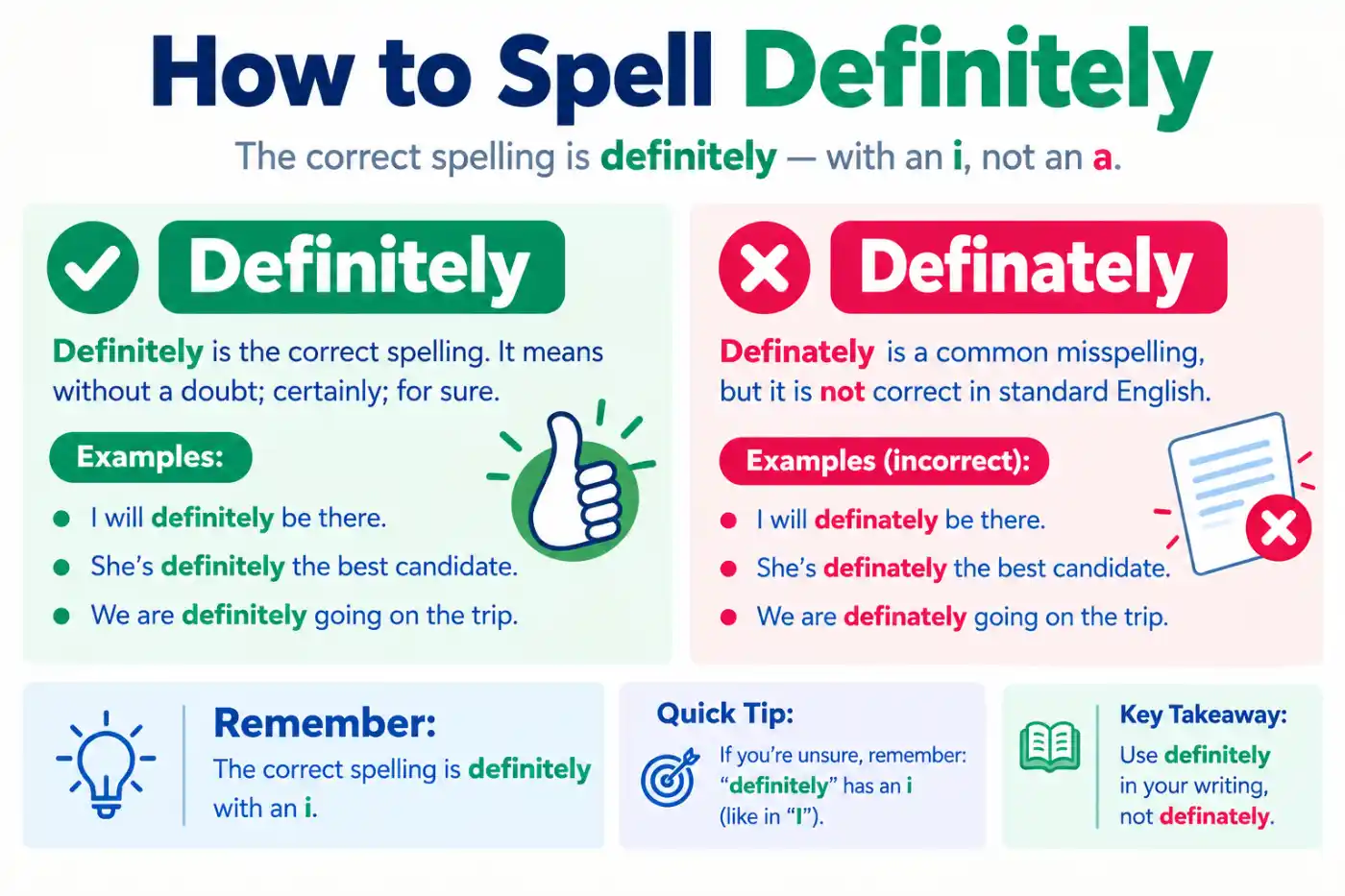
If you’re writing an email, essay, text, or social media post and wonder whether definately is the correct spelling, the answer is no. The correct spelling is definitely, while definately is a common misspelling that should be avoided in standard American English.
Definitely means “without doubt” or “certainly” and is commonly used to emphasize that something is true or certain. Although the word appears frequently in everyday writing, its spelling can be tricky because the pronunciation does not always make the correct vowel pattern obvious.
In this guide, you’ll learn how to spell definitely correctly, understand its meaning and pronunciation, and avoid the common mistake of writing definately. You’ll also find simple examples and an easy way to remember the correct spelling..
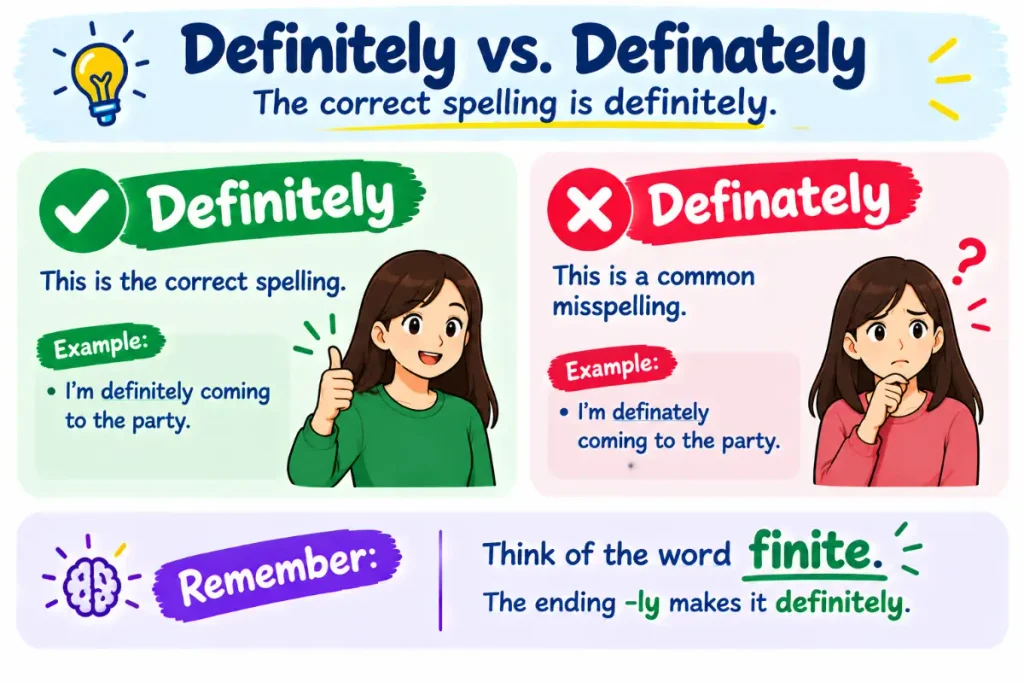
How Do You Spell “Definitely” Correctly?
The correct spelling is:
Definitely ✅
The common misspelling is:
Definately ❌
A useful way to remember the spelling is to focus on the word finite:
de + finite + ly = definitely
The spelling contains -finite-, not -finate-.
| Spelling | Correct? | Example |
|---|---|---|
| Definitely | ✅ Yes | I will definitely call you tomorrow. |
| Definately | ❌ No | I will definately call you tomorrow. |
| Definitly | ❌ No | She definitly wants to come. |
| Definatly | ❌ No | He is definatly coming. |
What Does “Definitely” Mean?
Definitely is an adverb that means certainly, without doubt, or clearly. It is used when you want to show that something is certain or that you strongly agree with something.
For example:
- I will definitely attend the meeting.
- She is definitely the right person for the job.
- We should definitely try that restaurant.
- “Are you coming with us?” “Definitely!”
The word can express certainty, confidence, or strong agreement.
Why Is “Definitely” So Often Misspelled?
The spelling of definitely can be tricky because its pronunciation does not make every letter obvious. Many people write definately because they associate the word with definite and unconsciously change the ending to -ately.
The key difference is:
- definite → definitely
- definately → incorrect
Another reason for the confusion is that the unstressed vowel sounds in spoken English can be difficult to connect with the written spelling.
The Easy Rule
Remember:
Definitely has “finite” inside it.
Think of:
de + finite + ly
Once you remember finite, the correct spelling becomes much easier.
Definitely vs Definately: Which Is Correct?
Definitely
It can be used in formal and informal writing.
Examples:
- I will definitely finish the report today.
- That was definitely the best part of the trip.
- She definitely knows the answer.
- We are definitely going to need more time.
Definately
Definately is a misspelling of definitely.
It should not be used in standard writing, including school assignments, resumes, business emails, or professional documents.
Incorrect:
I will definately be there.
Correct:
I will definitely be there.
How to Remember the Spelling of Definitely
Several memory tricks can help you avoid this mistake.
1. Remember “finite”
The simplest trick is:
DEFINITE → DEFINITELY
The word finite is contained in definitely:
de + finite + ly
If you remember finite, you’re much less likely to write definately.
2. Break It Into Parts
Try spelling it in three parts:
definite + ly
Then:
definite → definitely
This makes the spelling easier to visualize.
3. Watch the “i”
The common error changes the i in -finite- to an a:
- definitely ✅
- definately ❌
Whenever you’re unsure, look for -inite- in the middle.
4. Connect It to “definite”
If you already know how to spell definite, you can use it as a spelling anchor:
definite + ly = definitely
This is often more reliable than trying to remember the entire word at once.
Definitely: Meaning and Part of Speech
Definitely is an adverb. It modifies a verb, adjective, or an entire statement by expressing certainty. Compare these related forms:
| Word | Part of Speech | Meaning | Example |
|---|---|---|---|
| Definite | Adjective | Certain or clear | We need a definite answer. |
| Definitely | Adverb | Certainly; without doubt | I will definitely go. |
| Definition | Noun | The meaning of a word or idea | Check the definition. |
| Define | Verb | To explain the meaning | Please define the term. |
These words are related, but they do not serve the same grammatical purpose.
10+ Examples of “Definitely” in Real Sentences
Here are natural examples showing how definitely works in different situations.
- I will definitely call you after work.
- She definitely deserves another chance.
- We should definitely leave before traffic gets heavy.
- That is definitely something worth considering.
- He will definitely be excited about the news.
- I’m definitely interested in the position.
- This is definitely the address you gave me.
- They definitely need more information before making a decision.
- “Would you recommend the movie?” “Definitely.”
- I’ll definitely remember to send the email.
- The new schedule is definitely easier to follow.
- You should definitely check the instructions before starting.
Notice that definitely can appear in different positions in a sentence. Its position depends on what the writer wants to emphasize.
How to Use “Definitely” in Different Situations
In a Professional Email
Definitely is perfectly acceptable in most professional emails. I can definitely provide the updated document by Friday. However, if you need an especially formal tone, alternatives such as certainly or without a doubt may sometimes work better.
In an Essay
You can use definitely in an essay, but academic writing often benefits from precise language rather than overly strong statements.
For example:
The evidence definitely supports this conclusion.
Depending on the context, a more measured statement might be:
The evidence strongly supports this conclusion.
The best choice depends on how certain the evidence actually is.
In a Resume
You generally wouldn’t use definitely as a standalone claim on a resume.
Instead of:
I am definitely a hardworking employee.
Use specific evidence:
Managed multiple customer accounts while meeting weekly deadlines.
Specific accomplishments are usually stronger than simply describing yourself as “definitely” capable.
In Text Messages
Definitely is very common in casual texting.
For example:
“Are you coming tonight?”
“Definitely!”
It can also emphasize agreement:
“We should get pizza.”
“Definitely!”
In Everyday Conversation
People often use definitely to show certainty or strong agreement.
“Do you think she’ll come?”
“Definitely.”
In speech, it can also stand alone as a complete response.
Definitely vs Certainly
Definitely and certainly are close in meaning, but they can have slightly different tones.
| Word | Meaning | Typical Tone | Example |
|---|---|---|---|
| Definitely | Certainly; without doubt | Natural, confident | I definitely want to go. |
| Certainly | Without doubt; surely | Slightly more formal | I will certainly consider it. |
In everyday American English, definitely is extremely natural. Certainly can sound somewhat more formal depending on the sentence.
Definitely vs Surely
Surely can also express certainty, but it sometimes carries a different feeling.
- Definitely = strong confidence
- Surely = confidence that can sometimes include surprise, expectation, or a rhetorical tone
Compare:
She will definitely arrive by noon.
This directly expresses confidence.
Surely she will arrive by noon.
This can sound more like an expectation or appeal to common sense.
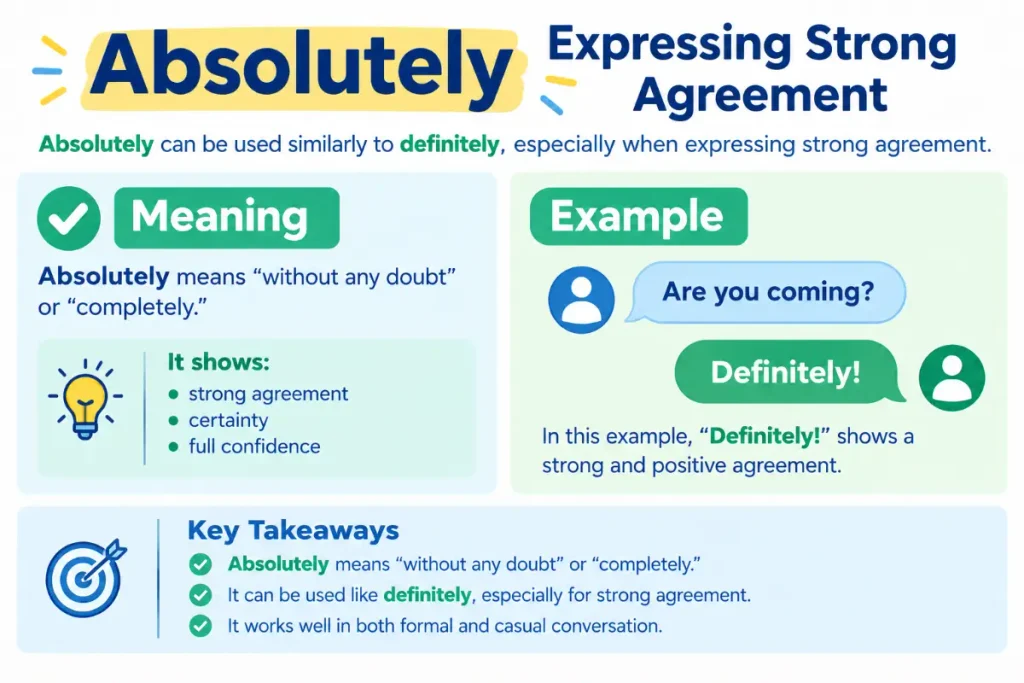
Definitely vs Absolutely
Absolutely can be used similarly to definitely, especially when expressing strong agreement.
“Are you coming?
“Definitely!”
“Are you coming?”
“Absolutely!”
Both are natural, but absolutely can sound more emphatic.
| Word | Main Use | Example |
|---|---|---|
| Definitely | Certainty | I definitely agree. |
| Absolutely | Strong agreement or certainty | I absolutely agree. |
| Certainly | Certainty, often more formal | I certainly agree. |
| Surely | Expected or assumed certainty | Surely you remember. |
Is “Definately” Ever Correct?
No. Definately is not the standard spelling of the English word definitely. If you see definately in an email, essay, article, or other standard writing, it is generally a spelling error.
The correction is:
definately → definitely
Common Misspellings of Definitely
Besides definately, several other forms appear because writers may spell the word according to how they hear it.
Common incorrect forms include:
- definately ❌
- definitly ❌
- definatly ❌
- definatelly ❌
- definetly ❌
- definitley ❌
The standard form is:
definitely ✅
The safest strategy is not to memorize every incorrect version. Just remember the correct structure:
definite + ly → definitely
How Do You Pronounce “Definitely”?
In American English, definitely is commonly pronounced approximately like:
DEF-uh-nit-lee
The exact pronunciation can vary slightly depending on the speaker and sentence. The important point is that pronunciation does not always make the spelling obvious. This is why relying entirely on sound can lead to definately. If you’re learning the spelling, focus on the written form:
definitely
rather than trying to spell it purely from pronunciation.
Where Did “Definitely” Come From?
Definitely comes from definite, which traces back through French to Latin definitus, meaning something determined, bounded, or clearly defined. The related English word define comes from the same broader Latin family. That connection helps explain why these words share the spelling pattern defin- and why definitely contains the sequence -finite-. You don’t need to know the full history to spell the word correctly, but understanding the relationship between definite and definitely can make the spelling easier to remember.
Definitely in American vs. British English
There is no major US-versus-UK spelling difference for definitely.
The standard spelling is:
- American English: definitely
- British English: definitely
- Canadian English: definitely
- Australian English: definitely
So if you’re writing for a US audience, definitely is the correct form. The misspelling definately is not a legitimate British alternative.
Common Mistakes to Avoid
Mistake 1: Writing “Definately”
Incorrect:
She will definately attend.
Correct:
She will definitely attend.
Mistake 2: Replacing “i” With “a”
The most common spelling error is writing -nate- instead of -nite-.
Remember:
defin-ite-ly ✅
not:
defin-ate-ly ❌
Mistake 3: Dropping the “i”
Some people write:
definitly
The word needs the i before the final t:
definitely
Mistake 4: Adding Extra Letters
Avoid forms such as:
definatelly
The standard spelling is simply:
definitely
Mistake 5: Assuming Every Strong Statement Needs “Definitely”
Although definitely is useful for expressing certainty, don’t use it when the evidence is uncertain.
For example:
The meeting will definitely start at 9:00.
This makes a strong claim.
If the time has not been confirmed, a better sentence might be:
The meeting is expected to start at 9:00.
Good writing matches the strength of the language to the certainty of the information.
What Are Some Alternatives to “Definitely”?
Depending on the sentence, you can replace definitely with several other expressions.
| Alternative | Tone | Example |
|---|---|---|
| Certainly | Formal/neutral | I will certainly consider it. |
| Absolutely | Strong | I absolutely agree. |
| Surely | Neutral | Surely they know the answer. |
| Clearly | Confident | She clearly understands the issue. |
| Undoubtedly | Formal | He is undoubtedly talented. |
| Unquestionably | Formal | It was unquestionably important. |
| Without doubt | Formal/neutral | She is, without doubt, qualified. |
| For sure | Casual | I’ll be there for sure. |
| Of course | Neutral/casual | Of course I’ll help. |
| Indeed | Formal | Indeed, the results were significant. |
These aren’t always interchangeable. The best choice depends on the meaning and tone of the sentence.
Quick Comparison: Definite, Definitely, and Definition
These related words are easy to confuse, but their functions are different.
Definite
Definite is an adjective meaning clear, certain, or specific.
We need a definite answer.
Definitely
Definitely is an adverb meaning certainly or without doubt.
We will definitely need an answer.
Definition
Definition is a noun referring to the meaning or explanation of a word or concept.
I looked up the definition of the word.
A quick way to remember them:
definite = describes something
definitely = describes how certain something is
definition = explains what something means
A Simple Memory Trick for “Definitely”
If you’re still wondering how to spell definately, use this sentence:
Definitely has “finite” in it.
Write the word in pieces:
DE + FINITE + LY
Then put it together:
DEFINITELY
This is more reliable than trying to remember the spelling by pronunciation alone.
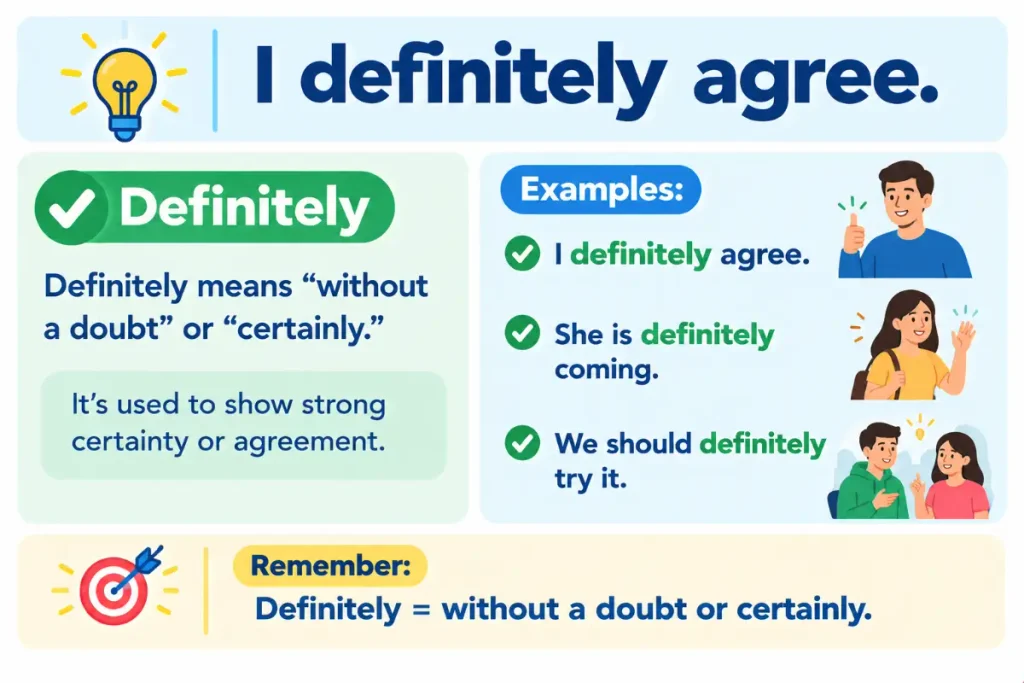
Quick Rule: Definitely or Definately?
Use this rule whenever you’re unsure: If you mean “certainly,” spell it definitely.
Examples:
- I definitely agree.
- She is definitely coming.
- We should definitely try it.
Never use definately in standard English writing.
Conclusion
If you’re asking how to spell definately, the answer is simple: the correct spelling is definitely. The form definately is a common misspelling and should be avoided in standard English.
The easiest way to remember the correct spelling is to look for finite inside the word: de + finite + ly = definitely. The word is an adverb meaning certainly, without doubt, or with strong confidence.
Whether you’re writing a school assignment, professional email, resume, text message, or everyday sentence, definitely is the standard spelling in American English. When in doubt, remember: definitely has “finite” in it.
Frequently Asked Questions
How do you spell definately correctly?
The correct spelling is definitely. Definately is a common misspelling and should be changed to definitely in standard writing.
Is “definately” a word?
No. Definately is not the standard spelling of an English word. The correct word is definitely, meaning certainly or without doubt.
How do you spell “definitely”?
It is spelled D-E-F-I-N-I-T-E-L-Y: definitely. A useful memory trick is to remember the word finite inside it.
Which is correct, definitely or definately?
Definitely is correct, while definately is incorrect. The correct spelling contains -finite-, not -finate-.
What does definitely mean?
Definitely means certainly, without doubt, or in a way that expresses strong confidence. For example, “I will definitely be there.”
Is definitely formal or informal?
Definitely works in both formal and informal English. It’s natural in professional emails, everyday conversation, texts, and many types of general writing.
What’s an easy way to remember definitely?
Remember “finite” is inside definitely: de + finite + ly = definitely. This helps prevent the common definately spelling mistake.
1 thought on “How to Spell Definately: Correct Spelling Explained”