

If you’re writing an email, school assignment, resume, or text and wonder whether “writen or written” is correct, the answer is simple: written is the correct spelling. “Writen” is a common spelling mistake.
Written is the past participle of the verb write. You can rewrite it in active voice as:
Writers use “written” with forms of “have” and “be,” and they also use it as an adjective in some contexts. For example, “I have written the report,” or “Someone wrote the instructions clearly.”
This article explains why written is correct, why “writen” is incorrect, how to use the word naturally, and how it differs from related forms such as write, wrote, and writing.
Is “Writen” or “Written” Correct?
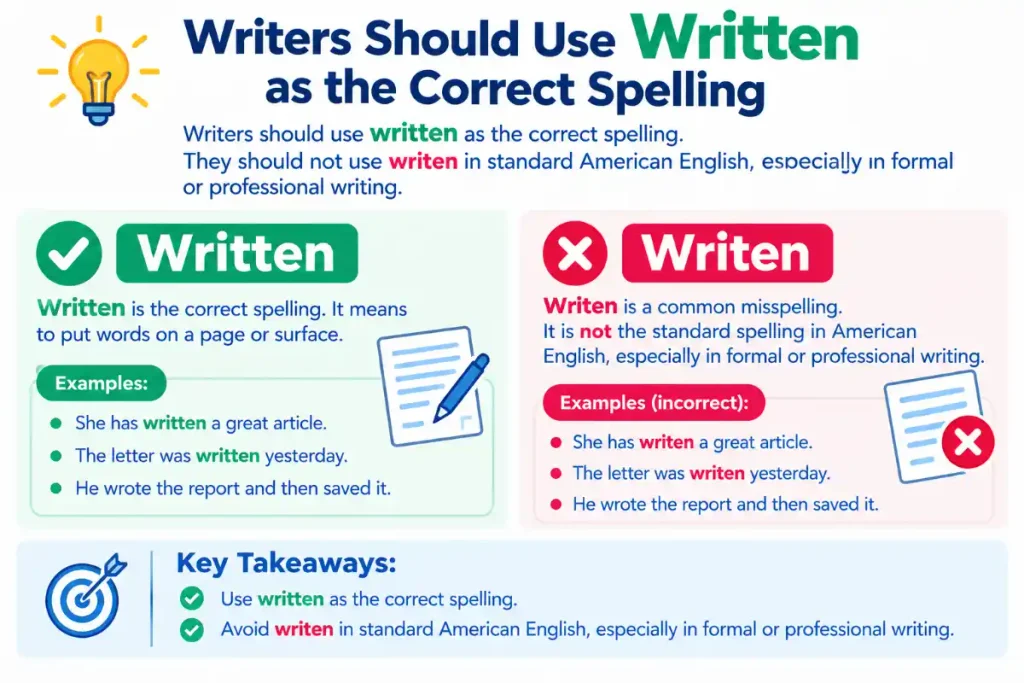
Writers should use written as the correct spelling. They should not use writen in standard American English, especially in formal or professional writing.
The word comes from the verb write, whose main forms are:
| Verb Form | Word | Example |
|---|---|---|
| Base form | write | I write every day. |
| Simple past | wrote | I wrote an email yesterday. |
| Past participle | written | I have written an email. |
| Present participle | writing | I am writing an email. |
| Third-person singular | writes | She writes clearly. |
The key point is that written has two t’s.
Correct
- written
- I have written a letter.
- The book was written by a famous author.
- She has written three pages.
Incorrect
- writen
- I have writen a letter.
- The book was writen by a famous author.
- She has writen three pages.
What Does “Written” Mean?
Written means that something has been put into words using writing. It can refer to something that someone has already composed, recorded, or expressed in written form.
For example:
- I have written a note for you.
- The instructions are written in English.
- She has written several articles.
- The agreement was written clearly.
As the past participle of write, written commonly appears after have, has, or had.
It can also appear in passive constructions with forms of be:
- The letter was written yesterday.
- The report is written in plain English.
- The rules were written by the committee.
How Do You Spell “Written”?
The correct spelling is:
W-R-I-T-T-E-N
The important feature is the double T in the middle:
written
A useful way to remember it is to connect it with the spelling pattern of write → written. Although the pronunciation changes, the word retains the letters w-r-i-t-t before the final -en.
Why Is “Writen” a Common Mistake?
The spelling writen is understandable because English pronunciation does not always make spelling obvious. When people say written, the two t’s aren’t strongly emphasized as separate sounds. This can make it tempting to spell the word with only one t. Another reason is that English contains many irregular verbs. The forms of write do not follow a simple pattern:
- write
- wrote
- written
Learners may also confuse written with other words ending in -en, such as given, driven, and taken.
However, the standard spelling is always written, with two t’s.
Written or Writen: What’s the Difference?
There is no standard spelling difference in meaning between these two forms because writen is not the standard English spelling.
| Spelling | Correct? | Meaning |
|---|---|---|
| written | Yes | Past participle of write |
| writen | No | Common misspelling of written |
If you’re writing for school, work, a resume, an application, or any other formal setting, use written.
Example
Correct:
I have written the email.
Incorrect:
I have writen the email.
How to Use “Written” Correctly
The most common use of written is as the past participle of write. It usually works with an auxiliary verb such as have, has, or had.
With “Have”
- I have written my essay.
- We have written to the company.
- They have written several reports.
With “Had”
- I had written the letter before lunch.
- She had written the report before the meeting.
- They had written everything down.
In the Passive Voice
Written can also be used in passive sentences.
- The book was written in 2024.
- The letter was written by Sarah.
- The instructions were written for beginners.
- The report has been written and reviewed.
10+ Examples of “Written” in Real Sentences
Seeing the word in different situations makes its usage easier to understand.
- I have written the information in my notebook.
- She has written a thoughtful message to her teacher.
- The report was written in clear and simple language.
- He had written the address on a piece of paper.
- We have written down all the important details.
- The instructions are written on the package.
- I haven’t written my response yet.
- The article was written for a general American audience.
- She has written several pages of her school assignment.
- The rules are written clearly on the website.
- He has written an email to his manager.
- The note was written in blue ink.
Notice that written often appears after has, have, had, was, were, or been.
Written or Write or Wrote or Writing
One of the most useful ways to understand written is to compare it with the other forms of write.
| Word | Form | Example |
|---|---|---|
| write | Base form | I need to write a letter. |
| writes | Present, third person | She writes every morning. |
| wrote | Simple past | She wrote a letter yesterday. |
| written | Past participle | She has written a letter. |
| writing | Present participle/gerund | She is writing a letter. |
Write
Use write for the base form of the verb.
- I need to write an email.
- Please write your name here.
- They want to write a book.
Wrote
Use wrote for a completed action in the simple past.
- I wrote the email yesterday.
- She wrote a letter last week.
- He wrote the report on Monday.
Written
Use written as the past participle.
- I have written the email.
- She has written a letter.
- He had written the report already.
Writing
Use writing for an action that is happening or as a noun.
- I am writing an email.
- She is writing a report.
- Writing takes practice.
Written or Wrote: When Should You Use Each?
Wrote and written are both forms of write, but they don’t work in exactly the same grammatical structures.
Use wrote as the simple past:
I wrote the letter yesterday.
Use written with an auxiliary verb such as have, has, or had:
I have written the letter.
A common mistake is using wrote after have or has.
Incorrect
I have wrote the letter.
Correct
I have written the letter.
Similarly:
Incorrect
She has wrote an email.
Correct
She has written an email.
Written or Writing: What’s the Difference?
Written and writing describe different grammatical forms.
I have written the report.
Writing is the present participle or gerund:
I am writing the report.
Compare these sentences:
- She has written three pages.
- She is writing three pages.
- The report was written yesterday.
- She is writing the report now.
The first form focuses on a completed action or result, while writing generally refers to the activity or an action in progress.
Written or Read: An Interesting Spelling Pattern
English has several verbs that can confuse learners because of their spelling and pronunciation. Written is one of them. The pronunciation of written does not simply add -en to the pronunciation of write. People pronounce written approximately like “rit-en,” while write sounds like “right.” This difference between spelling and pronunciation can make the word difficult for learners. Even though the first part sounds different, writers still spell the word written.
written
Is “Writen” Ever Correct?
No. Writen is not the standard spelling of the English word. If you see writen in an email, text, document, or online post, it is normally a spelling error for written. For standard American English, always choose written.
This applies to:
- School assignments
- Resumes
- Cover letters
- Professional emails
- Business reports
- Applications
- Websites
- Academic writing
- Social media posts
Common Mistakes With “Written”
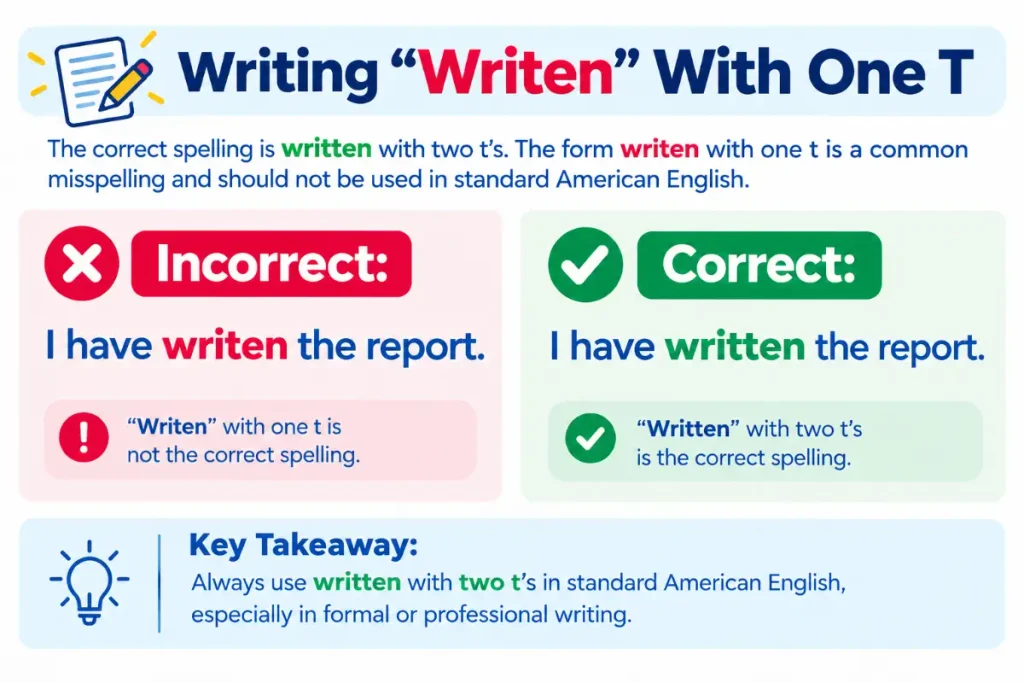
1. Writing “Writen” With One T
Incorrect:
I have writen the report.
Correct:
I have written the report.
Remember that written contains two t’s.
2. Using “Wrote” After “Have”
Incorrect:
I have wrote a letter.
Correct:
I have written a letter.
After have, has, or had, use the past participle written.
3. Using “Written” for Every Past Sentence
Not every past-tense sentence needs written.
For example:
Correct:
I wrote the letter yesterday.
But:
Correct:
I have written the letter.
4. Confusing “Write” and “Written”
Incorrect:
I have write the report.
Correct:
I have written the report.
After have or has, use written, not write.
How to Remember the Correct Spelling
A simple memory trick is:
write → written
Think of the double t as staying in the middle:
WRI + TT + EN
You can also remember the three main forms together:
write → wrote → written
If you remember this sequence, it’s much easier to avoid writen. Another useful trick is to associate written with other past participles that contain a similar -tt- pattern, such as forgotten and bitten. The spelling pattern isn’t identical in every verb, but it can help reinforce the double consonant.
A natural active-voice version is:
Written is neutral and works in both formal and casual English.
You can use it in:
- Everyday conversation
- Text messages
- School writing
- Professional emails
- Business documents
- Academic writing
- Resumes
- Formal reports
For example:
Casual:
I’ve written it down for you.
Professional:
I have written the requested information below.
Academic:
The word itself isn’t especially formal. The surrounding language determines the overall tone.
How to Use “Written” in Professional Writing
Written is very common in workplace communication.
For example:
- I have written a summary of the meeting.
- The author wrote the proposal for the management team.
- Please review the instructions that we wrote.
- Both parties must write and sign the agreement.
- I have written the details below for your review.
On a resume, you might see phrases such as:
- Written reports for senior management.
- Written and edited customer communications.
- Written training materials for new employees.
In these examples, written is grammatically correct and natural.
Written in Academic Writing
Students frequently use written in essays, research papers, and assignments.
Examples include:
- The author wrote the essay to explain the issue.
- Several researchers have written about the topic.
- Students should write the response in complete sentences.
- The researcher wrote the paper using a formal academic style.
One point to watch for is subject-verb agreement and the correct auxiliary verb.
For example
Correct:
Incorrect:
The correct form depends on whether the subject is singular or plural.
Written in Everyday Conversation
Although written can sound more formal than write in some contexts, it is completely normal in everyday English.
You might hear:
- I’ve written it down.
- Have you written your name?
- She already written it?
The last example, however, is incomplete in standard English. It should be:
Has she already written it?
“Written” in Passive Sentences
The passive voice is another common place where written appears.
The basic structure is:
- An American author wrote the book.
- Someone wrote the instructions in English.
- Someone wrote the report clearly.
- Someone wrote the letter yesterday.
- Someone wrote the rules for new employees.
In active voice, the sentence focuses on who performed the writing rather than the thing thatwas written.
Is “Written” an Adjective?
Yes, written can function as an adjective in some sentences.
For example:
Please follow the written instructions.
Here, written describes the instructions.
Another example:
We need written permission.
In this sentence, written describes the type of permission required.
Written or Verbal
Written and verbal are often used to distinguish communication methods.
- Written communication uses text.
- Verbal communication uses spoken words.
Examples:
Please send me a written confirmation.
The manager gave us a verbal explanation.
The distinction is useful in workplaces, schools, contracts, and everyday communication.
Written or Oral
In academic and professional contexts, written is also commonly contrasted with oral.
| Term | Meaning | Example |
|---|---|---|
| Written | Communicated through writing | a written report |
| Oral | Communicated through speech | an oral presentation |
For example:
The students completed a written assignment and an oral presentation.
These words describe different forms of communication rather than different levels of quality.
Is “Written” Different in American and British English?
No. Written is spelled the same in American and British English.
Both varieties use:
written
For example:
American English:
She has written a letter.
British English:
She has written a letter.
There is no American-versus-British spelling difference for this word. Some other English words have different regional spellings, such as color/colour and center/centre, but written is not one of them.
Quick Comparison: Write, Wrote, Written, and Writing
| Word | Main Use | Example |
|---|---|---|
| write | Base verb | I will write a letter. |
| writes | Present tense, he/she/it | She writes every day. |
| wrote | Simple past | She wrote yesterday. |
| written | Past participle | She has written a letter. |
| writing | Ongoing action/gerund | She is writing now. |
A quick rule is:
- write → present/base form
- wrote → simple past
- written → past participle
- writing → ongoing action or gerund
Quick Tips for Choosing “Written”
Keep these rules in mind:
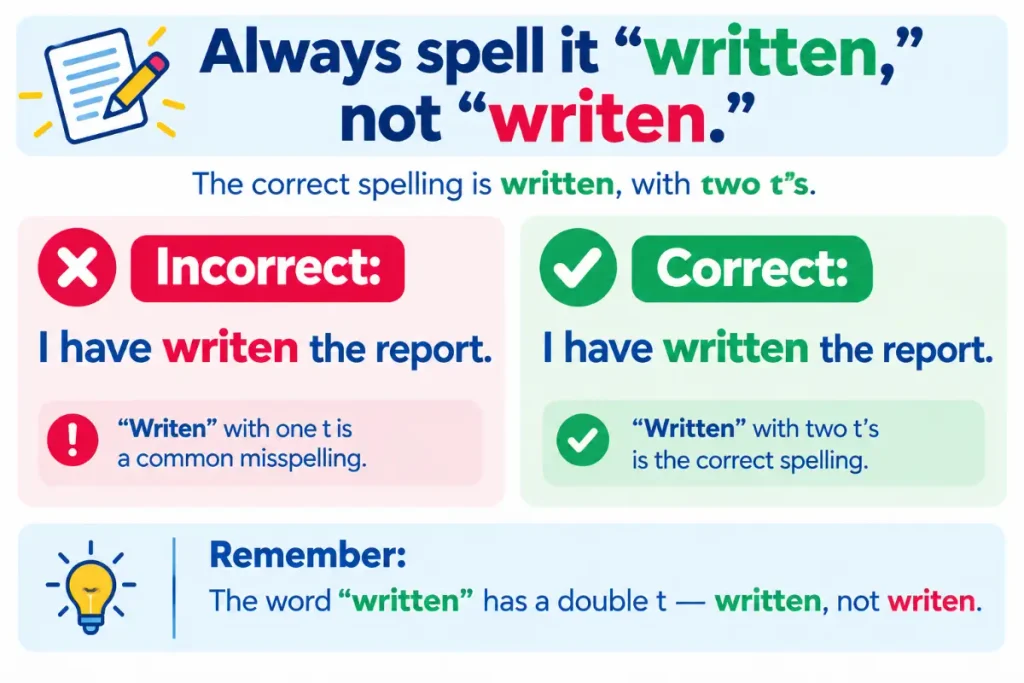
- Always spell it “written,” not “writen.”
- Remember the double t.
- Use written after have, has, and had.
- Use wrote for simple past without an auxiliary such as have.
- Use writing for an action in progress.
- Use the word freely in casual, professional, and academic contexts.
Conclusion
If you’re deciding between writen or written, always choose written. It is the standard spelling of the past participle of write, and it works in American and British English alike.
Remember the basic verb forms: write, wrote, written, writing. Use wrote for the simple past, such as “I wrote a letter yesterday,” and use written after auxiliary verbs such as have, has, and had, as in “I have written a letter.”
The easiest way to avoid the common spelling mistake is to remember the two t’s in written. Whether you’re writing a school assignment, professional email, resume, or everyday message, written is the correct choice.
Frequently Asked Questions
Is “writen” or “written” correct?
Written is correct. Writen is a misspelling and should be corrected to written.
How do you spell “written”?
The correct spelling is W-R-I-T-T-E-N, with two t’s.
Is “writen” a word?
No. Writen is not the standard English spelling. The correct word is written.
Should I say “I have written” or “I have wrote”?
The correct form is “I have written.” After have, use the past participle written, not the simple past wrote.
What is the difference between “wrote” and “written”?
Wrote is the simple past form, while written is the past participle. For example, “I wrote the letter yesterday” but “I have written the letter.”
Is “written” American or British English?
Written is used in both American and British English, with the same spelling and meaning.
Why does “written” have two t’s?
The standard spelling of the past participle of write is written. The double t is part of the established spelling of this irregular verb and must be retained.
2 thoughts on “Writen or Written: Which Spelling Is Correct?”