

If you’re writing an email, completing a school assignment, or talking about your favorite hobby, you might wonder whether passtime or pastime is the correct spelling. Both forms look similar, but only one is the standard English word for an activity you enjoy during your free time.
Pastime is the correct spelling. It refers to an activity that someone enjoys for relaxation, entertainment, or personal interest. Passtime is a common misspelling and should be avoided in standard American English.
People often confuse these words because pastime sounds as though it could contain the word pass followed by time. However, the accepted spelling uses only one s between pa and time.
Understanding the difference will help you write more clearly and avoid common spelling mistakes. This guide explains the meaning of pastime, its correct usage, related words, common expressions, and practical examples you can use in everyday writing.
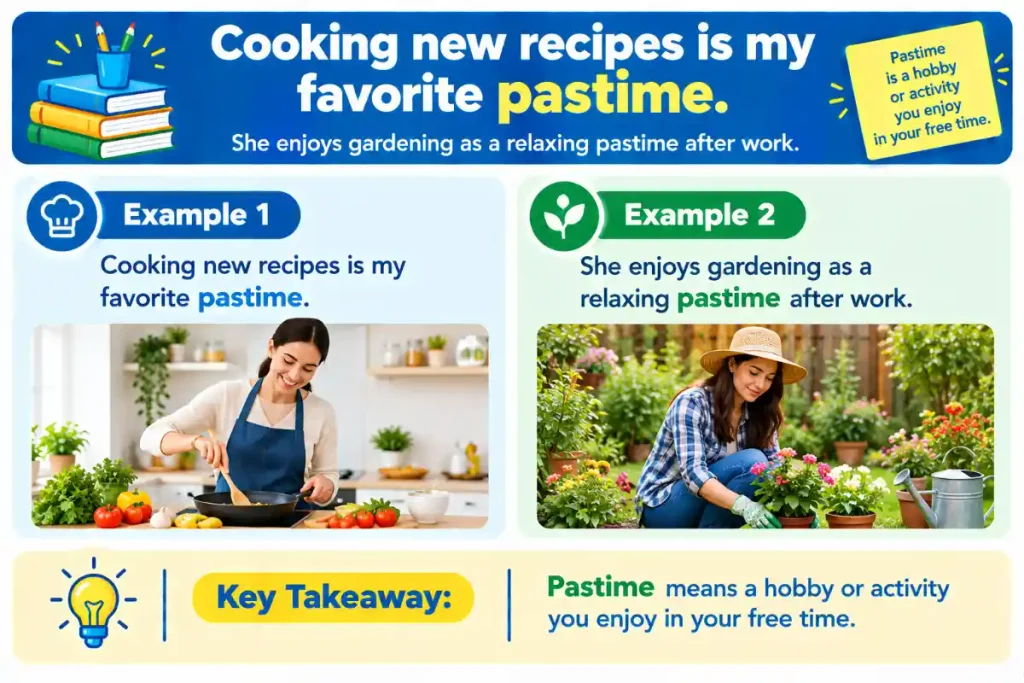
What Does Pastime Mean?
Pastime is a noun that describes an activity someone enjoys doing during their free time. People usually choose pastimes for pleasure, relaxation, entertainment, or personal satisfaction rather than because they must complete a task. Reading books, playing sports, gardening, listening to music, collecting stamps, and solving puzzles are all examples of pastimes. Some activities require special equipment or training, while others cost little or nothing. For example, someone might enjoy painting after work because it helps them relax. Another person might spend Sunday afternoons watching baseball or working on a collection of vintage records. Both activities qualify as pastimes because the people involved choose them for enjoyment.
Here are a few more examples:
- Cooking new recipes is my favorite pastime.
- She enjoys gardening as a relaxing pastime after work.
- Playing chess has become a popular pastime among students.
- My grandfather’s favorite pastime is reading historical novels.
- Photography gives him a creative pastime during his travels.
In each sentence, pastime identifies an enjoyable activity. It doesn’t necessarily mean the activity is easy, unproductive, or completely free of effort. Someone can spend years improving a skill while still treating it as a pastime.
Is Pastime a Noun?
Yes. Pastime is a countable noun, which means you can use it in singular and plural forms. Use the singular form when describing one activity:
- Reading is a wonderful pastime.
- Basketball is his favorite pastime.
- Gardening provides a peaceful pastime.
Use the plural form when referring to several activities:
- Reading and hiking are my favorite pastimes.
- Our weekend pastimes include cooking and cycling.
- The book explores traditional pastimes from different cultures.
The correct plural is pastimes, not passtimes.
You can also use pastime with adjectives to describe the kind of activity someone enjoys. Common combinations include favorite pastime, popular pastime, traditional pastime, relaxing pastime, and creative pastime. For example, “Birdwatching is a relaxing pastime” describes both the activity and the enjoyment associated with it.
Passtime or Pastime: Which Spelling Is Correct?
The correct spelling is pastime. The form passtime is a misspelling when you intend to describe a hobby or leisure activity. Although the incorrect version may appear in casual writing, standard American English uses pastime. You should use this spelling in essays, workplace documents, personal messages, and published writing.
| Word or phrase | Correct usage? | Meaning | Example |
|---|---|---|---|
| Pastime | Correct | An enjoyable leisure activity | Reading is my favorite pastime. |
| Passtime | Incorrect for this meaning | Common misspelling of pastime | Reading is my favorite passtime. |
| Pastimes | Correct | More than one leisure activity | My pastimes include hiking and painting. |
| Passtimes | Incorrect for this meaning | Misspelled plural form | My passtimes include hiking and painting. |
| Pass time | Correct in the right context | Spend time doing something | We played cards to pass time. |
| Past time | Correct in certain contexts | Separate words with their own grammatical roles | It is past time to leave. |
The last two expressions are important because they show that similar-looking words can have different meanings. Pass time is a verb phrase that describes spending time while waiting or doing something else. Past time can describe a time that has gone by or appear in expressions such as “It is past time to act.” Neither expression replaces pastime when you want to name an enjoyable activity.
Why Is Passtime Incorrect?
The spelling passtime likely comes from confusion about the word’s sound and its connection to the phrase pass the time. Writers may assume that the noun should contain the same spelling as the verb pass. However, English spelling doesn’t always follow the pattern that a writer might expect. The established noun is pastime, and adding another s makes it incorrect.
Compare these sentences:
Incorrect: My favorite passtime is playing soccer.
Correct: My favorite pastime is playing soccer.
Incorrect: Reading is one of her favorite passtimes.
Correct: Reading is one of her favorite pastimes.
The meaning remains clear in the incorrect examples, but the spelling needs correction. Using the standard form helps your writing look polished and professional.
Why Do People Confuse Passtime and Pastime?
Several factors explain why writers make this mistake. Understanding them can make the correct spelling easier to remember.
1. The Word Resembles Pass Time
The phrase pass time describes an action. For example, you might play a game to pass time while waiting for a friend. Because pastime has a related meaning, writers may assume that the noun should be spelled passtime. However, the noun has its own established spelling.
Remember the difference:
- Pastime: An activity you enjoy.
- Pass time: An action that occupies time.
For example, “Playing cards is a favorite pastime” names an activity. “We played cards to pass time” explains why someone played.
2. Pronunciation Doesn’t Always Reveal Spelling
English words sometimes sound similar even when their spellings differ. A person who learns vocabulary mainly through conversation may know what pastime means without knowing how to spell it. This problem is common with words that have familiar-looking parts. Writers may try to build the spelling from the sound instead of remembering the complete word. The best solution is to learn pastime as a whole word and practice it in a sentence.
3. Typing Habits Can Reinforce Mistakes
People often type familiar words quickly without checking every letter. If you repeatedly write passtime, the incorrect spelling may become a habit. Spell-checking tools can help identify the error, but they shouldn’t replace basic spelling knowledge. A quick review before submitting an assignment or sending an important email can prevent avoidable mistakes.
4. The Word May Look Like Two Separate Words
Some writers type past time because they assume that every word related to passing time must contain two separate parts. However, the noun for a leisure activity is written as one word: pastime.
For example:
- Correct: Gardening is a peaceful pastime.
- Incorrect for this meaning: Gardening is a peaceful past time.
Learning the word in context helps you recognize when to use the one-word noun.
How to Use Pastime Correctly in a Sentence
The word pastime works in many everyday situations. You can use it to discuss personal interests, family activities, entertainment, sports, creative projects, and cultural traditions. The examples below show how to use the word naturally in different contexts.
Everyday Activities
Pastimes often involve ordinary activities people enjoy during their free time.
- Walking around the park is a peaceful pastime for my mother.
- Listening to jazz helps him relax after a long day at work.
- Baking cookies has become my favorite weekend pastime.
- My neighbors enjoy playing board games as a family pastime.
These examples show that a pastime doesn’t have to be unusual or expensive. Simple activities can be meaningful sources of enjoyment.
School and Education
Students may use pastime when writing about their interests, free-time habits, or favorite activities.
- Drawing cartoons is my favorite pastime after I finish my homework.
- Our teacher asked us to write a paragraph about a popular pastime.
- Playing chess provides a fun pastime that also encourages strategic thinking.
- Several students listed reading as one of their favorite pastimes.
In school assignments, make sure the word fits the sentence. If you’re describing a regular personal interest, hobby may also be appropriate.
Work and Professional Communication
The word can appear in professional writing when discussing interests outside work or describing employee activities.
- Gardening is a relaxing pastime that helps me disconnect from work.
- The employee newsletter featured a colleague whose pastime is restoring old bicycles.
- During the introduction, each team member shared a favorite pastime.
- She enjoys photography as a pastime outside her regular work schedule.
You generally don’t need to use pastime in formal workplace communication unless the subject is relevant. For example, a professional biography might mention a hobby, while a business report would usually focus on work-related activities.
Travel and Outdoor Recreation
Travelers often develop pastimes that help them explore their surroundings or enjoy time away from home.
- Birdwatching became his favorite pastime during his camping trip.
- She enjoys taking photographs as a pastime whenever she visits a new city.
- Fishing has been a popular pastime in the lakeside community for generations.
- Hiking provides an enjoyable pastime for people who like exploring nature.
These examples demonstrate that a pastime can involve physical activity, observation, or creative expression.
Technology and Entertainment
Modern pastimes can include digital activities as well as traditional ones.
- Solving online puzzles has become a regular pastime for my brother.
- My cousin enjoys editing short videos as a creative pastime.
- Playing trivia games with friends is a favorite pastime on Friday nights.
- Listening to podcasts has become a relaxing pastime during her commute.
The word describes the role the activity plays in someone’s free time, not the type of equipment or technology involved.
What Is the Difference Between Pastime and Hobby?
Pastime and hobby are close in meaning, but they can emphasize slightly different things. A pastime is an activity someone enjoys during free time. A hobby is usually an activity a person pursues regularly because of personal interest or enjoyment. For example, watching a movie on Saturday night can be a pastime. Collecting classic movies, researching directors, and building a collection may be a hobby.
| Feature | Pastime | Hobby |
|---|---|---|
| Main meaning | An enjoyable leisure activity | A personal interest pursued for pleasure |
| Regularity | Can be occasional or regular | Often practiced regularly |
| Skill development | Not required | May involve learning or improving skills |
| Common examples | Watching movies, playing games | Painting, knitting, collecting coins |
| Tone | General and descriptive | Often suggests a personal interest |
| Example | Baseball is a popular pastime. | Baseball card collecting is his hobby. |
These differences aren’t strict rules. A hobby can also be a pastime, and a pastime can become a hobby over time. For example, someone might begin gardening simply to relax. As that person learns about soil, plant care, and seasonal growing, gardening may become a more developed hobby.
When Should You Use Hobby Instead of Pastime?
Use hobby when you want to emphasize a personal interest that someone enjoys pursuing.
Examples:
- My hobby is building model airplanes.
- She has several creative hobbies, including painting and knitting.
- He turned his photography hobby into a small business.
Use pastime when you want to describe an activity mainly as a way to spend free time.
Examples:
- Watching baseball is a favorite American pastime.
- Crossword puzzles are a popular pastime among my relatives.
- Reading provides a quiet pastime on rainy afternoons.
If either word fits your sentence, choose the one that expresses your intended meaning most clearly.
Pastime vs. Recreation: What’s the Difference?
Recreation refers to activities people do for enjoyment, refreshment, or relaxation. Like pastime, it can include sports, games, and other leisure activities. The main difference is that recreation often emphasizes the activity’s role in refreshing the mind or body. It can also refer to organized programs and facilities.
| Word | Meaning | Example |
|---|---|---|
| Pastime | An activity enjoyed in free time | Reading is her favorite pastime. |
| Recreation | An activity that provides enjoyment or refreshment | The park offers space for outdoor recreation. |
Consider these examples:
- Pastime: Fishing is his favorite pastime.
- Recreation: The city provides recreational programs for local families.
The first sentence describes a personal interest. The second refers to activities offered by a community. You can use both words to discuss leisure, but pastime is often the more natural choice when naming a specific favorite activity.
Pastime vs. Leisure: How Are They Different?
Leisure usually refers to free time or activities enjoyed during that time. Pastime refers more specifically to an activity that occupies that time pleasantly.
For example, a person may have two hours of leisure after work and spend that time reading. Reading is the pastime; the available free time is leisure time.
| Word | Main focus | Example |
|---|---|---|
| Pastime | The activity | Painting is my favorite pastime. |
| Leisure | Free time or relaxation | I paint during my leisure time. |
| Leisure activity | An activity enjoyed during free time | Swimming is a popular leisure activity. |
Use leisure when discussing free time in general, particularly in formal writing or conversations about schedules and recreation. Use pastime when you want to identify the activity itself.

What Are Other Words for Pastime?
Several words have meanings similar to pastime. However, they aren’t always exact replacements. The best choice depends on whether you want to emphasize personal interest, relaxation, entertainment, or the time available for an activity.
Everyday Synonyms for Pastime
These words work well in ordinary conversation and informal writing.
| Word or phrase | Meaning | Tone | Example |
|---|---|---|---|
| Hobby | An activity pursued for enjoyment | Everyday | Painting is my favorite hobby. |
| Activity | Something a person does | Neutral | Gardening is a relaxing activity. |
| Interest | Something a person cares about or enjoys | Everyday | Music is one of her main interests. |
| Recreation | An activity for enjoyment or refreshment | Neutral | Swimming is a form of recreation. |
| Leisure activity | Something done during free time | Neutral | Hiking is a popular leisure activity. |
| Entertainment | Something that amuses or engages people | Everyday | Watching comedies is his favorite entertainment. |
| Diversion | An activity that takes the mind away from routine concerns | Neutral | A puzzle provides a welcome diversion. |
| Pursuit | An activity someone follows with interest | Neutral | Photography is a creative pursuit. |
Words That Emphasize Relaxation
Use these alternatives when the main point is unwinding or taking a break.
| Word or phrase | Meaning | Tone | Example |
|---|---|---|---|
| Relaxation | Time or activity that reduces tension | Neutral | Reading gives her time for relaxation. |
| Recreation time | Time set aside for enjoyable activities | Neutral | The camp schedules recreation time each afternoon. |
| Downtime | A period without work or demands | Casual | I listen to music during my downtime. |
| Break | A short pause from an activity | Everyday | He takes a break to walk outside. |
| Escape | An activity that offers a temporary mental break | Expressive | Reading offers an escape from daily stress. |
| Unwinding | Relaxing after work or activity | Casual | Gardening helps her unwind. |
These words describe related experiences, but not all of them name a pastime directly. For example, downtime refers to a period of free time, while unwinding describes the process of relaxing.
Words That Emphasize Enjoyment or Entertainment
These alternatives work when an activity provides amusement or pleasure.
| Word or phrase | Meaning | Tone | Example |
|---|---|---|---|
| Amusement | Something that entertains | Neutral | The game provided hours of amusement. |
| Enjoyment | The feeling of pleasure | Neutral | She gets great enjoyment from painting. |
| Pleasure | A feeling of satisfaction or happiness | Neutral | Reading is a simple pleasure for him. |
| Fun activity | Something done for enjoyment | Casual | Bowling is a fun activity for the group. |
| Game | An activity with rules or goals | Everyday | Chess is his favorite game. |
| Sport | A physical activity or competitive game | Everyday | Soccer is a popular sport in the community. |
| Creative outlet | An activity that allows creative expression | Neutral | Writing is her creative outlet. |
These words can help you write more precisely. Pleasure describes a feeling, while pastime identifies the activity that may produce that feeling.
More Formal Alternatives
Some alternatives fit academic, professional, or descriptive writing better than everyday conversation.
| Word or phrase | Meaning | Tone | Example |
|---|---|---|---|
| Leisure pursuit | An activity followed during free time | Formal | Photography is a popular leisure pursuit. |
| Recreational activity | An activity done for enjoyment or refreshment | Formal | The program includes several recreational activities. |
| Personal interest | A subject or activity someone enjoys | Professional | Her personal interests include music and design. |
| Avocation | An activity pursued outside one’s main occupation | Formal | Gardening is his favorite avocation. |
| Amusement | An activity or experience that entertains | Neutral to formal | The festival offers amusement for visitors. |
| Pursuit | An activity someone devotes time to | Formal | Scientific reading is a lifelong pursuit. |
An avocation is not always identical to a pastime. It often refers to a serious interest pursued outside someone’s main job or profession. Choose it when that distinction matters.
Can You Replace Pastime With Any of These Words?
No. Some alternatives are close synonyms, while others describe related concepts.
For example:
- Pastime and hobby: Often interchangeable when describing enjoyable activities.
- Pastime and recreation: Overlap, but recreation may refer to organized activities.
- Pastime and leisure: Different grammatical meanings; one names an activity, and the other often describes free time.
- Pastime and enjoyment: One names the activity, and the other describes the pleasure someone feels.
- Pastime and avocation: Similar when discussing personal interests, but avocation can suggest a more serious pursuit.
Avoid replacing a word simply to make your writing sound different. A clear, accurate word is better than a complicated alternative that changes the meaning.
Is Pastime Formal or Informal?
Pastime is a neutral word. You can use it in casual conversation, school assignments, articles, and professional writing when the context calls for it.
Using Pastime in Casual Conversation
The word works naturally when talking with friends and family about interests.
Examples:
- “What’s your favorite pastime?”
- “Gaming has become his favorite pastime.”
- “My favorite pastime is exploring new hiking trails.”
In everyday speech, people may prefer the simpler word hobby, but pastime is still natural.
Using Pastime in Essays and Academic Writing
Students can use pastime in essays about culture, history, leisure, sports, or personal interests.
For example:
“Baseball became an important pastime in many American communities, bringing people together through local games and professional competitions.”
In academic writing, make sure the word accurately describes the subject. If you’re discussing an organized sports program, recreation or sporting activity might be more precise.
Using Pastime in Professional Emails
You can use pastime in a professional email when discussing personal interests, team introductions, or workplace activities.
For example:
“During our team meeting, we’ll have a few minutes for everyone to share a favorite pastime.”
However, the word isn’t necessary in every professional message. If you’re asking a colleague about personal interests, hobby may sound more conversational.
Using Pastime on a Resume
A resume usually benefits from clear, direct language. If you include personal interests, list them only when they are relevant to the role or help present a useful picture of your skills.
For example:
- Relevant interests: Photography, community volunteering, and creative writing.
- In a sentence: “Outside work, my favorite pastime is photography, which has helped me develop an eye for detail.”
You generally don’t need to label every interest as a pastime. A concise list is often enough.
Is Pastime Spelled the Same in American and British English?
Yes. Pastime is the standard spelling in both American and British English. The spelling passtime is not the standard form in either variety when referring to a leisure activity.
| English variety | Standard spelling | Example |
|---|---|---|
| American English | Pastime | Reading is my favorite pastime. |
| British English | Pastime | Reading is my favorite pastime. |
| Canadian English | Pastime | Hiking is a popular pastime. |
| Australian English | Pastime | Cricket is a popular pastime. |
Other English words may have different regional spellings, but pastime does not require an American or British spelling change. If you’re writing for a US audience, use pastime and follow American English conventions throughout the rest of your writing.
What Are the Most Common Pastime-Related Expressions?
Learning common expressions can help you use pastime more naturally.
Favorite Pastime
This expression identifies the activity someone enjoys most during free time.
Examples:
- Reading is my favorite pastime.
- Her favorite pastime is baking bread.
- What is your favorite pastime during the summer?
Popular Pastime
Use popular pastime to describe an activity enjoyed by many people.
Examples:
- Watching movies is a popular pastime.
- Baseball is a popular pastime in many American communities.
- Walking in local parks is a popular pastime among residents.
Be careful with broad claims. An activity can be popular in a particular group or community without being popular everywhere.
Traditional Pastime
A traditional pastime is an activity associated with a culture, community, or earlier generation.
Examples:
- Storytelling has served as a traditional pastime in many communities.
- The museum displays toys used for traditional pastimes.
- The festival celebrates games that were once common family pastimes.
Favorite Pastimes
Use the plural expression when naming several enjoyable activities.
Examples:
- My favorite pastimes are reading, hiking, and cooking.
- The article explores the favorite pastimes of retired adults.
- Her favorite pastimes change with the seasons.
These expressions are useful in everyday conversation and descriptive writing because they help readers understand the role an activity plays in someone’s life.
What Are the Opposites of Pastime?
Pastime doesn’t have one exact antonym because it names an activity rather than a single quality. However, several words express ideas that contrast with leisure, enjoyment, or free-time activities.
| Word or phrase | Meaning | Example |
|---|---|---|
| Obligation | Something a person must do | Finishing the report was an obligation, not a pastime. |
| Chore | A routine task that needs to be completed | Cleaning the garage felt like a chore rather than a pastime. |
| Duty | A responsibility someone is expected to fulfill | Her duty took priority over her usual pastime. |
| Work | Effort performed to complete a task or earn a living | He spent the afternoon working instead of enjoying his pastime. |
| Burden | Something difficult or demanding to manage | The extra responsibility became a burden rather than an enjoyable activity. |
These words aren’t direct dictionary opposites. They contrast with the idea of an activity chosen for pleasure because they emphasize responsibility, effort, or difficulty. For example, gardening can be a pastime when someone enjoys it, but it can feel like a chore when the person must maintain a large garden under time pressure. The activity itself doesn’t determine the meaning; the context matters.
How to Avoid Pastime Spelling Mistakes
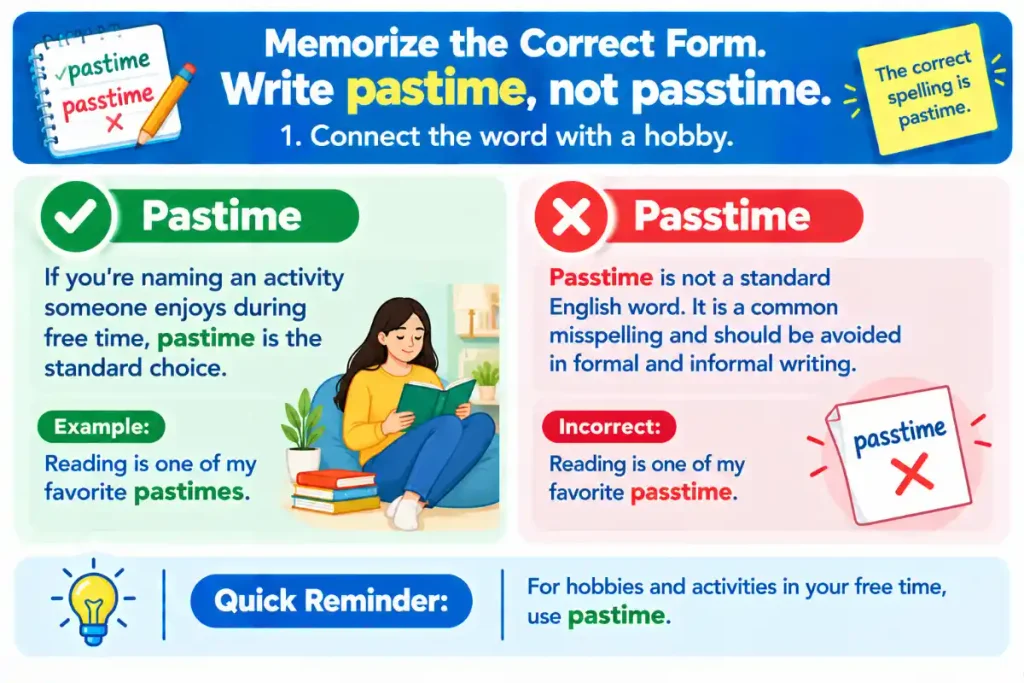
You can prevent most errors by learning the spelling, checking the meaning, and reviewing your sentence before using the word. Here are five practical steps:
- Memorize the correct form. Write pastime, not passtime.
- Connect the word with a hobby. If you’re naming an activity someone enjoys during free time, pastime is the standard choice.
- Learn the related phrase. Remember that pass time is a verb phrase, while pastime is a noun.
- Check the plural. Use pastimes for more than one activity.
- Read the sentence aloud. Confirm that the word fits the meaning, even if the pronunciation sounds similar to the incorrect spelling.
You can also practice by writing three sentences about your own interests. For example, describe a favorite activity, an activity you enjoy with friends, and something you do to relax after a busy day. The goal isn’t to memorize a long list of rules. It’s to recognize the correct word quickly and use it confidently.
Conclusion
The difference between passtime or pastime is straightforward: pastime is the correct spelling for an activity someone enjoys during free time, while passtime is a misspelling. Reading, gardening, playing sports, listening to music, and solving puzzles can all be pastimes. The word works in casual conversations, school assignments, and professional writing when you want to describe an enjoyable leisure activity.
Remember that pastime is written as one word and has the plural form pastimes. Don’t confuse it with pass time, which describes the action of spending time, or past time, which can be correct in other grammatical contexts. Learning these distinctions will help you choose the right expression and write with greater confidence. When describing a favorite leisure activity, choose pastime every time.
Frequently Asked Questions
Is passtime a correct English word?
No. Passtime is a common misspelling of pastime when referring to an enjoyable leisure activity. Use pastime in standard written English.
Which is correct, passtime or pastime?
Pastime is correct. The phrase passtime or pastime often appears in spelling searches because the two forms look similar, but only pastime is the standard noun for a hobby or leisure activity.
What does pastime mean in simple words?
A pastime is something you enjoy doing in your free time. Reading, playing games, gardening, and listening to music are common examples.
What is the plural of pastime?
The plural is pastimes. For example, “My favorite pastimes are hiking and reading.”
Is pastime the same as hobby?
The words have similar meanings, but hobby often suggests a regular personal interest, while pastime can describe any enjoyable leisure activity. Many hobbies are also pastimes.
Is past time one word or two?
Use pastime as one word when naming an enjoyable activity. The separate words past time can be correct in other sentences, such as “It is past time to leave.”
What is another word for pastime?
Hobby is one of the closest alternatives. Other choices include recreational activity, leisure pursuit, and diversion, depending on the context.
1 thought on “Passtime or Pastime: Correct Spelling and Usage Guide”