

If you’re writing a sentence about sunlight, a bright smile, or a polished surface, you might wonder whether to use shinning or shining. The two words look similar, but they have different meanings and grammatical uses. Choosing the right one helps you communicate clearly and avoid spelling mistakes.
Shining is the correct spelling when you mean giving off light, reflecting light, or doing something exceptionally well. Shinning is also a real word, but it refers to climbing by gripping a surface with your legs or pressing your shins against it.
The difference comes from the verb shine and how English forms its present participles. This guide explains the meanings of both words, their spelling rules, common mistakes, and examples that show you when to use each form.
Shinning or Shining: What’s the Difference?
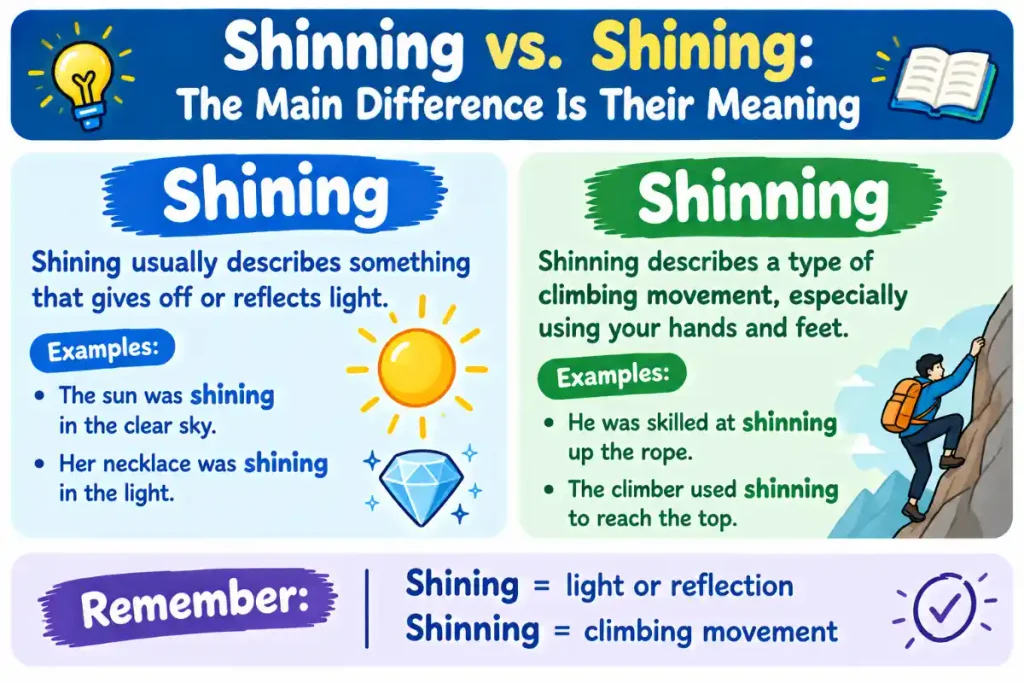
The main difference between shinning and shining is their meaning. Shining usually describes something that gives off or reflects light, while shinning describes a type of climbing movement. Although both spellings are valid, they aren’t interchangeable. The correct choice depends on the action you want to describe.
| Word | Meaning | Example |
|---|---|---|
| Shining | Giving off or reflecting light; performing very well | The stars are shining tonight. |
| Shinning | Climbing by gripping or pressing against a surface | The boy was shinning up the pole. |
In everyday American English, shining is much more common. You’ll see it in expressions such as shining sun, shining example, and shining personality. The word shinning appears less often and usually describes a specific physical action.
What Does Shining Mean?
Shining is the present participle of the verb shine. It describes something that emits light, reflects light, looks bright, or performs exceptionally well. People use shining in both literal and figurative ways. In its literal sense, it refers to visible brightness. In a figurative sense, it can describe a person’s best qualities, an impressive achievement, or an excellent performance.
Examples of shining in different contexts
- Light: The moon was shining through the bedroom window.
- Reflection: His shining shoes looked ready for the ceremony.
- Weather: The sun is shining brightly this morning.
- Achievement: She gave a shining performance in the school play.
- Character: His honesty is a shining example for others.
- Success: The young athlete has a shining future ahead.
In these examples, shining communicates brightness, excellence, or a positive quality.
Is shining a verb or an adjective?
Shining can function as a verb form or an adjective, depending on how you use it in a sentence.
| Grammatical role | Example | Explanation |
|---|---|---|
| Present participle | The sun is shining. | Describes an ongoing action. |
| Adjective | She wore a shining necklace. | Describes the necklace’s appearance. |
| Figurative adjective | He is a shining example of kindness. | Describes someone who represents a positive quality. |
The word can also appear in noun phrases, such as a shining star. Its grammatical role depends on the sentence rather than the spelling alone.
What Does Shinning Mean?
Shinning is the present participle of the verb shin, which can mean climbing a pole, tree, or similar object by gripping it or pressing the shins and legs against it. This is a less common word in everyday American English, but it is a valid spelling. It has nothing to do with producing light.
For example:
- The worker was shinning up the pole to reach the equipment.
- The child kept shinning up the tree despite his father’s warnings.
- The monkey was shinning along the narrow trunk.
- The climber practiced shinning up a smooth post.
In each sentence, shinning describes a climbing action.
Is shinning a real word?
Yes, shinning is a real English word. It comes from the verb shin, not from shine. The verb shin describes a particular way of climbing, often using the legs and shins for support. However, if you want to describe a bright light, a glowing object, or an excellent example, you should use shining.
Why Do People Confuse Shinning and Shining?
The confusion occurs because both words look almost identical. They differ by just one letter, yet they come from different verbs. English spelling rules also contribute to the confusion. Some verbs double their final consonant before adding -ing, while others drop a final silent e.
1. The verbs have different meanings
The verb shine refers to producing or reflecting light. The verb shin can refer to climbing by using the legs or shins. Because their meanings differ, their -ing forms also differ.
- Shine → shining
- Shin → shinning
2. English uses different spelling rules
When you add -ing to shine, you drop the final silent e. When you add -ing to shin, you double the final consonant. These are two separate spelling patterns. Understanding them helps you choose the right form without relying on guesswork.
3. Spell-checkers may not catch the mistake
Both shining and shinning are valid words. A spell-checker may accept either one even when you use the wrong word for your intended meaning.
For example:
- Incorrect for brightness: The stars are shinning tonight.
- Correct for brightness: The stars are shining tonight.
The first sentence contains a real English word, but it doesn’t express the intended meaning. Always check the context, not just the spelling.
Shining or Shinning: Spelling Rules Explained
The easiest way to remember the difference is to look at each word’s base form.
How to spell shining correctly
Start with the verb shine. Remove its final silent e, then add -ing.
Shine − e + ing = shining
Examples:
- The polished floor is shining.
- Her eyes were shining with excitement.
- The streetlights were shining through the fog.
- The trophy kept shining under the display lights.
You don’t double the final n because the base verb shine follows the silent-e spelling pattern.
How to spell shinning correctly
Start with the verb shin. Double the final n before adding -ing. Shin + n + ing = shinning
Examples:
- The boy was shinning up the pole.
- They watched him shinning up the tree.
- The worker was shinning along the support structure.
The doubled n belongs to the spelling of the climbing verb’s present participle.
Quick comparison of the spelling patterns
| Base verb | Spelling change | Correct form | Meaning |
|---|---|---|---|
| Shine | Drop final e and add -ing | Shining | Giving off or reflecting light |
| Shin | Double final n and add -ing | Shinning | Climbing using the legs or shins |
Remember that the spelling change follows the base verb. You shouldn’t apply the doubling rule to shine simply because shinning looks similar.
Shining or Shinning in Real Sentences
The following examples show how to use each word naturally in different situations.
Examples of shining
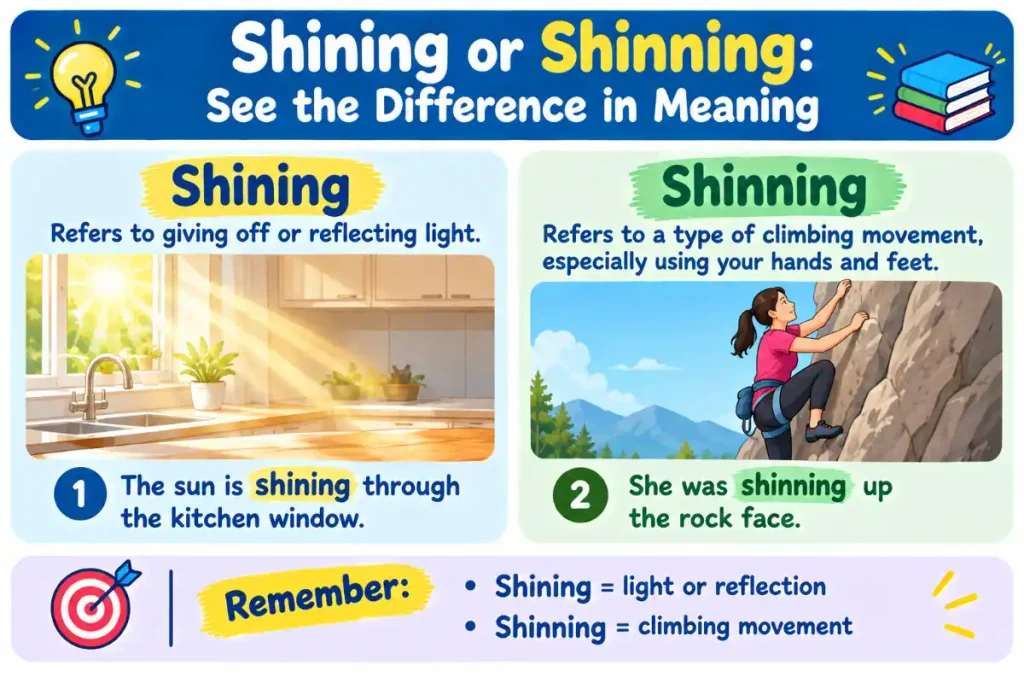
- The sun is shining through the kitchen window.
- Her new earrings were shining under the bright lights.
- The students watched the stars shining above the campsite.
- He polished the silver until it was shining again.
- The teacher praised Maya for her shining performance.
- The company’s dedication to customer service is a shining example of professionalism.
- I noticed the moon shining over the lake during my evening walk.
- The headlights were shining through the heavy rain.
- Her confidence was shining during the job interview.
- The polished trophy was shining on the winner’s desk.
- The morning sun kept shining through the clouds.
- His kindness makes him a shining example for the younger students.
Examples of shinning
- The boy was shinning up the pole during the demonstration.
- The worker was shinning up the post to reach the upper section.
- The children watched as their guide demonstrated shinning up a tree trunk.
- The climber practiced shinning up a smooth wooden pole.
These examples illustrate why context matters. Use shining for light, reflections, and excellence. Use shinning when describing the specific climbing action.
Common Mistakes When Using Shining and Shinning
Writers often make spelling mistakes when they rely on how a word looks or sounds rather than its base form. Here are the most common errors and how to correct them.
| Incorrect or confusing sentence | Correct sentence | Reason |
|---|---|---|
| The sun is shinning brightly. | The sun is shining brightly. | Shine becomes shining. |
| Her shoes were shinning in the light. | Her shoes were shining in the light. | The shoes reflected light. |
| He was shining up the pole. | He was shinning up the pole. | The sentence describes climbing. |
| The stars are shinning tonight. | The stars are shining tonight. | Stars appear bright in the night sky. |
| She gave a shinning example of leadership. | She gave a shining example of leadership. | The phrase describes an excellent example. |
| The worker was shining up the post. | The worker was shinning up the post. | The intended meaning is climbing. |
Mistake 1: Doubling the final consonant in shining
Some writers mistakenly double the n in shine before adding -ing. However, the standard spelling drops the silent e.
Incorrect: The lamp is shinning on the desk.
Correct: The lamp is shining on the desk.
Mistake 2: Using shining for a climbing action
Although shining is much more common, it doesn’t replace shinning when you specifically mean climbing by using the legs or shins.
Incorrect: The child was shining up the pole.
Correct: The child was shinning up the pole.
Mistake 3: Assuming shinning is always a misspelling
Shinning isn’t inherently incorrect. It is simply less common and has a different meaning. If the sentence describes climbing, the word may be exactly right.
Shining vs. Glowing vs. Sparkling: What’s the Difference?
Shining, glowing, and sparkling are related words, but each describes a slightly different kind of brightness.
| Word | Meaning | Example |
|---|---|---|
| Shining | Giving off or reflecting light | The sun is shining through the window. |
| Glowing | Giving off a steady, soft light | The fireplace was glowing in the dark. |
| Sparkling | Producing small, bright flashes of light | The diamonds were sparkling under the lights. |
Use shining for general brightness or reflection. Choose glowing when the light appears soft or steady, and sparkling when it appears as small flashes. These alternatives can help you make descriptions more precise, but none changes the spelling rule for shine.
Shining or Shiny: What’s the Difference?
Shining and shiny can both describe something bright, but they serve different grammatical purposes. Shiny is an adjective that usually describes a smooth, reflective, or glossy surface.
| Word | Part of speech | Example |
|---|---|---|
| Shining | Verb form or adjective | The sun is shining. |
| Shiny | Adjective | She bought a shiny new handbag. |
Compare these sentences:
- The metal is shining under the lamp.
- The metal has a shiny surface.
The first emphasizes the light or the act of reflecting it. The second describes the metal’s appearance.
Is Shining or Shinning Correct in American English?
In American English, shining is the standard spelling for the present participle of shine. American and British English use this spelling for the ordinary meanings of giving off light, reflecting light, and performing well. Shinning is also a valid word in both varieties of English when it comes from the verb shin, meaning to climb using the legs or shins. There isn’t a general American-versus-British spelling difference between these two forms. The distinction is based on meaning and the base verb, not regional spelling preferences. For everyday writing, school assignments, workplace emails, and social media posts, you’ll usually want shining when discussing brightness or success.
How to Remember the Difference Between Shinning and Shining
A simple memory trick can help you select the correct spelling every time.
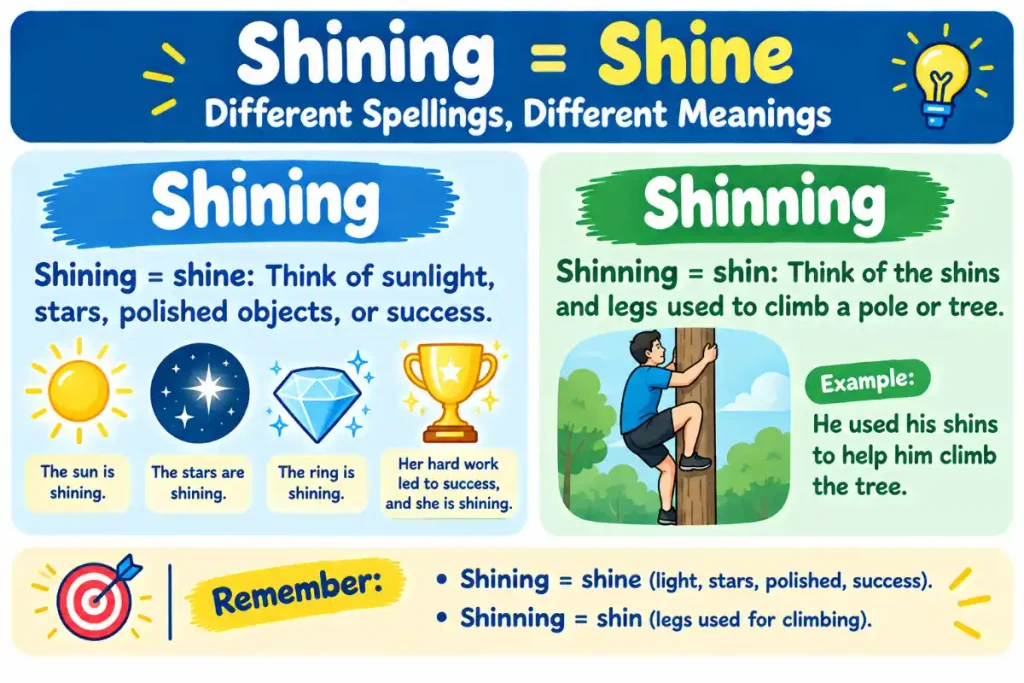
- Shining = shine: Think of sunlight, stars, polished objects, or success.
- Shinning = shin: Think of the shins and legs used to climb a pole or tree.
You can also remember the spelling patterns:
- Start with the base verb.
- If the verb is shine, drop the final e and add -ing.
- If the verb is shin, double the final n and add -ing.
- Read the complete sentence to make sure the meaning fits.
For example, if you’re describing a bright moon, write The moon is shining. If you’re describing someone climbing a pole, The person is shinning up the pole may be correct.
Conclusion
Choosing between shinning or shining becomes easy when you understand the meaning of each word. Shining is the correct choice for describing sunlight, stars, reflective surfaces, and outstanding qualities. Shinning is a valid but less common word that describes a climbing action involving the legs or shins.
Remember the base verbs to avoid confusion: shine becomes shining by dropping its final silent e, while shin becomes shinning by doubling the final n. These spelling patterns explain why the two words look similar but serve different purposes.
For most everyday writing, including schoolwork, emails, and social media posts, you’ll need shining far more often. When you mean climbing, however, shinning is the appropriate form. Always let the meaning guide your spelling choice.
Frequently Asked Questions
Is shinning or shining the correct spelling?
Shining is correct when you mean giving off or reflecting light or describing excellence. Shinning is correct when referring to climbing by gripping or pressing against a surface with the legs or shins.
Is shinning a real word?
Yes, shinning is a real English word. It is the -ing form of shin, a verb that can mean climbing a pole, tree, or similar object using the legs.
Why is shining spelled with one n?
The word shining comes from shine. English drops the final silent e before adding -ing, producing shining rather than shinning.
What does shining mean?
Shining means giving off or reflecting light. It can also describe someone or something that demonstrates excellence, as in a shining example of honesty.
How do you use shining in a sentence?
You can use shining to describe light, reflections, or excellence. For example, “The sun is shining through the window” describes light, while “She is a shining example of kindness” describes a positive quality.
What is the difference between shining and glowing?
Shining generally describes giving off or reflecting light, while glowing often suggests a soft, steady light. For example, sunlight shines through a window, while embers glow in a fireplace.
Is shinning the same as climbing?
Shinning describes a particular way of climbing by gripping or pressing against a surface with the legs or shins. It is more specific than the general verb climbing and doesn’t describe giving off light.
1 thought on “Shinning or Shining: Which Spelling Is Correct?”