

If you’re writing an essay, preparing a professional email, or describing a whole-person approach to health, you may wonder whether to use holistic or wholistic. Both spellings appear in English, and their similar meanings can make the choice confusing.
Holistic is the standard spelling in American English. Wholistic is a less common variant that also appears in some contexts, but holistic is the preferred choice for most writing, including academic papers, workplace communication, and health-related materials.
Understanding the difference between holistic and wholistic helps you choose the right word for your audience. Although both forms relate to considering something as a whole, their spelling, usage, and acceptance in formal writing are not exactly the same.
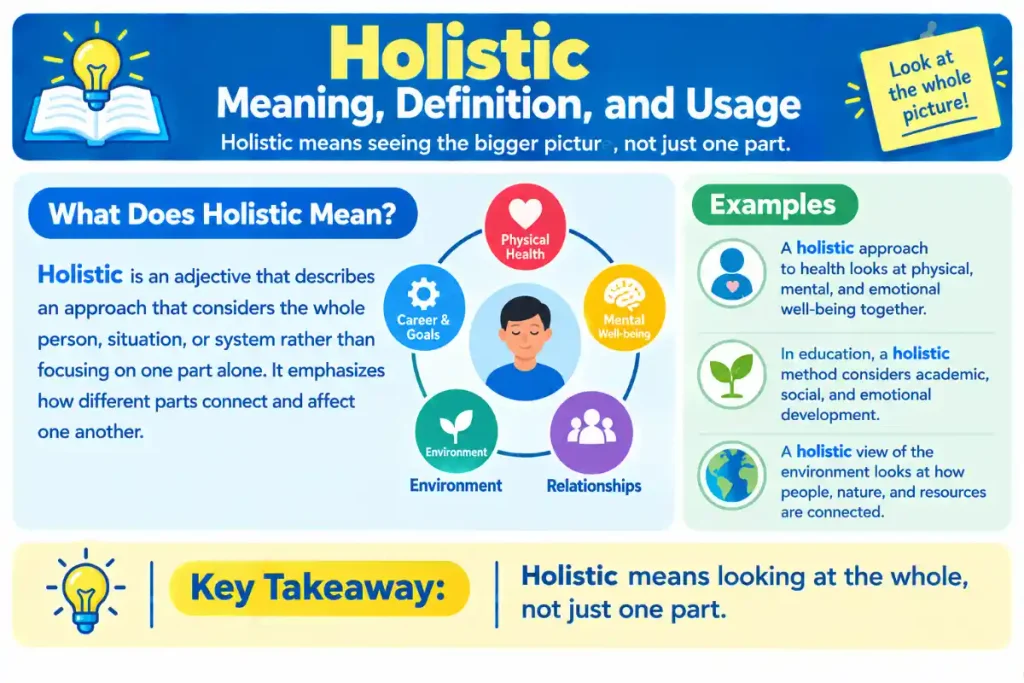
What Does Holistic Mean?
Holistic is an adjective that describes an approach that considers the whole person, situation, or system rather than focusing on one part alone. It emphasizes how different parts connect and affect one another. The word appears in several fields, including health care, education, psychology, business, and environmental planning.
For example, a holistic approach to student success considers more than test scores. It may also account for a student’s emotional well-being, home environment, learning needs, and relationships.
In health care, holistic care considers a person’s overall well-being instead of focusing only on a single symptom. Depending on the setting, this approach may include physical, emotional, social, and lifestyle factors. Here are some common expressions that use holistic:
- Holistic approach: A way of considering all relevant parts of a problem.
- Holistic health: An approach that considers different aspects of overall well-being.
- Holistic education: Teaching that supports a student’s broader development, not just academic performance.
- Holistic treatment: Care that considers the patient’s overall circumstances and health needs.
- Holistic thinking: Looking at how different parts work together within a larger system.
In each example, the central idea is the same: understand the bigger picture before focusing on individual details.
Holistic or Wholistic: What’s the Difference?
The main difference between holistic and wholistic is their spelling and standard usage, not their basic meaning.
| Feature | Holistic | Wholistic |
|---|---|---|
| Spelling status | Standard and preferred | Less common variant |
| Basic meaning | Considering the whole rather than isolated parts | Generally expresses the same idea |
| American English | Widely accepted | Used less often |
| Academic writing | Recommended | Usually avoid |
| Professional writing | Recommended | Use only when specifically intended |
| Pronunciation | Usually \hoh-LIS-tik | Usually pronounced the same way |
| Best general choice | Yes | No, unless there is a specific reason |
Major dictionaries use holistic as the main entry for this concept. Some references also recognize wholistic as a variant, so it is more accurate to call it uncommon than to claim that it never exists as a word.
Why Do People Spell It Wholistic?
The confusion makes sense because wholistic looks as though it comes directly from the English word whole. Since holistic describes considering something as a whole, adding a w may seem logical. However, holistic developed from holism, which comes from the Greek root holos, meaning “whole.” The word entered modern English through this connection rather than through the spelling of the English word whole.
Writers sometimes choose wholistic to make the connection with wholeness more obvious. Some organizations may also use it in a business name or as part of their own terminology. Even so, holistic remains the safer and more widely recognized choice when you want your writing to follow standard American English.
Examples of Holistic and Wholistic in Sentences
Seeing both spellings in context makes the distinction easier to remember. The following examples show how each form may appear and which one is preferable in ordinary writing.
Examples Using Holistic
- The school adopted a holistic approach to student development.
- Her doctor discussed a holistic treatment plan that considered her daily habits and overall health.
- The company developed a holistic strategy to improve employee satisfaction.
- Our teacher encourages holistic thinking instead of memorizing isolated facts.
- The city needs a holistic plan to address traffic, housing, and public transportation.
- The counselor takes a holistic view of each student’s learning needs.
- The organization focuses on holistic community development.
- A holistic assessment considers several factors before reaching a conclusion.
- The manager proposed a holistic solution to the team’s communication problems.
- The course teaches students to understand ecosystems from a holistic perspective.
- Her resume highlights her holistic approach to project management.
- The school district is working toward a more holistic education model.
All 12 examples use the standard spelling and demonstrate how the word works in everyday, academic, and professional contexts.
Examples Using Wholistic
The less common spelling can also appear in writing, particularly when a person or organization deliberately uses it as a variant.
- The wellness center advertises a wholistic approach to personal care.
- The practitioner describes the program as wholistic health support.
- The organization uses the phrase wholistic wellness in its promotional materials.
- The business includes the word wholistic in its registered name.
These examples illustrate possible uses of the variant; they do not mean that it is the preferred spelling. In ordinary prose, you would generally replace wholistic with holistic.
When Should You Use Holistic?
Choose holistic whenever you need the standard spelling in American English. It works in most situations where you want to describe a complete, connected, or whole-person approach.
In Academic Writing
Use holistic in essays, research papers, school assignments, and reports.
Example:
“The study examines how a holistic approach to education supports students’ academic and personal development.”
This spelling is appropriate because it follows established English usage and is familiar to academic readers.
In Professional Emails and Workplace Communication
Use holistic when discussing broad plans, connected challenges, or solutions that account for multiple factors.
Example:
Hi Team,
I’d like us to take a holistic approach to project planning by considering our timeline, budget, staffing needs, and long-term goals together.
This will help us identify potential challenges before we finalize the plan.
Best,
[Your Name]
In Health and Wellness Writing
Use holistic when describing an approach that considers several aspects of a person’s well-being.
Example:
“Our program takes a holistic approach to wellness by considering physical activity, sleep, nutrition, and emotional well-being.”
Keep in mind that describing care as holistic does not, by itself, establish that a treatment is effective. Specific health claims still need reliable evidence.
In Resumes and Job Applications
Use holistic when it accurately describes your professional approach or a relevant skill.
Example:
“Developed a holistic customer-support strategy that addressed communication, training, and service quality.”
This wording can work when the job involves planning, problem-solving, education, management, or other work that requires considering several connected factors.
In Everyday Conversation
You can use holistic naturally when explaining how you approach a problem.
For example:
“I think we need a holistic solution instead of fixing just one part of the problem.”
The word may sound more formal than phrases such as overall approach or the bigger picture, but it is still useful in everyday speech.
Holistic or Whole: What’s the Difference?
Although holistic and whole are related in meaning, they serve different grammatical purposes.
| Word | Part of speech | Meaning | Example |
|---|---|---|---|
| Holistic | Adjective | Considering something as an interconnected whole | The counselor uses a holistic approach. |
| Whole | Adjective or noun | Complete; not divided into parts | She ate the whole apple. |
| Wholeness | Noun | The state of being complete | The program supports a sense of wholeness. |
| Holism | Noun | The idea that a whole cannot be fully understood by examining its parts alone | The course explores holism in psychology. |
Use whole when you mean complete or entire. Use holistic when you describe an approach or way of thinking that considers the relationships among different parts. For example, “the whole team attended the meeting” means every team member attended. “The manager took a holistic approach” means the manager considered the wider situation rather than just one detail.
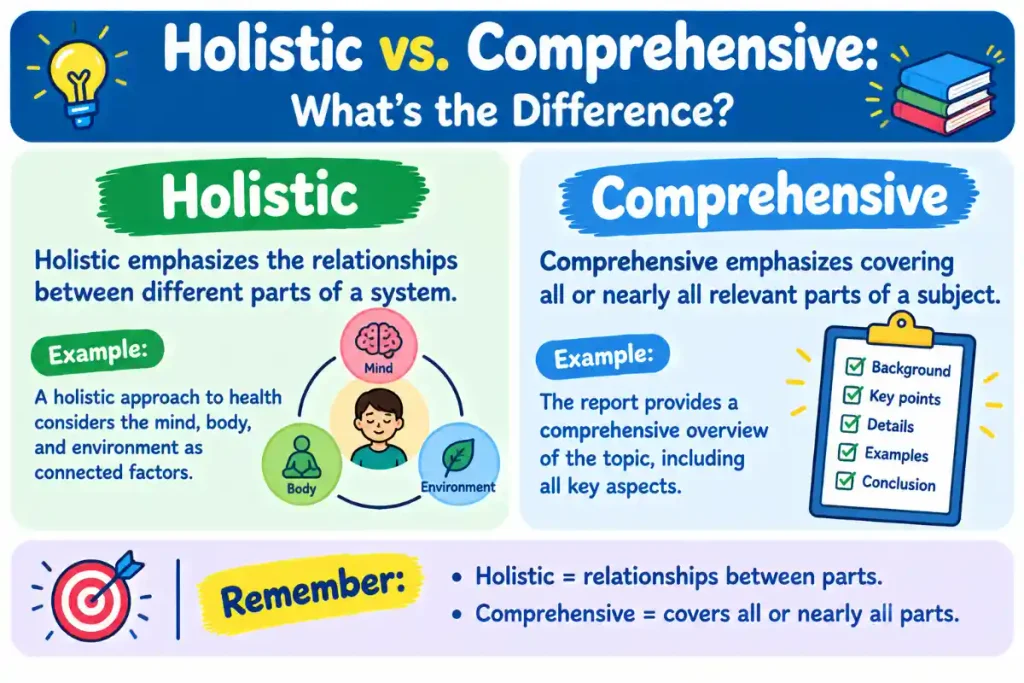
Holistic or Comprehensive: What’s the Difference?
Holistic and comprehensive are similar, but they do not always mean the same thing.
- Holistic emphasizes the relationships between different parts of a system.
- Comprehensive emphasizes covering all or nearly all relevant parts of a subject.
Consider these examples:
- “The school developed a holistic approach to student well-being.” This emphasizes how academic, emotional, and social needs connect.
- “The school prepared a comprehensive student handbook.” This emphasizes the handbook’s broad coverage of rules and information.
A plan can be comprehensive without being holistic. It might cover every department separately without examining how the departments affect one another.
Choose holistic when interconnectedness matters. Choose comprehensive when completeness or coverage is the main point.
What Are Some Synonyms for Holistic?
The best alternative depends on what you want to emphasize. No single synonym fits every use of holistic.
| Word or phrase | Meaning | Tone | Example |
|---|---|---|---|
| Whole-person | Considering a person’s overall needs | Health-related | The clinic promotes whole-person care. |
| Overall | Considering the general picture | Everyday | We reviewed the overall situation. |
| Comprehensive | Covering many relevant aspects | Formal | The team created a comprehensive plan. |
| Integrated | Combining connected parts | Professional | The school adopted an integrated program. |
| Inclusive | Taking different people or factors into account | General | The policy uses an inclusive approach. |
| All-encompassing | Covering a very broad range | Emphatic | The proposal offers an all-encompassing framework. |
| System-wide | Covering an entire system | Technical | The district introduced system-wide changes. |
| Interconnected | Linked or affecting one another | General | The report explains interconnected problems. |
| Multidimensional | Involving several different aspects | Academic | The issue requires multidimensional analysis. |
| Balanced | Giving appropriate attention to different needs | Everyday | We need a balanced approach to learning. |
| Big-picture | Focused on the wider situation | Casual | Let’s take a big-picture view first. |
| Well-rounded | Developed across several areas | General | The program supports well-rounded learning. |
These alternatives are related to holistic thinking, but they are not perfect replacements in every sentence. For example, comprehensive emphasizes coverage, while integrated emphasizes combining parts. Select the term that matches your intended meaning.
What Is the Difference Between Holistic and Holistically?
Holistic is an adjective, while holistically is an adverb. Both forms relate to considering the whole rather than isolated parts.
Use holistic to describe a noun:
- The doctor recommended a holistic approach.
- Our team developed a holistic strategy.
- The school supports holistic education.
Use holistically to describe how someone thinks, acts, or approaches a situation:
- The doctor evaluates patients holistically.
- The team approached the problem holistically.
- The school considers student needs holistically.
The same spelling preference applies to the less common variant: holistically is the standard form to choose for most writing, rather than wholistically.
Common Mistakes When Using Holistic or Wholistic
Understanding a few common errors can help you use the word correctly.
1. Assuming Wholistic Is the Standard Spelling
Because the word relates to wholeness, wholistic may look more logical. However, holistic is the established standard form.
Less preferred: The organization uses a wholistic approach to education.
Preferred: The organization uses a holistic approach to education.
2. Treating Both Spellings as Equally Common
Both forms appear in use, but they are not equally established. Holistic is much more familiar in standard writing and is the better choice for most American readers.
3. Using Holistic When You Mean Comprehensive
The two words overlap, but their emphasis differs.
Less precise: The report provides a holistic list of all expenses.
Clearer: The report provides a comprehensive list of all expenses.
The second sentence emphasizes that the list covers the expenses. Use holistic if you mean that the report examines how different expenses relate to the larger budget.
4. Confusing Holistic With Alternative Medicine
Although holistic often appears in health and wellness discussions, the word is not limited to medicine. It can describe education, business strategy, environmental planning, and many other fields.
For example, a holistic approach to managing a business is not a medical treatment. It means considering the business as a connected system.
5. Assuming Holistic Means Including Everything Without Prioritization
A holistic approach considers relevant connections and broader circumstances. It does not necessarily require addressing every possible detail. A holistic project plan, for instance, can focus on the factors that matter most while still considering how they affect one another.
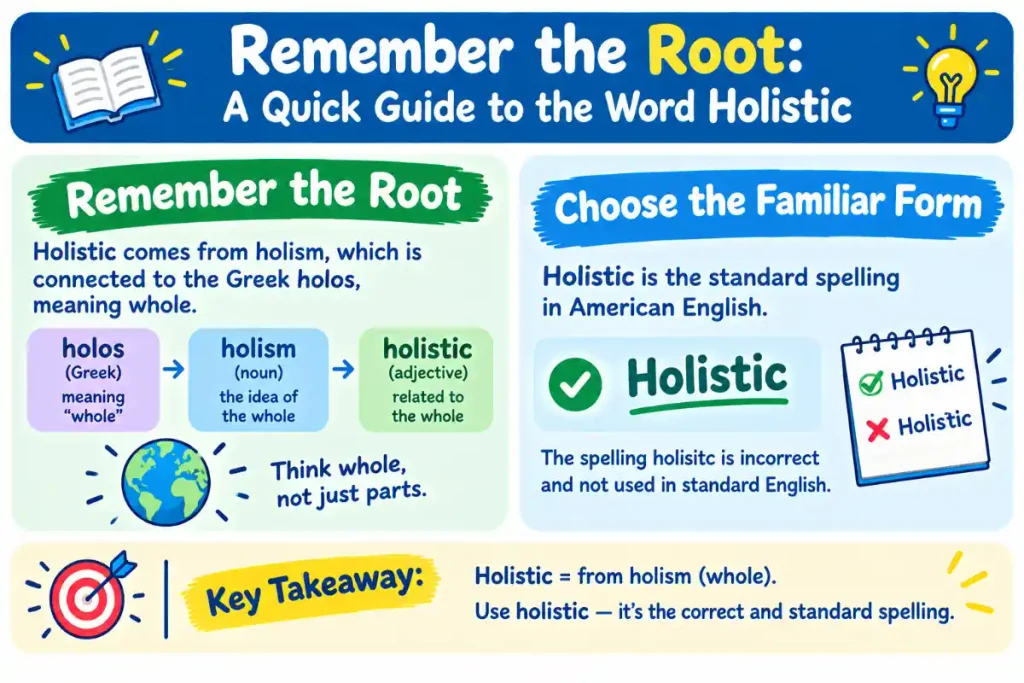
Quick Tips for Remembering the Correct Spelling
Use these simple reminders when choosing between holistic and wholistic:
- Remember the root: Holistic comes from holism, which is connected to the Greek holos, meaning whole.
- Choose the familiar form: Holistic is the standard spelling in American English.
- Check your context: Use holistic in academic, professional, educational, and health-related writing.
- Know the distinction: Holistic emphasizes how parts connect; comprehensive emphasizes how much a plan or document covers.
- Watch the adverb: Write holistically, not wholistically, when describing how an action is performed.
- Follow official names: If a business or organization deliberately uses Wholistic in its name, preserve that spelling when referring to it.
Conclusion
When deciding between holistic or wholistic, choose holistic for standard American English. It is the established spelling used to describe approaches that consider a whole person, situation, or system rather than focusing on isolated parts.
Although wholistic appears in some references and may be used intentionally by certain organizations, it remains much less common. For essays, resumes, professional emails, educational materials, and general writing, holistic is the clearest and safest choice.
Remember that holistic and comprehensive are related but not identical: holistic emphasizes connections among parts, while comprehensive emphasizes broad coverage. Understanding this distinction will help you choose precise wording and communicate your meaning more clearly.
Frequently Asked Questions
Is holistic or wholistic correct?
Holistic is the standard and preferred spelling in American English. Wholistic is a less common variant that appears in some dictionaries and real-world usage.
What does holistic mean in simple words?
Holistic means looking at the whole of something instead of focusing on only one part. For example, a holistic approach to education considers a student’s academic, social, and emotional needs.
Why is holistic not spelled with a W?
The word comes from holism, which developed from the Greek holos, meaning whole. It does not come directly from the English word whole, which explains why the standard spelling does not contain a W.
Is wholistic a real word?
Yes, wholistic appears as a variant spelling in some references, including Collins. However, it is much less common than holistic, so the standard spelling is the safer choice for most writing.
Should I use holistic or wholistic in a resume?
Use holistic in a resume or cover letter. For example, “Developed a holistic approach to customer service” is appropriate when it accurately describes your work.
Is holistic the same as comprehensive?
Not exactly. Holistic emphasizes how different parts connect within a larger system, while comprehensive emphasizes covering all or most relevant aspects of a subject.
What is the correct adverb: holistically or wholistically?
Holistically is the standard adverb. For example, “The team evaluated the problem holistically” means the team considered the wider situation and the relationships between its parts.
3 thoughts on “Holistic or Wholistic: Which Spelling Is Correct?”