

If you’re writing an email, an essay, or a text message, you might wonder whether bearable vs bareable is the correct spelling. Both forms look reasonable because they sound alike, but only one is standard in modern English.
Bearable is the correct spelling. It means something is tolerable, manageable, or possible to endure. Bareable is a nonstandard spelling that you should generally avoid in formal and everyday writing.
Understanding bearable vs bareable is simple once you know how the word relates to the verb bear, which means to endure, carry, or tolerate something. This guide explains the correct spelling, its meaning, common examples, related words, and easy ways to remember the difference.
What Is the Difference Between Bearable and Bareable?
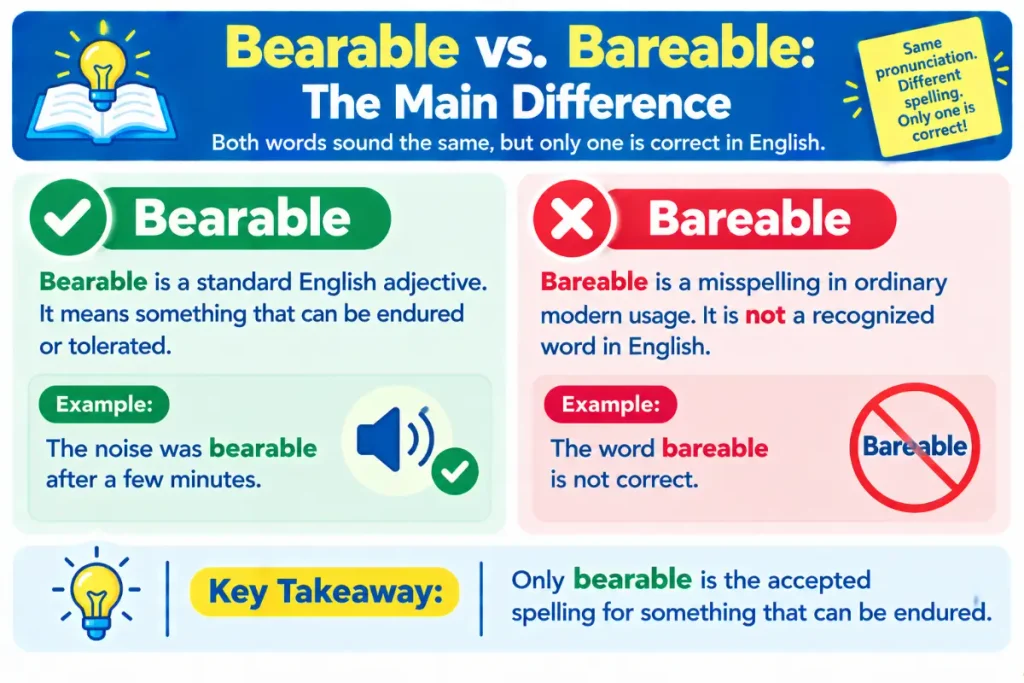
The main difference is that bearable is a standard English adjective, while bareable is a misspelling in ordinary modern usage. Although both forms have the same pronunciation in most English accents, only bearable is the accepted spelling for something that can be endured.
| Word | Meaning | Correctness | Example |
|---|---|---|---|
| Bearable | Tolerable or possible to endure | Correct | The heat became bearable after sunset. |
| Bareable | Intended to mean tolerable | Nonstandard spelling | The heat became bareable after sunset. |
The first sentence uses the correct spelling. The second sentence should use bearable instead. The confusion comes from the fact that bear and bare sound alike. However, they have different meanings and uses. The adjective bearable comes from the verb bear, not bare.
What Does Bearable Mean?
Bearable means tolerable, manageable, or not too difficult to endure. People use it to describe unpleasant situations, physical discomfort, emotional difficulties, or challenging experiences that they can withstand. The word often suggests that something is uncomfortable or difficult but not completely overwhelming.
For example:
- The long wait was bearable because we had snacks.
- The pain became more bearable after I rested.
- The summer heat is more bearable in the evening.
- Her workload felt bearable once she organized her schedule.
- The first week at my new school was difficult but bearable.
In each example, bearable describes something that a person can tolerate or get through.
Bearable as an Adjective
Bearable is an adjective. It describes a condition, experience, situation, or feeling. Here are some common expressions:
| Expression | Meaning | Example |
|---|---|---|
| Bearable pain | Pain that can be tolerated | The headache was bearable after a short rest. |
| Bearable weather | Weather that is not too uncomfortable | The cool breeze made the weather bearable. |
| Bearable workload | An amount of work that can be managed | A flexible schedule made the workload bearable. |
| Bearable expense | A cost that someone can reasonably manage | The monthly payment was bearable on her salary. |
| Bearable situation | A difficult situation that can be endured | Their support made the situation bearable. |
Bearable does not necessarily mean pleasant or enjoyable. Something can still be frustrating, uncomfortable, or difficult while remaining bearable.
Why Is Bareable Incorrect?
Bareable is not the standard spelling of the adjective meaning tolerable. Writers sometimes use it because they associate the word with bare, which means uncovered, empty, or lacking something. However, the correct word comes from a different verb: bear.
Consider these examples:
- Incorrect: The noise was barely bareable.
- Correct: The noise was barely bearable.
- Incorrect: The long journey became bareable after lunch.
- Correct: The long journey became bearable after lunch.
- Incorrect: The situation was not bareable anymore.
- Correct: The situation was not bearable anymore.
In each corrected sentence, bearable describes something a person can endure. There is an additional source of confusion: barely is a real word that means only just or hardly. For example, “I could barely hear the announcement.” However, barely does not make bareable a correct spelling.
Bearable vs. Bareable: Understanding Bear and Bare
To remember the correct spelling, it helps to understand the difference between the two base words.
What Does Bear Mean?
Bear can function as a verb or a noun. As a verb, it can mean to carry, support, endure, or tolerate something. As a noun, it refers to the animal. The adjective bearable comes from the verb meaning to endure or tolerate.
Examples:
- I can barely bear the noise from the construction site.
- She could not bear the thought of missing the graduation.
- We must bear the responsibility for our decisions.
- The discomfort was difficult to bear.
- The conditions became more bearable as the weather cooled.
The connection is straightforward: if you can bear something, you can endure it. If something is bearable, you can tolerate it.
What Does Bare Mean?
Bare is an adjective or verb associated with being uncovered, exposed, or lacking something.
Examples:
- The room had bare walls.
- He walked across the bare floor.
- She decided to bare her feelings during the conversation.
- The tree’s branches were bare in winter.
- The report revealed the bare facts of the case.
These examples have nothing to do with tolerating a difficult experience. Because bare does not supply the intended meaning of bearable, the spelling bareable is not appropriate when describing something tolerable.
How Do You Spell Bearable Correctly?
The correct spelling is B-E-A-R-A-B-L-E: bearable.
A useful way to understand its structure is:
- Bear: to endure or tolerate.
- -able: a suffix meaning capable of being or able to be.
Together, bear and -able form bearable, meaning capable of being endured. The same spelling pattern appears in other familiar words:
| Word | Base word | Meaning |
|---|---|---|
| Washable | Wash | Able to be washed |
| Readable | Read | Easy or possible to read |
| Manageable | Manage | Possible to manage |
| Understandable | Understand | Possible to understand |
| Bearable | Bear | Possible to endure |
These examples show how the suffix -able helps form adjectives describing possibility or capability.
Is Bearable Spelled With an E or an A?
Bearable contains both letters in sequence at the beginning: b-e-a-r. The word starts with bear, not bare. That distinction is the key to remembering the spelling.
Incorrect: bareable
Correct: bearable
You do not need to change the spelling based on the type of discomfort or situation being described. The standard spelling remains bearable in American English and British English.
12 Examples of Bearable in Real Sentences
The following examples show how to use bearable naturally in different situations.
- Everyday life: The traffic was bearable because I left home early.
- School: The homework became more bearable when we divided it into smaller tasks.
- Work: A supportive manager made the busy week more bearable.
- Weather: The afternoon heat was more bearable under the shade.
- Travel: The long flight was bearable with a comfortable seat and a good book.
- Health: The discomfort was bearable, but I decided to ask a doctor about it.
- Family: Their kindness made a difficult family gathering more bearable.
- Money: The lower monthly payment made the expense more bearable.
- Relationships: Honest communication made the disagreement more bearable.
- Technology: Turning down the volume made the constant background noise bearable.
- Moving: Having friends help with the boxes made moving day more bearable.
- Daily routine: A short break made the repetitive task more bearable.
Notice that bearable often appears with words such as more, less, quite, fairly, and barely. These words help describe the degree to which something can be tolerated. For example, “The noise was barely bearable” means the noise was almost too difficult to tolerate.
Bearable vs Tolerable: What’s the Difference?
Bearable and tolerable have similar meanings. Both describe something that a person can endure without finding it completely unbearable. However, their tone can differ slightly.
| Word | Meaning | Typical tone | Example |
|---|---|---|---|
| Bearable | Possible to endure | Natural and conversational | The wait was bearable. |
| Tolerable | Acceptable or possible to endure | Sometimes more formal or measured | The delay was tolerable. |
In everyday American English, bearable often sounds natural when describing discomfort, frustration, or a difficult experience. Tolerable can sound slightly more objective, especially when discussing conditions, standards, or acceptable limits.
For example:
- The room was hot, but the temperature was bearable.
- The working conditions were tolerable, although improvements were needed.
The two words often overlap, so the best choice depends on the sentence and the tone you want.
Bearable vs Endurable: Which Word Should You Use?
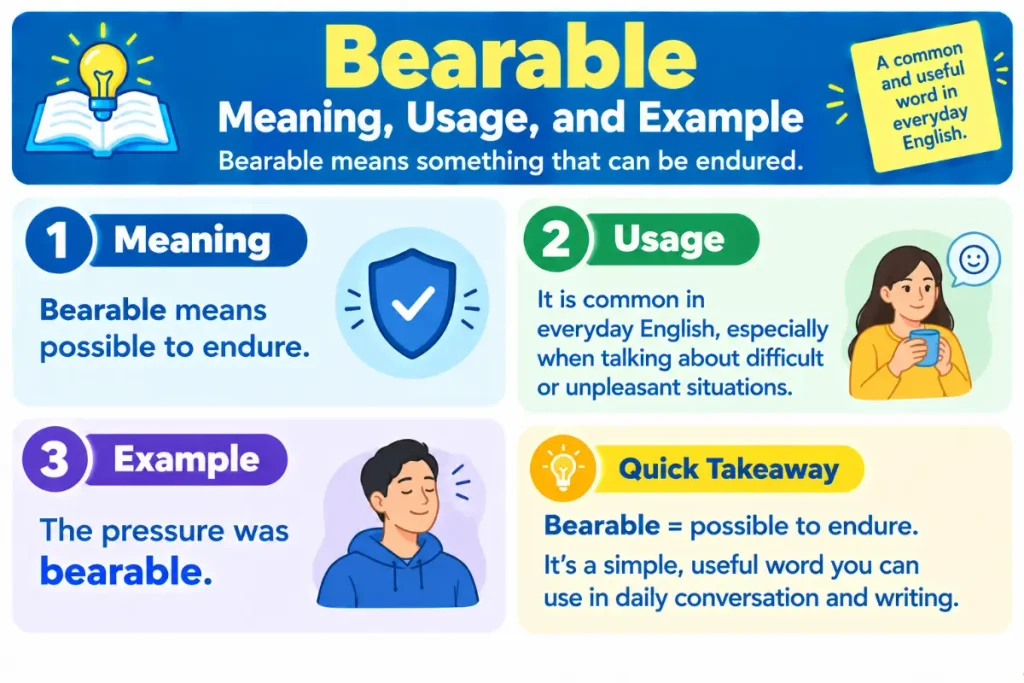
Endurable also means capable of being endured. However, it is less common in everyday conversation than bearable.
| Word | Meaning | Usage | Example |
|---|---|---|---|
| Bearable | Possible to endure | Common in everyday English | The pressure was bearable. |
| Endurable | Capable of being endured | Less common and sometimes more formal | The conditions remained endurable. |
For most everyday writing, bearable is the more natural choice. For example, you would generally write, “The workload became bearable after the deadline changed,” rather than choosing the less familiar endurable. Both words can be correct, but they are not equally common in ordinary conversation.
Bearable vs. Unbearable: Opposite Meanings
Unbearable is the direct opposite of bearable. It describes something that is too difficult, painful, unpleasant, or frustrating to endure.
| Word | Meaning | Example |
|---|---|---|
| Bearable | Possible to tolerate | The noise was bearable with the windows closed. |
| Unbearable | Too difficult to tolerate | The noise became unbearable during the night. |
The prefix un- reverses the meaning of bearable.
Here are more examples:
- The heat was bearable in the morning but unbearable by noon.
- The delay was bearable at first, but the lack of updates made it unbearable.
- The pressure felt bearable when the team worked together.
- The constant interruptions became unbearable during the meeting.
Use bearable when something can be endured. Use unbearable when it is too difficult or unpleasant to tolerate.
Common Mistakes When Using Bearable
Even after learning the correct spelling, writers can make other mistakes when using the word.
1. Writing Bareable Instead of Bearable
This is the main spelling mistake.
Incorrect: The long meeting was bareable.
Correct: The long meeting was bearable.
Remember that the adjective comes from bear, meaning to endure.
2. Confusing Bearable With Barely
Bearable means tolerable, while barely means only just or almost not.
Incorrect: The room was barely after we turned on the fan.
Correct: The room was bearable after we turned on the fan.
Another correct sentence is, “The room was barely cool enough to be comfortable.”
The two words serve different grammatical functions, so they cannot replace each other.
3. Assuming Bearable Means Enjoyable
Something bearable is not necessarily pleasant. It is simply possible to tolerate.
For example:
“The long wait was bearable, but I wouldn’t want to repeat it.”
This sentence makes sense because the wait was manageable without being enjoyable.
4. Using Bearable When You Mean Bare
If you mean uncovered or exposed, use bare, not bearable.
Incorrect: The walls were bearable.
Correct: The walls were bare.
The first sentence suggests the walls could be endured, which is unlikely to express the intended meaning. The second correctly describes walls without decorations or coverings.
5. Using Unbearable When You Mean Bearable
These words have opposite meanings.
Incorrect: The cool breeze made the weather unbearable.
Correct: The cool breeze made the weather bearable.
Use unbearable only when something is too difficult or unpleasant to tolerate.
Can You Use Bearable in Formal Writing?
Yes. Bearable is a standard English word suitable for both casual and formal writing when it fits the context.
However, the best word may depend on your audience and purpose.
| Context | Recommended wording | Example |
|---|---|---|
| Text message | Bearable | The wait was bearable. |
| School essay | Bearable or tolerable | The conditions became more bearable. |
| Professional email | Bearable or manageable | The revised schedule makes the workload more manageable. |
| Academic discussion | Tolerable or manageable, depending on meaning | The new arrangement created more tolerable working conditions. |
| Everyday conversation | Bearable | The heat is finally bearable. |
In a professional setting, manageable may be more precise when discussing workload, deadlines, or resources. Bearable works well when you want to emphasize that an unpleasant experience can be endured. You should avoid bareable in resumes, academic assignments, workplace communication, and other polished writing because it is a nonstandard spelling.
Is Bearable the Correct Spelling in American and British English?
Yes. Bearable is the standard spelling in both American and British English. There is no regional spelling difference that makes bareable correct in one variety and incorrect in another. The same distinction applies in other major varieties of English, including Canadian and Australian English.
Examples in American English:
- The summer heat is becoming bearable.
- The workload is manageable and bearable.
- The delay was frustrating but bearable.
The spelling remains bearable regardless of the country or the type of situation being described.
What Are Some Synonyms for Bearable?
Several words can replace bearable, but the best choice depends on what you mean. Some emphasize the ability to endure discomfort, while others focus on practical management or acceptability.
| Word/Phrase | Meaning | Tone | Example |
|---|---|---|---|
| Tolerable | Possible to endure | Neutral | The noise was tolerable. |
| Endurable | Capable of being endured | Formal or uncommon | The conditions were endurable. |
| Manageable | Possible to handle | Practical | The workload was manageable. |
| Acceptable | Good enough to be approved or allowed | Neutral or formal | The delay was acceptable. |
| Livable | Suitable enough to live with | Everyday | The arrangement was livable. |
| Sustainable | Possible to maintain over time | Professional | The schedule was sustainable. |
| Reasonable | Fair or not excessive | Neutral | The cost was reasonable. |
| Permissible | Allowed under a rule or standard | Formal | The variation was permissible. |
| Supportable | Capable of being supported or defended | Formal | The decision was supportable. |
| Palatable | Acceptable or easier to accept | Neutral or formal | The compromise was palatable. |
| Comfortable | Providing ease or freedom from discomfort | Everyday | The temperature was comfortable. |
| Adequate | Sufficient for a particular purpose | Neutral | The conditions were adequate. |
| Satisfactory | Good enough to meet expectations | Neutral or formal | The result was satisfactory. |
| Workable | Practical and possible to use | Everyday or professional | The plan was workable. |
| Feasible | Possible to accomplish | Formal or professional | The arrangement was feasible. |
| Bearable enough | Tolerable to a sufficient degree | Conversational | The noise was bearable enough to continue working. |
These alternatives are not exact substitutes in every sentence. For example, manageable is particularly useful for tasks and workloads, while palatable often describes an idea, proposal, or compromise that someone finds acceptable. Sustainable focuses on whether something can continue over time, not simply whether someone can endure it at the moment. Choose the word that best expresses the specific meaning you intend.
Quick Tips to Remember Bearable vs Bareable
Use these simple tips to avoid the spelling mistake.
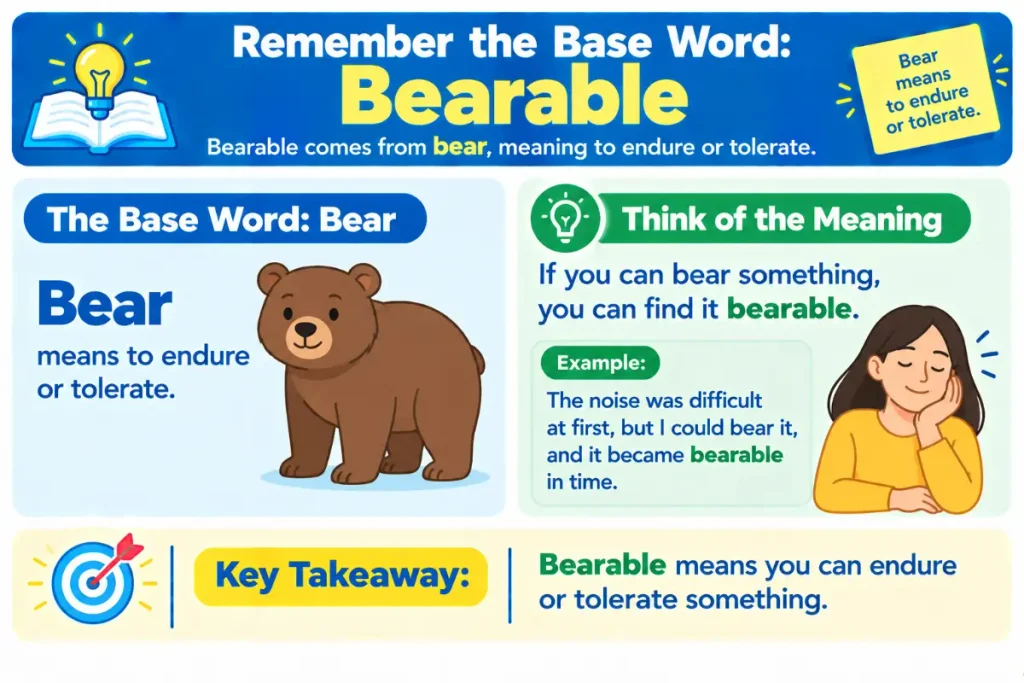
- Remember the base word: Bearable comes from bear, meaning to endure or tolerate.
- Think of the meaning: If you can bear something, you can find it bearable.
- Separate bear and bare: Bear relates to enduring or carrying; bare relates to being uncovered or exposed.
- Check the spelling in formal writing: Use bearable, never bareable, for the meaning “tolerable.”
- Remember the opposite: Unbearable means too difficult to endure, which reinforces the spelling of bearable.
A quick memory trick is to think, “I can bear it, so it is bearable.”
Conclusion
The difference between bearable vs bareable comes down to one correct spelling and one nonstandard variant. Bearable is the correct word when you mean that something is tolerable, manageable, or possible to endure. It comes from the verb bear, which means to carry, support, or withstand something.
By contrast, bare refers to something uncovered or exposed, so bareable does not follow the standard spelling for the intended meaning. Remember the simple connection: if you can bear a difficult experience, that experience is bearable. This rule applies in American, British, Canadian, and Australian English. Whether you’re writing a school assignment, a professional email, or a casual message, choosing bearable will help keep your writing clear, accurate, and natural.
Frequently Asked Questions
Is bearable or bareable correct?
Bearable is correct. It means tolerable or possible to endure, while bareable is a nonstandard spelling that should generally be avoided.
What does bearable mean in simple words?
Bearable means that something is difficult, unpleasant, or uncomfortable but can still be tolerated. For example, a long wait may be bearable if you have something to do.
Why do people spell bearable as bareable?
People often confuse the two spellings because bear and bare sound alike. However, bearable comes from bear, meaning to endure, rather than bare, meaning uncovered.
Is bearable a real English word?
Yes. Bearable is a standard English adjective used to describe something that can be endured or tolerated. It is appropriate in both everyday and formal writing.
Is bearable the opposite of unbearable?
Yes. Bearable means possible to tolerate, while unbearable describes something too difficult or unpleasant to endure.
Can I use bearable in a professional email?
Yes. Bearable is correct in professional communication when you want to describe a difficult situation that can be tolerated. For workload discussions, manageable may sometimes communicate the intended meaning more precisely.
Is bearable spelled the same in the US and UK?
Yes. American and British English both use bearable. Neither variety uses bareable as the standard spelling for something tolerable.
1 thought on “Bearable vs Bareable: Which Spelling Is Correct?”