

If you’re writing an email, preparing a school assignment, or updating your resume, you may wonder about ingage vs engage. The two words look similar, but only one is the standard spelling in modern English. Choosing the correct form helps you communicate clearly and maintain a professional tone.
Engage is the correct standard spelling. Ingage is generally a misspelling of engage. The verb engage means to participate in something, attract someone’s attention, become involved, or hire someone for a particular task.
Although ingage may appear in informal writing, online searches, or older texts, it is not the accepted spelling for ordinary modern English usage. If you want to write clearly in American English, choose engage.
This guide explains the difference between ingage vs engage, the meaning and grammar of engage, common mistakes, useful alternatives, and examples that show how to use the correct word in everyday and professional situations.
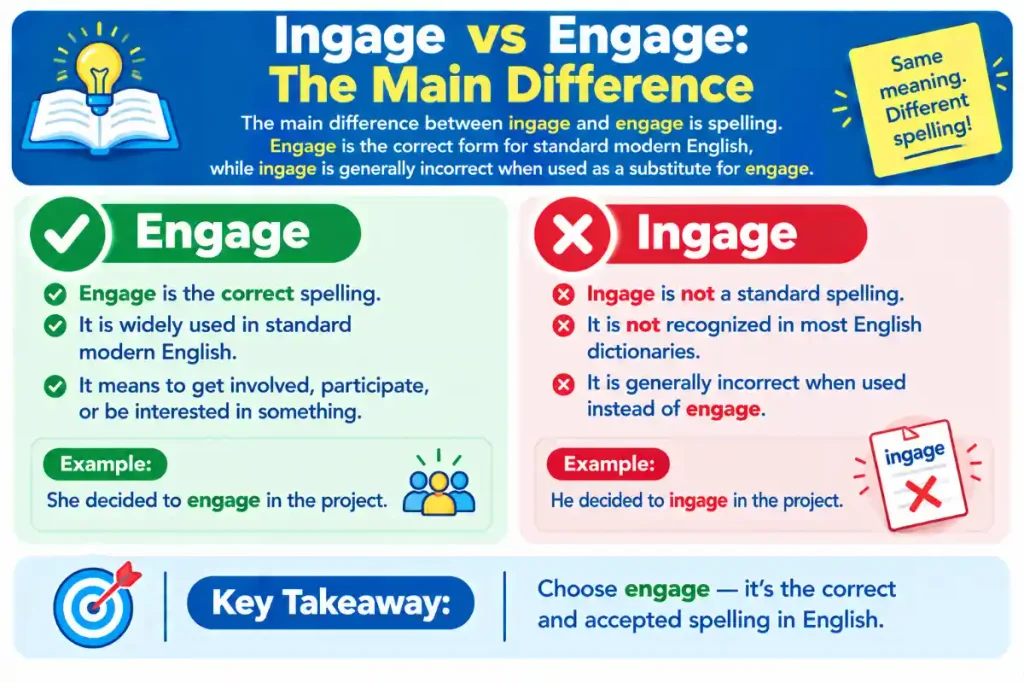
Ingage vs Engage: What’s the Difference?
The main difference between ingage and engage is spelling. Engage is the correct form for standard modern English, while ingage is generally incorrect when used as a substitute for engage.
| Word | Status | Meaning | Example |
|---|---|---|---|
| Engage | Correct | To participate, involve, attract attention, or hire | Students engage in classroom discussions. |
| Ingage | Generally incorrect | Usually an incorrect spelling of engage | Incorrect: We want to ingage more customers. |
The correct sentence is:
We want to engage more customers.
The incorrect version uses ingage instead of engage. In business, education, and everyday writing, use the standard spelling to avoid confusion.
Why Is Engage the Correct Spelling?
Engage is the established spelling recorded in modern English dictionaries. It functions as a verb and appears in many common expressions, including engage in conversation, engage an audience, and engage a professional. The spelling does not change to ingage when the word appears in different contexts. The same base form works in academic writing, business communication, personal conversations, and formal documents.
For example:
- Correct: The company plans to engage a new consultant.
- Incorrect: The company plans to ingage a new consultant.
The first sentence follows standard English spelling conventions. The second does not.
What Does Engage Mean?
The verb engage has several related meanings. Its exact meaning depends on the situation, but it usually involves participation, attention, involvement, commitment, or employment. Here are the most common meanings.
1. To Participate in Something
Engage can mean to take part in an activity or become involved in a particular situation.
Examples:
- Students engage in group discussions during class.
- The community engaged in a cleanup project.
- Employees engage in training to improve their skills.
- The children engaged in a game after school.
In these examples, the word emphasizes active participation rather than simply being present. For instance, a student who listens carefully, asks questions, and contributes ideas is actively engaging in a lesson.
2. To Attract or Hold Someone’s Attention
Writers, teachers, speakers, and businesses often use engage to describe capturing someone’s interest.
Examples:
- The teacher used a story to engage the class.
- A strong opening can engage readers immediately.
- The speaker engaged the audience with practical examples.
- The video aims to engage viewers through useful information.
In this context, engage means to make someone interested enough to pay attention or participate. A writer might engage readers by using clear explanations, relatable situations, and examples that answer their questions.
3. To Hire or Employ Someone
Engage can also mean to hire a person or arrange for someone to provide a service. This meaning is common in formal and professional English.
Examples:
- The family engaged a lawyer to review the contract.
- The business engaged an accountant for tax advice.
- The event organizer engaged a photographer for the ceremony.
In everyday American English, hire is often the simpler and more natural choice. However, engage can sound appropriate in formal business or legal contexts.
4. To Become Involved in a Conversation
The word also describes beginning or taking part in communication with another person.
Examples:
- She engaged her neighbor in a friendly conversation.
- The manager engaged the team in a discussion about workplace safety.
- He found it easy to engage new people at the conference.
Here, the word suggests active communication rather than simply exchanging a few words.
5. To Make a Promise or Agreement
In certain expressions, engage refers to committing to an arrangement or becoming obligated to do something. For example, someone might engage to do a task in a formal or older style of English. The phrase engage to be married also has a traditional meaning related to a marriage promise. In contemporary American English, people more commonly say agree to do something or get engaged to be married, depending on the intended meaning.
How to Use Engage Correctly
The verb engage works with several common grammatical patterns. Learning these patterns makes it easier to use the word naturally.
Engage in Something
Use engage in when describing participation in an activity, discussion, or process.
Examples:
- The students engage in independent research.
- The team engaged in a detailed discussion.
- Many people engage in outdoor activities on weekends.
- The organization engages in community service.
The word in connects the verb to the activity.
Incorrect: The students engage on independent research.
Correct: The students engage in independent research.
Although other prepositions may work with engage in different contexts, engage in is the standard expression for participating in an activity.
Engage With Someone or Something
Use engage with when describing interaction, communication, or active involvement with a person, group, idea, or subject.
Examples:
- Teachers encourage students to engage with the material.
- The company wants to engage with its customers.
- Readers can engage with the author through an online discussion.
- The manager engaged with employees to understand their concerns.
In American English, engage with is common in education, workplace communication, and discussions about customer relationships.
Engage Someone in Something
Use engage someone in when one person involves another person in an activity or conversation.
Examples:
- The teacher engaged the students in a debate.
- She engaged her guests in a discussion about travel.
- The coach engaged the players in a planning session.
This construction identifies the person being involved and the activity in which they participate.
Engage Someone or Something
Sometimes, engage takes a direct object without a preposition.
Examples:
- The presenter engaged the audience.
- The story engaged my attention.
- The company engaged a consultant.
- The speaker engaged the listeners with humor.
The correct structure depends on the intended meaning. Do not add a preposition automatically when the sentence does not require one.
Ingage vs Engage: Examples in Real Sentences
The following examples demonstrate the correct spelling and show how engage works in different settings.
| Context | Example sentence |
|---|---|
| School | Teachers use questions to engage students during lessons. |
| Workplace | The manager encouraged employees to engage in problem-solving. |
| We would like to engage your team in the planning process. | |
| Business | The company hopes to engage more customers this year. |
| Social media | The creator shared a question to engage followers. |
| Conversation | She knows how to engage people in meaningful discussions. |
| Reading | The opening paragraph helped engage the reader. |
| Community | Volunteers engaged local residents in the recycling program. |
| Hiring | The organization engaged a specialist to review its procedures. |
| Research | Participants were asked to engage in a series of activities. |
| Customer service | Our staff works hard to engage customers and answer their questions. |
| Public speaking | The speaker used a personal story to engage the audience. |
| Technology | The app encourages users to engage with educational content. |
| Sports | The coach taught the players how to engage their opponents strategically. |
| Everyday life | I try to engage in conversations that help me learn something new. |
Each sentence uses engage in a natural way. Replacing it with ingage would introduce a spelling error in these examples.
Correct vs. Incorrect Usage
Compare the following pairs to recognize the error quickly.
Example 1: Customer communication
- Incorrect: We need to ingage our customers more effectively.
- Correct: We need to engage our customers more effectively.
Example 5: Workplace discussion
- Incorrect: The manager tried to ingage the team in the meeting.
- Correct: The manager tried to engage the team in the meeting.
In every pair, the correct version uses the established spelling engage.
Why Do People Confuse Ingage and Engage?
Several factors may explain why people type ingage instead of engage. Most involve pronunciation, spelling habits, or unfamiliarity with the word.
1. The Pronunciation Can Be Confusing
In standard American English, engage begins with a vowel sound similar to the one heard in enjoy and enter. However, people may misremember the first vowel when spelling the word.
The correct spelling begins with en-, not in-.
- Engage: correct
- Ingage: generally incorrect
Remembering the first two letters is the easiest way to avoid the error.
2. People May Type the Word Too Quickly
Typing mistakes often happen when someone writes a message without checking it. Because ingage looks similar to engage, a spell-checking tool or a quick reread may be helpful.
For example, someone writing a customer service email might type:
We want to ingage with every customer.
A quick correction produces:
We want to engage with every customer.
3. Similar Spellings Can Cause Uncertainty
English contains words that begin with en- and in-. Some spelling choices are predictable, while others require memorization.
For example:
| Correct word | Meaning |
|---|---|
| Enable | Give someone the ability to do something |
| Encourage | Give support or confidence |
| Enlarge | Make something bigger |
| Include | Contain something as part of a whole |
| Inform | Give someone information |
| Engage | Involve, participate, attract attention, or hire |
These words do not follow one universal rule that determines every spelling. The best approach is to learn the established spelling of each word.
4. Search Results May Include Incorrect Forms
People sometimes encounter misspellings in comments, posts, informal messages, or website text. Seeing a spelling online does not automatically make it correct. If you encounter ingage, consider the context. It might be a typo, a username, a brand name, or another proper name. For ordinary English writing, however, engage is the standard choice.
Engage as a Verb: Forms and Grammar
Engage is primarily a verb. Its form changes according to tense, subject, and grammatical structure.
| Form | Word | Example |
|---|---|---|
| Base form | Engage | We engage with customers. |
| Third-person singular | Engages | She engages students through discussion. |
| Present participle | Engaging | The teacher is engaging the class. |
| Simple past | Engaged | They engaged a professional last month. |
| Past participle | Engaged | The audience was engaged by the presentation. |
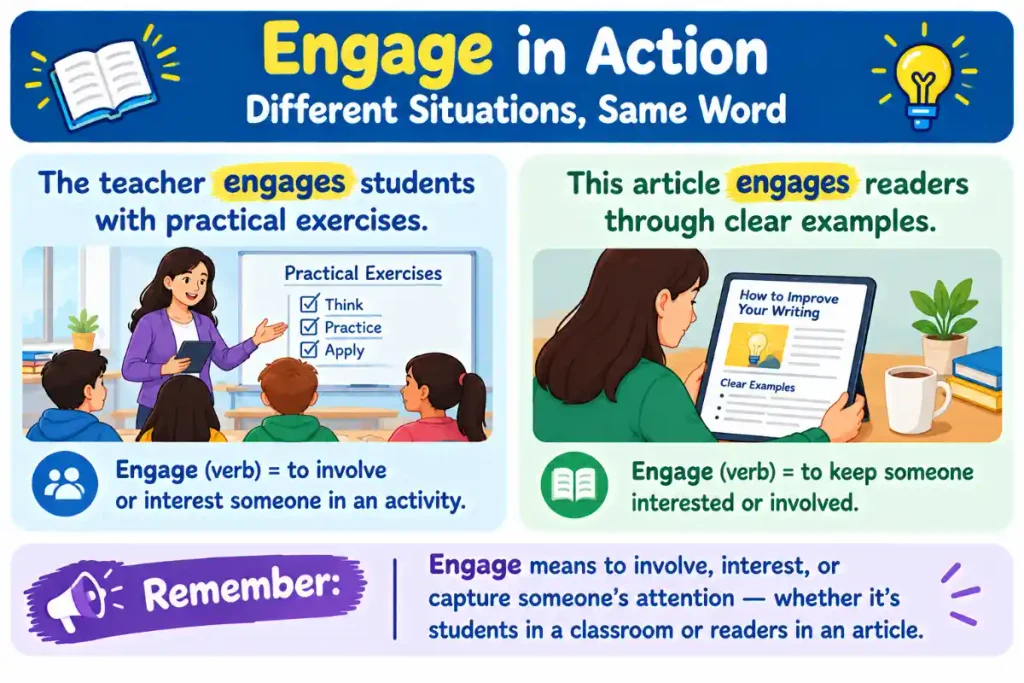
How to Use Engages
Use engages with a singular third-person subject in the simple present tense.
Examples:
- The teacher engages students with practical exercises.
- This article engages readers through clear examples.
- The business engages customers through helpful service.
Incorrect: The teacher engage students with practical exercises.
Correct: The teacher engages students with practical exercises.
How to Use Engaging
Engaging can function as a present participle in a verb phrase or as an adjective describing something interesting or appealing.
Examples:
- The speaker is engaging the audience in a discussion.
- She wrote an engaging introduction.
- The museum offers an engaging educational experience.
When engaging describes a noun, it usually means interesting, appealing, or capable of attracting attention.
How to Use Engaged
Engaged can function as the past tense or past participle of engage. It can also act as an adjective.
Examples:
- The company engaged a consultant last week.
- Students remained engaged throughout the lesson.
- The team engaged in a productive discussion.
Notice the difference between the two common constructions:
- Engaged in: participated in an activity.
- Engaged with: interacted with a person, subject, or idea.
For example, The students engaged in a debate describes participation in an activity. The students engaged with the reading material describes their active interaction with the material.
Engage vs Involve: What’s the Difference?
Engage and involve have related meanings, but they are not always interchangeable.
| Word | Meaning | Example |
|---|---|---|
| Engage | Participate actively, attract attention, or interact | The teacher engaged the students in a debate. |
| Involve | Include someone or make them part of an activity | The teacher involved the students in the project. |
Use engage when you want to emphasize active participation, attention, or interaction. Use involve when you want to emphasize inclusion or participation in a process.
For example:
- The activity involved every student. This emphasizes that everyone took part.
- The activity engaged every student. This emphasizes active interest or participation.
Both sentences can be correct, but their emphasis differs.
Engage vs Interact: What’s the Difference?
Engage and interact often appear in discussions about communication and relationships.
| Word | Meaning | Example |
|---|---|---|
| Engage | Become involved or attract attention | The speaker engaged the audience with a question. |
| Interact | Communicate or act with another person or thing | The speaker interacted with audience members after the presentation. |
Interact usually emphasizes a two-way exchange. Engage can describe that exchange, but it can also refer to capturing attention or participating in an activity. For instance, a video can engage viewers even when they do not communicate directly with its creator. However, a live question-and-answer session allows viewers and the presenter to interact.
Engage vs Participate: What’s the Difference?
Both words describe taking part in an activity, but they place different emphasis on the action.
| Word | Meaning | Example |
|---|---|---|
| Engage | Become actively involved or attentive | Students engaged in a thoughtful discussion. |
| Participate | Take part in an activity or event | Students participated in the school competition. |
Participate is often the more direct choice when you simply mean taking part. Engage can suggest deeper attention, interaction, or involvement.
For example:
- All employees participated in the meeting.
- All employees engaged in a discussion about the new policy.
The first sentence confirms attendance and participation. The second emphasizes active discussion.
Synonyms for Engage
If you want to avoid repetition, several words can replace engage in the right context. However, no synonym works in every sentence. Choose an alternative that preserves the original meaning.
Everyday Alternatives
| Word or phrase | Meaning | Tone | Example |
|---|---|---|---|
| Involve | Include in an activity | Neutral | We involved the team in planning. |
| Participate | Take part | Neutral | She participated in the workshop. |
| Join | Become part of an activity or group | Casual | He joined the discussion. |
| Interact | Communicate or act with others | Neutral | Students interacted during the exercise. |
| Connect | Establish a relationship or shared understanding | Everyday | The speaker connected with the audience. |
| Communicate | Exchange information | Neutral | The manager communicated with employees. |
| Attend to | Give attention to something | Neutral | She attended to the customer’s concerns. |
Alternatives for Attracting Attention
| Word or phrase | Meaning | Tone | Example |
|---|---|---|---|
| Interest | Make someone curious | Neutral | The story interested the readers. |
| Attract | Draw attention | Neutral | The headline attracted attention. |
| Captivate | Hold someone’s attention strongly | Expressive | The performance captivated the audience. |
| Fascinate | Make someone very interested | Expressive | The subject fascinated the students. |
| Entertain | Amuse or hold someone’s interest | Everyday | The host entertained the guests. |
| Appeal to | Attract or interest a particular group | Neutral | The program appeals to young learners. |
| Inspire | Encourage interest or action | Positive | Her speech inspired the audience. |
| Motivate | Encourage someone to act | Neutral | The coach motivated the players. |
Professional Alternatives
| Word or phrase | Meaning | Tone | Example |
|---|---|---|---|
| Collaborate | Work together | Professional | The departments collaborated on the project. |
| Consult | Seek or provide expert advice | Professional | The company consulted an attorney. |
| Hire | Employ someone for a job | Direct | We hired a new designer. |
| Employ | Give someone paid work | Formal | The business employs a specialist. |
| Recruit | Seek and attract candidates | Professional | The company recruited experienced staff. |
| Enlist | Obtain someone’s help or support | Formal | The manager enlisted help from the team. |
| Involve | Include in a process | Neutral | The director involved staff in planning. |
| Solicit | Ask for something, often formally | Formal | The organization solicited public feedback. |
Alternatives for Active Participation
| Word or phrase | Meaning | Tone | Example |
|---|---|---|---|
| Take part | Participate in an activity | Everyday | Everyone took part in the discussion. |
| Contribute | Add ideas, effort, or resources | Neutral | She contributed useful suggestions. |
| Commit | Dedicate yourself to a task or goal | Neutral | He committed to the project. |
| Immerse | Become deeply involved | Expressive | She immersed herself in the research. |
| Pursue | Work toward or follow an activity | Neutral | They pursued further training. |
| Respond | React or answer | Neutral | The audience responded to the question. |
| Attend | Be present at an event or activity | Neutral | She attended the workshop. |
| Support | Help or encourage | Neutral | The team supported the initiative. |
These alternatives cover different meanings of engage. For example, hire works when the verb means employing someone, while captivate works when it means holding someone’s attention. Neither word is a universal substitute.
Is Engage Formal or Informal?
Engage works in both formal and informal settings. Its tone depends on the sentence and the meaning you want to express.
In Formal Writing
In academic papers, business reports, and professional documents, engage can describe active participation, communication, or professional services.
Examples:
- The study examines how students engage with digital learning materials.
- The organization engaged an external consultant.
- The report recommends ways to engage community members.
These sentences use the word naturally in formal contexts.
In Everyday Conversation
In casual speech, people may use simpler alternatives such as talk to, join, involve, or get interested in.
For example:
- Formal: I would like to engage the team in a discussion.
- Casual: I’d like to get the team talking about it.
Both sentences express a similar idea, but the second sounds more conversational.
In Professional Emails
Engage can be appropriate when discussing collaboration, customer communication, or outside services.
Example:
We would like to engage your team in the next stage of the project.
If you simply mean that you want to speak with someone, a more direct sentence may sound better:
We would like to discuss the next stage of the project with your team.
Choose the wording that communicates your purpose most clearly.
Is Engage Used Differently in American and British English?
The standard spelling engage is the same in American and British English. There is no general US-versus-UK spelling difference between ingage and engage.
Both varieties use expressions such as:
- Engage in a discussion.
- Engage with an audience.
- Engage a professional.
- Become engaged to be married.
Some expressions may vary in frequency or formality across regions, but that does not make ingage an accepted regional alternative. For American readers, the safest choice is to use engage in schoolwork, business communication, formal writing, and everyday messages.
Common Mistakes to Avoid
Understanding the spelling is important, but you should also learn how to use the word correctly in a sentence.
Mistake 1: Writing Ingage Instead of Engage
Incorrect: Our goal is to ingage more readers.
Correct: Our goal is to engage more readers.
Tip: Remember that the word begins with en-.
Mistake 2: Using the Wrong Verb Form
Incorrect: She engage with customers every day.
Correct: She engages with customers every day.
Use engages with a singular third-person subject in the simple present tense.
Mistake 3: Choosing the Wrong Preposition
Incorrect: The students engaged on a classroom debate.
Correct: The students engaged in a classroom debate.
Use engage in for participation in an activity. Use engage with for interaction with people, ideas, or material.
Mistake 4: Using Engage When a Simpler Word Is Clearer
Awkward: I will engage in a conversation with my brother about dinner.
More natural: I will talk with my brother about dinner.
The first sentence is grammatically possible, but the second sounds more natural in ordinary conversation.
Mistake 5: Assuming Every Similar Word Has the Same Meaning
Incorrect word choice can make a sentence unclear even when its spelling is correct.
For example, hire and interact cannot replace engage in every context. If you mean employing a person, hire may work. If you mean communicating with someone, interact may be more precise.
Always consider the intended meaning before selecting a synonym.
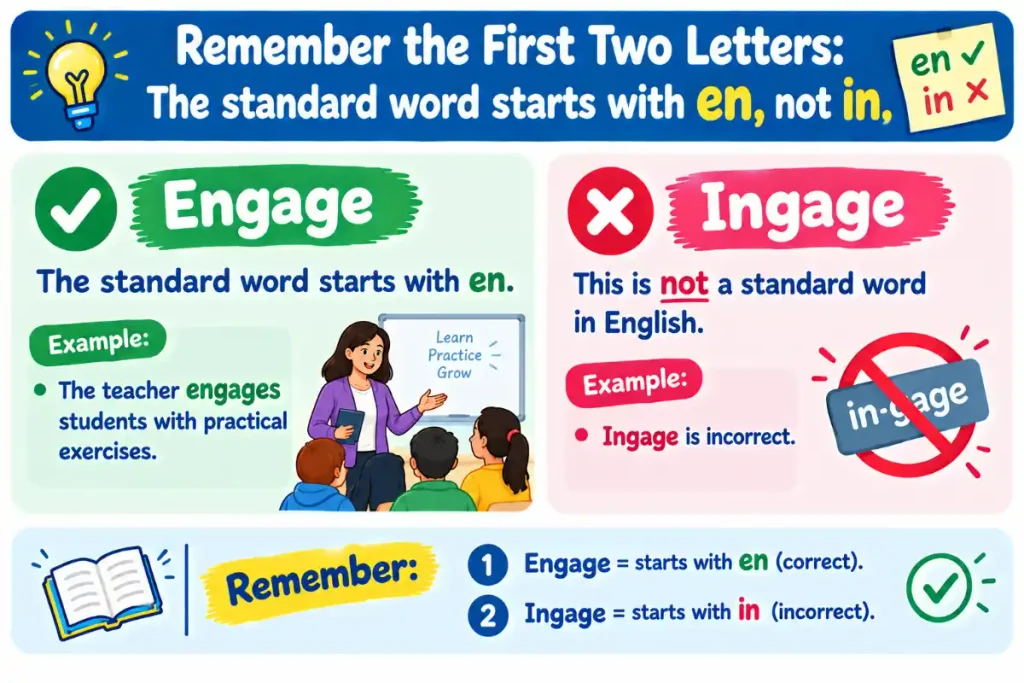
Quick Tips to Remember the Correct Spelling
Use these simple tips to remember the difference between ingage and engage.
- Remember the first two letters: The standard word starts with en, not in.
- Learn a familiar phrase: Practice expressions such as engage in conversation and engage with customers.
- Read your sentence aloud: This can help you check whether the word fits the context, although it may not reveal a spelling mistake by itself.
- Use a spell-checking tool: A dictionary or spelling checker can help identify ingage as an error in ordinary writing.
- Check the meaning: If you mean participate, involve, attract attention, or hire, engage may be the word you need.
- Remember related forms: The standard forms are engages, engaging, and engaged.
The most useful rule is simple: use engage unless you are referring to a specific proper name that intentionally uses a different spelling.
Conclusion
When comparing ingage vs engage, the correct choice for standard modern English is engage. The alternative ingage is generally a spelling mistake unless it appears as an intentional proper name. The verb engage has several useful meanings, including participating in an activity, involving others, attracting attention, communicating, and hiring a professional.
Use expressions such as engage in a discussion and engage with customers to make your meaning clear. Remember that the related forms are engages, engaging, and engaged. If you’re writing a school assignment, professional email, resume, or social media post, choose the established spelling and check that the verb fits the context. Once you remember the en- at the beginning, choosing the correct form becomes much easier.
Frequently Asked Questions
1. Which Is Correct, Ingage or Engage?
Engage is correct in standard modern English. Ingage is generally a misspelling when used with the same meaning.
2. How Do You Spell Engage?
The correct spelling is E-N-G-A-G-E. It begins with en- and ends with -age.
3. What Does Engage Mean?
Engage means to participate in something, become involved, attract attention, interact with someone, or hire a person for a task. The intended meaning depends on the context.
4. Is Ingage Ever Correct?
Ingage is not the standard spelling of the ordinary English verb engage. It may appear in a brand name, username, or other proper name, where the spelling is intentional.
5. What Is the Past Tense of Engage?
The past tense of engage is engaged. For example, The company engaged a consultant last month.
6. What Is Another Word for Engage?
Possible alternatives include involve, participate, interact, connect, attract, and hire. The best choice depends on whether you mean taking part, communicating, attracting attention, or employing someone.
7. Is Engage the Correct Spelling in American English?
Yes. American English uses engage as the standard spelling. The same spelling is also standard in British English.
1 thought on “Ingage vs Engage: Which Spelling Is Correct?”