

If you’re writing an email, school assignment, resume, or social media post, you may wonder whether noteable or notable is the correct spelling. The two words look similar, and the extra vowel in noteable may seem reasonable because the word comes from note. However, only one spelling is standard in modern English.
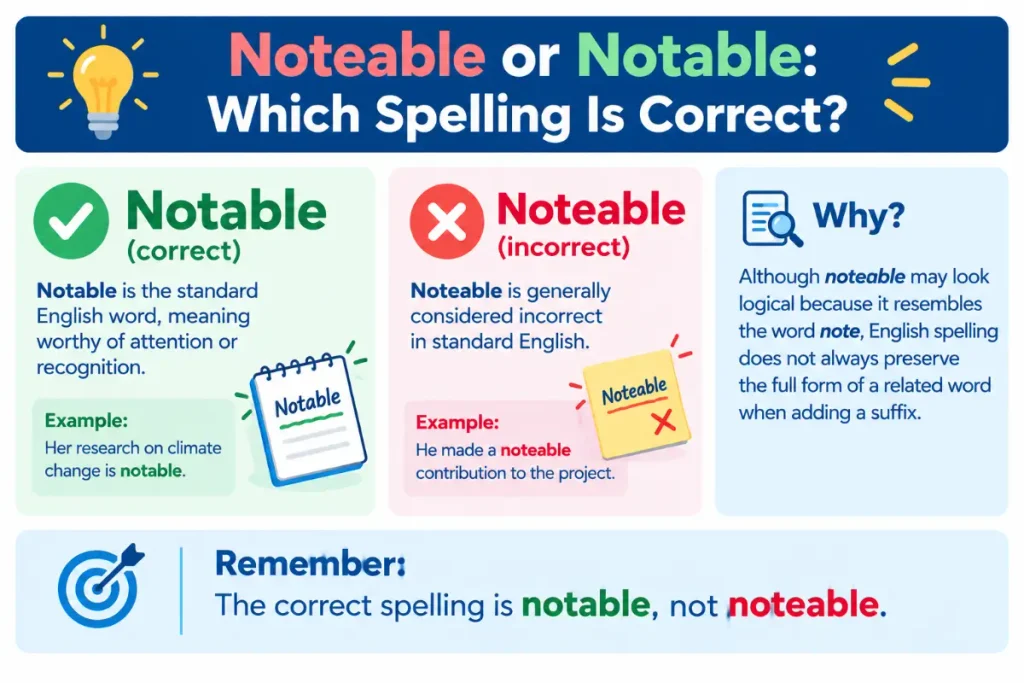
Notable is the correct spelling. It means worthy of attention, important, remarkable, or deserving of notice. Noteable is a common misspelling and should not replace notable in standard American English.
You can use notable to describe an achievement, event, person, change, or feature that stands out for a particular reason. For example, you might describe a student’s notable progress, a notable business achievement, or a notable improvement in a team’s performance.
This guide explains the difference between the two spellings, how to use notable correctly, why the mistake happens, and which alternatives work best in different situations.
Noteable or Notable: What’s the Difference?
The main difference between noteable and notable is spelling. Notable is the correct standard English word, while noteable is generally considered incorrect. Although noteable may look logical because it resembles the word note, English spelling does not always preserve the full form of a related word when adding a suffix.
| Word | Status | Meaning | Example |
|---|---|---|---|
| Notable | Correct | Worthy of attention or notice | She made notable progress in mathematics. |
| Noteable | Incorrect in standard usage | Intended to mean worthy of notice | She made noteable progress in mathematics. |
The second sentence contains a spelling error. Replace noteable with notable to make it correct.
Why Is Notable the Correct Spelling?
English forms many adjectives by adding suffixes to nouns or verbs. However, these spelling patterns vary, and writers cannot always create a correct word by simply adding a suffix to the complete base word. The adjective notable comes from the Latin notabilis, meaning worthy of being noticed. English adopted the word in a form that does not include the extra e found in note. That is why the correct spelling is notable, not noteable.
Is Noteable Ever Correct?
In ordinary American English, noteable is not the accepted spelling of the adjective meaning remarkable or worthy of attention. You may occasionally encounter it in informal writing, online posts, usernames, product names, or other contexts where someone has deliberately chosen that spelling. Such uses do not make it the standard spelling. For schoolwork, professional communication, academic writing, and everyday English, use notable.
What Does Notable Mean?
Notable is an adjective that describes someone or something worthy of attention because of importance, distinction, achievement, or an unusual quality. The word does not always mean famous or extraordinary. Something can be notable simply because it stands out in a particular situation. For example, a student who improves significantly in reading may make notable progress. A small business may achieve notable growth without becoming nationally famous. A change in a company’s schedule may also be notable if it affects many employees.
Here are the main meanings of notable:
- Worthy of attention: Something deserves notice or consideration.
- Remarkable: Something stands out because of a special quality or achievement.
- Important: Something has significance in a particular situation.
- Distinguished: A person has earned recognition for their work or accomplishments.
Examples of Notable in Different Contexts
Education: The student showed notable improvement in writing.
Business: The company reported notable growth during the final quarter.
History: The invention marked a notable moment in the development of modern communication.
Sports: The player made several notable contributions to the team’s victory.
Everyday life: One notable feature of the apartment is its large kitchen.
Each example uses notable to describe something that deserves attention. The specific reason may differ, but the central meaning remains the same.
How to Use Notable Correctly in a Sentence
Use notable before a noun when you want to describe a person, achievement, event, quality, or change that deserves attention. You can also use it after a linking verb such as is, was, or seems.
For example:
- She received recognition for her notable achievements.
- His contribution was notable.
- The report identifies several notable differences between the two products.
- One notable advantage of the new system is its simplicity.
In each sentence, the adjective identifies something worth noticing.
1. Use Notable for Achievements
Notable works well when describing accomplishments that deserve recognition.
Examples:
- The researcher made a notable discovery during the study.
- Her notable achievements helped her earn a promotion.
- The student received an award for notable academic progress.
- The coach praised the team for its notable improvement.
You do not need to describe an achievement as world-famous for notable to fit. The word can refer to progress that matters within a school, workplace, or community.
2. Use Notable for People
You can describe a person as notable when that person is recognized for their achievements, influence, expertise, or contribution.
Examples:
- The conference featured several notable speakers.
- She interviewed a notable author for the school newspaper.
- The museum honors notable figures from the city’s history.
- He became a notable voice in the local business community.
When referring to people, notable often suggests that others recognize their work or influence.
3. Use Notable for Events and Changes
The word also describes events, developments, and changes that stand out.
Examples:
- The town experienced a notable increase in tourism.
- One notable event occurred during the final minutes of the game.
- The new policy introduced several notable changes.
- The report highlights a notable shift in customer preferences.
These sentences focus on developments that deserve attention rather than on people or personal achievements.
4. Use Notable for Features and Differences
Notable can identify an important characteristic or difference between two or more things.
Examples:
- The most notable feature of the phone is its long battery life.
- There is a notable difference between the two proposals.
- One notable benefit of the program is its flexible schedule.
- The designer introduced several notable improvements to the layout.
This use is common in reviews, reports, comparisons, and product descriptions.
Notable vs. Noteable in Real Sentences
The easiest way to remember the difference is to compare incorrect and corrected sentences.
| Incorrect sentence | Correct sentence |
|---|---|
| She made a noteable contribution to the project. | She made a notable contribution to the project. |
| The school showed noteable improvement this year. | The school showed notable improvement this year. |
| His work received noteable recognition. | His work received notable recognition. |
| The report contains several noteable findings. | The report contains several notable findings. |
| One noteable feature is the low price. | One notable feature is the low price. |
| The city has a noteable history. | The city has a notable history. |
| The team achieved noteable success. | The team achieved notable success. |
| Her presentation included noteable examples. | Her presentation included notable examples. |
The correction is the same in every case: remove the unnecessary e and write notable.
Ten More Examples of Notable in Everyday English
Here are additional examples showing how the word fits different situations.
- Work: The manager praised Jordan for making a notable contribution to the project.
- School: Maya made notable progress in reading comprehension this semester.
- Email: I wanted to highlight one notable change in the updated schedule.
- Resume: Led a project that produced notable improvements in customer service.
- Business: The store experienced notable growth after expanding its online services.
- Technology: The latest update includes several notable security improvements.
- Sports: The goalkeeper made a notable save during the final minute.
- History: The building is a notable example of nineteenth-century architecture.
- Community: Volunteers made a notable difference in the neighborhood.
- Social media: One notable moment from the event was the surprise performance.
These examples demonstrate that notable works in both formal and everyday contexts.
Why Do People Confuse Noteable and Notable?
The confusion mainly comes from the relationship between note and notable. Because note ends in e, writers sometimes assume that the adjective should retain that letter. However, spelling in English depends on established word forms, not just on adding suffixes to familiar words.
The Influence of the Word Note
The noun note can mean a short written message, a musical sound, or a point worth remembering. The adjective notable, by contrast, means worthy of attention. The words are related historically, but their modern spellings are different.
Compare these forms:
- Note: Please write a note for your teacher.
- Notable: The teacher made a notable contribution to the school.
- Notably: The school’s attendance improved notably this year.
Notice that notable and notably do not retain the e from note.
The Influence of Other English Words
English contains many words that retain or drop letters when their forms change. This variation can make spelling less predictable.
For example:
| Base word | Related word | Spelling pattern |
|---|---|---|
| Notice | Notable | The adjective has a different established form. |
| Comfort | Comfortable | The adjective uses the suffix -able. |
| Depend | Dependable | The adjective retains the base spelling. |
| Value | Valuable | The final e is dropped. |
| Note | Notable | The standard adjective does not retain the final e. |
These examples show why it is better to learn the accepted spelling of a word than to rely entirely on a spelling rule.
Notable vs Remarkable: What’s the Difference?
Notable means worthy of attention or recognition. Remarkable often suggests that something is especially unusual, impressive, or surprising.
| Word | Meaning | Tone | Example |
|---|---|---|---|
| Notable | Worthy of attention | Neutral to formal | The company reported notable progress. |
| Remarkable | Unusually impressive or surprising | Stronger emphasis | The company achieved remarkable growth in one year. |
Use notable when you want to identify something that deserves attention without overstating its importance. Choose remarkable when the achievement or quality is especially impressive. For example, a student may make notable progress over a semester. If the student improves far beyond expectations, remarkable progress may communicate that stronger achievement.
Notable vs Noticeable: What’s the Difference?
Although notable and noticeable look similar, their meanings differ slightly. Notable describes something worthy of attention or recognition. Noticeable describes something that can be easily seen, heard, felt, or detected.
| Word | Main meaning | Example |
|---|---|---|
| Notable | Worthy of attention or recognition | She made a notable contribution to the research. |
| Noticeable | Easy to observe or detect | There was a noticeable change in the room’s temperature. |
A difference can be noticeable without being important. For instance, a small change in a room’s lighting may be easy to see but not especially significant. A notable difference, however, is one that deserves attention because of its relevance or importance.
When Should You Use Each Word?
Use notable when discussing significance, distinction, or achievement.
- The report identifies a notable improvement in performance.
- The author made a notable contribution to the debate.
Use noticeable when describing something perceptible.
- The new paint created a noticeable difference in the room.
- There was a noticeable increase in background noise.
Choosing the right word makes your meaning more precise.
Notable vs. Famous: What’s the Difference?
Notable and famous sometimes describe the same person or event, but their meanings are not identical. Famous means widely known by many people. Notable means worthy of attention or recognition. A person can be notable within a particular field without being famous to the general public.
| Word | Meaning | Example |
|---|---|---|
| Notable | Worthy of attention | The scientist made a notable contribution to medicine. |
| Famous | Known by many people | The scientist became famous after appearing on television. |
Use notable when the person’s achievement or importance matters more than public recognition. Use famous when widespread awareness is the main point.
What Are the Best Synonyms for Notable?
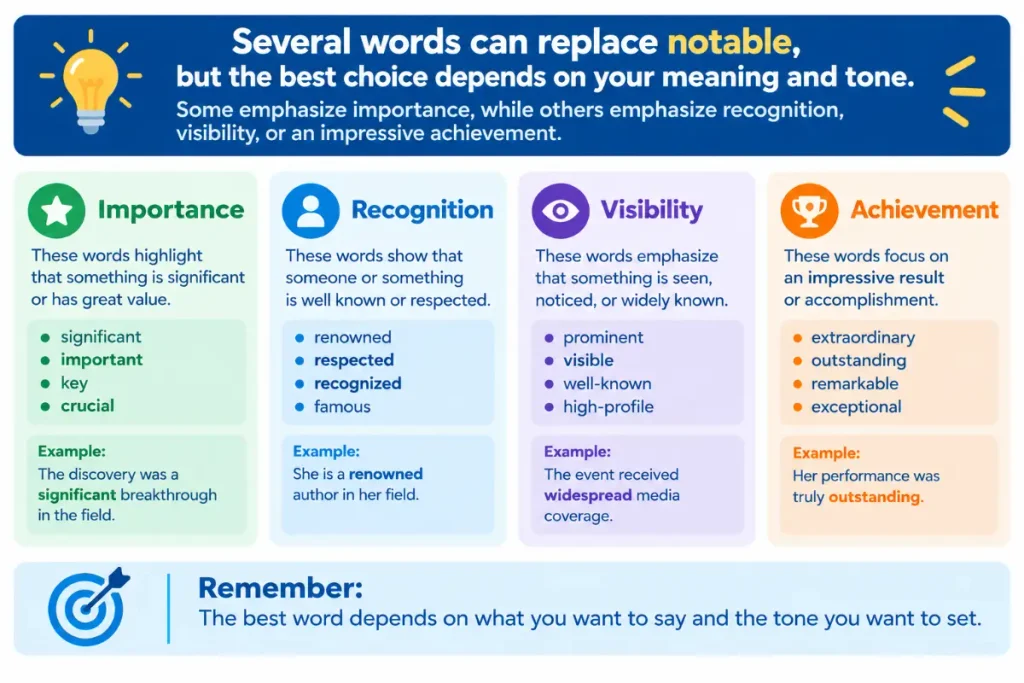
Several words can replace notable, but the best choice depends on your meaning and tone. Some emphasize importance, while others emphasize recognition, visibility, or an impressive achievement.
Common Synonyms for Notable
| Word or phrase | Meaning | Tone | Example |
|---|---|---|---|
| Remarkable | Unusually impressive | Strong | She made remarkable progress. |
| Significant | Important or meaningful | Neutral/formal | The study found a significant change. |
| Important | Having considerable value | Everyday | This is an important decision. |
| Distinguished | Recognized for excellence | Formal | The event honored distinguished scholars. |
| Outstanding | Exceptionally good | Positive | He delivered outstanding results. |
| Prominent | Well-known or influential | Formal | She is a prominent local leader. |
| Memorable | Worth remembering | Everyday | It was a memorable performance. |
| Impressive | Causing admiration | Positive | The team achieved impressive results. |
| Exceptional | Unusually good or different | Strong | She demonstrated exceptional skill. |
| Recognized | Acknowledged for an achievement | Neutral | He is a recognized expert in the field. |
| Renowned | Widely respected or known | Formal | The city is home to a renowned museum. |
| Celebrated | Publicly admired | Positive/formal | The celebrated author visited the school. |
| Distinguished | Showing high achievement or status | Formal | The distinguished guest addressed the audience. |
| Worthwhile | Valuable or useful | Neutral | The project produced worthwhile results. |
| Meaningful | Having significance | Neutral | The meeting led to meaningful changes. |
| Salient | Most relevant or noticeable | Academic/formal | The report identifies the salient issues. |
| Striking | Attracting attention strongly | Descriptive | The chart shows a striking difference. |
| Evident | Clear or apparent | Neutral | An evident improvement followed the changes. |
| Significant | Worth attention because of its impact | Formal | The policy had a significant effect. |
| Influential | Able to affect people or events | Neutral/formal | She became an influential community leader. |
Some words in this table overlap in meaning, but they are not interchangeable in every sentence. For example, renowned usually implies widespread recognition, while salient refers to the most relevant or important point in a particular context.
Simple Alternatives for Everyday Writing
For everyday communication, these alternatives are often easy to understand:
- Important
- Remarkable
- Impressive
- Memorable
- Significant
- Worth noticing
Examples:
- Original: The speaker made a notable point.
- Alternative: The speaker made an important point.
- Original: The team achieved notable results.
- Alternative: The team achieved impressive results.
- Original: The event was notable.
- Alternative: The event was memorable.
Choose an alternative that preserves the original meaning instead of replacing the word simply to avoid repetition.
Formal Alternatives for Academic and Professional Writing
In academic papers, business reports, and formal correspondence, you may prefer words such as significant, distinguished, salient, or prominent.
For example:
- The research identified significant differences between the groups.
- The report highlights the salient features of the proposal.
- The conference welcomed distinguished professionals from several industries.
- The organization has a prominent role in the local economy.
Be careful with significant in scientific writing. In statistical contexts, it can have a specific technical meaning. Do not use it to imply statistical significance unless the evidence supports that interpretation.
Alternatives for Stronger Emphasis
If you want to emphasize an achievement that stands well above the ordinary, consider:
- Exceptional
- Outstanding
- Extraordinary
- Remarkable
- Impressive
- Unprecedented
These words are generally stronger than notable. However, unprecedented means that something has no known earlier example, so it should only be used when that claim is accurate. For example, a notable increase in sales does not necessarily represent an unprecedented increase. The second phrase makes a much stronger claim.
What Is the Opposite of Notable?
The opposite of notable depends on the context. If something deserves little attention, you might describe it as ordinary, unremarkable, or insignificant.
| Antonym | Meaning | Example |
|---|---|---|
| Ordinary | Normal or typical | It was an ordinary day at the office. |
| Unremarkable | Not especially unusual or impressive | The review described the performance as unremarkable. |
| Insignificant | Too small or unimportant to matter in context | The report found an insignificant difference. |
| Inconspicuous | Not attracting attention | The building has an inconspicuous entrance. |
| Minor | Small in importance or scale | The update included only minor changes. |
| Unimportant | Lacking importance | The detail was unimportant to the main argument. |
These words are not exact opposites in every situation. For example, inconspicuous usually refers to something that does not attract attention, while insignificant emphasizes a lack of importance. Choose the antonym that matches the quality you want to describe.
Is Notable Formal or Informal?
Notable works in both formal and informal English, although it appears particularly often in professional, academic, journalistic, and descriptive writing. It is not overly technical, so you can use it in everyday conversation as well.
Notable in Professional Emails
In a workplace email, notable can highlight an important development without sounding overly dramatic.
Examples:
- The revised proposal includes several notable improvements.
- I would like to highlight one notable change to the schedule.
- The team made notable progress toward its quarterly goals.
For a more conversational message, you might use important or impressive, depending on the intended meaning.
Notable in Resumes
On a resume, notable can describe achievements, contributions, or improvements. However, specific results usually communicate more than a general adjective.
Compare these statements:
- Less specific: Made notable improvements to customer service.
- More specific: Improved customer response times by redesigning the support process.
The second version explains the achievement directly. If you use notable on a resume, connect it to a concrete accomplishment whenever possible.
Notable in Academic Writing
Academic writing often uses notable to identify findings, differences, contributions, or developments that deserve attention.
Examples:
- The study identified several notable patterns in the data.
- One notable limitation was the small sample size.
- The author made a notable contribution to the field.
Use the word carefully. Calling a finding notable does not prove that it is statistically significant or scientifically conclusive. Explain the evidence that makes the finding worthy of attention.
Notable in Everyday Conversation
You can also use the word in casual conversation, although simpler alternatives may sound more natural.
For example:
- One notable thing about the restaurant is its friendly service.
- There was a notable change in his attitude.
- The most notable part of the trip was the mountain scenery.
In a relaxed conversation, you could say the best part, the biggest change, or the most impressive thing instead.
Is Notable Spelled Differently in American and British English?
No. Notable is the standard spelling in both American and British English. Unlike words such as color and colour or organize and organise, this word does not have a standard American-versus-British spelling difference.
| English variety | Correct spelling | Example |
|---|---|---|
| American English | Notable | The company achieved notable success. |
| British English | Notable | The company achieved notable success. |
| Canadian English | Notable | The report identifies a notable trend. |
| Australian English | Notable | The event attracted notable speakers. |
You should use notable regardless of which major variety of English you are writing. The spelling noteable is not the standard British alternative. It is generally treated as a misspelling rather than a regional variant.
Common Mistakes to Avoid When Using Notable
Learning the correct spelling is important, but writers can also misuse the word by choosing an unsuitable context or confusing it with a similar adjective.
Mistake 1: Adding an Extra E
Incorrect: The organization made a noteable contribution.
Correct: The organization made a notable contribution.
Remember that the standard spelling does not preserve the final e from note.
Mistake 2: Confusing Notable With Noticeable
Incorrect: The sound was notable from the next room.
Better: The sound was noticeable from the next room.
If you mean that something can be heard, seen, or detected, noticeable may be the better choice. Use notable when the subject deserves attention or recognition.
Mistake 3: Treating Notable as a Synonym for Famous
Incorrect: The local volunteer was notable because everyone in the country knew her name.
Better: The local volunteer was famous because people across the country knew her name.
The first sentence is not necessarily grammatically wrong, but famous expresses widespread public recognition more directly.
Mistake 4: Using Notable Without Supporting Details
Weak: The company made notable improvements.
Stronger: The company made notable improvements to its delivery process, reducing delays for customers.
The stronger sentence explains what improved and why the change matters. Specific details make your writing clearer and more convincing.
Mistake 5: Overusing Notable
Repeatedly using the same adjective can make an article or report sound repetitive.
Instead of writing:
- The company achieved notable growth.
- It introduced notable changes.
- It made notable improvements.
Vary the wording when the meanings support it:
- The company achieved significant growth.
- It introduced several important changes.
- It made impressive improvements.
Do not replace notable with a different word merely for variety. Choose the term that best communicates the intended meaning.
How to Remember the Correct Spelling of Notable
If you often write noteable by mistake, a simple memory trick can help.
Use the Word Notably
Remember the related word notably, which means particularly or especially. Both notable and notably use the same base spelling.
- Notable achievement
- Notable difference
- Notably improved
- Notably successful
The spelling pattern makes it easier to remember that the adjective does not contain the extra e.
Learn the Word as a Complete Unit
Rather than trying to build the adjective from note every time, memorize the standard form:
N-O-T-A-B-L-E
Then practice using it in short phrases:
- A notable achievement
- A notable change
- A notable person
- A notable difference
- A notable contribution
Repeated exposure to the correct form can make it easier to recognize and use automatically.
Check the Sentence Before Publishing
If you’re preparing an assignment, report, resume, or email, review the spelling before sending or submitting it. Spell-checking tools may catch noteable, but you should still learn the correct form rather than relying entirely on automatic corrections. A quick proofreading habit can help you avoid this error and other common spelling mistakes.
Quick Tips for Choosing the Correct Word
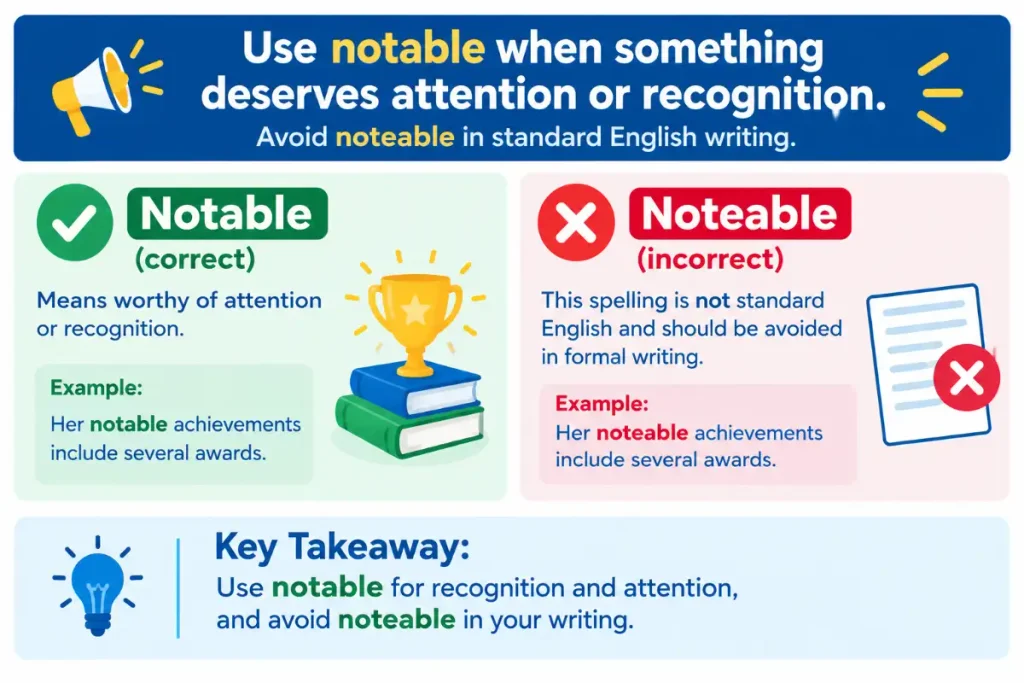
- Use notable when something deserves attention or recognition.
- Avoid noteable in standard English writing.
- Use noticeable when something is easy to see, hear, or detect.
- Use remarkable when something is especially impressive or unusual.
- Use famous when widespread public recognition is the main point.
- Add specific details when describing a notable achievement or change.
Conclusion
The correct spelling is notable, not noteable. Although the incorrect form may seem logical because the word note ends in e, standard English uses the established spelling notable without that extra letter.
Use notable when describing an achievement, person, event, feature, or change that deserves attention. The word works well in academic assignments, business reports, resumes, professional emails, and everyday communication. If you mean that something is easy to see or detect, noticeable may be more appropriate. If you want to emphasize exceptional quality, consider remarkable or impressive.
When choosing between noteable or notable, remember the simple rule: write notable every time you mean worthy of attention or recognition. Learning this spelling will help you communicate more clearly and avoid a common writing mistake.
Frequently Asked Questions
Which is correct, noteable or notable?
Notable is correct. It means worthy of attention, important, or remarkable. Noteable is generally considered a misspelling in standard English.
What does notable mean in simple words?
Notable means worth noticing or paying attention to. For example, a notable improvement is a change that stands out as important or meaningful.
Why is notable not spelled noteable?
English adopted notable from the Latin notabilis. Its established English spelling does not include the extra e found in the word note.
Is notable a real word?
Yes, notable is a standard English adjective. Writers use it to describe important achievements, distinguished people, significant changes, and other things worthy of attention.
Is noteable ever acceptable in English?
Noteable may appear in names, usernames, or nonstandard writing, but it is not the accepted spelling of the adjective meaning worthy of attention. Use notable in school, professional, and everyday writing.
What is another word for notable?
Common alternatives include remarkable, significant, important, impressive, and outstanding. The best choice depends on whether you want to emphasize importance, visibility, recognition, or exceptional quality.
Is notable the same as noticeable?
No. Notable means worthy of attention, while noticeable means easy to observe or detect. A change can be noticeable without being important enough to be notable.
2 thoughts on “Noteable or Notable: Which Spelling Is Correct?”