
If you’re writing an email, school assignment, or text message, you may wonder how to spell until correctly. The word is common in everyday English, but some people confuse it with untill or wonder whether till is also correct. Knowing the difference helps you write clearly and avoid spelling mistakes.
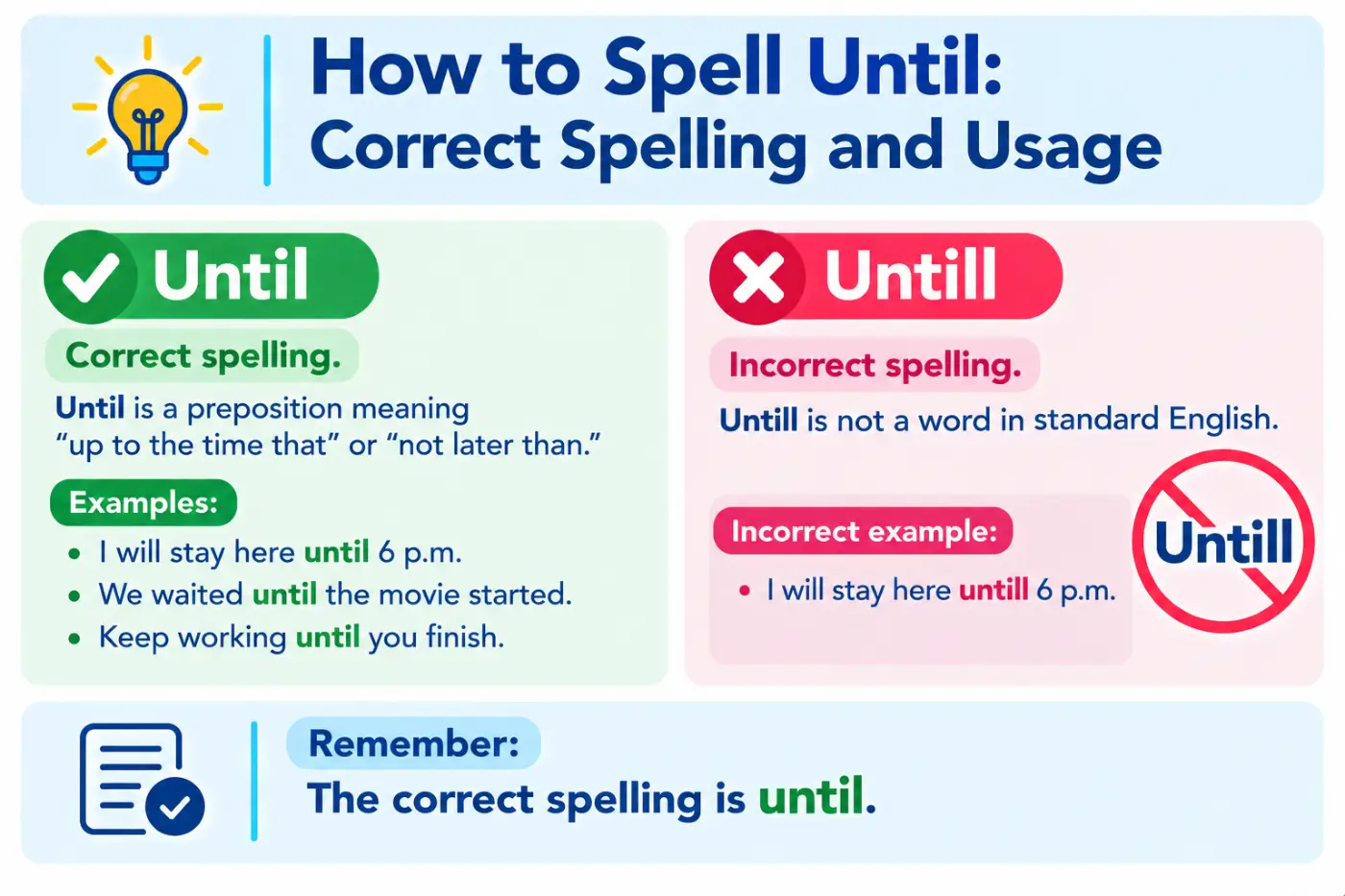
The correct spelling is until, with one final L. The spelling untill is incorrect in standard English, while till is also a correct word with a similar meaning.
You can use until to describe how long something continues or when an event will happen. For example, “I will wait until noon” means that the waiting will continue up to noon.
This article explains how to spell until, what the word means, how to use it in sentences, and how it differs from similar words such as till, by, and before.

What Is the Correct Spelling of Until?
The correct spelling is until. It contains five letters: U, N, T, I, and L. The word ends with one L, not two. Here is a quick comparison of the correct and incorrect forms.
| Spelling | Status | Example |
|---|---|---|
| Until | Correct | Please stay here until I return. |
| Untill | Incorrect | Please stay here untill I return. |
| Till | Correct | The store is open till 9 p.m. |
| ‘Til | Informal or stylistic | I’ll be here ’til noon. |
For standard American English, use until in formal writing, academic assignments, professional emails, and most everyday communication. You can also use till when it sounds natural. Remember that until does not need a second L at the end. If you are unsure how to spell until, write the word slowly and check that it ends with just one L.
What Does Until Mean?
Until means up to a particular time or event. It shows that an action, condition, or situation continues and identifies the point at which it stops or changes.
For example:
- I studied until midnight.
- The library remains open until 8 p.m.
- Please wait until the teacher arrives.
- We cannot start until everyone is ready.
In the first sentence, the studying continued up to midnight. In the second, the library’s opening hours extend to 8 p.m. In the third, the person must wait for the teacher’s arrival. The word can refer to a specific time, such as 5 p.m., or an event, such as a meeting ending.
Is Until a Preposition or a Conjunction?
Until can function as both a preposition and a conjunction, depending on how you use it in a sentence.
1. Until as a preposition
A preposition connects a time or event to the rest of the sentence. When until comes before a noun or noun phrase, it often functions as a preposition.
Examples:
- We worked until sunset.
- The office is closed until Monday.
- She stayed at the party until midnight.
In these sentences, sunset, Monday, and midnight identify the endpoint of an activity or situation.
2. Until as a conjunction
A conjunction connects a main clause to another clause. When until introduces a clause containing a subject and a verb, it functions as a conjunction.
Examples:
- Wait until I call you.
- We will stay until the rain stops.
- He practiced until he felt confident.
In each example, the clause after until explains the event that marks the endpoint. Understanding these two uses can help you recognize the word in different sentence structures.
How Do You Use Until Correctly?
Use until when you want to show that an action, event, or condition continues up to a particular time or event. The word works in past, present, and future contexts.
1. Use Until for a Specific Time
You can place until before a clock time, day, date, or other time expression.
Examples:
- The restaurant serves breakfast until 11 a.m.
- I will work until 6 p.m.
- The sale runs until Friday.
- We stayed at the beach until sunset.
These sentences identify the time when an activity or situation ends.
2. Use Until Before an Event
You can also use until before a clause describing an event.
Examples:
- Wait until your name is called.
- I won’t leave until my ride arrives.
- The students talked until the bell rang.
- Keep reading until you reach the final chapter.
The event following until provides the endpoint rather than a specific time on the clock.
3. Use Until in Negative Sentences
Negative sentences with until often mean that something does not happen before a particular time or event.
Examples:
- I didn’t understand the question until the teacher explained it.
- She won’t make a decision until she reviews the details.
- We didn’t receive the package until Thursday.
- He didn’t realize his mistake until he checked his work.
In these examples, the action or realization happens at the stated point or afterward, rather than before it.
4. Use Until in Everyday Conversation
Until is common in ordinary speech and informal writing. You do not need to replace it with a more complicated expression to sound natural.
Examples:
- I’ll be home until dinner.
- Let’s wait until tomorrow.
- Don’t open the gift until your birthday.
- I’ll stay here until you get back.
These sentences are clear, natural, and appropriate for everyday American English.
Until vs Untill: What’s the Difference?
The difference between until and untill is spelling. Until is the correct standard spelling, and untill is a misspelling. Both forms may look plausible because English has many words with doubled consonants, such as still and full. However, until does not follow that pattern.
| Word | Correct? | Explanation |
|---|---|---|
| Until | Yes | Standard spelling with one L |
| Untill | No | Incorrect extra L |
| Till | Yes | Separate word with a similar meaning |
Examples of correct usage:
- Correct: The meeting will continue until noon.
- Incorrect: The meeting will continue untill noon.
- Correct: Please wait until further notice.
If you have typed untill in a document, replace it with until. Spell-checking tools often identify the error, but learning the correct form helps you catch it yourself. There is no standard American English context in which untill becomes the preferred spelling. Use until consistently in formal and informal writing.
Until vs Till: Which Is Correct?
Both until and till are correct. They generally express the same idea: up to a certain time or event. The main difference is style. Until is common in both formal and informal writing, while till often sounds slightly more conversational.
| Feature | Until | Till |
|---|---|---|
| Meaning | Up to a time or event | Up to a time or event |
| Spelling | Correct | Correct |
| Formal writing | Suitable | Also acceptable, depending on context |
| Everyday conversation | Common | Common |
| Example | Stay until Friday. | Stay till Friday. |
Consider these sentences:
- I will remain at the office until 5 p.m.
- I will remain at the office till 5 p.m.
Both sentences are grammatically correct and communicate the same general meaning. For a formal report or academic paper, until is a safe, neutral choice. In casual conversation, text messages, and everyday writing, either form works.
Is Till a Shortened Form of Until?
No. Till is not simply a modern abbreviation of until. It is an established English word in its own right and has a long history of use.
The apostrophe form ’til is also used informally as a shortened-looking version of until or till. However, till itself does not require an apostrophe.
or standard writing, choose until or till without an apostrophe.
Until vs. ‘Til: Which Spelling Should You Use?
The form ’til appears in songs, informal messages, creative writing, and casual expressions. However, it is less suitable for formal or academic writing.
Compare these examples:
- Standard: I’ll wait until you arrive.
- Standard: I’ll wait till you arrive.
- Informal: I’ll wait ’til you arrive.
All three communicate a similar idea, but the first two are better choices for general-purpose writing. The apostrophe in ’til signals an informal shortened form. It may be appropriate when you want to reproduce someone’s speaking style or create a particular tone in dialogue. For schoolwork, business emails, and professional documents, use until unless you have a specific stylistic reason to choose another form.
Until vs By: What’s the Difference?
Until and by both refer to time, but they express different ideas. Understanding the distinction can prevent confusion in deadlines and schedules. Until describes how long an activity or condition continues. By identifies a deadline or the latest time something should happen.
| Word | Main meaning | Example |
|---|---|---|
| Until | Up to a time or event | I will work until 5 p.m. |
| By | No later than a time | I will finish the report by 5 p.m. |
In the first sentence, the speaker plans to continue working up to 5 p.m. In the second, the speaker promises to finish the report no later than 5 p.m.
More examples:
- The store stays open until 9 p.m.
- Please return the form by 9 p.m.
- We waited until the bus arrived.
- You must submit the assignment by Friday.
Using the correct word is especially important when discussing deadlines, appointments, and workplace responsibilities.
Until vs Before: What’s the Difference?
Until and before both refer to time, but they emphasize different relationships between events. Until describes a situation that continues up to a point. Before means earlier than a specified time or event.
| Word | Meaning | Example |
|---|---|---|
| Until | Continuing up to a point | Stay here until I return. |
| Before | Earlier than a point | Finish your homework before dinner. |
The first sentence tells someone to remain in a place until the speaker returns. The second requires the homework to be completed earlier than dinner.
Consider two more examples:
- I waited until the store opened.
- I arrived before the store opened.
The first describes waiting that continues to the opening time. The second describes arriving earlier than that time. Choosing between these words depends on whether you want to emphasize continuation or an earlier deadline.
15 Examples of Until in Real Sentences
The following examples show how to use until in different everyday situations.
Work and Professional Communication
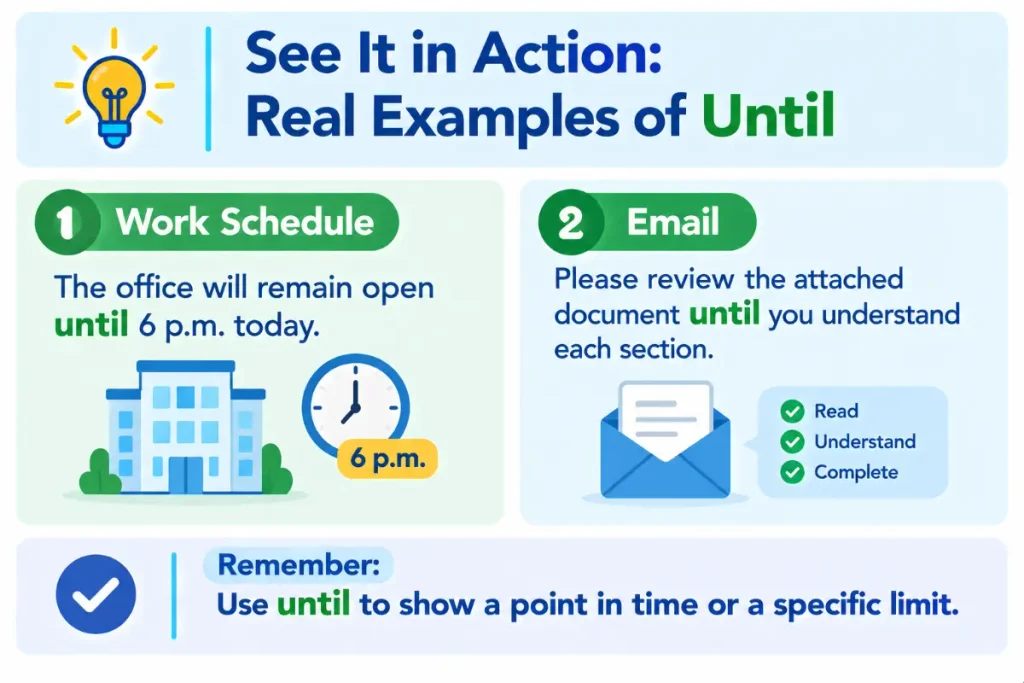
- Work schedule: The office will remain open until 6 p.m. today.
- Email: Please review the attached document until you understand each section.
- Project deadline: We will continue testing until the software meets the required standards.
- Meeting: The manager stayed until the final question was answered.
- Workplace update: I will be unavailable until Monday morning.
In the second example, a more natural alternative may be “Please review the attached document until you understand each section,” although “Please review the attached document and make sure you understand each section” is clearer for many professional situations.
School and Academic Writing
- Homework: Maya studied until she finished her history assignment.
- Classroom: The students remained quiet until the teacher began speaking.
- Research: The team gathered information until it had enough evidence to support its conclusion.
- Exam preparation: I practiced the equations until I could solve them without help.
- School schedule: The library will be closed until the semester begins.
Everyday Life and Conversation
- Family plans: We’ll wait until everyone arrives before serving dinner.
- Shopping: The store is offering discounts until Saturday.
- Travel: We stayed at the airport until our flight was announced.
- Text message: Don’t start the movie until I get there.
- Personal plans: I’m going to relax until it’s time to leave.
These examples illustrate how the word connects an ongoing action or condition to a time or event.
Common Mistakes When Using Until
Although until is a simple word, a few mistakes appear frequently in everyday writing.
1. Adding an Extra L
Incorrect: We waited untill the bus arrived.
Correct: We waited until the bus arrived.
The correct spelling contains only one L at the end. This is the most common spelling distinction to remember.
2. Confusing Until With By
Incorrect: Please stay by 8 p.m. if you mean that the person should remain there throughout the period.
Better: Please stay until 8 p.m.
Use until to describe how long someone should stay. Use by to give a deadline, such as “Please arrive by 8 p.m.”
3. Using Until When Before Is More Appropriate
Incorrect: Please finish the assignment until Friday if you mean that Friday is the deadline.
Better: Please finish the assignment by Friday.
You could also say, “Please finish the assignment before Friday,” if you mean it must be done earlier than Friday.
4. Adding Unnecessary Words
Wordy: I will continue to wait until the time when you arrive.
Clearer: I will wait until you arrive.
A shorter sentence often communicates the same meaning more clearly.
5. Assuming Till Is Incorrect
Incorrect assumption: You must always use until because till is misspelled.
Correct understanding: Both until and till are standard English words.
Choose the one that fits the tone of your sentence. Do not confuse till with untill, which is incorrect.
6. Misusing Until in a Sentence
Awkward: I will wait until 5 p.m. and then continue waiting until 6 p.m. because the first time has already passed.
Clearer: I will wait until 6 p.m.
This is not a spelling error, but it shows why checking the intended time relationship can improve clarity.
Is Until One Word or Two?
Until is always written as one word in standard English. Do not separate it into two words or add spaces within it.
Correct:
- until tomorrow
- until next week
- until the meeting ends
- until further notice
Incorrect:
- un til tomorrow
- un-till tomorrow
- un till tomorrow
There is no need for a hyphen or space when you write until. It remains one word regardless of whether it appears before a noun, a time expression, or a clause.
Is Until Formal or Informal?
Until is appropriate in both formal and informal contexts. It is a neutral word, so you can use it in professional documents, academic writing, emails, and casual conversation.
| Context | Example | Suitability |
|---|---|---|
| Academic writing | The experiment continued until the results stabilized. | Appropriate |
| Professional email | Please send the updated file by noon; I will be available until 3 p.m. | Appropriate |
| Everyday conversation | I’ll wait until you get here. | Appropriate |
| Text message | Call me when you’re free. I’ll be around until 8. | Appropriate |
| Formal announcement | The building will remain closed until further notice. | Appropriate |
You do not need to replace until with a longer phrase such as “up to the point at which” to sound professional. In most cases, until is simpler and clearer.
Does American English Spell Until Differently From British English?
No. American and British English both use the spelling until. The word does not change its spelling across these varieties of English. Similarly, till is an established word in both American and British English.
Examples:
- American English: The museum is open until 6 p.m.
- British English: The museum is open until 6 p.m.
The wording may vary in other parts of a sentence because of regional vocabulary or style, but the spelling of until remains the same. If you are writing for a US audience, use until confidently. There is no need to change it to another spelling for American English.
What Is the Origin of Until?
The word until developed from older English forms associated with the idea of reaching a particular point in time. It is related historically to till, which has also been used to express the meaning “up to.” Both words have been part of English for centuries. Their continued use explains why modern English accepts both until and till as correct forms. You do not need to know the word’s full history to spell it correctly. The practical rule is simple: write until with one L at the end, and use till as a separate, valid alternative when appropriate.
What Are Some Alternatives to Until?
The best alternative depends on the meaning you want to express. Some words indicate a deadline, while others describe continuation or a point in time.
| Alternative | Meaning | Example |
|---|---|---|
| Till | Up to a time or event | Stay till noon. |
| Up to | Continuing as far as a point | The road is open up to the bridge. |
| Through | Continuing during a period, often including its endpoint | The office is open through Friday. |
| By | No later than a deadline | Finish the report by Friday. |
| Before | Earlier than a time or event | Arrive before noon. |
| Pending | While awaiting a decision or event | The request remains pending approval. |
| Prior to | Before a specified time or event | Submit the form prior to the meeting. |
These alternatives are not always interchangeable with until. For example, “The office is open through Friday” usually indicates that Friday is included, while “The office is open until Friday” may depend on context and how the speaker defines the closing point. Choose the expression that communicates your intended timing most accurately.
Quick Tips to Remember the Correct Spelling
Use these simple tips whenever you are unsure how to spell until.
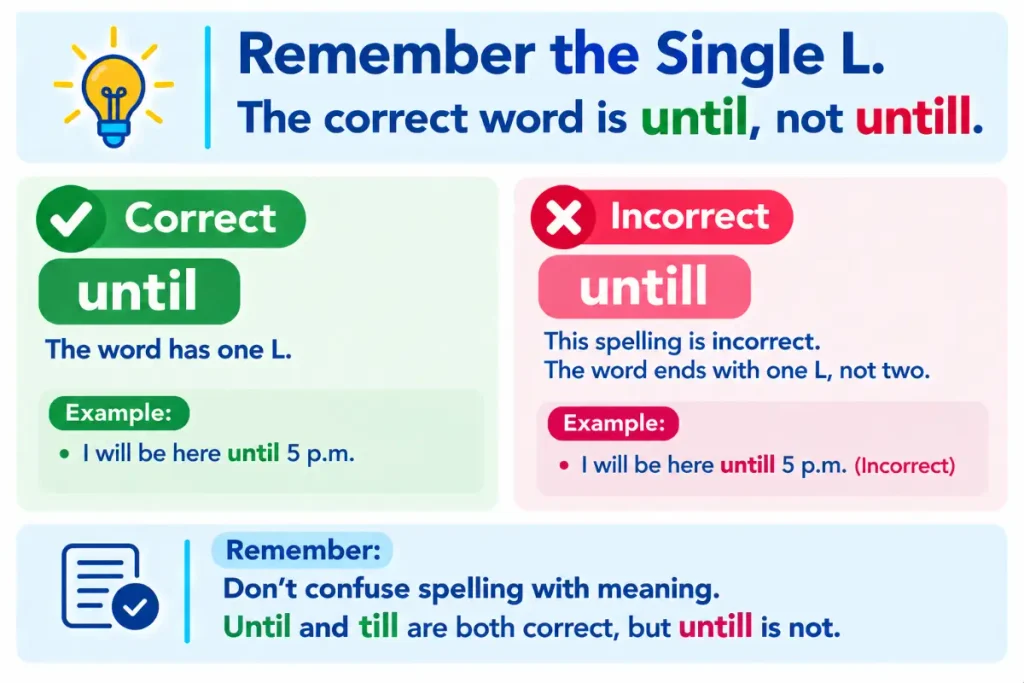
- Remember the single L. The correct word is until, not untill.
- Don’t confuse spelling with meaning. Until and till are both correct, but untill is not.
- Use until for continuation. “I worked until 5 p.m.” describes how long the work continued.
- Use by for deadlines. “I finished the work by 5 p.m.” tells the reader when the task was completed.
- Choose before for earlier timing. “Finish the task before dinner” means to complete it earlier than dinner.
- Keep formal writing simple. Until works well in academic assignments, professional emails, and reports.
- Check the sentence’s meaning. Correct spelling matters, but choosing the right time expression makes your writing clearer.
These rules cover most situations in which writers need to choose between until and similar time expressions.
Conclusion
Learning how to spell until correctly is simple once you remember that the word ends with one L. The spelling untill is incorrect, while till is a valid alternative with a similar meaning. Both correct forms can describe an action or situation that continues up to a particular time or event.
Use until in school assignments, professional emails, reports, and everyday conversations when you want a clear, neutral expression. Remember to distinguish it from by, which indicates a deadline, and before, which refers to an earlier time. These words may appear similar in some sentences, but they communicate different timing relationships.
The next time you wonder how to spell until, write it with one L and check that it expresses the meaning you intend. With this simple rule, you can use the word confidently and keep your writing accurate and easy to understand.
Frequently Asked Questions
1. How do you spell until correctly?
The correct spelling is until, with one L at the end. The spelling untill is incorrect in standard English.
2. Is it until or untill?
Until is correct, and untill is incorrect. Always use until in standard American English writing.
3. Is till a correct word?
Yes, till is a correct English word that means up to a particular time or event. It can replace until in many sentences.
4. Should I use until or till in formal writing?
Both are correct, but until is a safe and neutral choice for formal writing. Use it in academic papers, professional emails, and official documents when you want a straightforward tone.
5. Is ’til grammatically correct?
The form ’til appears in informal writing and creative contexts, but until and till are more straightforward choices for standard writing. The apostrophe form is generally unnecessary in formal documents.
6. What is the difference between until and by?
Until describes how long an action or condition continues, while by identifies a deadline. For example, “I worked until 5 p.m.” describes the duration of work, whereas “I finished by 5 p.m.” gives the latest completion time.
7. How do you remember how to spell until?
Remember that until ends with one L. You can also remember that till is a separate correct word, but adding another L to until creates the misspelling untill.
1 thought on “How to Spell Until: Correct Spelling and Usage”