
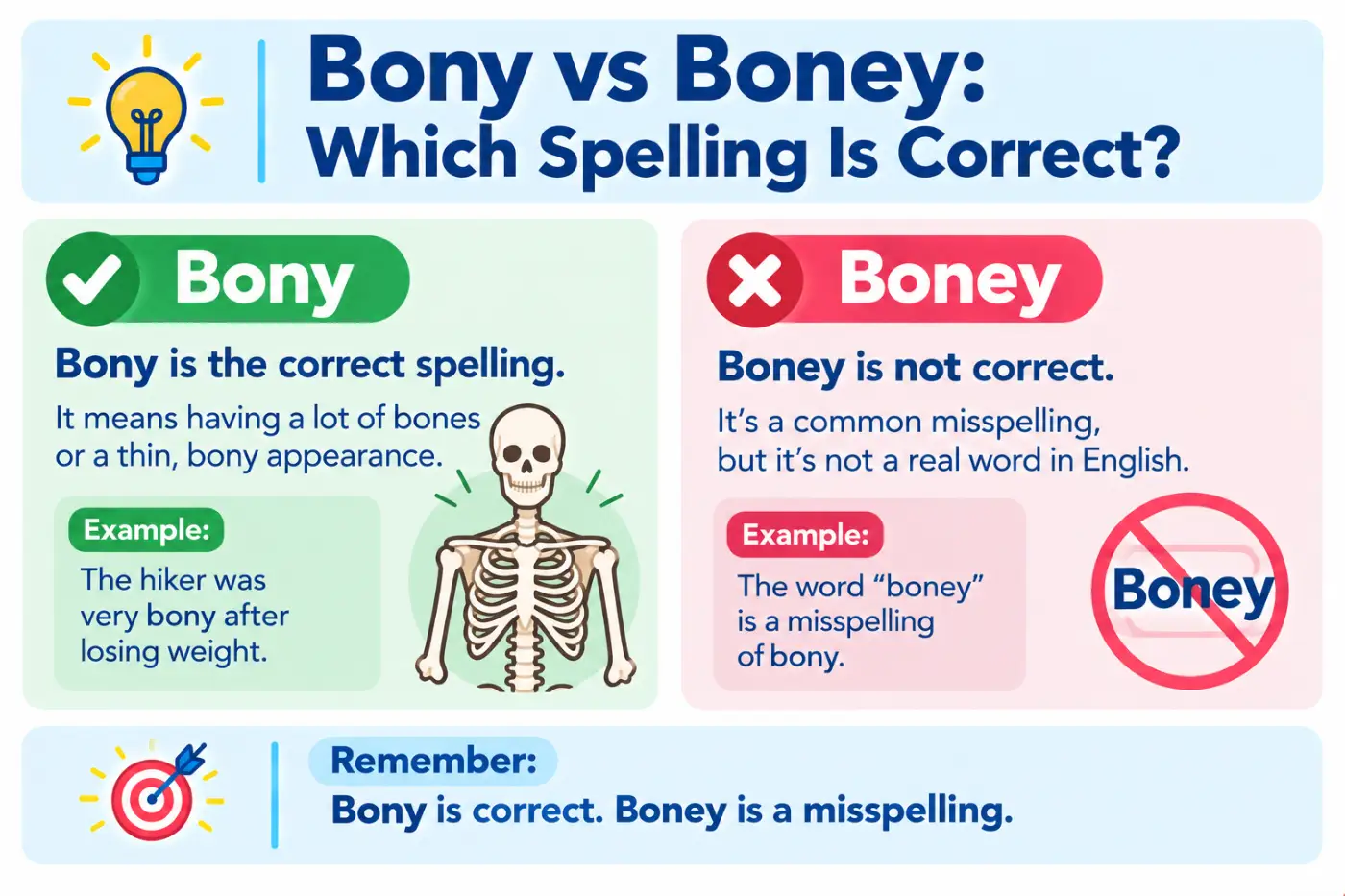
If you’re unsure whether to write Bony vs Boney, both spellings may appear in English, but they do not have the same level of common usage. The difference becomes especially important when you describe someone or something with prominent bones.
Bony is the standard and much more common spelling in American English. Boney is a less common variant that appears in some dictionaries and may also occur in names or informal contexts. In most everyday writing, bony is the preferred choice.
This article explains the difference between bony vs boney, defines each spelling, shows how to use them in sentences, and explains which form works best in American English.
Bony vs Boney: What’s the Difference?
The main difference is spelling and frequency, not a major difference in meaning.
| Word | Meaning | Commonness | Example |
|---|---|---|---|
| bony | Having many or prominent bones; resembling bone | Standard and very common | The dog had a bony frame. |
| boney | A variant spelling of bony | Less common | The old horse looked boney. |
In American English, bony is generally the preferred spelling. If you’re writing an essay, email, article, report, or other formal text, use bony unless you have a specific reason to use boney.
What Does Bony Mean?
Bony is an adjective that means having prominent or noticeable bones, consisting largely of bone, or relating to bones.
For example:
- The puppy had a bony body.
- His bony hands rested on the table.
- The fish was too bony to eat comfortably.
- The doctor examined the bony structure of the foot.
The exact meaning depends on context. Bony can describe a person’s or animal’s physical structure, an object containing many bones, or something associated with bones.
Bony Can Describe a Person or Animal
When bony describes someone’s appearance, it usually means that the person’s bones are especially noticeable.
For example:
The old man had a bony face and sharp features.
It can also describe an animal:
The stray cat looked bony after spending so much time outside.
Because descriptions of people’s bodies can sound negative depending on context, choose the word carefully. In neutral or professional writing, terms such as thin, slender, or angular may sometimes be more appropriate, depending on what you actually mean.
Bony Can Describe Food
Bony is also commonly used for fish or meat that contains many bones.
For example:
This fish is delicious, but it’s very bony.
Here, bony doesn’t describe someone’s appearance. It means the food contains many bones that may make it difficult to eat.
Bony Can Relate to Bones
The adjective can also refer more directly to bones or a skeletal structure.
For example:
The scan showed changes in the bony structure of the knee.
In medical, scientific, and anatomical contexts, bony is commonly used to mean “relating to or made of bone.”
What Does Boney Mean?
Boney generally has the same basic meaning as bony. It can describe something that has prominent bones or contains a lot of bone. However, boney is much less common than bony, especially in standard American English. For most readers, boney may look unusual or like a spelling mistake. That doesn’t mean the form can never be used. It is recognized as a variant spelling in some dictionaries and may appear in particular contexts.
For example:
The old fish was unusually boney.
The meaning is understandable, but most American readers would expect:
The old fish was unusually bony.
Why Does Boney Exist?
English adjectives ending in -y can sometimes create spelling questions. The noun bone becomes bony, rather than simply adding the letter y to produce a form such as boney. This type of spelling variation has occurred throughout the history of English. Some writers use boney because it visually resembles the base word bone, but bony is the established spelling most readers expect.
Bony vs. Boney: Which Is Correct?
Bony is the standard choice for most American English writing. Boney is a less common variant. If you’re unsure which one to use, choose bony.
| Situation | Recommended form |
|---|---|
| American English | bony |
| Formal writing | bony |
| Academic writing | bony |
| Professional writing | bony |
| Everyday writing | bony |
| Describing fish with many bones | bony |
| Describing prominent bones | bony |
| A specific name or proper noun | Follow the established spelling |
| Informal variant spelling | boney may appear |
The important point is that boney isn’t usually necessary when you simply mean “having or showing bones.” Bony communicates the meaning clearly and naturally.
Why Is Bony Sometimes Spelled Boney?
The spelling boney may seem logical because the word comes from bone. A writer may expect the adjective to be formed by adding -y to the complete word:
bone + y → boney
But English spelling doesn’t always work that way. In this case, the conventional spelling is:
bone → bony
Similar spelling patterns occur in other words where adding -y changes the spelling of the base word.
For example:
- bone → bony
- stone → stony
- nose → nosy
- ice → icy
This is one reason bony can look slightly unusual at first.
How Do You Spell Bony?
The standard spelling is:
B-O-N-Y
The word has four letters and does not contain an e before the final y.
Correct
- bony
- a bony face
- a bony fish
- bony hands
- bony structure
Less Common Variant
- boney
- a boney face
- a boney fish
For standard American English, bony is the spelling to remember.
Bony in Real Sentences
Here are natural examples showing how bony works in different contexts.
- The rescue dog had a bony frame when the shelter first found him.
- She noticed the fish was unusually bony and difficult to eat.
- The artist drew the character with a long, bony face.
- His bony fingers moved quickly across the keyboard.
- The horse had a strong but bony appearance.
- The doctor explained the bony structure of the shoulder.
- We picked another fish because this one was too bony.
- The old man’s bony hands rested on the wooden cane.
- The skeleton has a complex bony structure.
- The cat looked bony, so the veterinarian recommended an examination.
- The sculpture had a narrow, bony shape.
- The chef removed several small bones from the bony fish before serving it.
These examples show why context matters.
Bony vs. Skinny
Bony and skinny can overlap, but they aren’t exact synonyms. Skinny usually means very thin. Bony emphasizes the visibility or prominence of bones.
Compare:
The child was skinny.
This focuses on body size.
The child had bony knees.
This focuses on the appearance of the bones.
The distinction is useful because someone can be thin without looking particularly bony, and something can be described as bony without the word skinny being appropriate.
Which Word Should You Use?
Use skinny when you specifically mean very thin. Use bony when you want to emphasize visible or prominent bones. For descriptions of people, both can carry a negative or judgmental tone depending on context, so neutral wording may be better in sensitive situations.
Bony vs. Skeletal
Bony and skeletal are also related but have different uses. Skeletal can mean relating to the skeleton, but it can also describe something extremely thin or stripped down.
Examples:
The fish has a bony structure.
The museum displayed a skeletal model of a human body.
The animal looked skeletal after being lost for a long time.
Skeletal often sounds more technical or more extreme than bony.
Bony vs. Boned
These words should not be confused. Bony is an adjective meaning “having prominent bones” or “relating to bone.” Boned is a different adjective and can mean that the bones have been removed from food.
Compare:
The fish is bony.
This means the fish has many bones.
The fish is boned.
This means the bones have been removed.
This distinction is especially useful in cooking and food descriptions.
Examples
- We bought a bony fish for the soup.
- The chef prepared a boned chicken for dinner.
- This cut of meat is quite bony.
- The butcher sold us a boned piece of meat.
Bony vs. Bone-Like
Bony and bone-like can sometimes describe similar qualities, but they aren’t interchangeable in every sentence. Bone-like literally means “like bone” or “resembling bone.”
For example:
The fossil had a bony texture.
The material had a bone-like appearance.
Bone-like is useful when you’re specifically describing something that resembles bone but isn’t actually bone.
Is Bony an Adjective?
Yes. Bony is an adjective.
It modifies a noun by describing its appearance, structure, or relationship to bone.
Examples:
- bony hands
- bony knees
- bony fish
- bony structure
- bony frame
- bony face
In each case, bony provides information about the noun that follows it.
Bony as a Physical Description
When used to describe a body or body part, bony usually highlights bones that are prominent or easy to see or feel.
Common combinations include:
- bony face
- bony hands
- bony fingers
- bony knees
- bony shoulders
- bony arms
- bony frame
- bony body
For example:
The character was drawn with bony shoulders and long fingers.
This creates a visual description without necessarily saying that the character is thin overall.
Bony as a Food Description
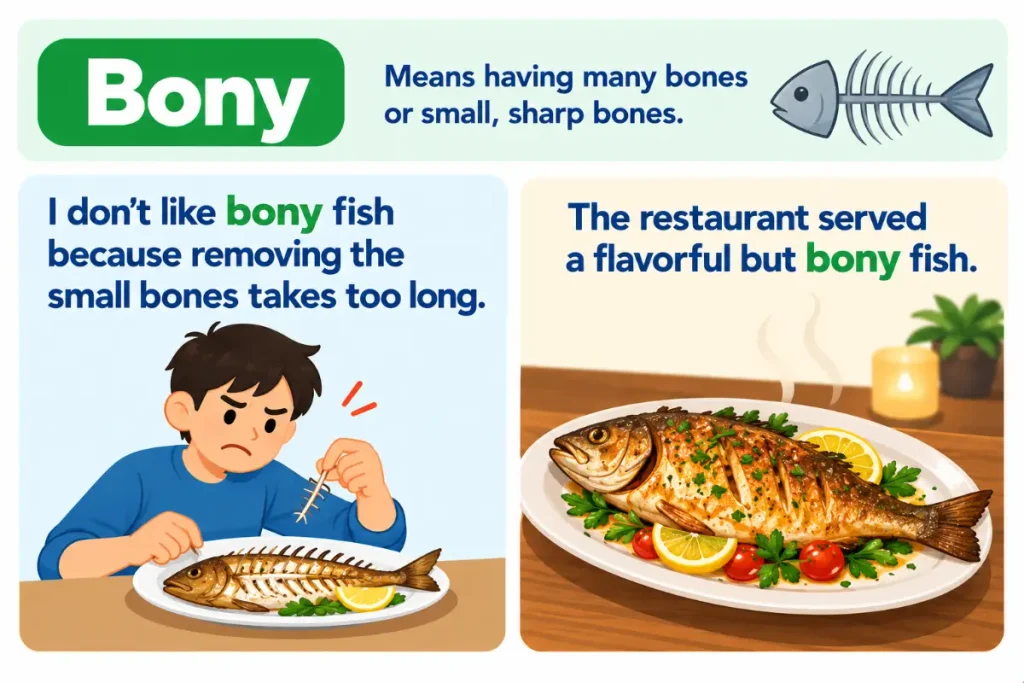
One of the most common non-body uses of bony relates to fish. A bony fish contains many bones, making it more difficult to eat than a fish with fewer large bones.
Examples:
I don’t like bony fish because removing the small bones takes too long.
The restaurant served a flavorful but bony fish.
The word can also be used for meat that contains a noticeable amount of bone:
The stew was made with a bony cut of beef.
Bony in Medical and Scientific Writing
Bony is also useful in anatomy and medical contexts.
Examples include:
- bony tissue
- bony structure
- bony prominence
- bony surface
- bony abnormality
- bony growth
In this context, the word is not commenting on someone’s appearance. It simply describes something involving bone.
For example:
The physician examined the bony prominence near the patient’s shoulder.
This is a more technical use of the word and is distinct from saying someone has a “bony face.”
Is Boney Wrong?
Boney is not necessarily an impossible spelling, but it is much less common than bony and is usually not the preferred form in standard American English. If you’re writing for a broad audience, bony is the clearer choice. There is also an important distinction between a word appearing as a variant spelling and a spelling being preferred in ordinary writing. A dictionary may recognize a less common variant without making it the usual choice for writers.
So, if the question is simply:
“Should I write bony or boney?”
The practical answer is:
Write bony.
Common Mistakes With Bony and Boney
Mistake 1: Writing Boney in Formal Text
Because boney looks related to bone, writers may use it automatically.
Less preferred:
The patient had a boney structure.
Preferred:
The patient had a bony structure.
Mistake 2: Assuming Boney Is Always the Standard Spelling
The existence of boney as a variant doesn’t mean it is equally common or equally suitable in every context. For standard American English, bony is the form most readers will recognize immediately.
Mistake 3: Confusing Bony With Boned
These words have different meanings.
- bony = having or relating to bones
- boned = having the bones removed
For example:
The fish was bony.
means it contained many bones.
The fish was boned.
means someone removed the bones.
Mistake 4: Using Bony When You Mean Thin
Bony and thin are related, but they aren’t identical. If your meaning is simply that someone has a small body size, thin may communicate that idea more directly. If your point is that bones are noticeable, bony is more precise.
When Should You Use Bony?
Use bony when you mean:
- having prominent bones
- containing many bones
- relating to bone
- resembling a bone or skeletal structure
Examples:
The fish is bony.
He has bony hands.
The scan showed a bony structure.
The animal looked bony.
When Might Boney Appear?
You may encounter boney in:
- informal writing
- older texts
- variant spellings
- personal or place names
- creative writing
- contexts where the writer intentionally chooses that spelling
If Boney appears as part of a proper name, don’t automatically change it to Bony. Proper names should normally retain their established spelling. For ordinary adjective use, however, bony is the better default.
Bony in American English vs. British English
There is no major American-versus-British distinction that makes boney the British form and bony the American form. Bony is widely used in standard English, including American and British English. The main issue is that boney is a less common variant rather than a straightforward US-versus-UK spelling difference.
So this isn’t like differences such as:
- color / colour
- center / centre
- traveled / travelled
For bony vs. boney, American writers should generally choose bony, but British readers may also use and recognize bony.
Formal vs. Casual Usage
For both formal and casual writing, bony is usually the easiest choice.
Academic Writing
Use bony when discussing anatomy, biology, zoology, or related subjects.
The study examined the bony structure of the animal’s skull.
Professional Writing
Bony works naturally in medical, veterinary, culinary, and other professional contexts.
The report describes a small bony prominence near the joint.
Everyday Conversation
The word is also common in ordinary speech.
That fish is really bony.
Texting and Social Media
You can use bony in casual messages as well.
That fish was so bony!
There is usually no reason to switch to boney simply because the writing is informal.
Synonyms for Bony
The best synonym depends on what bony means in the sentence.
| Word/Phrase | Meaning | Tone | Example |
|---|---|---|---|
| skeletal | Very thin or relating to a skeleton | Neutral/technical | The animal had a skeletal appearance. |
| thin | Having little body mass | Neutral | The dog was very thin. |
| lean | Having relatively little body fat | Neutral/positive | The athlete had a lean build. |
| slender | Thin and delicately built | Often positive | She had a slender frame. |
| angular | Having sharp or prominent features | Descriptive | He had an angular face. |
| gaunt | Very thin, often with a tired appearance | Strong | His face looked gaunt. |
| emaciated | Abnormally or extremely thin from illness or lack of nutrition | Clinical/strong | The animal appeared emaciated. |
| osseous | Relating to bone | Medical/scientific | The tissue had an osseous structure. |
| bone-filled | Containing many bones | Descriptive | The fish was bone-filled. |
| bone-heavy | Containing a significant amount of bone | Informal/descriptive | It was a bone-heavy cut of meat. |
These aren’t perfect substitutes in every situation. Bony can describe bones themselves, food with many bones, or a physical appearance, so the best alternative changes with the context.
Antonyms of Bony
There isn’t one universal opposite of bony because the word has several meanings. For physical appearance, possible opposites include:
- fleshy
- plump
- rounded
- soft-featured
- boneless
- meaty
- fleshy
For example:
We chose a boneless cut instead of a bony one.
The best antonym depends on exactly what you’re describing.
A Simple Memory Trick for Bony
A useful way to remember the spelling is:
Bone → bony
Drop the final e before adding -y.
You can remember the pattern with:
- bone → bony
- stone → stony
- ice → icy
- noise → noisy
So if you’re deciding between bony and boney, remember that the standard adjective is formed as bony.
Quick Reference: Bony vs Boney
| Question | Answer |
|---|---|
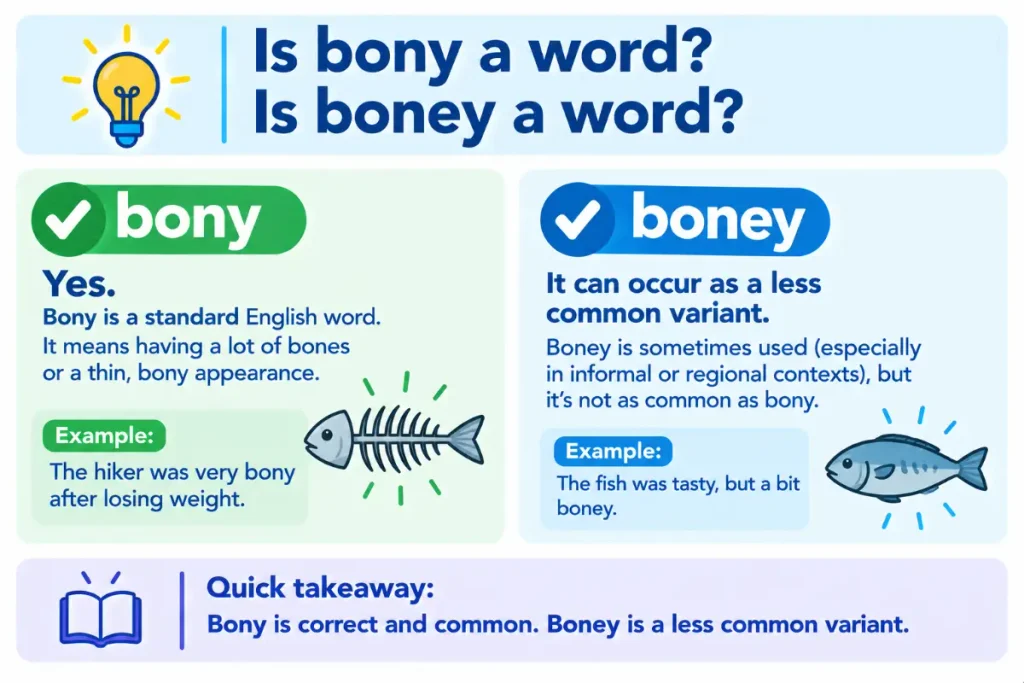
| Is bony a word? | Yes. |
| Is boney a word? | It can occur as a less common variant. |
| Which spelling is more common? | Bony |
| Which should I use in American English? | Bony |
| Is bony an adjective? | Yes. |
| Can bony describe fish? | Yes, especially fish with many bones. |
| Can bony describe a person? | Yes, when bones are prominent or noticeable. |
| Can bony refer to anatomy? | Yes. |
| Is bony the same as skinny? | No. The meanings overlap but aren’t identical. |
| Is bony the same as boned? | No. Boned can mean that bones have been removed. |
| Is boney a British spelling? | Not simply. It’s a less common variant rather than a standard US/UK spelling pair. |
Conclusion
When comparing bony vs boney, the main thing to remember is that bony is the standard, familiar spelling used in most American English writing. It can describe prominent bones, food that contains many bones, or something related to bone.
Boney may appear as a less common variant or in particular names and informal contexts, but it isn’t usually the spelling you should choose when writing a standard sentence. If you’re preparing an email, school assignment, professional document, or article, bony is the straightforward choice.
The easiest memory trick is simple: bone → bony. If you mean “having or relating to bones,” use bony unless a specific name or established usage calls for another spelling.
Frequently Asked Question
Which is correct, bony or boney?
Bony is the standard and more common spelling for the adjective in American English. Boney is a less common variant.
Is boney a real word?
Boney can be found as a variant spelling of bony, but it is much less common. For normal writing, bony is the preferred choice.
How do you spell bony?
The standard spelling is b-o-n-y, with no e before the final y.
What does bony mean?
Bony means having prominent or noticeable bones, containing many bones, or relating to bone. For example, you can describe a fish with many bones as bony.
Is bony the same as skinny?
No. Skinny means very thin, while bony emphasizes prominent or noticeable bones. The two words can overlap, but they don’t have exactly the same meaning.
Is bony the same as boned?
No. Bony means having or relating to bones, while boned can mean that bones have been removed from food. A fish can be bony before it is boned.
Should I use bony in formal writing?
Yes. Bony is appropriate for formal, academic, professional, and everyday writing when it accurately expresses your meaning. It is generally a better choice than the less common boney.
2 thoughts on “Bony vs Boney: Which Spelling Is Correct?”