
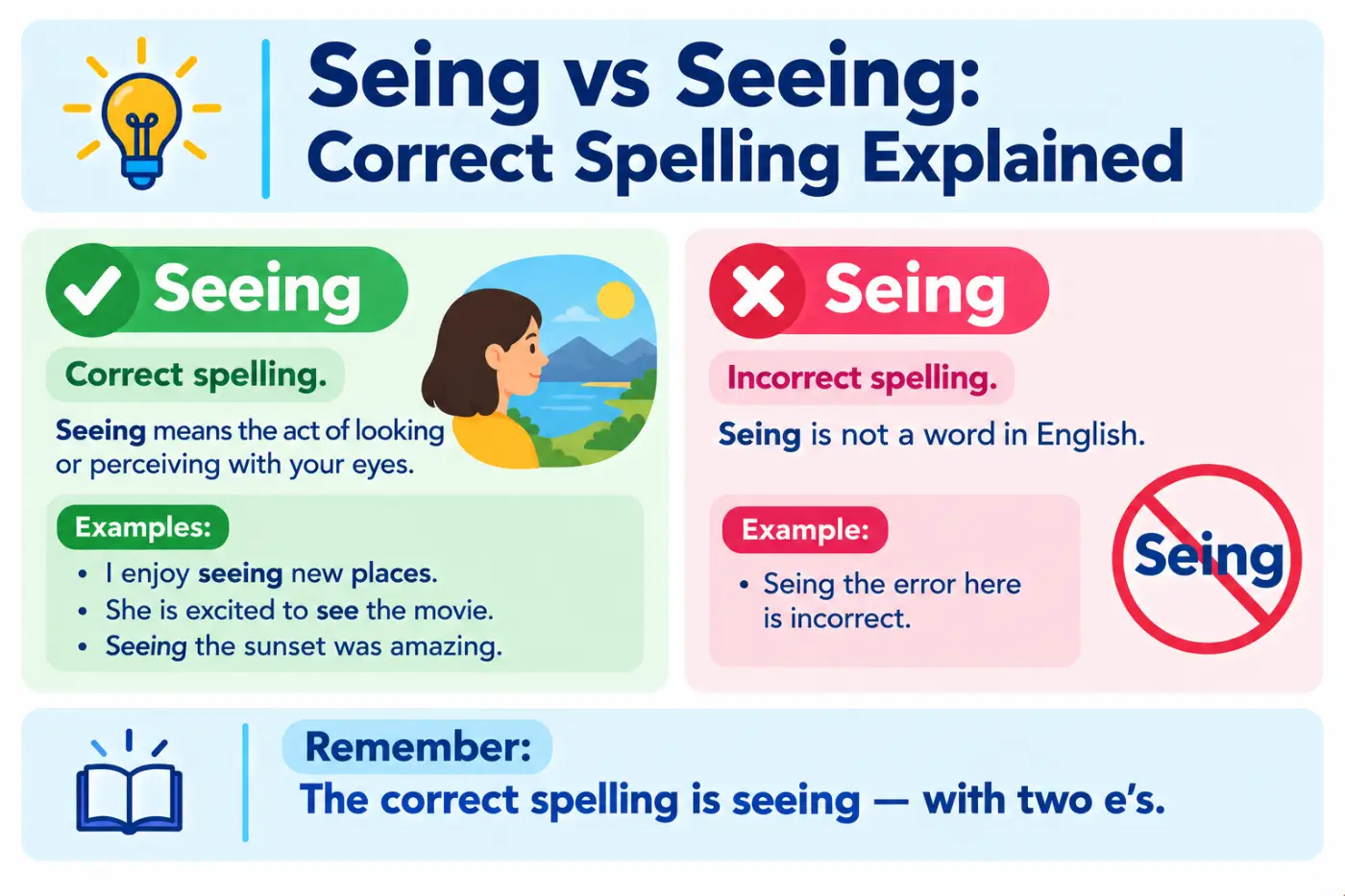
If you’re writing an email, school assignment, text, or social media post, you may wonder about seing vs seeing. The two forms look almost identical, but only one is standard English.
Seeing is the correct spelling. Seing is a common misspelling and should not be used in standard American English. The correct form is seeing, with two e’s after the initial “s” and before the final “ing.”
The confusion usually happens because many English verbs drop or change letters when seing is added. In this case, however, the verb see keeps its spelling and becomes seeing. This article explains why, shows how to use the word correctly, and provides examples to make the spelling easy to remember.
Is “Seing” or “Seeing” Correct?
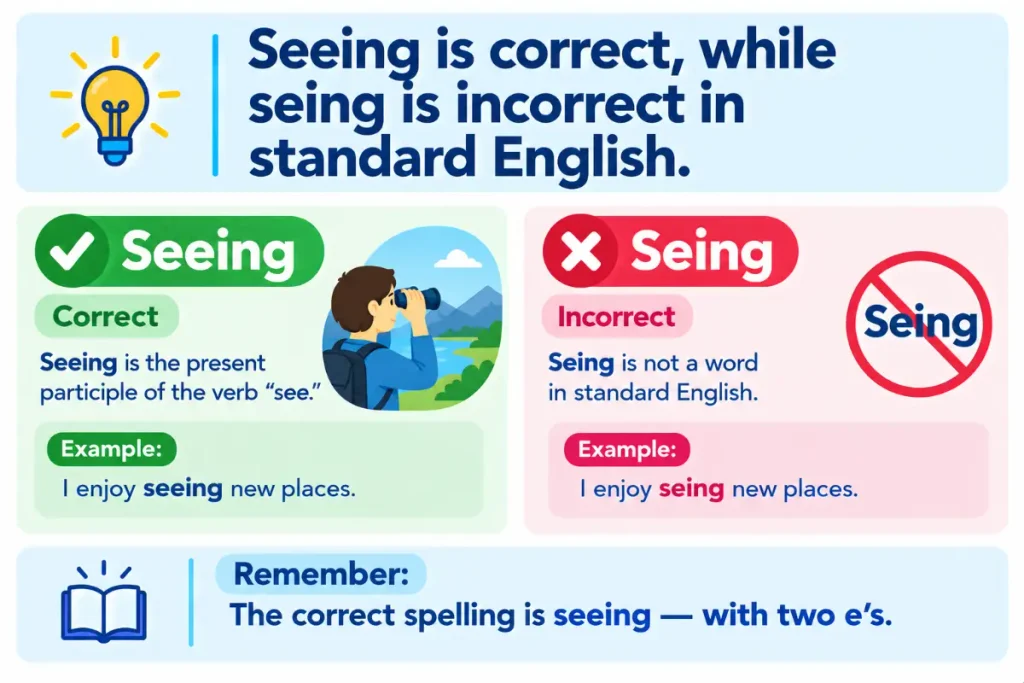
Seeing is correct, while seing is incorrect in standard English.
| Spelling | Correct? | Explanation |
|---|---|---|
| Seeing | ✅ Yes | Standard spelling of the -ing form of “see” |
| Seing | ❌ No | Common misspelling |
The base verb is see. When -ing is added, the word becomes seeing, not seing.
Correct
- I am seeing my doctor tomorrow.
- She enjoys seeing her friends.
- We were seeing the sights downtown.
- I can’t wait to start seeing the results.
Incorrect
- I am seing my doctor tomorrow.
- She enjoys seing her friends.
- We were seing the sights downtown.
The incorrect form seing is easy to type because English spelling often involves dropping a final silent e before adding -ing. But see does not follow that pattern because the word already ends in two e’s.
Why Is “Seeing” Spelled With Two E’s?
The spelling becomes clearer when you start with the base verb:
see + ing = seeing
The verb see ends with ee, and both e’s remain when -ing is added.
This is different from verbs such as:
- make → making
- write → writing
- hope → hoping
- use → using
Those verbs end in a single silent e, which is normally dropped before -ing. For see, there is no silent final e to remove. The word ends in the vowel combination ee, so the spelling stays intact:
see → seeing
This is why seing is not the standard form.
What Does “Seeing” Mean?
Seeing is the present participle or gerund form of the verb see. Depending on the sentence, it can describe the act of using your eyes, meeting someone, understanding something, or experiencing something. The word see has several meanings, so seeing can also have several uses.
Seeing Something With Your Eyes
This is the most basic meaning.
- I am seeing a beautiful sunset.
- She enjoys seeing birds in the backyard.
- We were seeing the mountains from the hotel.
Here, seeing refers to visually noticing or observing something.
Seeing Someone
Seeing can also mean meeting or spending time with someone.
- I’m seeing my cousin this weekend.
- Are you seeing your friends after school?
- She is seeing her dentist on Friday.
The exact meaning depends on context.
Seeing or Understanding an Idea
The verb see can also mean understand or recognize something.
- I can see why you’re upset.
- After the explanation, I was seeing the problem differently.
- He finally saw what his teacher meant.
In these cases, the word is not necessarily about physical vision.
How Do You Spell “Seeing” Correctly?
The easiest way to spell seeing is to remember that the base word see keeps both e’s before -ing.
Correct: see + ing = seeing
A useful visual pattern is:
S E E + I N G → S E E I N G
The word contains three consecutive vowels: eei. That may look unusual, but it is correct.
A Simple Memory Trick
Think:
You need to SEE before you can be SEEING.
The word seeing begins with the complete word see:
SEE + ING = SEEING
If you remove one of the e’s, you get seing, which is not the standard spelling.
“Seing vs Seeing”: What’s the Difference?
The difference is simple: seeing is a correctly spelled English word, while seing is a spelling error.
| Feature | Seeing | Seing |
|---|---|---|
| Standard English | Yes | No |
| Correct spelling | Yes | No |
| Base word | See | See |
| Form | See + -ing | Incorrect formation |
| Used in formal writing | Yes | No |
| Used in everyday writing | Yes | No |
There is no difference in meaning because seing is not the standard spelling of a separate word. If you mean the -ing form of see, use seeing.
Examples of “Seeing” in Sentences
Here are natural examples showing how seeing works in different situations.
- I am seeing my grandparents this weekend.
- She loves seeing new places when she travels.
- We were seeing the first signs of spring.
- I’m looking forward to seeing you tomorrow.
- He enjoys seeing his old classmates.
- Seeing the final result made everyone happy.
- I wasn’t expecting to be seeing so many people at the event.
- She is seeing her doctor for a routine appointment.
- Seeing the damage after the storm was difficult.
- After talking with him, I started seeing the situation differently.
- We’re excited about seeing the new exhibit.
- I remember seeing that movie when I was younger.
These examples show that seeing can refer to vision, meeting people, observing events, or understanding something.
Seeing in Different Grammar Structures
Understanding how seeing functions in a sentence can make the spelling easier to remember.
“Seeing” as a Present Participle
The present participle is often used with forms of be to create continuous verb forms.
- I am seeing the doctor tomorrow.
- She was seeing the sights around town.
- They are seeing a movie tonight.
In these sentences, seeing forms part of the verb phrase.
“Seeing” as a Gerund
A gerund is an -ing form that functions as a noun.
- Seeing the ocean for the first time was memorable.
- I enjoy seeing my family.
- Seeing is believing.
In these examples, seeing acts as a noun or noun-like element.
“Seeing” in a Phrase
The word can also appear in common phrases.
- Seeing as you’re already here, let’s begin.
- Seeing that everyone is ready, we can start.
- Seeing is believing.
These expressions have meanings that depend on the surrounding sentence.
Common Mistakes With “Seeing”
The most common mistake is removing one of the e’s from see before adding -ing.
Mistake 1: Writing “Seing”
Incorrect: I am seing my friend tomorrow.
Correct: I am seeing my friend tomorrow.
The mistake happens because the writer may assume that one e should be removed before -ing.
Mistake 2: Treating “See” Like “Write”
With write, the final e is dropped:
write → writing
But see is different:
see → seeing
The two e’s in see are part of the word’s spelling and remain there.
Mistake 3: Confusing Spelling With Pronunciation
The unusual sequence of vowels in seeing can make the word seem difficult to spell. Although seeing may look awkward on the page, its spelling is straightforward once you identify the base word:
see + ing
Don’t change the spelling simply because the combination of letters looks unusual.
Why Do People Write “Seing”?
Seing is usually a simple spelling error rather than a different English word. Several factors can cause the mistake:
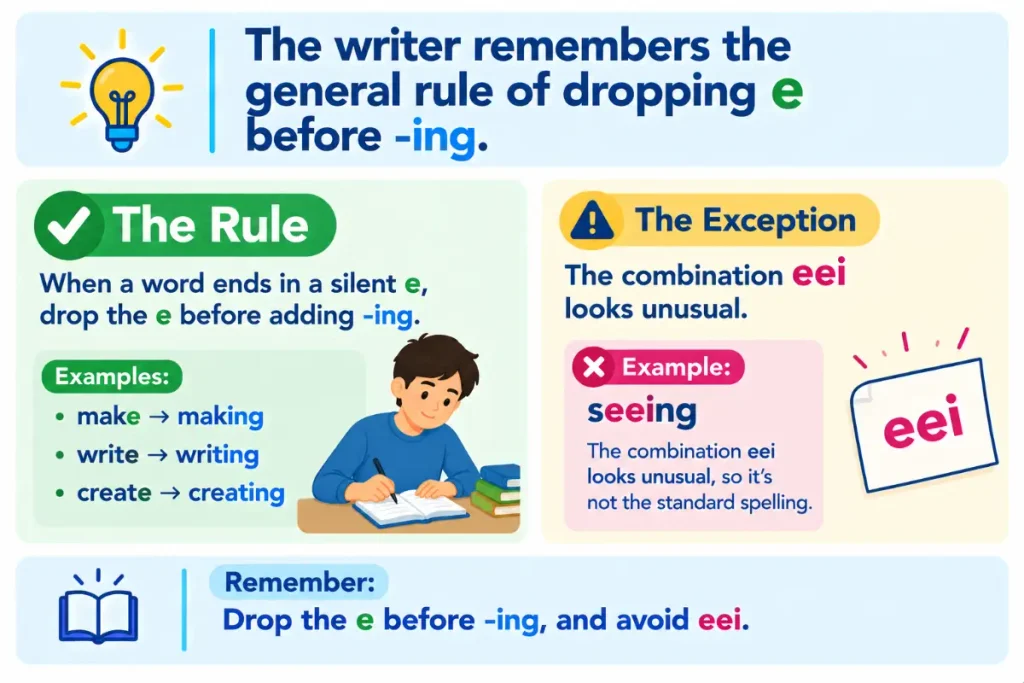
- The writer remembers the general rule of dropping e before -ing.
- The combination eei looks unusual.
- The writer types quickly and omits an e.
- The word is misspelled because of pronunciation or visual confusion.
- Spell-checking is unavailable or ignored.
The important point is that the spelling rule for see is different from the rule used with verbs ending in a single silent e.
See vs. Seeing
The difference between see and seeing is grammatical.
| Word | Form | Example |
|---|---|---|
| See | Base verb | I can see the building. |
| Seeing | -ing form | I am seeing the building from here. |
See can follow modal verbs and other structures:
- I can see the problem.
- You should see a doctor.
- We might see them later.
Seeing is used in continuous constructions and gerund phrases:
- I am seeing them tomorrow.
- Seeing the result surprised me.
See vs. Saw vs. Seen vs. Seeing
These forms come from the same verb, but they are not interchangeable.
| Form | Use | Example |
|---|---|---|
| See | Base/present form | I see the problem. |
| Saw | Simple past | I saw the movie yesterday. |
| Seen | Past participle | I have seen that movie. |
| Seeing | Present participle/gerund | I am seeing the movie tonight. |
A common error is using seen without an appropriate helping verb.
Incorrect: I seen that movie yesterday.
Correct: I saw that movie yesterday.
Correct: I have seen that movie before.
This is a grammar issue rather than a spelling issue, but knowing the different forms helps put seeing in context.
Seeing vs. Watching: What’s the Difference?
Seeing and watching can sometimes overlap, but they don’t always mean the same thing. Watching usually suggests paying attention to something over a period of time.
| Word | Typical meaning | Example |
|---|---|---|
| Seeing | Perceiving or experiencing something visually | I enjoyed seeing the mountains. |
| Watching | Looking at something attentively over time | We were watching a movie. |
For example, you might see a bird in your yard, but you might watch the bird for several minutes.
Seeing vs. Looking: What’s the Difference?
These words also have related but different meanings. Seeing generally describes perception. Looking usually describes intentionally directing your eyes toward something.
- I can see the sign.
- Please look at the sign.
You don’t always control what you see, but you can usually choose to look at something. This distinction is useful when choosing the right verb in everyday English.
Is “Seeing” Used in American English?
Yes. Seeing is standard in American English and is also standard in other major varieties of English, including British, Canadian, and Australian English. There is no American-versus-British spelling difference between seeing and seing.
| Variety | Correct form |
|---|---|
| American English | seeing |
| British English | seeing |
| Canadian English | seeing |
| Australian English | seeing |
The spelling seing is not simply a British alternative. It is a misspelling of seeing.
Is “Seeing” Appropriate in Formal Writing?
Yes. Seeing is perfectly acceptable in formal, academic, professional, and everyday writing.
You can use it in:
- School assignments
- Academic papers
- Business emails
- Resumes and cover letters
- Reports
- Professional communication
- Text messages
- Social media posts
- Everyday conversations
The level of formality depends on the sentence, not on the word seeing itself.
In a Professional Email
I look forward to seeing you at the meeting.
In Academic Writing
Seeing the results in context helps explain the difference between the two groups.
In Everyday Conversation
I’m looking forward to seeing you this weekend.
All three uses are grammatically acceptable.
Is “Seing” Ever Correct?
In standard modern English, seing is not the correct spelling of the -ing form of see. If you’re writing a normal English sentence and mean the verb see, use seeing.
For example:
Incorrect: I’m seing my cousin tomorrow.
Correct: I’m seeing my cousin tomorrow.
You may occasionally encounter unusual spellings in historical texts, names, usernames, or other specialized contexts, but that does not make seing the standard spelling for modern English writing.
How to Remember “Seeing”
A few quick tricks can help you avoid the mistake.
Remember the Base Word
Start with:
SEE
Then add:
ING
The result is:
SEEING
Don’t Apply the Silent-E Rule Automatically
Some verbs lose a final e before -ing:
- take → taking
- drive → driving
- make → making
But see does not become seing.
Instead:
- see → seeing
- flee → fleeing
- agree → agreeing
Look for “SEE” Inside “SEEING”
The correct word contains the entire base verb:
SEE + ING
That makes seeing easier to remember.
Quick Rule: Seing or Seeing?
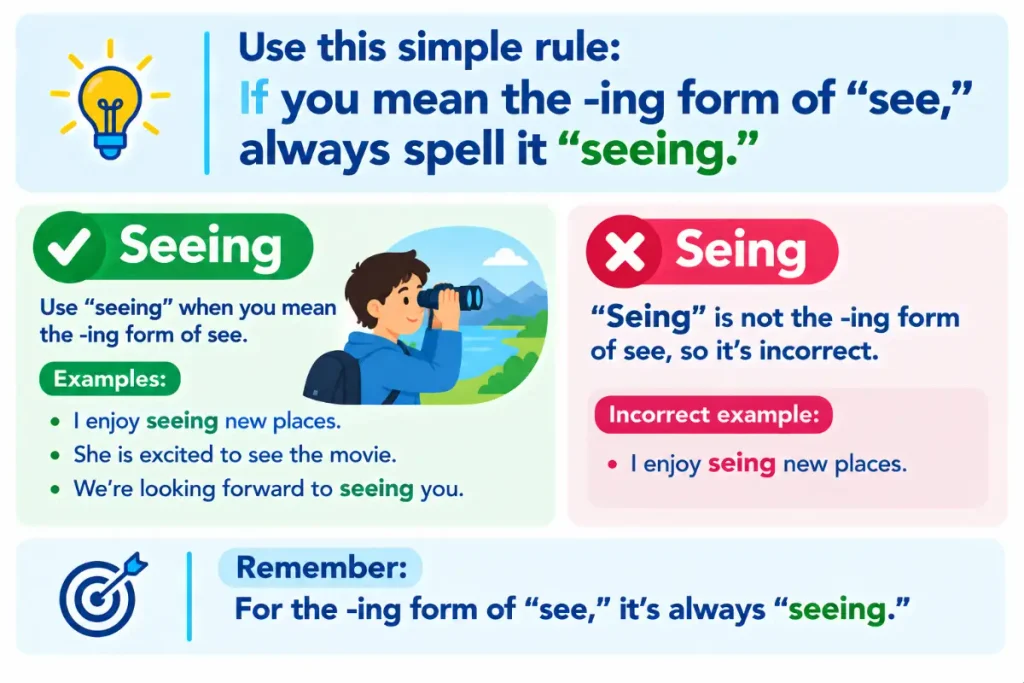
Use this simple rule:
If you mean the -ing form of “see,” always spell it “seeing.”
Remember:
see + ing = seeing
Not:
see + ing = seing
The correct spelling has two e’s from “see” plus the “i” from “-ing.”
Conclusion
When comparing seing vs seeing, the correct choice is always seeing when you mean the -ing form of the verb see. The spelling comes directly from see + -ing, so both e’s in see remain: seeing.
The spelling can be confusing because many English verbs drop a final silent e before adding -ing. However, see does not follow that pattern. Words such as make → making and write → writing are different from see → seeing.
For schoolwork, professional emails, social media, or everyday writing, use seeing. If you remember SEE + ING, you’ll have a simple way to avoid the common misspelling seing.
Frequently Asked Questions
Is “seing” a word?
No. Seing is not the standard spelling of the -ing form of see. The correct spelling is seeing.
Which is correct, seing or seeing?
Seeing is correct. Seing is a common misspelling.
How do you spell seeing?
The correct spelling is seeing: s-e-e-i-n-g. It comes from see + -ing.
Why does “seeing” have two e’s?
Seeing keeps both e’s from the base verb see. The correct formation is see + ing = seeing.
Is seeing correct in American English?
Yes. Seeing is the standard spelling in American English and is also used in British, Canadian, and Australian English.
Is “seing” ever correct?
Not when you mean the standard -ing form of see. In ordinary modern English writing, use seeing.
What is the difference between seeing and watching?
Seeing usually refers to perceiving or experiencing something visually, while watching often suggests deliberately paying attention to something for a period of time. For example, you can see a bird and watch it fly across the yard.
2 thoughts on “Seing vs Seeing: Correct Spelling Explained”