
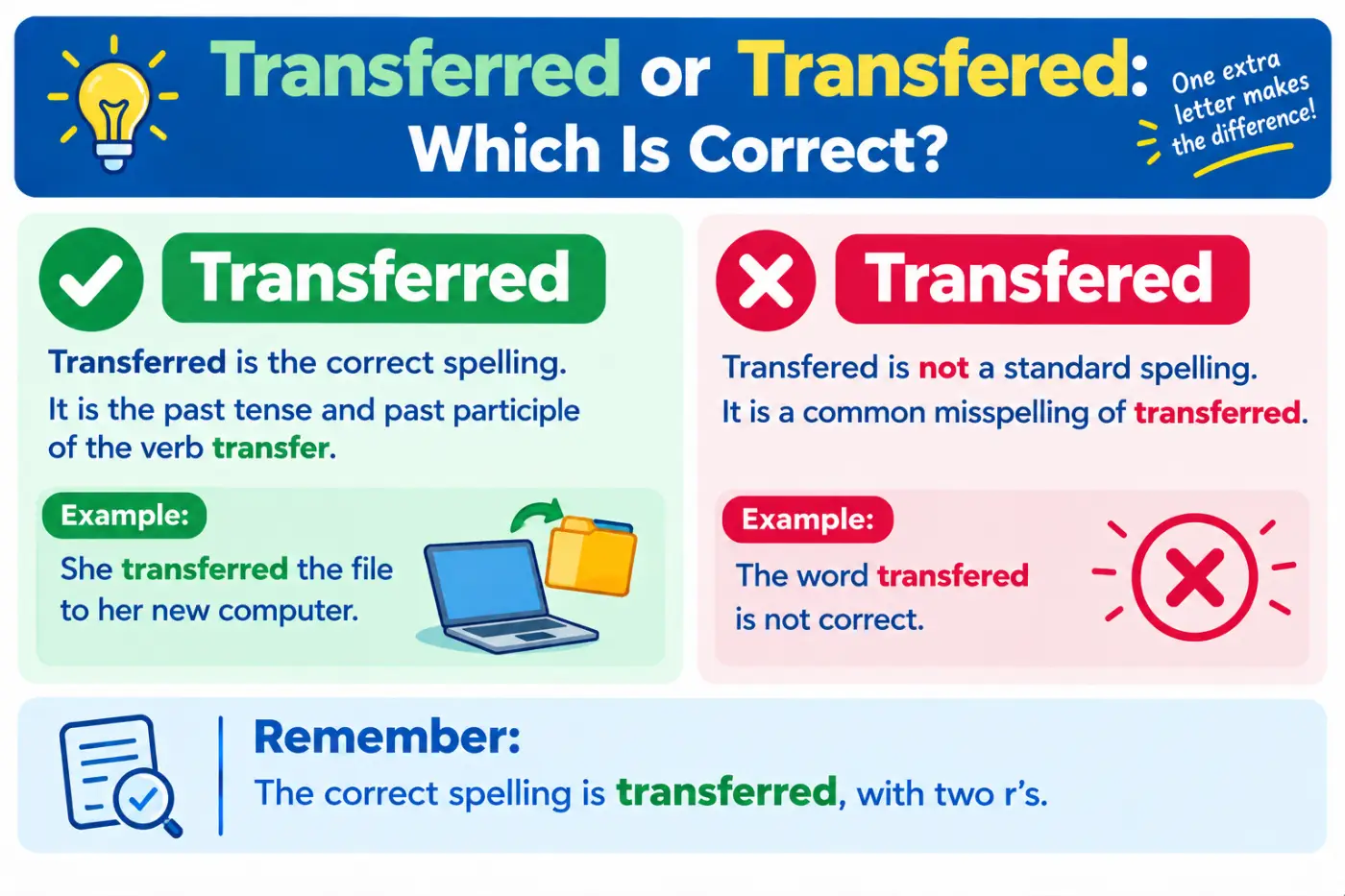
If you’re writing an email, resume, school assignment, or workplace message and wonder whether to use transferred or transfered, choose transferred. Although the two forms look similar, transfered violates standard English spelling rules.
Transferred is the past tense and past participle of transfer. Use it when describing someone or something that moved from one place, position, or organization to another. For example, a school may have transferred a student to another class, or a company may have transferred an employee to a different department.
The confusion arises because many English verbs form their past tense by adding -ed without changing the original spelling. However, transfer follows a rule that doubles the final consonant before adding -ed when the final syllable receives the stress. This guide explains the spelling rule and provides examples to help you use transferred correctly.
Transferred or Transfered: Which Is Correct?
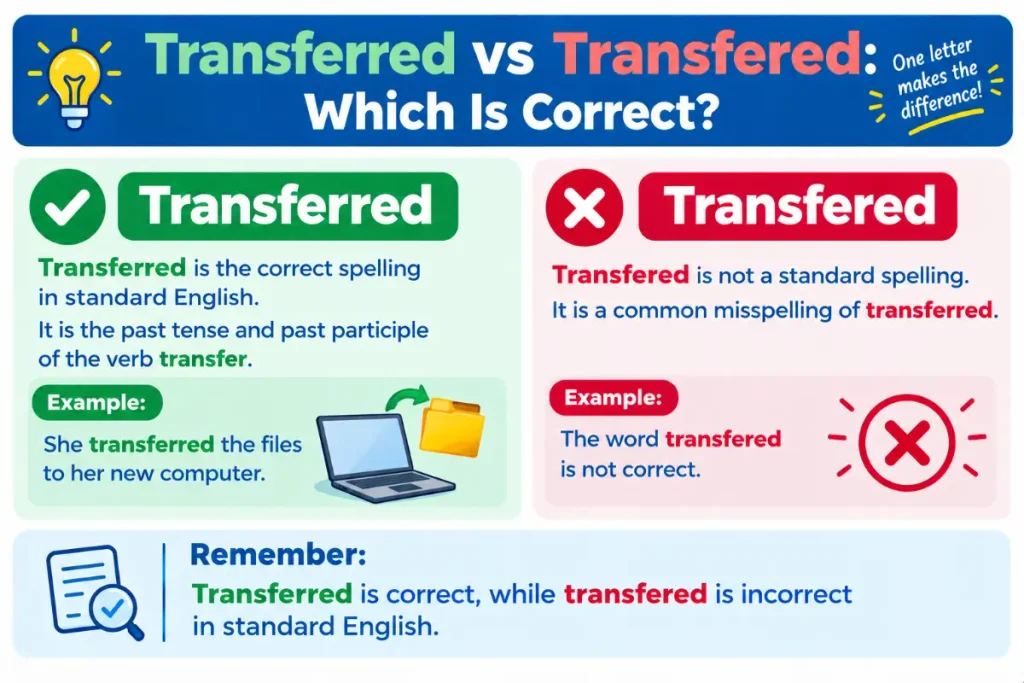
Transferred is correct, while transfered is incorrect in standard English.
| Spelling | Correct? | Example |
|---|---|---|
| Transferred | Yes | She transferred the money yesterday. |
| Transfered | No | She transfered the money yesterday. |
The correct form is:
transfer + r + ed = transferred
Writers double the final r because transfer ends in a consonant-vowel-consonant pattern and stresses the final syllable.
Why Do We Spell “Transferred” With Two Rs?
The spelling rule requires writers to double the final consonant before adding -ed when a verb ends in a consonant-vowel-consonant pattern and meets the stress rule. Since the final syllable of transfer carries the stress, writers double the final r to form transferred.
transfer → transferred
This same pattern appears in words such as:
- prefer → preferred
- refer → referred
- occur → occurred
- admit → admitted
What Does “Transferred” Mean?
Transferred means moved, changed, or sent from one person, place, account, position, or situation to another. It is the past tense and past participle form of transfer.
For example:
- The employee transferred to another department.
- We transferred the money to her account.
- The school transferred him to a different school.
- The medical team transferred the patient to another hospital.
The exact meaning depends on the context, but the basic idea is moving something or someone from one place or situation to another.
How Do You Spell “Transferred” Correctly?
The correct spelling is:
T-R-A-N-S-F-E-R-R-E-D
A simple way to remember it is:
transfer + red = transferred
Don’t remove one of the two r’s.
Correct Forms
Here are the main forms of the verb:
| Form | Example |
|---|---|
| Transfer | I need to transfer the files. |
| Transfers | She transfers money every month. |
| Transferring | He is transferring to another school. |
| Transferred | They transferred the account yesterday. |
Notice that both transferred and transferring keep the double r.
Why Do People Write “Transfered”?
Transfered is usually a spelling mistake caused by applying the regular -ed rule too directly. Many verbs form their past tense simply by adding -ed:
- work → worked
- clean → cleaned
- open → opened
- call → called
A writer may therefore assume:
transfer + ed = transfered
But English spelling has an additional rule for certain verbs ending in a stressed consonant-vowel-consonant pattern. In transfer, the final r is doubled before -ed.
So:
❌ transfered
✅ transferred
Transferred in Real Sentences
Seeing the word in different contexts makes the spelling easier to remember.
- The company transferred him to its Chicago office.
- I transferred the payment to your bank account.
- She was transferred to a new department last month.
- The school transferred the student to another class.
- We transferred the files to a secure computer.
- The patient was transferred to a larger hospital.
- He transferred ownership of the vehicle to his brother.
- The bank transferred the funds overnight.
- My credits were transferred to the new college.
- The employee transferred to another branch.
- They transferred the call to customer service.
- She transferred her reservation to a different date.
In every example, transferred is spelled with two r’s.
Transferred vs. Transfered: What’s the Difference?
There is no difference in meaning because transfered is not the standard spelling of the word.
| Feature | Transferred | Transfered |
|---|---|---|
| Standard spelling | Yes | No |
| Meaning | Moved or changed from one place/situation to another | Intended as the same word |
| Past tense of transfer | Yes | No |
| Suitable for formal writing | Yes | No |
| Suitable for resumes | Yes | No |
| Suitable for school writing | Yes | No |
If you’re choosing between the two, use transferred.
Transferred vs. Transfer: What’s the Difference?
Transfer is the base form, while transferred is the past tense and past participle.
| Word | Function | Example |
|---|---|---|
| Transfer | Base verb | I will transfer the files. |
| Transferred | Past tense | I transferred the files yesterday. |
| Transferred | Past participle | The files have been transferred. |
Compare these sentences:
- Present: I transfer the money every Friday.
- Future: I will transfer the money tomorrow.
- Past: I transferred the money yesterday.
- Present perfect: I have transferred the money already.
The spelling changes because the verb form changes, but the double r remains in transferred.
Transferred vs. Transferring
Both words come from transfer, but they are used in different grammatical situations. Transferred is generally the past tense or past participle.
She transferred to another department last year.
Transferring is the present participle or gerund.
She is transferring to another department next month.
The spelling rule also doubles the final r before -ing:
transfer → transferring
Not:
❌ transfering
✅ transferring
Transferred vs. Referred and Preferred
Words such as referred and preferred follow a similar spelling pattern.
| Base word | Correct past form |
|---|---|
| transfer | transferred |
| refer | referred |
| prefer | preferred |
| occur | occurred |
| admit | admitted |
These verbs have a stressed final syllable and double their final consonant before a suffix beginning with a vowel. This can help explain why transferred has two r’s rather than one.
Is “Transfered” Ever Correct?
In standard modern English, transfered is not the accepted spelling of the past tense or past participle of transfer. If you’re writing an essay, email, resume, report, application, or other formal text, use transferred.
For example:
❌ The records were transfered to the new system.
✅ The records were transferred to the new system.
How to Use “Transferred” in Professional Writing
Transferred is common in workplace and business communication. It can describe employees, responsibilities, money, files, customers, accounts, or ownership.
Workplace Example
After two years in sales, Maria was transferred to the marketing department.
Financial Example
The bank transferred the funds to the requested account.
Customer Service Example
Your call has been transferred to a specialist.
Business Example
The company transferred ownership of the property last year.
The word is neutral and professional, so it works well in business writing.
Using “Transferred” on a Resume
Transferred can be appropriate on a resume when describing a job move, internal promotion, relocation, or change in responsibilities.
For example:
Transferred to the New York office to support the company’s growing customer service team.
Or:
Transferred to the operations department after demonstrating strong project-management skills.
Make sure the surrounding sentence clearly explains why the transfer was relevant to your experience.
Using “Transferred” in Academic Writing
Transferred is also standard in essays, reports, research papers, and other academic writing.
Examples:
The data were transferred to a separate spreadsheet for analysis.
Several students transferred from the community college to a four-year university.
The results were transferred to the final report.
There’s no need to replace transferred with a more complicated word simply because you’re writing formally.
Using “Transferred” in Everyday Conversation
The word is completely natural in everyday English.
You might say:
I just transferred the money.
She transferred to another school.
They transferred me to a different department.
The call was transferred to the billing team.
The correct spelling stays the same whether the context is casual or formal.
Common Mistakes With “Transferred”
1. Writing “Transfered”
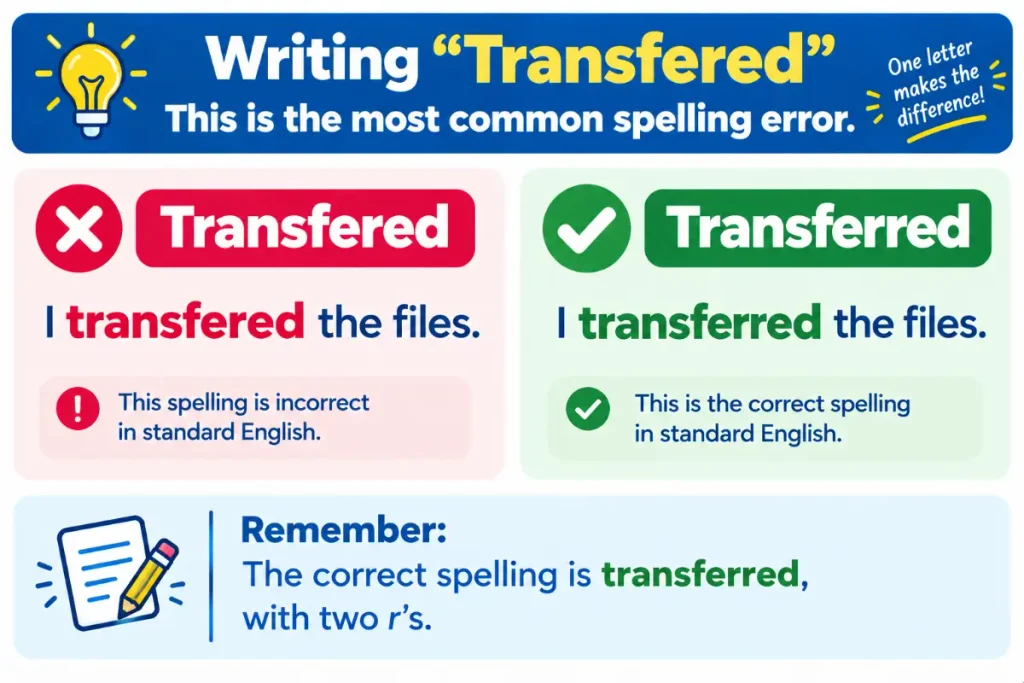
This is the most common spelling error.
❌ I transfered the files.
✅ I transferred the files.
2. Writing “Transfering”
The same doubling rule applies before -ing.
❌ She is transfering to another office.
✅ She is transferring to another office.
3. Confusing “Transferred” With “Transfer”
Don’t use the base form when describing something that already happened.
❌ Yesterday, I transfer the money.
✅ Yesterday, I transferred the money.
4. Forgetting the Double R in Passive Sentences
The same spelling applies when transferred is used as a past participle.
❌ The patient was transfered to another hospital.
✅ The patient was transferred to another hospital.
A Simple Memory Trick for “Transferred”
Think of the word as:
TRANS + FERR + ED
The middle section contains FERR, with two r’s.
You can also connect it with similar words:
- refer → referred
- prefer → preferred
- transfer → transferred
If you remember that these verbs double the final consonant before -ed, it’s easier to avoid the spelling transfered.
Does American English Use “Transferred”?
Yes. Transferred is the standard spelling in American English. Unlike some words that have different American and British spellings, such as color/colour or center/centre, transferred is not normally changed between American and British English.
| Variety | Standard spelling |
|---|---|
| American English | transferred |
| British English | transferred |
| Canadian English | transferred |
| Australian English | transferred |
So American readers should use transferred, just as readers of these other major varieties of English generally do.
Why Does English Double the Final Consonant?
The doubling rule helps preserve the pronunciation of certain words when suffixes are added. For verbs such as transfer, refer, and prefer, the final syllable is stressed. Doubling the final consonant is part of the standard spelling pattern:
- transfer → transferred
- refer → referred
- prefer → preferred
The rule has some exceptions and depends on syllable structure, stress, and the ending of the base word, so it isn’t wise to double every final consonant automatically.
For transfer, however, the standard forms are straightforward:
transferred and transferring.
More Words With Similar Spelling Patterns
If you’re learning English spelling, these examples can help reinforce the pattern:
| Base Verb | Past Tense |
|---|---|
| admit | admitted |
| commit | committed |
| occur | occurred |
| prefer | preferred |
| refer | referred |
| transfer | transferred |
Compare them with verbs that don’t double their final consonant:
| Base Verb | Past Tense |
|---|---|
| open | opened |
| visit | visited |
| listen | listened |
| offer | offered |
| enter | entered |
The difference depends on spelling and pronunciation rules rather than simply the number of letters in the verb.
Is “Transferred” a Verb?
Yes. Transferred is a verb form.
It can function as:
- the simple past of transfer
- the past participle of transfer
Examples:
Simple past:
The company transferred the employee.
Past participle:
The employee was transferred to another office.
The money has been transferred.
The word can therefore appear in both active and passive constructions.
What Are the Synonyms for “Transferred”?
The best synonym depends on what is being moved and why.
| Word/Phrase | Meaning | Tone | Example |
|---|---|---|---|
| Moved | Changed location or position | Everyday | She moved to another office. |
| Relocated | Moved to a new place | Formal | He was relocated to Denver. |
| Shifted | Moved from one position or place | Neutral | The project was shifted to another team. |
| Sent | Caused to go somewhere | Everyday | The documents were sent to the new office. |
| Forwarded | Sent onward | Professional | The email was forwarded to the manager. |
| Reassigned | Given a new role or responsibility | Professional | She was reassigned to another project. |
| Referred | Directed to another person or service | Professional | The patient was referred to a specialist. |
| Converted | Changed from one form to another | Technical | The files were converted to a new format. |
| Switched | Changed from one option to another | Everyday | He switched to a different provider. |
| Handed over | Given control or responsibility | Casual/neutral | The account was handed over to another manager. |
These aren’t perfect replacements in every sentence. For example, relocated works well for a person or office, while forwarded is more natural for an email or message.
Transferred vs. Moved
Moved is broader and more casual than transferred.
I moved to a new apartment.
I was transferred to a new office.
Both describe a change of location, but transferred often suggests that an organization or system arranged the change.
Transferred vs. Relocated
Relocated emphasizes moving to a new physical place.
The company relocated its headquarters.
Transferred can refer to physical movement, but it can also describe money, data, ownership, responsibilities, or employees.
The company transferred the employee to another branch.
The bank transferred the money.
Because relocated is more specifically associated with physical location, it isn’t always interchangeable with transferred.
Quick Rule: Transferred or Transfered?
Remember this simple rule:
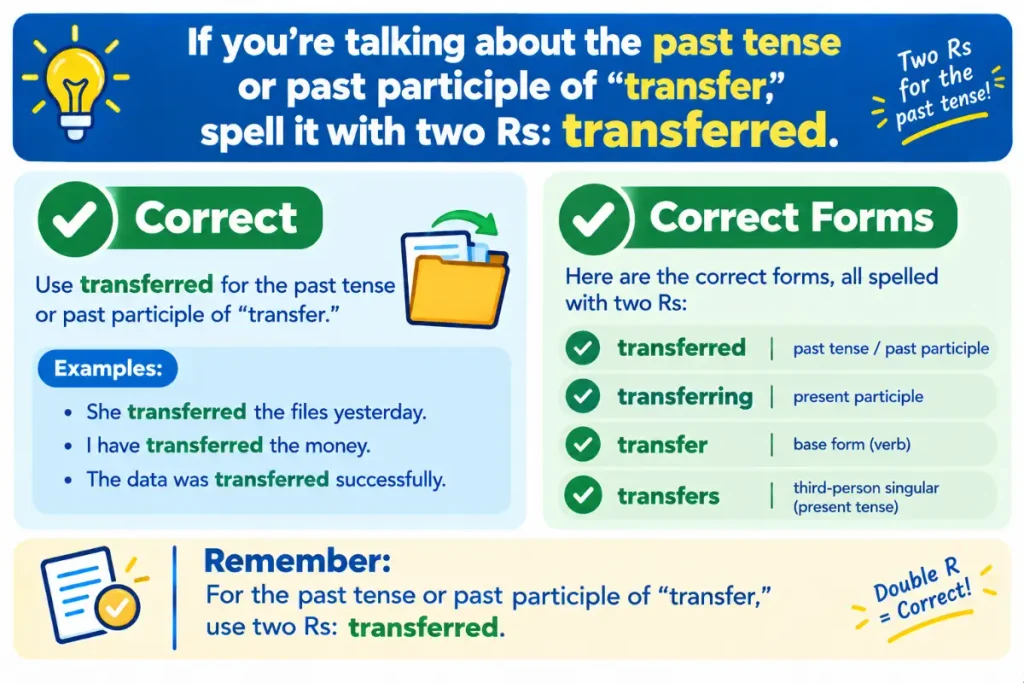
If you’re talking about the past tense or past participle of “transfer,” spell it with two Rs: transferred.
Correct
- transferred
- transferring
- transfer
- transfers
Incorrect
- transfered
- transfering
A useful visual reminder is:
transfer → transfeRR + ed → transferred
Conclusion
When choosing between transferred or transfered, always use transferred. The spelling has two r’s because transfer doubles its final consonant before the -ed ending.
Transferred is the past tense and past participle of transfer, and it can describe moving a person, account, payment, file, responsibility, or other item from one place or situation to another. The incorrect form transfered is a common spelling mistake.
If you remember the pattern transfer → transferred, you’ll also have a useful connection to words such as referred and preferred. For American English writing, whether you’re working on an email, resume, school assignment, or everyday message, transferred is the spelling to choose.
Frequently Asked Questions
Is “transferred” or “transfered” correct?
Transferred is correct. Transfered is a misspelling in standard English.
How do you spell “transferred”?
The correct spelling is transferred, with two r’s before -ed.
Why does “transferred” have two Rs?
Transfer doubles its final r before -ed because the final syllable is stressed and follows a consonant-vowel-consonant spelling pattern.
Is “transfered” a word?
Transfered is not the standard spelling of the past tense or past participle of transfer. Use transferred instead.
Is “transferred” correct in American English?
Yes. Transferred is the standard spelling in American English, as well as in major varieties such as British, Canadian, and Australian English.
What is the past tense of “transfer”?
The past tense is transferred.
She transferred the money yesterday.
What is the difference between “transferred” and “transferring”?
Transferred is the past tense or past participle, while transferring is the present participle or gerund.
He transferred to another school last year.
He is transferring to another school next year.
1 thought on “Transferred or Transfered: Which Is Correct?”