
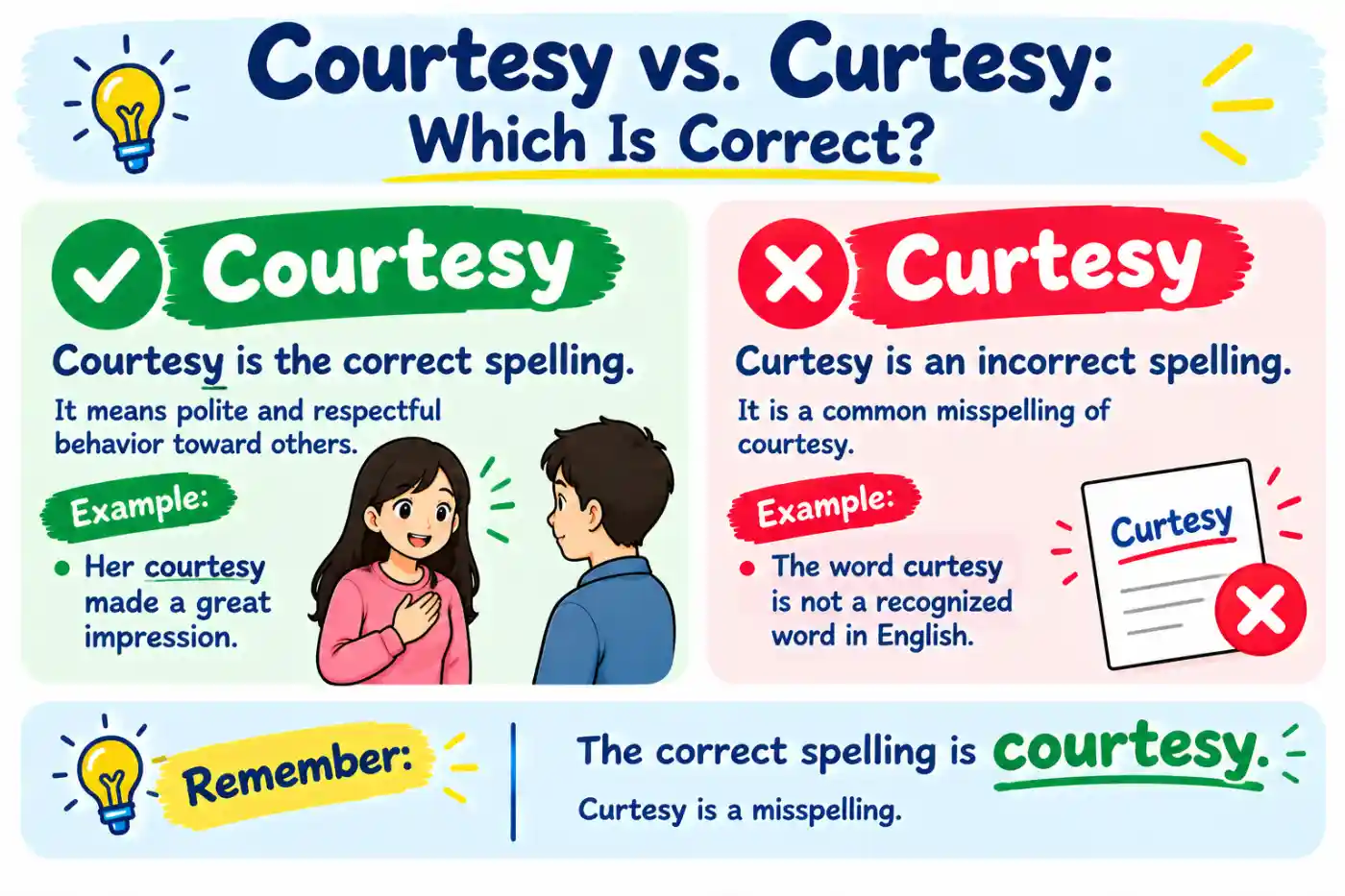
If you’re writing an email, school assignment, thank-you note, or professional message, you may wonder about courtesy vs curtesy. The two spellings look almost identical, but only one is the standard spelling in modern American English.
Courtesy is the correct and standard spelling. It is usually a noun meaning polite behavior, a respectful act, or a favor given to someone. Curtesy is generally considered an archaic or obsolete spelling and should not be used in ordinary modern writing.
This spelling confusion happens because courtesy is pronounced somewhat differently from how it looks, and the letters can be easy to mix up. This article explains the difference, gives natural examples, and shows how to remember the correct spelling.
Courtesy vs Curtesy: What’s the Difference?
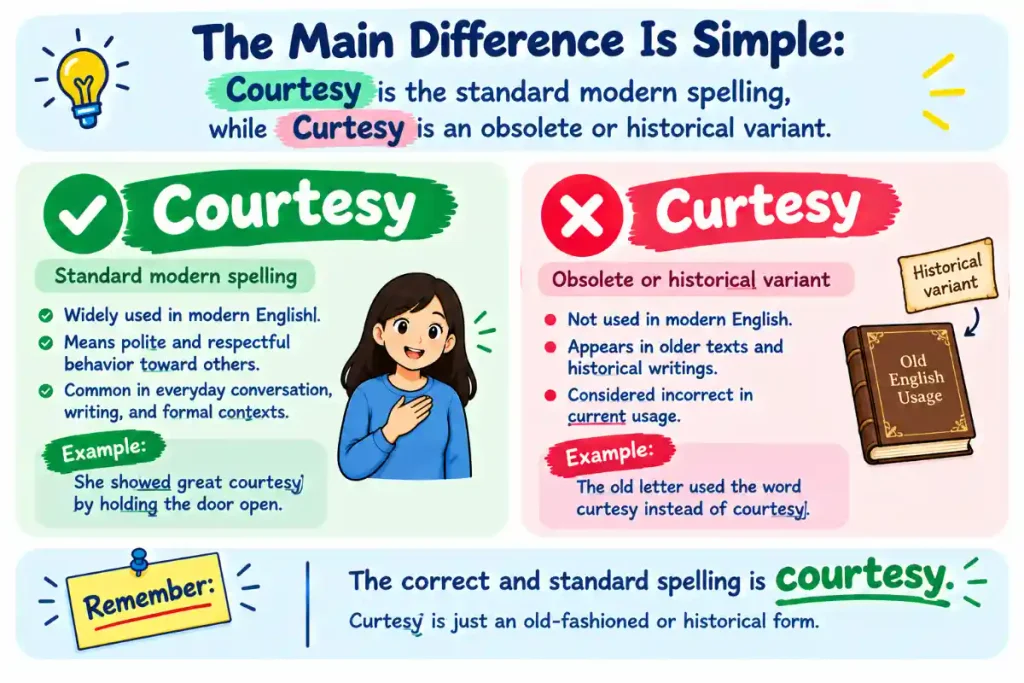
The main difference is simple: courtesy is the standard modern spelling, while curtesy is an obsolete or historical variant.
| Word | Standard Modern English? | Meaning | Example |
|---|---|---|---|
| courtesy | Yes | Polite behavior, respect, or a favor | “He showed courtesy to the other guests.” |
| curtesy | Generally no | Historical/obsolete spelling of courtesy | Avoid this spelling in modern writing. |
For American English, use courtesy in virtually all everyday, academic, workplace, and professional situations.
Is “Courtesy” Correct?
Yes. Courtesy is the correct spelling in modern English. You can use it to describe polite behavior:
She treated everyone with courtesy.
It can also describe a favor or something provided as a gesture of goodwill:
The hotel provided a courtesy shuttle for its guests.
Is “Curtesy” Correct?
Curtesy is not the standard spelling you should use in modern English. It appears in historical texts and older forms of English, but contemporary writers should normally use courtesy. If you’re deciding between courtesy vs curtesy for an email, essay, resume, or other modern document, choose courtesy.
What Does Courtesy Mean?
Courtesy is a noun that generally refers to polite, respectful, or considerate behavior toward another person. It can also refer to a favor, service, or gesture provided without requiring payment or as an act of goodwill.
For example:
- “Thank you for your courtesy.”
- “She showed courtesy to her coworkers.”
- “The company offered a courtesy call.”
- “We received a courtesy invitation.”
The meaning depends on the context, but the spelling remains the same: courtesy.
Courtesy as Polite Behavior
The most common meaning of courtesy involves good manners and respect.
Please treat other customers with courtesy.
Here, courtesy means behaving politely and respectfully.
Courtesy as a Favor or Gesture
The word can also describe something offered as a favor.
The restaurant provided a courtesy ride home.
In this example, the ride is offered as a helpful gesture rather than simply being part of the customer’s purchase.
Courtesy in Professional Communication
Courtesy is especially common in workplace and customer-service language.
For example:
As a courtesy, we wanted to let you know about the schedule change.
This means the speaker is providing information as a polite consideration.
Why Do People Confuse Courtesy and Curtesy?
The confusion usually comes from pronunciation and spelling. The word courtesy contains our, but the pronunciation doesn’t make that spelling especially obvious. Someone who hears the word without seeing it written may reasonably guess a spelling such as curtesy. English has many words whose pronunciation does not make their spelling immediately obvious. Similar problems occur with words such as separate, definitely, and necessary. Another reason for the confusion is that curtesy has appeared as a historical spelling. Therefore, someone who encounters it in an old text may assume it is still an accepted modern alternative. For contemporary American English, however, courtesy is the form to use.
How Do You Spell Courtesy?
The correct spelling is:
C-O-U-R-T-E-S-Y
A useful way to remember it is to focus on the beginning:
COUR + TESY = COURTESY
The first four letters are cour, not cur.
Correct Spelling
- courtesy
- courteous
- courteously
Incorrect or Nonstandard Modern Spelling
- curtesy
Don’t confuse courtesy with courtsey, another common misspelling in which the letters s and e are placed incorrectly.
Courtesy vs Curtesy in a Sentence
Here are examples showing how courtesy works in different contexts.
- Please show courtesy to everyone in the waiting room.
- She thanked him for his courtesy.
- The hotel offers a courtesy shuttle to nearby attractions.
- As a courtesy, the manager called the customer personally.
- Good customer service requires patience and courtesy.
- He held the door open as a simple courtesy.
- The teacher asked the students to treat one another with courtesy.
- We appreciate your courtesy during the meeting.
- The company provided a courtesy vehicle while the repair was completed.
- She responded with courtesy even though she disagreed with his opinion.
- A little courtesy can make a difficult conversation easier.
- The receptionist greeted every visitor with courtesy.
Notice that courtesy can refer to both general politeness and a specific helpful gesture.
Courtesy vs Courteous: What’s the Difference?
| Word | Part of Speech | Meaning | Example |
|---|---|---|---|
| courtesy | Noun | Polite behavior or a favor | “He showed courtesy.” |
| courteous | Adjective | Polite or respectful | “He was courteous.” |
| courteously | Adverb | In a polite manner | “She responded courteously.” |
Courtesy
His courtesy impressed the guests.
Courteous
Courteous is an adjective that describes someone or their behavior.
He was courteous to the staff.
Courteously
Courteously is an adverb.
She answered the question courteously.
These words are related, but they cannot always be substituted for one another.
Courtesy vs Respect: What’s the Difference?
Courtesy usually refers to polite or considerate behavior. Respect can involve having regard for someone’s rights, abilities, position, feelings, or worth.
For example:
He showed courtesy by listening without interrupting.
The emphasis is on polite behavior.
She has great respect for her teacher.
The emphasis is on admiration or regard.
You can show someone courtesy without necessarily agreeing with them. Similarly, respect can be deeper than ordinary politeness.
Courtesy vs Politeness: What’s the Difference?
Courtesy and politeness are often interchangeable, especially when referring to good manners. However, courtesy can also describe a specific favor or service:
The hotel offered a courtesy shuttle.
In this sentence, politeness would not have the same meaning. So, politeness is mainly about good manners, while courtesy can refer to good manners, consideration, or a helpful gesture.
Is Courtesy Formal or Casual?
Courtesy works in both formal and everyday English.
It is common in:
- Professional emails
- Business communication
- Academic writing
- Customer service
- Everyday conversation
- Public notices
- Workplace policies
- Formal letters
For example, a professional email might say:
Thank you for your courtesy and assistance.
In casual conversation, someone might simply say:
He did it as a courtesy.
The word itself isn’t excessively formal. Its tone depends largely on the sentence and situation.
How to Use Courtesy in Professional Writing
Courtesy is a useful word in workplace communication because it can express respect without sounding overly emotional.
In a Professional Email
As a courtesy, we’re letting you know that the meeting time has changed.
In Customer Service
We apologize for the inconvenience and appreciate your courtesy while we resolve the issue.
In a Workplace Policy
Employees are expected to treat customers and coworkers with courtesy.
In a Business Letter
Thank you for your courtesy and prompt response.
In professional writing, courtesy can be useful when you want to emphasize consideration, respect, or a helpful gesture.
Courtesy in Everyday Conversation
You don’t need a formal setting to use courtesy.
For example:
It’s common courtesy to let people know if you’re running late.
He gave me the courtesy of explaining what happened.
She held the door open as a courtesy.
A little courtesy goes a long way.
These sentences sound natural in everyday American English.
Common Expressions With Courtesy
Several familiar expressions contain courtesy.
Common Courtesy
Common courtesy means basic polite behavior that people generally expect from one another.
It’s common courtesy to say thank you.
Out of Courtesy
Out of courtesy means doing something because it is polite or considerate.
I called out of courtesy to let her know I’d be late.
As a Courtesy
As a courtesy means something is done as a favor or polite gesture.
Courtesy Call
A courtesy call is a call made as a polite or helpful gesture, often to provide information or check on something.
The representative made a courtesy call before the appointment.
Courtesy of
Courtesy of can mean that something is provided, supplied, or made possible by a particular person or organization.
The photographs were provided courtesy of the local museum.
In some contexts, courtesy of can also mean that someone or something is responsible for an outcome, sometimes humorously.
Is “Courtesy of” Correct?
Yes. Courtesy of is a standard English expression. It can indicate who provided something:
Photos courtesy of the event organizer.
It can also indicate the source of a service or benefit:
Transportation was provided courtesy of the hotel.
In formal writing, make sure the phrase clearly identifies the person, organization, or source being credited.
Courtesy in American English
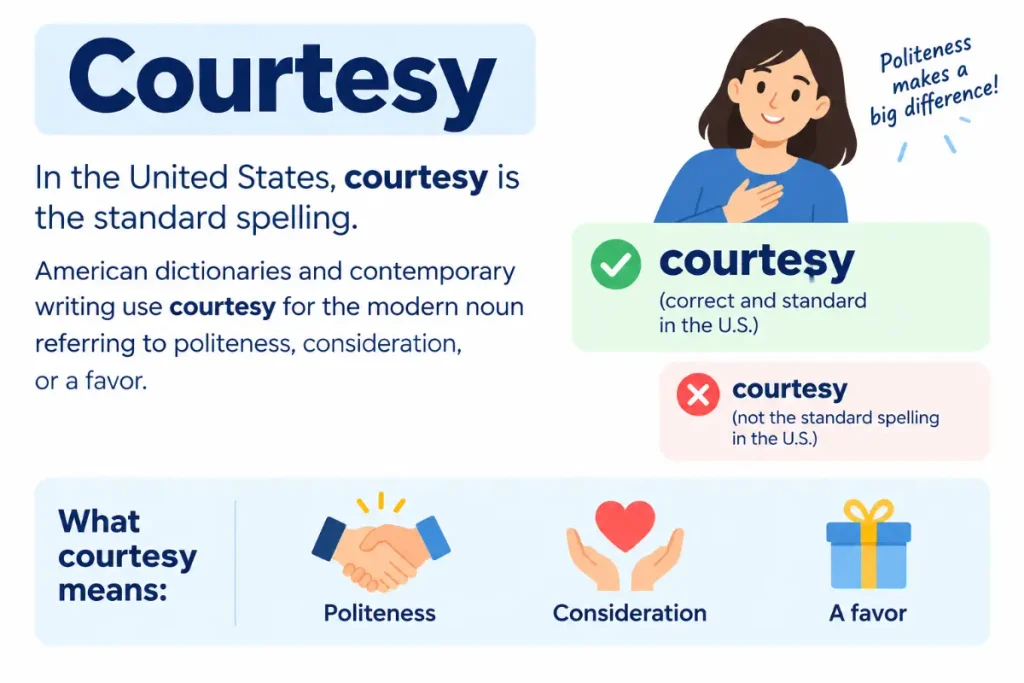
In the United States, courtesy is the standard spelling. American dictionaries and contemporary writing use courtesy for the modern noun referring to politeness, consideration, or a favor.
You should use courtesy in:
- School assignments
- College applications
- Resumes
- Cover letters
- Business emails
- Reports
- Websites
- Social media posts
- Everyday messages
Curtesy should not be used as a normal modern spelling in these contexts.
Is “Curtesy” a British Spelling?
No. Curtesy should not be treated as the normal British equivalent of American courtesy. British English also uses courtesy.
Therefore, the difference is not:
- American: courtesy
- British: curtesy
Instead, courtesy is the standard modern spelling in both major varieties of English. The form curtesy is primarily encountered as an older or historical spelling rather than as a modern regional alternative.
The History of Courtesy
The word courtesy has a long history connected with the idea of behavior associated with a court or polite society. It ultimately developed through French and Middle English forms associated with courtly behavior. Over time, its meaning broadened beyond behavior at a royal or aristocratic court and came to refer more generally to politeness, consideration, and respectful conduct. Older texts may contain spelling variations that are no longer standard today. That’s one reason readers may occasionally encounter forms such as curtesy.
Historical spelling, however, doesn’t automatically make a spelling appropriate for modern English. In current writing, courtesy is the established form.
Common Mistakes With Courtesy
1. Writing “Curtesy”
Incorrect in standard modern usage:
Thank you for your curtesy.
Correct:
Thank you for your courtesy.
2. Writing “Courtsey”
Another common spelling mistake is switching the positions of s and e.
Incorrect:
Thank you for your courtsey.
Correct:
Thank you for your courtesy.
3. Confusing Courtesy With Courteous
Because courtesy and courteous are related, writers sometimes use the wrong form.
Incorrect:
She was courtesy to the guests.
Correct:
She was courteous to the guests.
But:
She showed courtesy to the guests.
Here, courtesy is correct because it functions as a noun.
4. Using Politeness When You Mean a Favor
Sometimes courtesy refers to a service or gesture rather than general good manners.
The hotel provides a courtesy shuttle.
Replacing courtesy with politeness would change the meaning and sound unnatural.
Courtesy vs Curtesy: Quick Comparison
| Feature | Courtesy | Curtesy |
|---|---|---|
| Modern standard spelling | Yes | No |
| Common in American English | Yes | No |
| Common in British English | Yes | No |
| Means polite behavior | Yes | Historical usage |
| Can mean a favor or gesture | Yes | Historical usage |
| Suitable for modern professional writing | Yes | No |
| Recommended spelling | Yes | No |
How to Remember the Correct Spelling
A simple memory trick is to connect courtesy with court.
The word begins:
COUR-
Think:
COURtesy → COURT → polite behavior
You don’t need to remember the full history of the word. Just remember that the modern spelling begins with cour-, not cur-. Another useful trick is to remember the related word courteous:
- courtesy
- courteous
- courteously
All three begin with cour-.
When Should You Use Courtesy?
Use courtesy when you mean:
- Polite behavior
- Good manners
- Consideration for others
- A respectful act
- A favor
- A helpful gesture
- A complimentary service
- A polite phone call or message
Examples include:
Please show courtesy to your neighbors.
The airline provided a courtesy hotel room.
I called as a courtesy.
Thank you for your courtesy.
What Are Some Synonyms for Courtesy?
The best synonym depends on the context. Some words describe politeness, while others describe a favor or consideration.
| Word/Phrase | Meaning | Tone | Example |
|---|---|---|---|
| politeness | Good manners | Neutral | “Her politeness was appreciated.” |
| respect | Regard for someone | Neutral | “Treat others with respect.” |
| consideration | Thoughtfulness toward others | Neutral/Formal | “Thank you for your consideration.” |
| civility | Polite, respectful behavior | Formal | “The discussion remained civil.” |
| good manners | Appropriate polite behavior | Everyday | “Good manners matter.” |
| kindness | Friendly or caring behavior | Warm | “Her kindness helped everyone.” |
| decency | Proper and respectful behavior | Neutral | “He treated them with decency.” |
| grace | Polite, composed behavior | Formal | “She handled the situation with grace.” |
| thoughtfulness | Care for another person’s needs | Warm | “His thoughtfulness was appreciated.” |
| consideration | Careful regard for others | Professional | “We appreciate your consideration.” |
| tact | Skill in avoiding offense | Professional | “She handled the issue with tact.” |
| decorum | Proper behavior in formal settings | Formal | “The meeting required decorum.” |
| diplomacy | Careful handling of sensitive situations | Formal | “He responded with diplomacy.” |
| courteousness | The quality of being courteous | Formal | “Her courteousness stood out.” |
| respectfulness | The quality of showing respect | Formal | “His respectfulness was evident.” |
These aren’t perfect substitutes in every sentence. Courtesy can specifically refer to a favor or complimentary service, while words such as politeness and civility generally focus on behavior.
Courtesy vs Kindness
He showed courtesy by waiting his turn.
Kindness usually suggests a more caring or generous action:
She showed kindness by helping her neighbor carry the boxes.
Someone can be courteous without being especially kind, and an act of kindness can go beyond ordinary courtesy.
Courtesy vs Civility
Civility usually refers to respectful and polite behavior, particularly in social or public interactions.
The debate remained civil despite strong disagreements.
Courtesy is broader and can include favors or services:
The hotel offered a courtesy shuttle.
Thus, civility is especially useful when discussing respectful conduct, while courtesy has several meanings.
Courtesy vs Consideration
Consideration often means thinking about another person’s needs, feelings, or circumstances.
Thank you for your consideration.
Courtesy can describe the outward polite action itself:
Thank you for your courtesy.
The two words are sometimes interchangeable, but they aren’t identical in every context.
Can Courtesy Be an Adjective?
Courtesy is primarily a noun, but it can appear before another noun in combinations such as courtesy call, courtesy shuttle, or courtesy vehicle.
For example:
The hotel provides a courtesy shuttle.
Here, courtesy modifies shuttle within the noun phrase.
The adjective courteous is the standard choice when you want to directly describe a person or their behavior:
The driver was courteous.
Not:
The driver was courtesy.
Is Courtesy Countable or Uncountable?
Courtesy can be used in different ways depending on its meaning. When referring to polite behavior in a general sense, it is often uncountable:
Courtesy is important in the workplace.
When referring to a particular polite act or favor, it can be countable:
He extended several courtesies to his guests.
The plural courtesies is also used when referring to specific acts of politeness or formal social practices.
What Is the Plural of Courtesy?
The plural form is courtesies.
For example:
The host observed all the usual courtesies.
The spelling changes from courtesy to courtesies, following the common English pattern in which a final y changes to ies when forming the plural.
Other examples include:
- courtesy → courtesies
- city → cities
- policy → policies
- story → stories
Courtesy in Formal and Informal Contexts
Courtesy works across a wide range of settings.
| Context | Example |
|---|---|
| Professional email | “Thank you for your courtesy.” |
| Workplace | “Employees should treat customers with courtesy.” |
| School | “Students are expected to show courtesy.” |
| Academic writing | “Courtesy and respect are important in professional communication.” |
| Everyday conversation | “It’s common courtesy to say thank you.” |
| Customer service | “The store offered a courtesy replacement.” |
| Texting | “Just calling as a courtesy.” |
| Social media | “Please give others the courtesy of hearing them out.” |
The word doesn’t automatically make a sentence formal. The surrounding language determines the overall tone.
Quick Tips for Remembering Courtesy
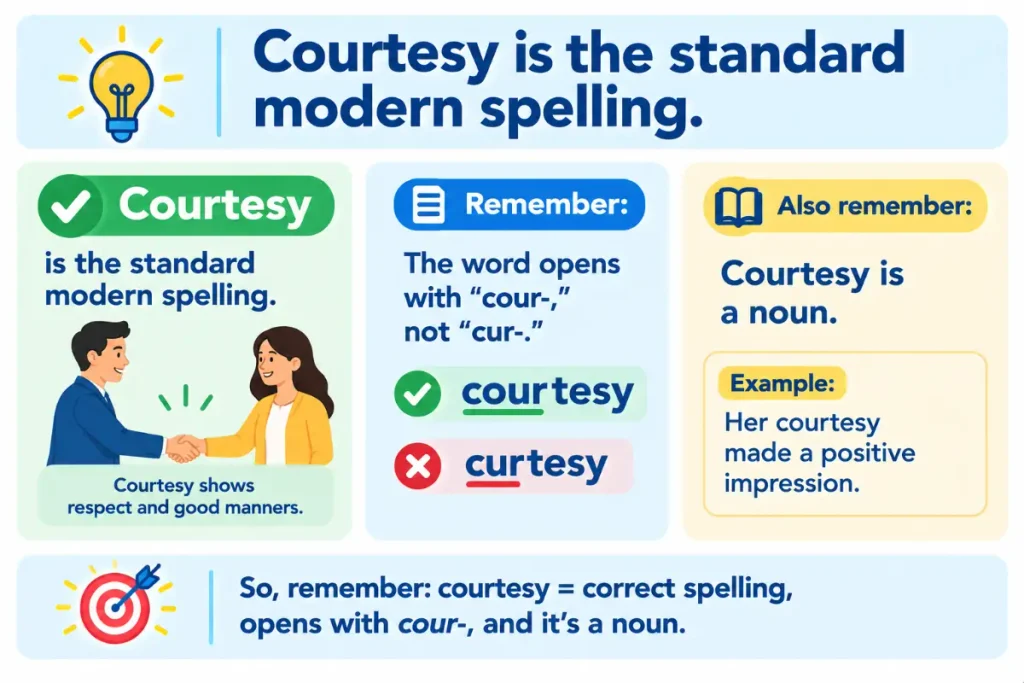
- Courtesy is the standard modern spelling.
- Remember the opening cour-, not cur-.
- Courtesy is a noun.
- Courteous is the related adjective.
- Courteously is the related adverb.
- Courtesies is the plural form.
- Use courtesy in American and British English.
- Treat curtesy as a historical or obsolete form rather than a normal modern alternative.
- In professional writing, courtesy is the safe and standard choice.
Conclusion
The difference between courtesy vs curtesy is mainly a matter of modern spelling. Courtesy is the standard form used in contemporary American and British English, while curtesy is an outdated or historical spelling that should generally be avoided in modern writing.
Use courtesy when talking about polite behavior, consideration, a favor, or a helpful gesture. Remember that related forms such as courteous and courteously also begin with cour-. If you’re writing an email, essay, resume, workplace message, or everyday text, choosing courtesy will give you the standard modern spelling and keep your writing clear and correct.
Frequently Asked Questions
Is “courtesy” or “curtesy” correct?
Courtesy is the correct standard spelling in modern English. Curtesy is an obsolete or historical spelling and should generally be avoided in contemporary writing.
How do you spell courtesy?
The correct spelling is courtesy: C-O-U-R-T-E-S-Y. A useful reminder is that it begins with cour-, as in court.
What does courtesy mean?
Courtesy means polite, respectful, or considerate behavior. It can also mean a favor, complimentary service, or helpful gesture provided as a matter of goodwill.
Is curtesy a word?
Curtesy can be found as a historical or obsolete spelling, but it is not the standard spelling used in modern American English. For contemporary writing, use courtesy.
Is courtesy a noun or an adjective?
Courtesy is primarily a noun. For example, “She showed courtesy to the guests.” The related adjective is courteous, as in “She was courteous to the guests.”
What’s another word for courtesy?
Depending on the context, alternatives include politeness, respect, consideration, civility, good manners, kindness, decency, and tact. The best choice depends on whether you mean polite behavior, respect, or a specific favor.
Is “courtesy” used in British English?
Yes. Courtesy is also the standard modern spelling in British English. Curtesy is not the normal British spelling.
1 thought on “Courtesy vs Curtesy: Which Is Correct?”