
If you’re writing an email, school assignment, resume, or social media post, you may wonder whether prooving vs proving is the correct spelling. The confusion usually comes from the verb prove and the way English forms words ending in -ing.
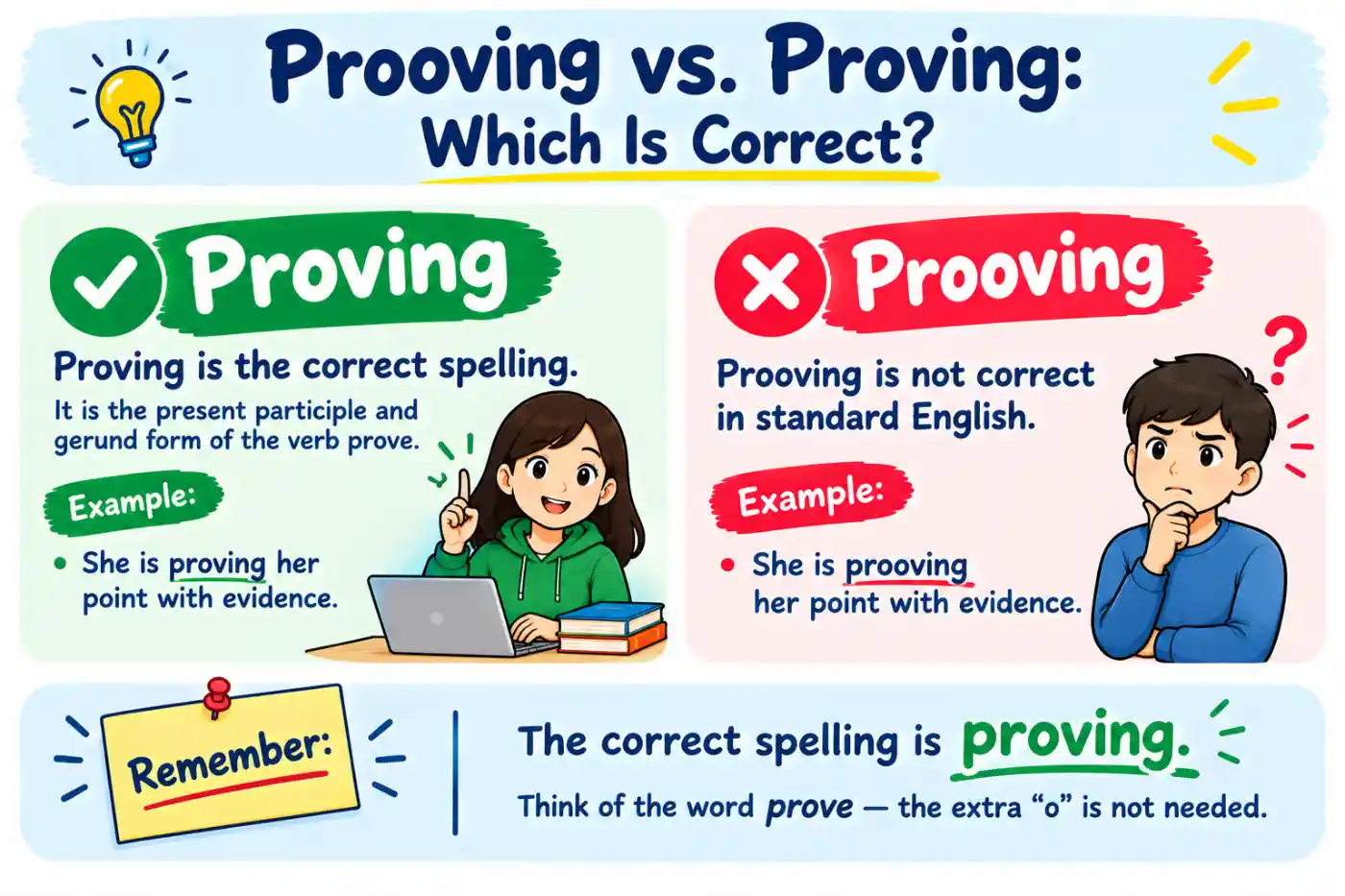
Proving is the correct spelling, while prooving is incorrect in standard English. Proving is the present participle and gerund form of the verb prove, which means to demonstrate that something is true, correct, or valid.
In this guide, you’ll learn why proving is correct, why prooving may look tempting, how to use proving in sentences, and how it differs from related words such as prove, proved, and proof.
Prooving vs Proving: Which Is Correct?
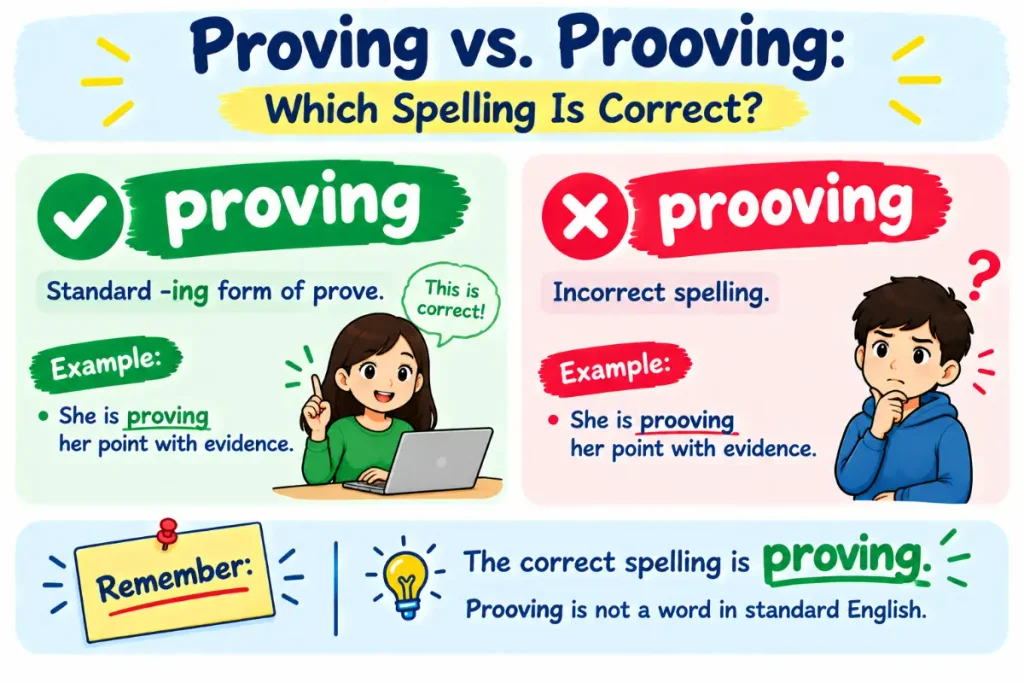
The correct spelling is proving.
| Spelling | Correct? | Explanation |
|---|---|---|
| proving | ✅ Yes | Standard -ing form of prove |
| prooving | ❌ No | Incorrect spelling |
| proveing | ❌ No | Incorrect spelling |
| proved | ✅ Yes | Past tense and past participle of prove |
The key spelling rule is simple: when prove becomes an -ing form, the final silent e is dropped before adding -ing.
prove → proving
You do not keep the final e, and you do not add another o.
What Does Proving Mean?
Proving means showing that something is true, correct, effective, or valid through evidence, facts, actions, or reasoning.
It is the -ing form of the verb prove.
For example:
- The scientist is proving the theory with new evidence.
- She is proving that she can handle the responsibility.
- The test is proving useful.
- He spent months proving his point.
Depending on the context, proving can refer to demonstrating a fact, establishing something through evidence, or showing someone’s ability or worth through actions.
Why Is “Proving” Spelled Without the Second O?
The spelling can seem confusing because prove already contains two vowels near the end: o-v-e. When you add -ing, however, English spelling rules change the form.
The basic pattern is:
prove + ing → proving
The final e is removed before -ing is added.
This is a common pattern with many English verbs ending in a silent e:
| Base Verb | -ing Form |
|---|---|
| make | making |
| take | taking |
| write | writing |
| use | using |
| give | giving |
| move | moving |
| prove | proving |
So prooving is not formed by simply attaching -ing to prove. The final silent e is removed first.
How Do You Spell Proving Correctly?
Spell it:
P-R-O-V-I-N-G
The correct form is proving.
A useful way to remember it is:
prove → proving
Do not write:
- ❌ prooving
- ❌ proveing
- ❌ prooving
The correct spelling is:
- ✅ proving
Example
Incorrect: The experiment is prooving that the method works.
Correct: The experiment is proving that the method works.
Prooving vs Proving in Real Sentences
Seeing the word in context can make the spelling easier to remember. Here are natural examples using proving:
- The new evidence is proving that the original theory was correct.
- She is proving herself to be a reliable team member.
- The results are proving more useful than we expected.
- He kept proving his point with clear examples.
- The company is proving that quality and affordability can work together.
- Your actions are proving that you are serious about the project.
- The student is proving that hard work can improve her results.
- The new software is proving easier to use than the previous version.
- The evidence played an important role in proving the claim.
- The coach said the young player was proving himself during practice.
- The experiment is proving the value of the new approach.
- He had difficulty proving that the document was authentic.
Notice that proving works naturally after forms of be and after certain verbs or prepositions.
Prove vs Proving: What’s the Difference?
| Word | Function | Example |
|---|---|---|
| prove | Base verb | We need to prove the claim. |
| proving | -ing form | She is proving the claim. |
| proved | Past tense/past participle | They proved the claim. |
Prove
Use prove when the base form of the verb is required.
- We need to prove that the information is accurate.
- The evidence may prove his argument correct.
Proving
Use proving when the action is ongoing or when the verb functions as a gerund.
- She is proving her ability.
- Proving the claim took several months.
Proved
Use proved for a completed action in the past or as a past participle.
- The experiment proved successful.
- The evidence proved that the statement was false.
Prove vs Proved vs Proving
These three forms are related, but they are not interchangeable.
Prove
Prove is the base form.
We need to prove the results are accurate.
Proved
Proved is the usual past-tense form.
The test proved that the system worked.
Proving
Proving describes an ongoing action or can function as a noun-like gerund.
The team is proving its ability to compete.
A quick comparison:
| Form | Example |
|---|---|
| prove | They want to prove their case. |
| proved | They proved their case yesterday. |
| proving | They are proving their case now. |
Why Do People Write “Prooving”?
The most common reason is that people may apply the wrong spelling pattern to the word prove. Because prove contains oo in its pronunciation-related spelling pattern, it can look natural to some writers to create prooving. However, the spelling of the base word does not mean another o should appear when -ing is added.
The correct transformation is:
prove → remove final e → add -ing → proving
Not:
prove → add -ing → prooving
This same issue occurs with other words ending in a silent e.
For example:
- hope → hoping, not hooping
- move → moving, not moveing
- write → writing, not writeing
- prove → proving, not prooving
Proving vs Proove
Another spelling mistake worth knowing is proove. Proove is not the standard spelling of the verb. The correct base verb is prove.
| Incorrect | Correct |
|---|---|
| proove | prove |
| prooving | proving |
| proveing | proving |
For example:
❌ The results will proove the theory.
✅ The results will prove the theory.
The incorrect form proove can lead to the incorrect form prooving, so learning the base word prove helps prevent both mistakes.
Proving vs Proof: What’s the Difference?
Proving and proof are closely related, but they have different grammatical functions.
| Word | Part of Speech | Meaning | Example |
|---|---|---|---|
| proving | Verb form/gerund | Showing something is true | She is proving her point. |
| proof | Noun | Evidence that establishes something | We need proof of the claim. |
| prove | Verb | To establish something as true | We must prove the claim. |
| proved | Verb | Established as true in the past | The evidence proved the claim. |
For example:
- Proving the theory required more research.
- The researchers found proof supporting the theory.
- They need to prove the theory.
- Their findings proved the theory was useful.
Proving vs Testing: Are They the Same?
Not always.
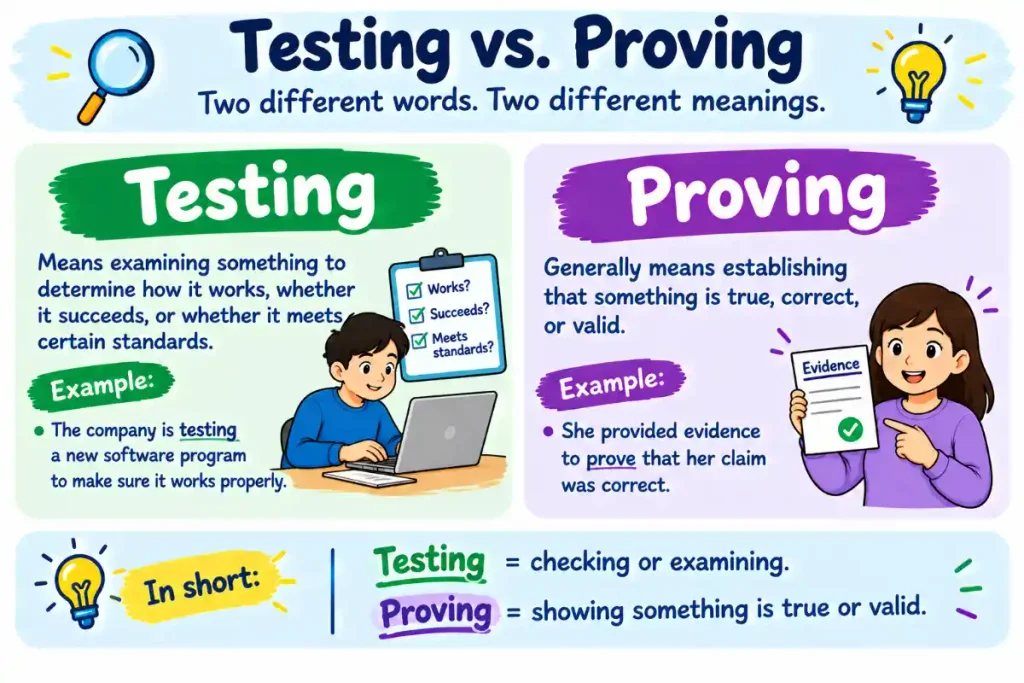
Testing means examining something to determine how it works, whether it succeeds, or whether it meets certain standards. Proving generally means establishing that something is true, correct, or valid.
For example:
Scientists are testing the new treatment.
This tells us that an examination or trial is taking place.
Scientists are proving that the treatment works.
This makes a stronger statement: the evidence is establishing that the treatment works. The words can overlap in some contexts, but they are not exact synonyms.
Proving vs Demonstrating
Proving and demonstrating can sometimes be used similarly, but there is a slight difference. Demonstrating often means showing how something works or showing a particular quality. Proving usually focuses more strongly on establishing truth, validity, or correctness.
Compare:
- The teacher is demonstrating how the machine works.
- The evidence is proving that the machine is safe.
The first sentence focuses on showing how something works. The second focuses on establishing a conclusion.
How to Use “Proving” in Different Contexts
The word proving is useful in many kinds of writing and conversation.
In Academic Writing
In essays and research writing, proving can describe the process of establishing a conclusion with evidence.
The researchers are proving the relationship between the two variables.
However, academic writers should be precise. In some cases, supporting, demonstrating, or providing evidence for may be more appropriate than proving, especially when the evidence does not establish an absolute conclusion.
In Professional Emails
You can use proving in workplace communication when discussing results, performance, or evidence.
The new process is proving effective for our team.
The data is proving useful in making the decision.
In a Resume
The word can describe demonstrated ability, although resume wording should focus on specific achievements.
For example:
Proving the effectiveness of the new process through improved customer response times.
A more direct resume style might be:
Demonstrated the effectiveness of the new process through improved customer response times.
The second version may be clearer because it directly states the completed achievement.
In Everyday Conversation
Proving is common in ordinary speech.
- You’re proving my point.
- He’s proving that he can do it.
- This is proving harder than I expected.
- She’s proving herself every day.
Common Mistakes With Proving
Here are the mistakes most likely to cause confusion.
1. Writing “Prooving”
❌ The evidence is prooving the claim.
✅ The evidence is proving the claim.
2. Writing “Proveing”
❌ She is proveing her point.
✅ She is proving her point.
The final e in prove is dropped before -ing.
3. Using “Proove” as the Base Verb
❌ We need to proove that the information is accurate.
✅ We need to prove that the information is accurate.
4. Confusing Proving With Proof
❌ We need proving of the claim.
✅ We need proof of the claim.
However, you could say:
We need to keep proving the claim with reliable evidence.
The correct choice depends on the grammatical role of the word.
5. Assuming “Prooving” Is a British Variant
Prooving is not simply a British spelling of proving. Standard English uses proving in both American and British English.
Is “Prooving” Ever Correct?
No. “Prooving” is not the standard English spelling of the -ing form of prove. If you see prooving in an email, article, assignment, or other standard English writing, it should normally be corrected to proving.
The correct forms are:
- prove
- proves
- proved
- proving
- proven
Is “Proving” Used in American English?
Yes. Proving is standard in American English. There is no American-versus-British spelling difference for this word.
| American English | British English |
|---|---|
| proving | proving |
Both varieties use proving.
The same spelling is also standard in other major varieties of English.
Proving in Formal vs. Casual Writing
Proving is acceptable in both formal and casual writing when it accurately describes the action.
Formal
The results are proving the reliability of the proposed method.
Professional
The new procedure is proving effective for reducing processing time.
Casual
You’re proving that I was right.
The word itself does not sound unusually formal or informal. The surrounding language determines the overall tone.
What Part of Speech Is “Proving”?
Proving is the present participle and gerund form of the verb prove. As a present participle, it can help form progressive verb tenses:
She is proving her point.
As a gerund, it can function like a noun:
Proving the claim required additional evidence.
In both cases, the spelling remains proving.
Word Origin of Prove
The verb prove comes through Old French from Latin probare, meaning to test, approve, or establish as good or worthy. English developed related words such as proof, prove, and proven from this history. The modern spelling prove ends with a silent e, which explains why its -ing form becomes proving rather than proveing or prooving.
A Simple Rule for Remembering Proving
Use this formula:
PROVE − E + ING = PROVING
Think of the final e as something that disappears before -ing:
- make → making
- take → taking
- write → writing
- move → moving
- prove → proving
If you remember prove → proving, you can avoid both prooving and proveing.
Quick Comparison: Prooving vs Proving
| Feature | Prooving | Proving |
|---|---|---|
| Standard English | ❌ No | ✅ Yes |
| Correct spelling | ❌ | ✅ |
| Base word | — | prove |
| Form | Incorrect | Present participle/gerund |
| American English | ❌ | ✅ |
| British English | ❌ | ✅ |
| Example | prooving the point | proving the point |
Quick Tips to Remember the Correct Spelling
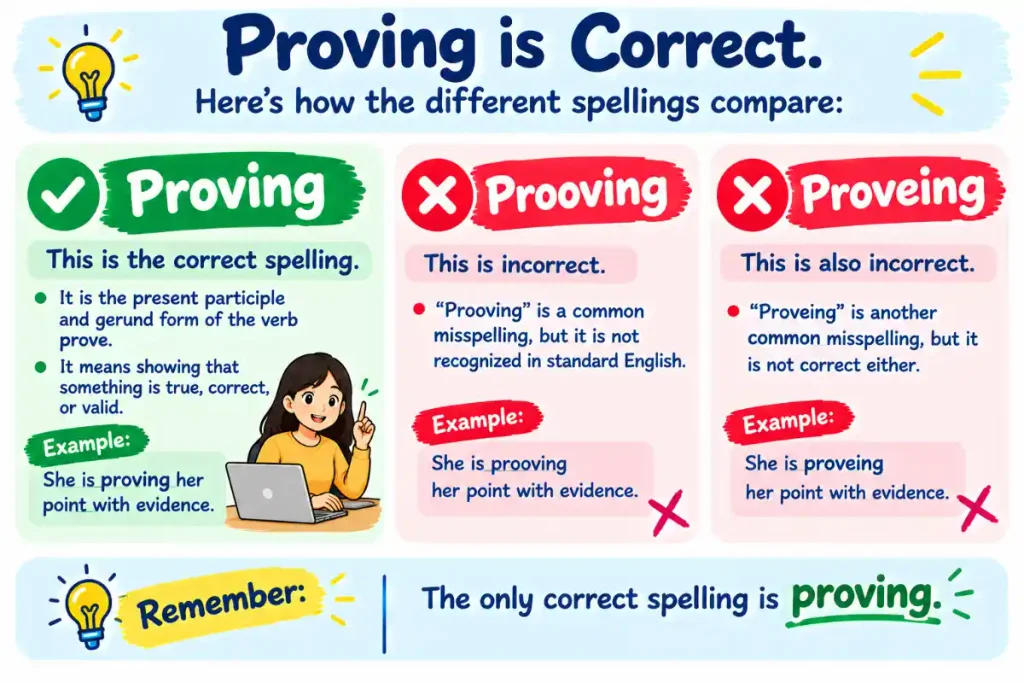
- Proving is correct.
- Prooving is incorrect.
- Proveing is also incorrect.
- Start with prove.
- Drop the final e before adding -ing.
- Remember: prove → proving.
- Don’t add another o.
- American and British English both use proving.
Conclusion
When comparing prooving vs proving, the correct spelling is proving. It is the -ing form of the verb prove, and it is formed by dropping the final silent e before adding -ing.
The incorrect forms prooving and proveing are common spelling mistakes, but neither is standard English. The simple pattern prove → proving makes the correct spelling easy to remember.
Use proving when you mean showing that something is true, valid, effective, or correct. Whether you’re writing an email, assignment, professional document, or casual message, proving is the standard form in American English and British English alike.
Frequently Asked Questions
Is “prooving” a correct word?
No. Prooving is not the standard spelling. The correct form is proving.
How do you spell proving?
Proving is spelled P-R-O-V-I-N-G. It comes from prove by dropping the final silent e and adding -ing.
Which is correct, prooving or proving?
Proving is correct. In the spelling comparison prooving vs proving, prooving is an incorrect form.
Why isn’t it spelled “proveing”?
Because verbs ending in a silent e generally drop that e before -ing. Therefore, prove becomes proving, not proveing.
Is “prooving” a British spelling?
No. Prooving is not a standard British spelling. Both American and British English use proving.
What’s the difference between prove and proving?
Prove is the base form of the verb, while proving is its -ing form. For example, “We need to prove the claim” and “We are proving the claim.”
What is the past tense of prove?
The usual past tense is proved. For example, “The evidence proved that the claim was accurate.” Proven is also commonly used as a past participle, especially in certain constructions.
1 thought on “Prooving vs Proving: Which Is Correct?”