
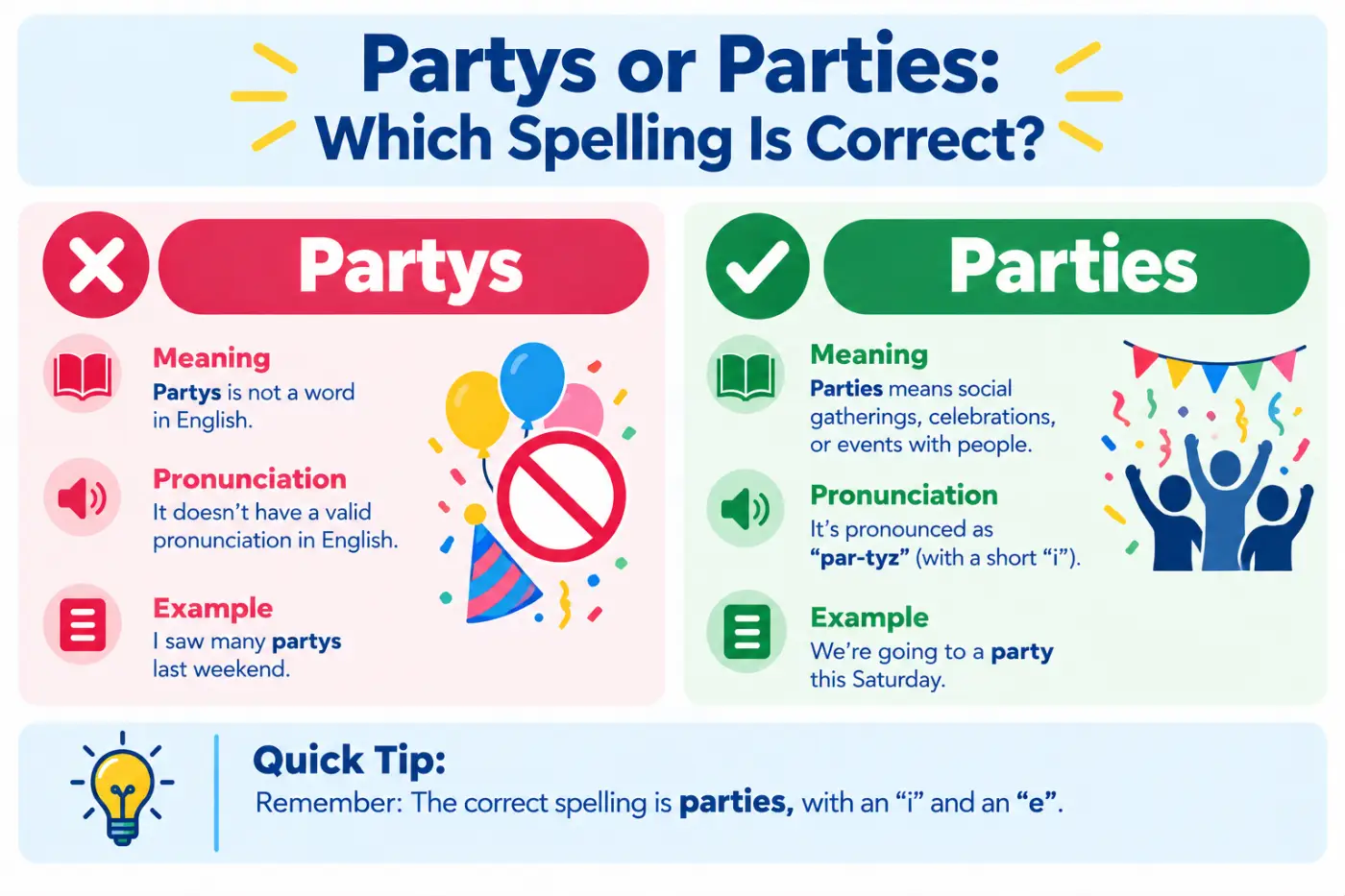
If you’re writing about several celebrations, political groups, social gatherings, or organized groups, you may wonder whether the plural of party is partys or parties. This is a common spelling question because many English nouns simply add -s to form their plurals.
The correct plural spelling is parties. Partys is incorrect when you mean more than one party. The spelling changes from party to parties because the word ends in a consonant followed by y.
Quick answer: The correct spelling is parties, not partys. For example, “We attended two parties last weekend” is correct In this guide, you’ll learn why parties is correct, how to use it in sentences, when to use party’s or parties’, and how to avoid common mistakes.
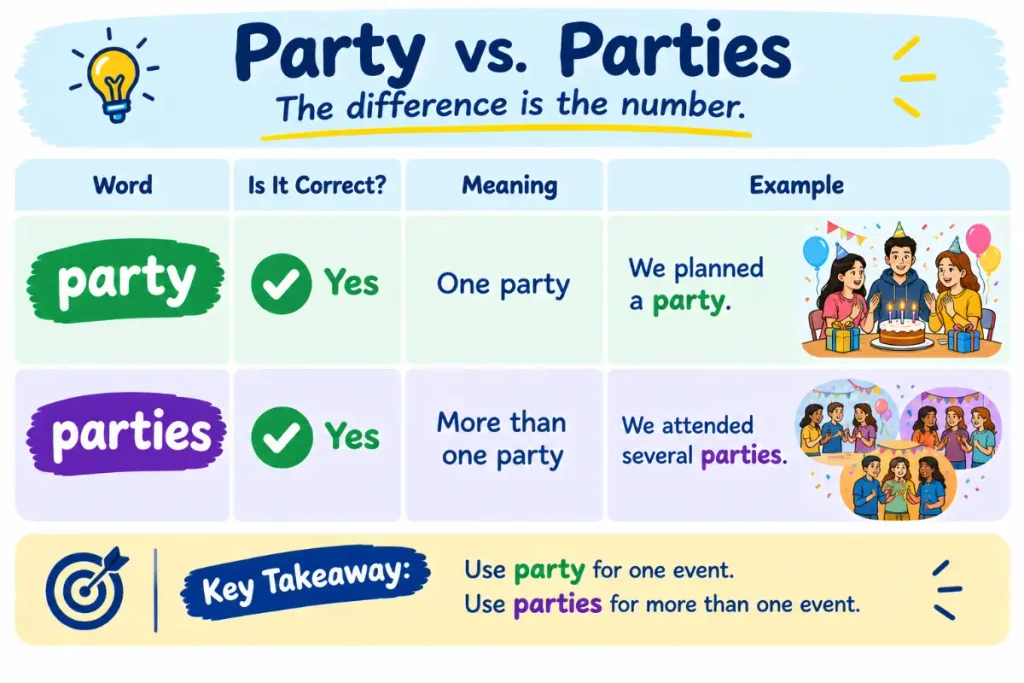
Partys or Parties: What’s the Difference?
The difference is simple:
| Word | Correct? | Meaning | Example |
|---|---|---|---|
| party | Yes | One party | We planned a party. |
| parties | Yes | More than one party | We attended several parties. |
| partys | No | Incorrect plural spelling | ❌ We attended three partys. |
| party’s | Yes | Belonging to one party or “party is” | The party’s location is nearby. |
| parties’ | Yes | Belonging to multiple parties | The parties’ schedules were different. |
The main point is that parties is the standard plural form of party.
Why Is “Parties” the Correct Plural?
The spelling rule explains the change.
When a noun ends in a consonant + y, the y usually changes to i before adding -es.
So:
- party → parties
- city → cities
- baby → babies
- story → stories
- country → countries
- family → families
The word party follows this standard English pluralization rule.
Why Isn’t It “Partys”?
Simply adding -s would produce partys, but that isn’t the standard English plural spelling. The final y changes to ie, giving us parties.
Party + -es → parties
This spelling represents the plural form correctly in standard American English.
How Do You Spell the Plural of “Party”?
The plural of party is spelled parties.
The spelling changes as follows:
party → parties
For example:
- We are having a party tonight.
- We are having several parties this month.
The same pattern applies to many other words ending in consonant + y.
When Do You Use “Party”?
Use party when you’re talking about one party.
Examples:
- We’re hosting a birthday party.
- The party starts at 7 p.m.
- She invited me to her graduation party.
- The office is planning a holiday party.
- They had a small dinner party.
Because party refers to one event or group in these examples, the singular form is appropriate.
When Do You Use “Parties”?
Use parties when you’re talking about two or more parties.
Examples:
- We attended two birthday parties last month.
- Several parties were held at the venue.
- The hotel hosts private parties.
- The children enjoyed different holiday parties.
- Both parties agreed to the arrangement.
The word parties can refer to different kinds of groups or events, depending on the context.
“Parties” Can Have More Than One Meaning
The plural parties isn’t limited to celebrations. The meaning depends on how the word is being used.
Parties as Social Events
In everyday conversation, parties often means celebrations or social gatherings.
For example:
We went to three parties during the summer.
Here, parties means multiple social events.
Parties as Groups of People
Party can also mean a group of people involved in an activity or agreement.
For example:
Both parties signed the contract.
Here, parties refers to two groups involved in the agreement, not two celebrations.
Parties in Politics
In political contexts, parties can mean organized political groups.
For example:
Several political parties participated in the election.
The word is still plural because it refers to more than one party.
Parties in Legal or Business Writing
In legal and business language, parties often refers to people or organizations involved in a contract, case, or agreement.
For example:
The parties agreed to the new terms.
Again, parties is the plural form of party.
Partys or Parties in a Sentence
The easiest way to remember the difference is to look at examples.
| Incorrect | Correct |
|---|---|
| We went to two partys. | We went to two parties. |
| Several partys were scheduled. | Several parties were scheduled. |
| The venue hosts birthday partys. | The venue hosts birthday parties. |
| They attended three holiday partys. | They attended three holiday parties. |
| Many political partys participated. | Many political parties participated. |
Whenever you mean more than one party, use parties.
10+ Examples of “Parties” in Real Sentences
Here are some natural examples showing how parties works in different situations:
- We attended two birthday parties last weekend.
- The restaurant is popular for private parties.
- My friends are planning several holiday parties this year.
- The school holds graduation parties for students.
- We received invitations to three different parties.
- The hotel has rooms available for large parties.
- Both parties agreed to meet again next week.
- The two parties signed the agreement on Monday.
- Several political parties announced their positions.
- The children enjoyed the different birthday parties.
- Our family usually hosts small dinner parties.
- The contract explains the responsibilities of both parties.
Notice that parties can describe social events, groups, organizations, or people involved in an agreement.
Party vs Parties
The difference between party and parties is mainly singular versus plural.
| Form | Number | Example |
|---|---|---|
| party | One | She planned a party. |
| parties | More than one | She planned two parties. |
Compare these sentences:
- The party was fun. → One event
- The parties were fun. → Multiple events
Another example:
- The party signed the agreement. → One group
- The parties signed the agreement. → Multiple groups
Party’s vs Parties’: Don’t Confuse the Possessive Forms
One reason people search for partys or. parties is that English has several forms of the word that look similar.
The three most important forms are:
- party — singular
- parties — plural
- party’s — singular possessive or contraction
- parties’ — plural possessive
What Does “Party’s” Mean?
Party’s can show possession by one party.
For example:
The party’s location was changed.
This means the location belongs to or is associated with one party. Party’s can also be a contraction of party is in some contexts, although this use is less common.
For example:
The party’s starting soon.
Here, party’s means party is.
What Does “Parties'” Mean?
Parties’ is the possessive form of the plural parties.
For example:
The parties’ responsibilities were clearly defined.
This means the responsibilities belong to multiple parties.
Compare:
- The party’s plans = plans of one party
- The parties’ plans = plans of multiple parties
The apostrophe comes after the s in parties’ because parties is already plural.
Partys, Parties, Party’s, and Parties’ Compared
These forms are easy to mix up, so here’s a quick reference:
| Form | Use | Example |
|---|---|---|
| party | Singular | The party begins at 8. |
| parties | Plural | We attended several parties. |
| party’s | Singular possessive | The party’s theme was blue. |
| parties’ | Plural possessive | The parties’ schedules conflicted. |
| partys | Incorrect | ❌ We attended two partys. |
If you’re simply making party plural, don’t add an apostrophe. Write parties.
Why Do Words Ending in “Y” Change to “IES”?
English has a common spelling pattern for nouns ending in consonant + y.
The y changes to i, and -es is added.
Examples include:
- party → parties
- city → cities
- company → companies
- library → libraries
- country → countries
- enemy → enemies
- university → universities
This is why parties, rather than partys, is the correct spelling.
What About Words Ending in a Vowel + Y?
The rule is different when a word ends in a vowel + y. In those cases, the y usually stays and you simply add -s.
Examples:
- boy → boys
- toy → toys
- day → days
- key → keys
- journey → journeys
Compare:
- party → parties
- boy → boys
The letter before the y determines which plural pattern is used.
Common Mistakes With “Parties”
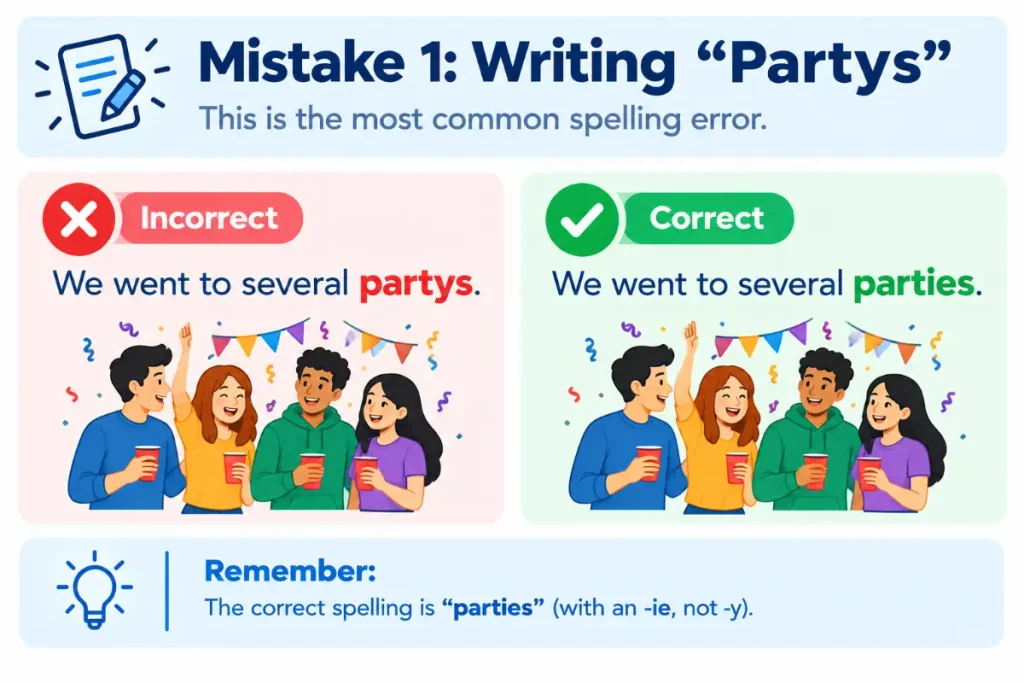
Mistake 1: Writing “Partys”
This is the most common spelling error.
Incorrect:
We went to several partys.
Correct:
We went to several parties.
Mistake 2: Using “Party’s” as the Plural
An apostrophe does not normally make a noun plural.
Incorrect:
We attended three party’s.
Correct:
We attended three parties.
Party’s is possessive or can be a contraction, not the ordinary plural.
Mistake 3: Writing “Parties” When You Mean One Party
Because parties is plural, it shouldn’t be used with a singular meaning.
Incorrect:
The parties starts at 6 p.m.
Correct:
The party starts at 6 p.m.
Mistake 4: Confusing “Parties'” With “Parties”
These forms have different functions.
- parties = more than one party
- parties’ = something belonging to multiple parties
Compare:
Several parties attended the meeting.
The parties’ representatives attended the meeting.
The apostrophe changes the grammatical role of the word.
Is “Partys” Ever Correct?
Partys is not the standard plural spelling of party. If you’re referring to multiple parties, use parties. There may be unusual contexts in which a sequence of letters happens to contain “partys,” such as a username, brand name, filename, or other intentionally created name. But in standard English writing, partys should not be used as the plural of party.
How to Remember “Party → Parties”
A simple memory trick is:
Consonant + Y → change Y to I and add ES.
So:
party → parties
You can remember it with a few familiar examples:
- city → cities
- baby → babies
- story → stories
- party → parties
Think of party as following the same spelling pattern as city and story.
“Parties” in Formal and Informal Writing
The spelling parties is appropriate in both formal and informal English.
In Professional Writing
Both parties must approve the revised agreement.
In Academic Writing
Political parties can influence public debate.
In an Email
We have several parties scheduled for December.
In Everyday Conversation
We went to a couple of parties last weekend.
On Social Media
These summer parties have been so much fun!
The spelling doesn’t change based on the level of formality. Parties is the standard plural form in all of these contexts.
US vs. UK Usage
There is no meaningful US-versus-UK spelling difference for the plural of party.
American English uses:
party → parties
British English also uses:
party → parties
Canadian and Australian English generally use the same plural form as well. So if you’re writing for a US audience, parties is clearly the correct choice.
“Parties” in Different Contexts
The meaning of parties changes according to context, but the spelling stays the same.
Social Gatherings
The neighborhood hosts several parties each year.
Legal Agreements
The parties agreed to the terms.
Business
The two parties are negotiating a new contract.
Politics
Several parties competed for seats in the election.
Groups Involved in an Activity
Both parties were responsible for completing the project.
This flexibility makes party a useful word with several meanings, but its plural form remains parties.
Is “Parties” a Noun?
Yes. Parties is the plural form of the noun party. Depending on the context, the noun can refer to:
- social gatherings
- groups of people
- political organizations
- people or organizations involved in an agreement
- groups participating in a particular activity
Examples:
The parties were held on Saturday.
The parties signed the contract. In both cases, parties functions as a plural noun.
What Is the Singular Possessive of “Party”?
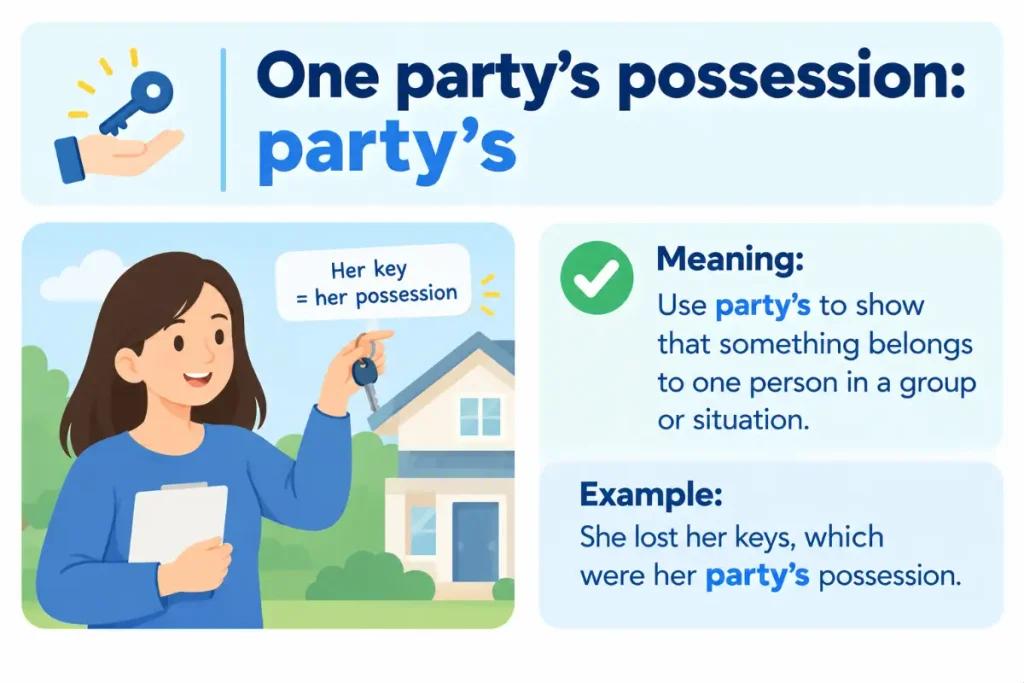
The singular possessive form is party’s.
For example:
The party’s theme was announced yesterday.
This means the theme is associated with one party.
Other examples include:
- the party’s guests
- the party’s location
- the party’s schedule
- the party’s host
- the party’s decorations
Don’t use party’s simply because you mean more than one party.
What Is the Plural Possessive of “Party”?
The plural possessive form is parties’.
For example:
The parties’ agreements were reviewed.
Here, the apostrophe follows the s because parties is already plural.
Another example:
The parties’ representatives met yesterday.
This means the representatives belong to or represent multiple parties.
Partys or Parties: Quick Comparison
| Feature | Partys | Parties |
|---|---|---|
| Standard English? | No | Yes |
| Plural of party? | No | Yes |
| Used for multiple parties? | ❌ | ✅ |
| Used in US English? | No | Yes |
| Correct spelling in formal writing? | No | Yes |
| Example | ❌ three partys | ✅ three parties |
For standard English writing, choose parties.
Quick Tips for Remembering the Correct Spelling
Keep these rules in mind:
- One: party
- More than one: parties
- One party’s possession: party’s
- Multiple parties’ possession: parties’
- Never use “partys” as the standard plural.
- For consonant + y nouns, remember the y → ies pattern.
A useful mental shortcut is:
party + ies = parties
If you’re talking about multiple celebrations, groups, or organizations, parties is the form you want.
Conclusion
The correct spelling is parties, not partys, when you’re referring to more than one party. The change happens because party ends in a consonant followed by y, so the y changes to i and -es is added: party → parties.
It’s also important to distinguish parties from party’s and parties’. Party’s shows possession by one party, while parties’ shows possession by multiple parties. These apostrophe forms have different grammatical purposes and shouldn’t be used as ordinary plurals.
Once you remember the consonant + y → ies rule, the partys or. parties question becomes easy. Whether you’re writing about social gatherings, business agreements, or political organizations, use parties for the standard plural form.
Frequently Asked Questions
Is “partys” correct?
No. Partys is not the standard plural form of party. The correct plural spelling is parties.
Which is correct, “partys” or “parties”?
Parties is correct. Party changes to parties because nouns ending in consonant + y generally change the y to i and add -es.
How do you spell the plural of party?
The plural is spelled parties: party → parties.
Is “party’s” the plural of party?
No. Party’s is the singular possessive form of party, or in some contexts a contraction of “party is.” The ordinary plural is parties.
What is the difference between “parties” and “parties'”?
Parties is the plural form, while parties’ is the plural possessive form. For example, “Several parties attended” uses the plural, while “the parties’ representatives” shows possession or association.
Why does party become parties?
Because party ends in a consonant followed by y. In its plural form, the y changes to i and -es is added, producing parties.
Can I use “parties” in formal writing?
Yes. Parties is the standard plural form and is appropriate for formal, academic, professional, and everyday writing.
2 thoughts on “Partys or Parties: Which Spelling Is Correct?”