
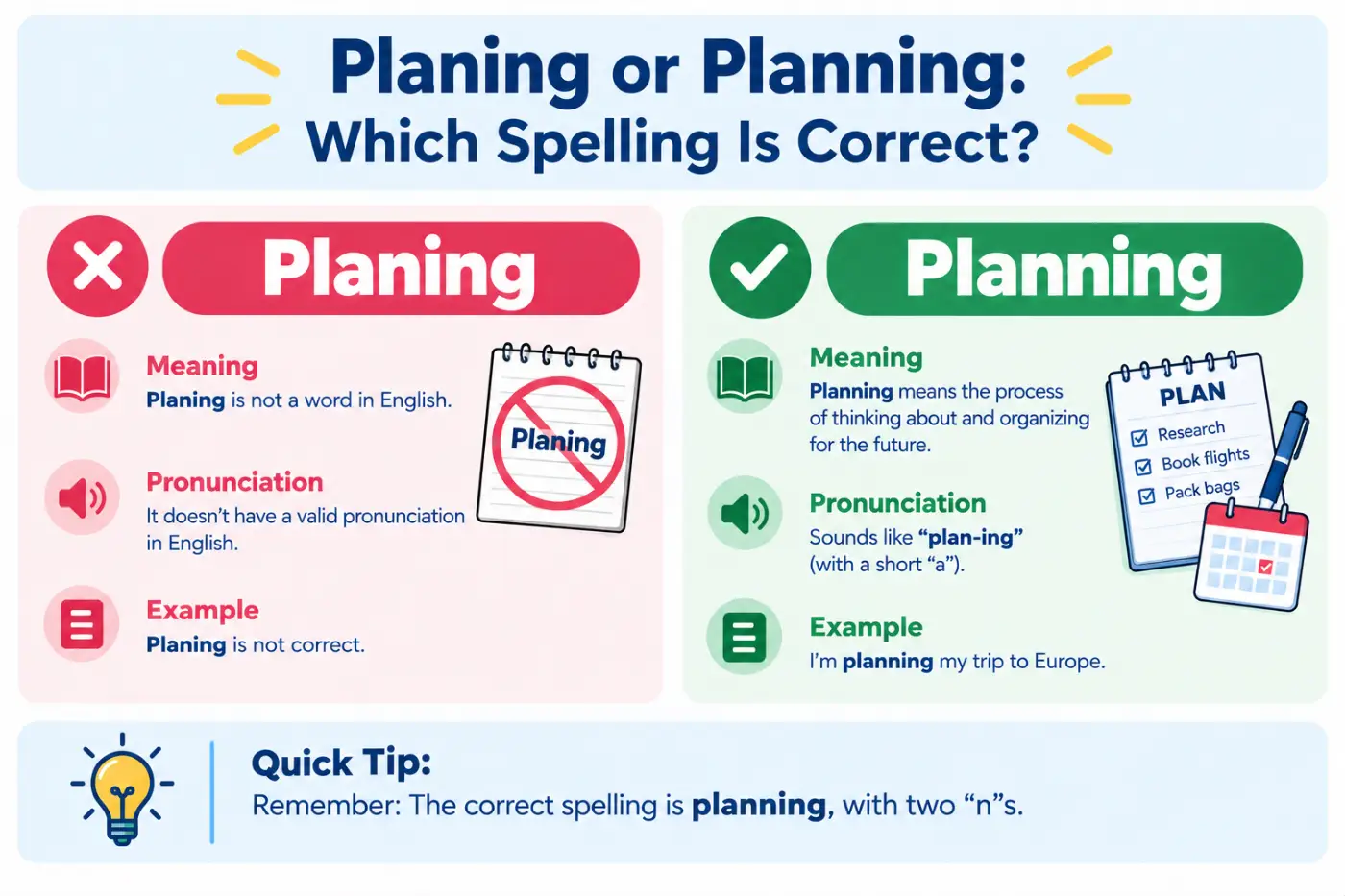
If you’re writing an email, school assignment, resume, or social media post and wonder about planing or planning, the correct spelling depends on the meaning you want to convey. Both are real English words, but they have different meanings and uses.
Planning means making arrangements, preparing for the future, or deciding what to do. Planing, on the other hand, refers to smoothing or shaping a surface, usually with a tool called a plane. Understanding this difference will help you choose the right spelling for your sentence.
In this guide, you’ll learn the difference between planing vs. planning, explore their meanings, and see examples of how to use each word correctly. You’ll also discover a simple way to remember when to use each spelling in American English.
Planing or Planning: Which Is Correct?
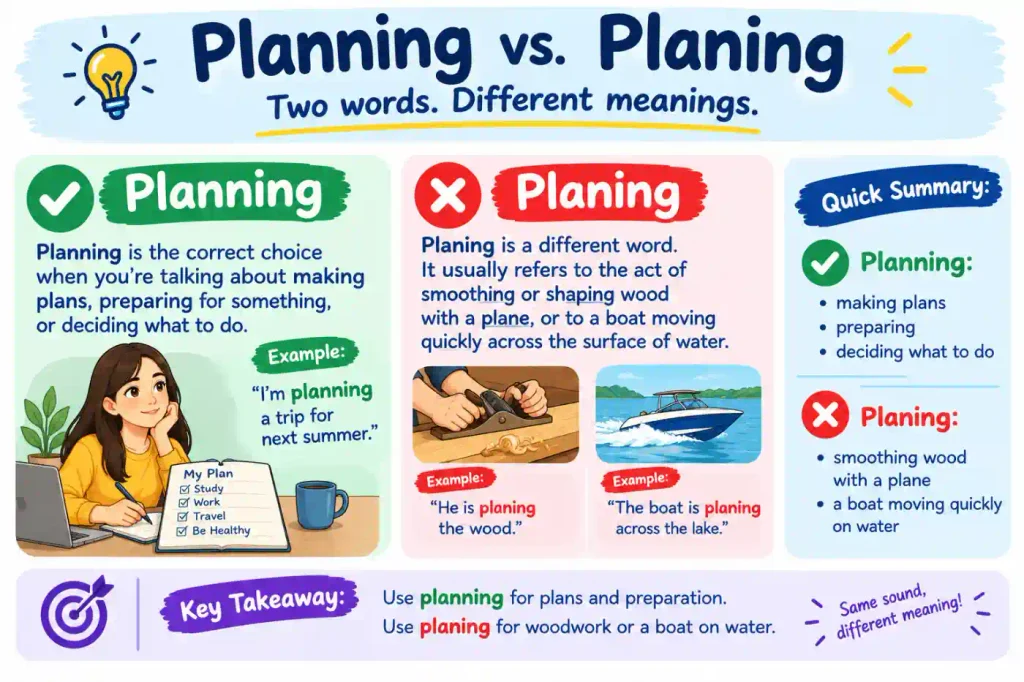
Planning is the correct choice when you’re talking about making plans, preparing for something, or deciding what to do.
Planing is a different word. It usually refers to the act of smoothing or shaping wood with a plane, or to a boat moving quickly across the surface of water.
| Word | Meaning | Example |
|---|---|---|
| Planning | Making arrangements or preparing | We are planning a trip to California. |
| Planing | Smoothing or shaping with a plane | He is planing the wooden board. |
So, if you’re writing about your future plans, use planning with two n’s.
What Does Planning Mean?
Planning is the present participle or gerund form of the verb plan. It means thinking ahead and deciding what you want to do, how you will do it, or when you will do it.
For example:
- We are planning our vacation.
- She is planning a birthday party.
- I’m planning to apply for the job.
- They are planning their next project.
The word planning can describe both everyday decisions and more organized preparation.
Planning as a Verb
As a verb, planning describes an action that is happening or continuing.
We are planning a family dinner for Saturday.
Here, planning means making arrangements for the dinner.
Planning as a Noun
Planning can also function as a noun. In this use, it refers to the process of preparing or organizing something.
Good planning can make a project easier to manage.
In this sentence, planning refers to the overall process rather than one specific action.
Why Is Planning Spelled With Two Ns?
The spelling becomes clearer when you look at the base word plan. When a one-syllable verb ends in a single vowel followed by a single consonant, the final consonant is often doubled before adding -ing.
So:
plan + ing → planning
The final n is doubled because plan ends in a consonant (n) preceded by a vowel (a).
Similar examples include:
- run → running
- sit → sitting
- stop → stopping
- swim → swimming
- plan → planning
This is why planing is not the normal spelling of the -ing form of plan.
Why Is Planing Also a Real Word?
The confusion comes from the fact that planing is not simply a misspelling of planning. It is a legitimate English word. Planing is associated with the verb plane, which means to smooth, flatten, or shape a surface using a plane or similar tool.
For example:
The carpenter is planing the wooden door.
Here, planing has nothing to do with making future arrangements. The word can also describe a boat or similar craft moving rapidly along the surface of water.
The small boat was planing across the lake.
Because these meanings are uncommon in everyday writing, many people encounter planing mainly as a spelling mistake for planning.
Planning vs. Planing: What’s the Difference?
The easiest way to distinguish these words is to look at their base verbs.
Planning
Planning comes from plan and means preparing, organizing, or deciding what to do.
We are planning our wedding.
Planing
Planing comes from plane and means smoothing or shaping something with a plane, or moving across water in a particular way.
The carpenter is planing the piece of wood.
| Feature | Planning | Planing |
|---|---|---|
| Base word | Plan | Plane |
| Main meaning | Preparing or organizing | Smoothing/shaping or moving over water |
| Common in everyday writing? | Yes | Less common |
| Spelling | Double n | Single n |
| Example | We are planning dinner. | He is planing the wood. |
A Simple Test
Ask yourself:
Am I talking about making arrangements?
If yes, use planning.
Am I talking about smoothing wood or a similar surface with a plane?
If yes, use planing.
10 Examples of Planning in Sentences
Here are some natural examples of planning in everyday American English:
- We are planning a family vacation for next summer.
- She is planning her schedule for the new semester.
- I’m planning to call the doctor tomorrow.
- They spent several weeks planning the event.
- Our team is planning a new project.
- He is planning a surprise party for his sister.
- Good planning helped us finish the work on time.
- We’re planning to move to a different apartment.
- The students are planning their presentation together.
- I wasn’t planning to stay out late.
In every example, planning relates to preparing, organizing, or deciding what to do.
Examples of Planing in Sentences
Although planing is much less common, it is correct in certain contexts.
- The carpenter is planing the rough wooden board.
- He spent the afternoon planing the table surface.
- The worker was carefully planing the edge of the door.
- The boat began planing across the water.
- The craftsman used a hand plane for planing the wood.
These sentences use planing because they refer to the verb plane, not plan.
Common Mistakes With Planing and Planning
The most common mistake is using planing when you mean making arrangements.
Incorrect: I’m planing a trip.
If you mean that you’re organizing a trip, this spelling is incorrect.
Correct: I’m planning a trip.
The correct form is planning because the base verb is plan.
Incorrect: We are planing our wedding.
Unless you’re talking about physically smoothing something with a plane, this isn’t the word you need.
Correct: We are planning our wedding.
Here, planning means organizing and preparing for the wedding.
Incorrect: She is planing to study tonight.
The phrase planing to is incorrect when you mean that someone intends to do something.
Correct: She is planning to study tonight.
The standard construction is:
planning + to + verb
For example:
- planning to travel
- planning to study
- planning to work
- planning to move
- planning to apply
Planning to vs. Planing to
This is one of the easiest places to make a spelling mistake. Planning to means intending or preparing to do something.
I’m planning to visit New York next month.
Planing to is normally incorrect in this context. The reason is simple: the phrase comes from plan, not plane.
Correct Examples
- I’m planning to start a new job.
- She is planning to visit her parents.
- We’re planning to renovate the kitchen.
- They are planning to attend the meeting.
Incorrect Examples
- I’m planing to start a new job.
- She is planing to visit her parents.
- We’re planing to renovate the kitchen.
If you see to followed by an ordinary action verb, you probably want planning to.

Planning in Formal and Professional Writing
Planning is completely standard in professional and academic writing.
You can use it in:
- Business emails
- Resumes
- Reports
- School assignments
- Academic writing
- Project documents
- Presentations
- Workplace communication
For example:
Our department is planning several improvements for the coming year.
Or:
I am planning to pursue additional training in this field.
There is no need to replace planning with a more complicated word just because you’re writing formally.
Planning in Everyday Conversation
Planning is also very common in casual speech. People regularly use it when talking about:
- Trips
- Parties
- Meals
- School
- Work
- Weekend activities
- Moving
- Appointments
- Future goals
Examples include:
What are you planning for the weekend?
We’re planning a barbecue on Saturday.
Are you planning to go to the game?
In casual American English, these uses are completely natural.
Planning vs. Preparing
Planning and preparing are related, but they aren’t always interchangeable.
Preparing usually means getting yourself, your materials, or something else ready.
For example:
I’m planning a presentation.
This suggests you’re deciding what the presentation will include and how it will be organized.
I’m preparing the presentation.
This suggests you’re actively getting the presentation ready.
You can do both:
I’m planning the presentation and preparing the slides.
Planning vs. Organizing
Planning and organizing can overlap, but they focus on slightly different ideas. Organizing often involves arranging people, information, objects, or tasks.
For example:
We’re planning the conference.
This focuses on deciding how the conference will work.
She’s organizing the conference materials.
This focuses on arranging the materials. Both words can be correct depending on the intended meaning.
Planning vs. Scheduling
These words are also closely related. Planning is broader. It can include deciding what to do, setting goals, choosing methods, and arranging details. Scheduling specifically focuses on deciding when something will happen.
For example:
We’re planning our vacation.
This could involve choosing a destination, booking transportation, selecting activities, and setting a budget.
We’re scheduling our flights.
This focuses on arranging the specific flight times.
How to Remember the Correct Spelling
A simple memory trick is to connect the spelling to the base word.
Plan → Planning
Think:
PLAN + N + ING = PLANNING
The extra n belongs to the spelling of the -ing form. Another useful trick is to remember that planing comes from plane:
plane → planing
So:
- plan → planning
- plane → planing
If you’re making arrangements, you’re planning. If you’re smoothing wood with a plane, you’re planing.
What About Other Forms of Plan?
Knowing the other forms of plan can make the spelling pattern easier to remember.
| Form | Example |
|---|---|
| Plan | I need to plan the trip. |
| Plans | She plans everything carefully. |
| Planned | We planned the event yesterday. |
| Planning | They are planning the event now. |
Notice that both planned and planning double the final n.
- plan → planned
- plan → planning
This happens because of the spelling rule for short verbs such as plan.
Why Do People Write Planing?
People often write planing because the pronunciation of planning does not clearly signal the second n. When spoken aloud, the two words can sound very similar, especially in fast conversation. Since English spelling isn’t always predictable from pronunciation, it’s easy to leave out the extra letter when typing.
Another reason is that people may know words such as:
- making
- taking
- using
- writing
and assume that plan should simply become planing.
But plan follows a consonant-doubling pattern:
plan → planning
The same pattern appears in:
- run → running
- hop → hopping
- stop → stopping
- sit → sitting
Is Planing Ever Correct?
Yes. Planing is a correct English word when it comes from plane.
For example:
The carpenter is planing the wood.
It can also be correct when describing a boat moving across water:
The speedboat was planing over the lake.
So it’s not accurate to say that planing is always wrong. The important point is that planing and planning have different meanings.
US vs. UK Usage
There is no major American-versus-British spelling difference between planning and planing. Both forms are used in American and British English with the same basic meanings.
American English:
We are planning a trip.
British English:
We are planning a trip.
The spelling remains planning in both varieties. Likewise, planing retains its separate meaning in both forms of English.
Quick Comparison: Plan, Plane, Planning, and Planing
These four words look similar but have different meanings.
| Word | Meaning | Example |
|---|---|---|
| Plan | Decide what to do | We need to plan our trip. |
| Plane | Smooth/shape a surface; also an aircraft | He used a plane on the wood. |
| Planning | Preparing or making arrangements | We are planning our trip. |
| Planing | Smoothing with a plane or moving across water | He is planing the wood. |
Understanding the base words makes the distinction much easier.
Common Questions About Planing or Planning
Quick Tips to Remember the Difference
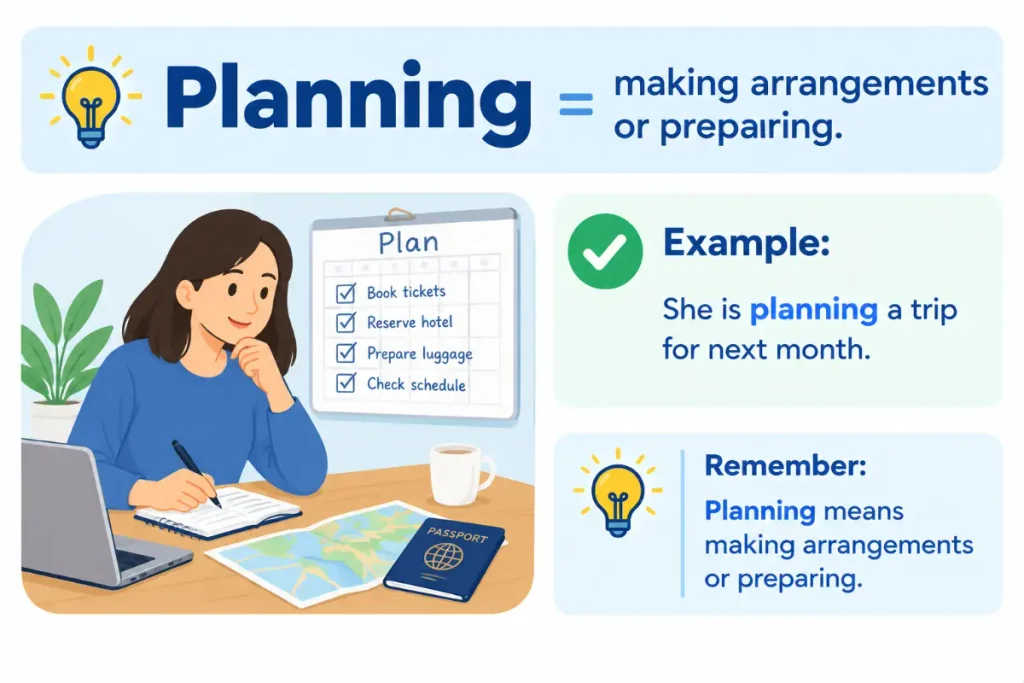
- Planning = making arrangements or preparing.
- Planing = smoothing or shaping with a plane.
- Plan + ing = planning.
- Plane + ing = planing.
- Use planning to when talking about an intention.
- If you’re discussing a vacation, project, party, schedule, or future activity, you almost certainly need planning.
Conclusion
In conclusion, planning is the correct spelling when you mean the process of preparing for something or deciding what to do in advance. Planing is a different word and is rarely used in everyday writing. It refers to the process of smoothing or shaping wood with a plane.
The key difference is the extra n in planning. When the verb plan becomes planning, the final consonant is doubled before adding -ing. For example, “We are planning a trip” and “She is planning her next project” both use the correct spelling.
To avoid confusion, remember that planning is used for organizing, preparing, or making arrangements, while planing relates to woodworking. Using the right spelling makes your writing clearer and helps you communicate your intended meaning accurately.
Frequently Asked Questions
Is planning the correct spelling?
Yes, planning is the correct spelling when you mean making arrangements, preparing, or deciding what to do. For example, “We are planning a vacation.”
Is planing a real word?
Yes, planing is a real English word. It comes from plane and commonly refers to smoothing or shaping a surface with a plane.
How do you spell planning?
The correct spelling is planning, with two n’s: p-l-a-n-n-i-n-g.
Which is correct, planing or planning?
Both can be correct, but they have different meanings. Planning means preparing or making arrangements, while planing usually means smoothing a surface with a plane.
Why does planning have two Ns?
The final consonant in the one-syllable verb plan is doubled before adding -ing, giving planning. This follows a common English spelling pattern also seen in words such as running and stopping.
Is “planning to” spelled correctly?
Yes. Planning to is correct when you mean intending or preparing to do something. For example, “I’m planning to visit my family this weekend.”
Can I use planing instead of planning?
No, not when you mean making arrangements or preparing for something. In that context, use planning. Planing has a different meaning related to plane.
2 thoughts on “Planing or Planning: Which Spelling Is Correct?”