
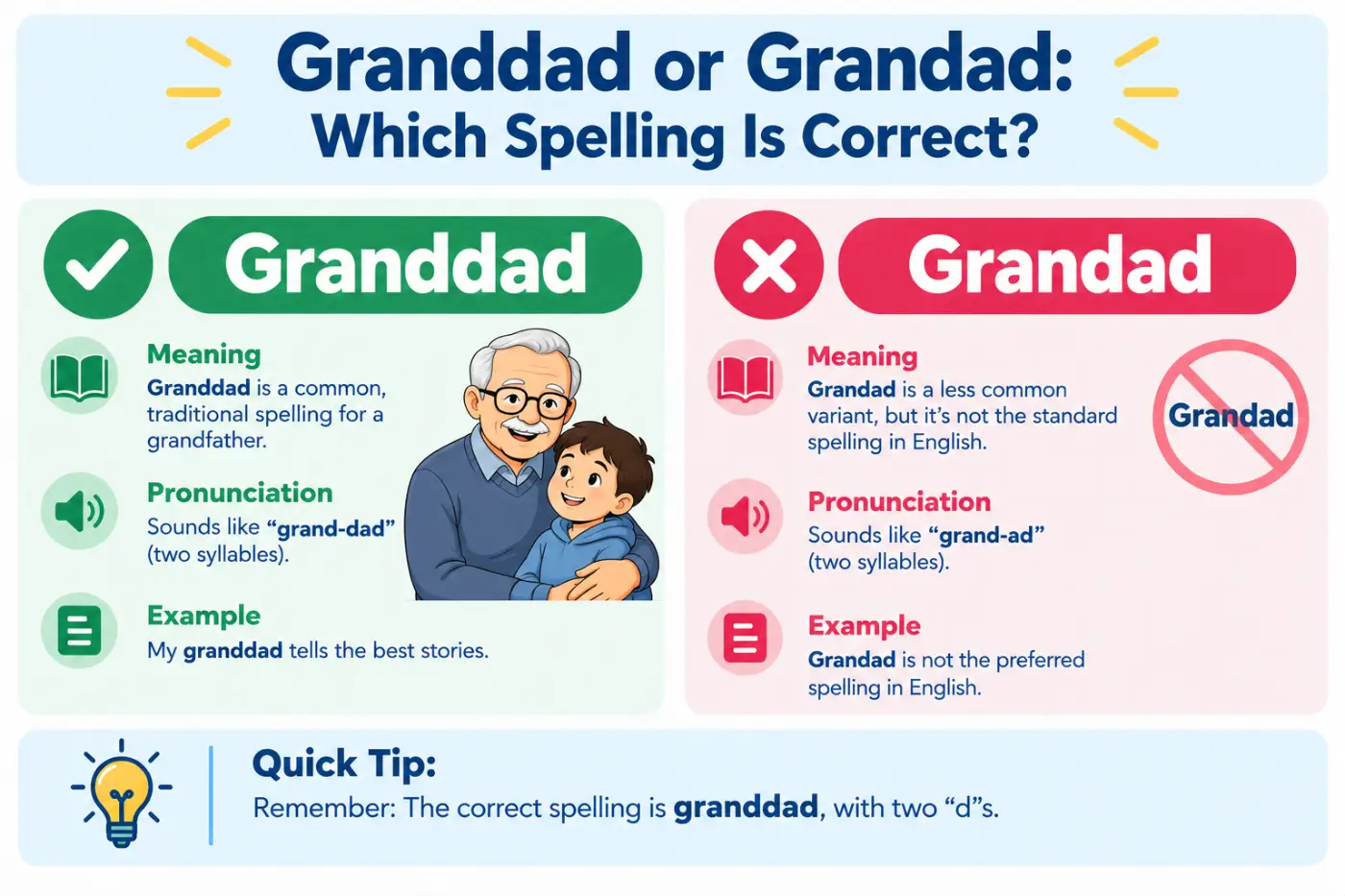
If you’re writing about your grandfather, you may wonder whether granddad or grandad is the correct spelling. Both forms are used in English, but they are more common in different varieties of English.
Granddad and grandad are both correct spellings for an informal word meaning grandfather. “Granddad” is more common in American English, while “grandad” is especially common in British English.
The difference is mainly regional rather than grammatical. This guide explains how each spelling is used, which version is best for American readers, and how the words compare with grandfather, grandpa, and other family terms.
What Does “Granddad” or “Grandad” Mean?
Granddad and grandad both mean grandfather. They are informal or familiar terms used when talking about or addressing one’s father’s or mother’s father.
For example:
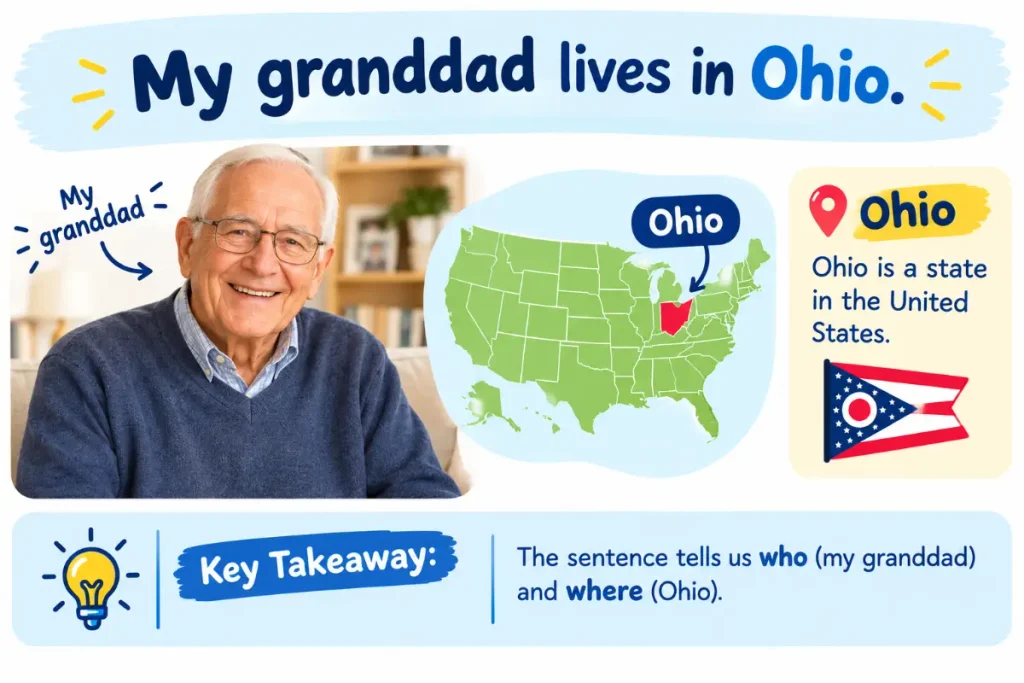
- “My granddad lives in Ohio.”
- “My grandad taught me how to fish.”
- “I called my grandfather last night.”
- “Granddad, can you tell me that story again?”
The meaning does not change because of the spelling. The main difference is regional preference.
In American English, granddad is a familiar and recognized spelling. In British English, grandad is very common. Both refer to the same family relationship.
Granddad vs. Grandad: Which Is Correct?
Both granddad and grandad are correct. The choice usually depends on the variety of English you’re using.
| Spelling | Meaning | Common Usage | Example |
|---|---|---|---|
| Granddad | Grandfather | Common in American English | “My granddad visits every Sunday.” |
| Grandad | Grandfather | Very common in British English | “My grandad lives near London.” |
| Grandfather | Father’s or mother’s father | Neutral/formal | “My grandfather was a teacher.” |
| Grandpa | Grandfather | Very common in American English | “My grandpa loves baseball.” |
If you’re writing for a U.S. audience, granddad is generally the better choice between the two. If you’re writing for a British audience, grandad may sound more natural. Neither spelling should automatically be labeled incorrect.
Why Are “Granddad” and “Grandad” Different?
The difference comes from spelling conventions that developed in different varieties of English. The word combines grand, meaning large or senior in a family relationship, with a familiar form of dad. Because English has no single worldwide spelling system, regional varieties sometimes settle on different forms. This is similar to other differences between American and British English. For example, American English often uses color, while British English uses colour. The difference doesn’t make one version universally correct. Likewise, granddad and grandad are established spellings. The important thing is to use the form that fits your audience and maintain consistency.
Is “Granddad” Correct in American English?
Yes. Granddad is correct in American English, although grandpa is often a more familiar choice in everyday American conversation. An American writer might use granddad in a family story, personal essay, conversation, or social media post:
“My granddad always had a funny story to tell.”
The word is informal, so it generally isn’t the first choice in formal documents. In a school paper or professional context, grandfather may be more appropriate unless you’re describing someone’s actual words or a personal relationship.
For example:
- Casual: “My granddad taught me to ride a bike.”
- Neutral: “My grandfather taught me to ride a bike.”
- Very familiar: “My grandpa taught me to ride a bike.”
Is “Grandad” Correct in American English?
Yes. Grandad is a valid English spelling, but it is more strongly associated with British English than American English. An American reader will generally understand grandad without difficulty. However, if you’re deliberately writing in standard American English, granddad or grandpa may feel more natural.
For example, a U.S. writer might choose:
“My granddad is coming to visit us this weekend.”
A British writer might naturally write:
“My grandad is coming to visit us this weekend.”
The meaning is identical.
Granddad or Grandad in the US?
For a U.S. audience, choose “granddad” if you specifically want one of these two spellings. That said, grandpa is also extremely natural in American English and may be more common in casual family conversation. Grandfather is the safest neutral option when the tone needs to be more formal.
Best choice for American readers
- Granddad — familiar and correct
- Grandpa — very natural and casual
- Grandfather — neutral and formal
- Grandad — understandable, but more associated with British English
Your choice should also reflect the person’s preferred family title. Families often use their own names for grandparents, and there isn’t one universally required term.
Granddad or Grandad in British English?
For British English, grandad is a very common spelling.
For example:
“My grandad used to take me to the park.”
British English also uses granddad, so it isn’t necessarily wrong in the UK. However, grandad is a familiar and widely recognized British form. This is why a British novel, website, or personal letter may use grandad, while an American publication may prefer granddad.
Granddad vs. Grandad vs. Grandpa
These three words have the same basic meaning, but their tone and regional associations differ.
| Word | Meaning | Tone | Typical Use |
|---|---|---|---|
| Granddad | Grandfather | Informal, warm | Family conversation |
| Grandad | Grandfather | Informal, warm | Especially common in British English |
| Grandpa | Grandfather | Informal, affectionate | Especially common in American English |
| Grandfather | Grandfather | Neutral/formal | General and formal writing |
There can also be personal or family preferences. One family may use Granddad, another may use Grandpa, and another may use a completely different nickname.
Granddad vs. Grandfather: What’s the Difference?
The difference is mainly tone and formality. Grandfather is the standard neutral term. Granddad is informal and more personal.
Compare these sentences:
- “My grandfather was born in 1940.”
- “My granddad used to tell me stories about his childhood.”
Both are grammatically correct. The first sounds more neutral, while the second sounds more conversational and familiar.
Use “grandfather” when:
- Writing formally
- Defining a family relationship
- Writing an academic or professional document
- You want a neutral tone
- The specific family nickname isn’t important
Use “granddad” when:
- Writing a personal story
- Talking about a family member
- Writing dialogue
- Using a warm, informal tone
- Reflecting the name your family actually uses
Granddad vs. Grandpa: What’s the Difference?
Granddad and grandpa both mean grandfather, and both can sound affectionate. The main difference is personal and regional preference. Grandpa is particularly familiar in American English, while granddad is also used in the United States and is especially recognizable across several varieties of English.
For example:
- “My grandpa loves gardening.”
- “My granddad loves gardening.”
Both sentences are correct. The best choice depends on what the family normally calls the grandfather and the style of the writing.
How Do You Spell Granddad Correctly?
The American spelling is commonly written as granddad, with dad at the end.
Correct: granddad
Also correct: grandad
More formal: grandfather
A common mistake is to assume that one spelling must be universally correct. English has many regional spelling differences, and grandad is an established form rather than simply a misspelling of granddad.
Is “Granddad” One Word?
Yes. Granddad is normally written as one word. The same applies to grandad, grandfather, and grandpa.
Correct:
“My granddad lives in Texas.”
Not standard:
“My grand dad lives in Texas.”
The two-word form grand dad isn’t the normal spelling when referring to a grandfather.
How Is “Granddad” Used in a Sentence?
Granddad functions as a noun. It can refer to a grandfather in a sentence or be used as a form of address.
As a noun
- “My granddad lives nearby.”
- “Her granddad taught her how to cook.”
- “Their granddad collects old photographs.”
- “I visited my granddad last weekend.”
As a form of address
- “Granddad, can you help me?”
- “Thanks, Granddad.”
- “Good morning, Granddad.”
When Granddad is used as a personal name or direct form of address, it is commonly capitalized.
When Should You Capitalize “Granddad”?
Capitalization depends on how the word is being used. Capitalize Granddad when it functions like a name:
“Thanks, Granddad!”
“Granddad is coming over tonight.”
Don’t capitalize it when it follows a possessive or is used as a general noun:
“My granddad is coming over tonight.”
“Her granddad lives in Florida.”
A useful test is to replace Granddad with the person’s first name. If the word is being used like a name, capitalization is often appropriate.
Compare:
- “I asked Granddad to help me.”
- “I asked my granddad to help me.”
10 Natural Examples of “Granddad” and “Grandad”
Here are examples showing how the words can appear in everyday writing.
- “My granddad makes the best pancakes on Sunday mornings.”
- “I spent the afternoon talking with my granddad.”
- “Granddad gave me an old family photo.”
- “Her granddad taught her how to play chess.”
- “My grandad lives in a small town outside Manchester.”
- “We visited our grandad during the holidays.”
- “Grandad always has a story ready for us.”
- “My grandfather and granddad are both terms for the same family relationship.”
- “I wrote about my granddad in my school essay.”
- “The children were excited to see their granddad again.”
The fifth through seventh examples show the British-style spelling in a natural context. The others demonstrate common informal usage.
Granddad or Grandad for an Essay?
For a formal school essay, grandfather is usually the safest neutral choice. However, granddad or grandad can be appropriate if you’re writing a personal narrative and that is the term your family uses.
For example:
Neutral:
“My grandfather played an important role in my childhood.”
Personal:
“My granddad played an important role in my childhood.”
The second sentence sounds more personal and conversational. If the assignment asks for a personal story, that can be a good fit.
Granddad or Grandad for a Professional Email?
In a professional email, grandfather is usually more appropriate because it has a neutral tone.
For example:
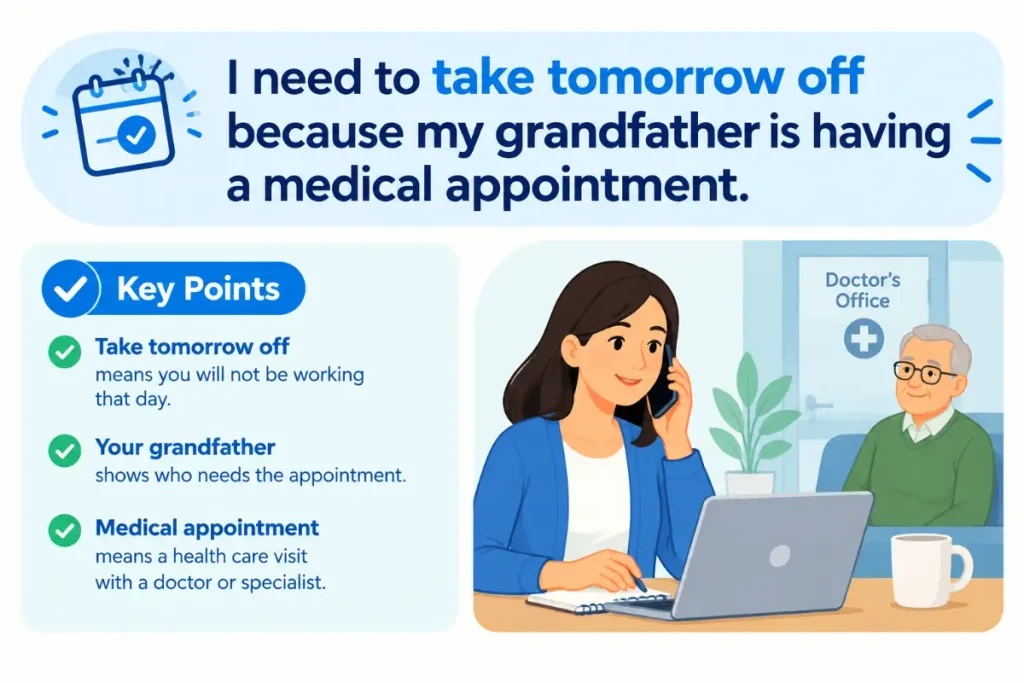
“I need to take tomorrow off because my grandfather is having a medical appointment.”
Using granddad isn’t grammatically wrong, but it sounds more personal and informal. If you’re writing to a close colleague who already knows the situation, an informal term may still be perfectly natural. The relationship between the writer and reader matters.
Granddad or Grandad in Texting?
Both are fine in texting.
Text messages are informal, so people generally use the word their family uses:
- “I’m going to see my granddad today.”
- “My grandad just sent me a funny photo.”
- “Grandpa wants us to come over.”
There’s no grammar rule requiring granddad instead of grandad in casual messages.
Granddad or Grandad on Social Media?
Either spelling works on social media. If you’re writing for an American audience, granddad or grandpa may sound more natural. If you’re writing for a British audience, grandad may be the more familiar choice.
For example:
“Happy birthday to my amazing granddad!”
Or:
“Happy birthday to my wonderful grandad!”
The spelling doesn’t change the basic meaning of the message.
Common Mistakes With Granddad and Grandad
Mistake 1: Calling “grandad” incorrect
Grandad is not simply a misspelling of granddad. It is an established spelling, particularly common in British English. Better understanding: Both forms are correct; regional usage differs.
Mistake 2: Writing “grand dad”
The standard family term is normally written as one word.
Incorrect: “My grand dad called me.”
Correct: “My granddad called me.”
Mistake 3: Assuming “grandfather” and “granddad” have the same tone
They share the same basic meaning, but their tone differs.
Grandfather is neutral or formal.
Granddad is informal and familiar.
Mistake 4: Changing the spelling based on grammar
The difference isn’t caused by grammatical rules. Granddad and grandad are spelling variants, not different grammatical forms.
Mistake 5: Using an informal term in a formal context
A word can be grammatically correct but still not be the best stylistic choice. For a formal report, grandfather is usually a better choice than granddad.
Which Spelling Should You Choose?
Use the following quick guide:
| Situation | Recommended Choice |
|---|---|
| American English | Granddad or grandpa |
| British English | Grandad is very common |
| Formal writing | Grandfather |
| Casual American conversation | Grandpa or granddad |
| Family story | The family’s preferred term |
| Text message | Any natural family term |
| Social media | Any appropriate informal term |
| Direct address | Granddad, Grandad, or the family’s preferred name |
The most important factor is audience and context.
A Simple Memory Trick
If you’re writing for an American audience and you’re choosing between the two spellings, remember:
Granddad → dad → American-style choice
Grandad → dad without the second “d” → strongly associated with British usage
This isn’t a strict rule for every speaker, but it’s a useful guide when you’re unsure. Another easy approach is to think about the tone:
- Grandfather = neutral
- Granddad = informal
- Grandad = informal, especially British
- Grandpa = informal and especially familiar in American English
Related Family Terms
English has several words for grandparents, and the best choice often depends on family tradition.
Grandfather
The standard neutral term for your parent’s father.
“My grandfather lives in Arizona.”
Grandpa
A common informal American term.
“My grandpa takes us fishing.”
Granddad
An informal term for grandfather.
“My granddad loves telling stories.”
Grandad
Another informal term for grandfather, especially common in British English.
“My grandad lives in Leeds.”
Gramps
A casual nickname for grandfather.
“Gramps always knows how to make us laugh.”
Granddaddy
An affectionate form that may be used in some families and regions.
“Granddaddy used to tell us stories.”
These terms are related, but they’re not always interchangeable in terms of family preference or regional style.
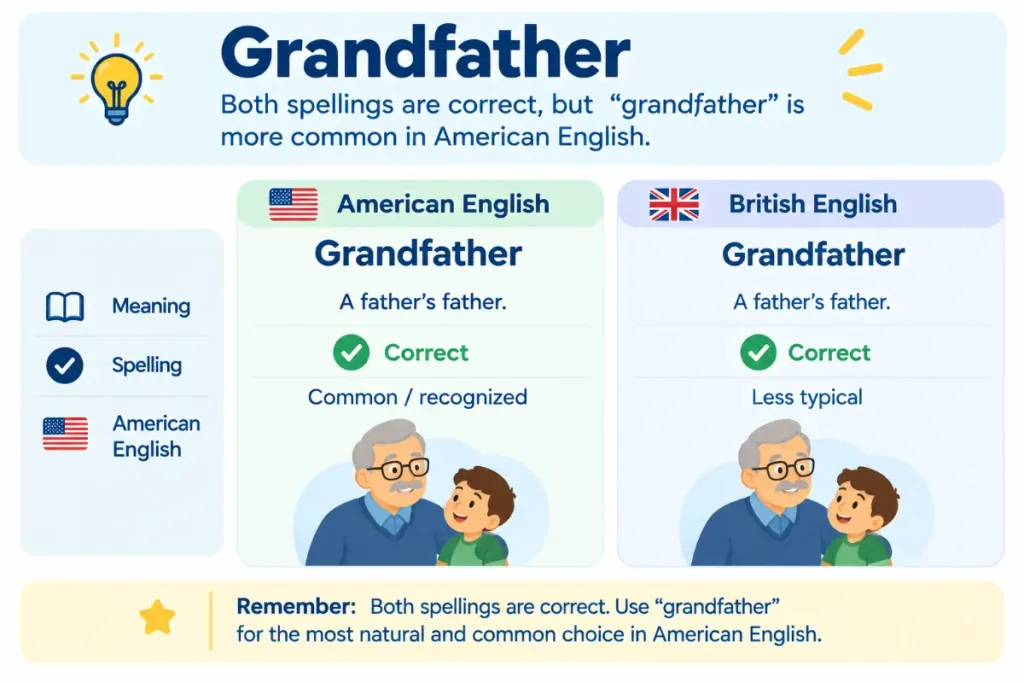
Granddad or Grandad: Quick Comparison
| Feature | Granddad | Grandad |
|---|---|---|
| Meaning | Grandfather | Grandfather |
| Spelling | Correct | Correct |
| American English | Common/recognized | Less typical |
| British English | Used | Very common |
| Tone | Informal | Informal |
| Formal writing | Usually avoid | Usually avoid |
| Alternative | Grandpa, grandfather | Grandpa, grandfather |
Conclusion
Granddad and grandad are both correct ways to refer to a grandfather. The main difference is regional preference: granddad fits American English well, while grandad is especially common in British English. Neither should be treated as a simple spelling error.
For a U.S. audience, granddad is a solid choice when you want an informal, familiar tone. If you need a neutral or formal term, choose grandfather. In casual American conversation, grandpa is another very natural option.
Ultimately, the best word depends on your audience, context, and family tradition. If you’re specifically deciding between granddad or grandad, use granddad for American English and grandad when following British usage.
Frequently Asked Questions
Is granddad or grandad correct?
Both granddad and grandad are correct. Granddad is commonly used in American English, while grandad is especially common in British English.
How do you spell granddad in American English?
The spelling granddad is a standard choice in American English. Grandad is also understandable and established, but it is more strongly associated with British English.
Is “grandad” a British spelling?
Yes. Grandad is particularly common in British English, although granddad is also used in Britain.
Which is more common in America, granddad or grandad?
Granddad is generally the better choice for American English when choosing between these two spellings. American speakers also commonly use grandpa.
Is granddad formal or informal?
Granddad is informal. For formal writing, grandfather is usually the more neutral choice.
Can I use grandad in an American essay?
Yes, if you’re using the term intentionally or reflecting your family’s preferred wording. If you’re writing in standard American English for a general audience, granddad or grandfather may be a more natural choice.
Is “grand dad” two words?
No. The standard spelling is granddad or grandad, written as one word. Grand dad is not the usual standard form.
2 thoughts on “Granddad or Grandad: Which Spelling Is Correct?”