

If you’re writing a text, email, school assignment, or social media post, you may pause over whiny vs whiney. Both spellings appear in English, but they aren’t equally common or equally useful in every context.
Whiny is the standard and most widely preferred spelling in American English. Whiney is a less common variant that appears in some dictionaries and real-world usage, but whiny is usually the safest choice.
The difference comes from the way the adjective is formed from the verb whine. Here’s how to spell and use the word naturally, plus examples, alternatives, and answers to common questions.
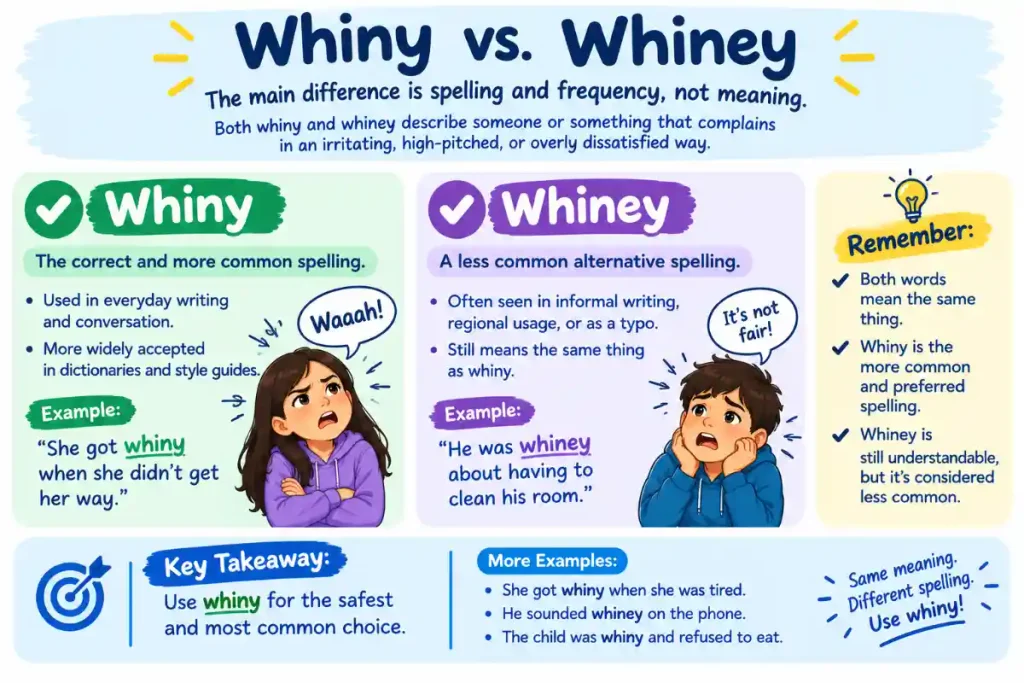
Whiny vs Whiney: What’s the Difference?
The main difference is spelling and frequency, not meaning. Both whiny and whiney describe someone or something that complains in an irritating, high-pitched, or overly dissatisfied way.
| Spelling | Meaning | Commonness | Best choice? |
|---|---|---|---|
| whiny | Complaining in an annoying or plaintive way | Very common | Yes |
| whiney | Same basic meaning as whiny | Less common | Usually avoid in formal writing |
The simple rule
If you’re unsure which spelling to use, choose whiny.
- Correct/preferred: She’s being whiny today.
- Less common variant: She’s being whiney today.
In American English, whiny is the spelling readers are most likely to expect.
What Does Whiny Mean?
Whiny is an adjective meaning inclined to whine or complain, especially in a way that sounds irritating, childish, or overly dissatisfied. The word comes from whine, which means to complain in a high-pitched, unpleasant, or persistent way.
For example:
The child became whiny after missing his nap.
Here, whiny describes the child’s behavior or manner of speaking. The word can also describe adults, voices, sounds, or even complaints:
- a whiny child
- a whiny voice
- a whiny customer
- a whiny complaint
- a whiny tone
Depending on context, whiny can be mildly teasing or openly critical.
How Do You Spell Whiny?
The standard spelling is:
W-H-I-N-Y → whiny
It is formed from whine by changing the ending before adding -y:
whine → whiny
The final e is dropped.
This pattern is similar to other English adjectives:
- noise → noisy
- ice → icy
- spice → spicy
- shine → shiny
- whine → whiny
That’s why whiny is generally preferred over whiney.
Is Whiney a Correct Spelling?
Whiney is a recognized variant spelling, but it is much less common than whiny. You may encounter whiney in informal writing, online conversations, and some dictionaries. It has the same basic meaning as whiny. However, if you’re writing something where standard spelling matters—such as an essay, professional email, article, or application—whiny is the better choice.
Why does “whiney” exist?
The spelling whiney is easy to understand because the original word is whine. A writer may naturally think:
whine + y = whiney
But English spelling doesn’t always work by simply attaching -y to the complete base word. In this case, the more established spelling is whiny. So while whiney isn’t an invented word, it is not usually the first choice.
Why Are Whiny and Whiney Confusing?
The confusion comes from the word whine itself. When you turn whine into an adjective, it feels natural to keep the spelling intact:
whine + y → whiney
But the conventional spelling removes the final e:
whin + y → whiny
The same kind of spelling change occurs in words such as:
- shine → shiny
- scare → scary
- taste → tasty
- haste → hasty
- noise → noisy
So the easiest way to remember it is:
Whine becomes whiny, not usually whiney.
Whiny vs Whiney Examples
Here are natural examples showing how the word works in everyday American English.
- The baby gets whiny when she’s tired.
- My little brother sounded whiny after he lost the game.
- Try not to sound whiny when you ask for help.
- The dog became whiny when everyone left the house.
- His whiny voice made the conversation harder to enjoy.
- She wasn’t trying to be rude; she was just tired and whiny.
- The customer sounded increasingly whiny during the phone call.
- The kids became whiny after spending too much time in the car.
- That complaint sounds more frustrated than whiny.
- He deleted the message because it sounded too whiny.
- The character has a deliberately whiny personality in the movie.
- I don’t want this email to sound whiny or demanding.
In each example, whiny works as an adjective.
Whiny in Different Contexts
The word can be appropriate in casual situations, but it isn’t always the best choice.
In Everyday Conversation
Whiny is common in casual speech.
You’re getting a little whiny about the weather.
The kids are being whiny today.
It can sound teasing among friends or family, but it can also sound insulting if used directly toward someone.
In Texting
In texts, whiny is perfectly natural:
I know I’m being whiny, but this homework is exhausting.
Sorry for being whiny earlier.
Here, the speaker is often using the word humorously or self-critically.
In Professional Emails
Use caution with whiny in workplace communication. It can sound judgmental.
Instead of:
Your email sounds whiny.
A more professional version might be:
Your email sounds frustrated.
Or:
The message could be made more neutral and solution-focused.
In Academic Writing
Whiny can be used in academic writing when you’re discussing language, characterization, behavior, or a source that genuinely calls for the term. However, it is often too informal for formal analysis if you’re simply describing someone’s dissatisfaction. Depending on the context, alternatives such as complaining, dissatisfied, critical, or discontented may be more appropriate.
In a Resume
You generally wouldn’t use whiny on a resume. It is an informal and negative description. For professional writing, describe the actual behavior instead:
- difficult
- dissatisfied
- demanding
- critical
- resistant
- negative
The right alternative depends on what you actually mean.
Whiny vs Whiney in American English
For US readers, whiny is the safest and most familiar spelling. Whiney can still be understood, and it appears in informal usage, but many American readers will be more accustomed to whiny. This means that if you’re choosing between the two for an article, school assignment, email, or other polished writing, use:
whiny
rather than:
whiney
That doesn’t mean every occurrence of whiney is automatically an error. It is better understood as a less common spelling variant.
Whiny vs Whiney: Which One Should You Use?
Use this quick guide:
| Situation | Recommended spelling |
|---|---|
| American English | whiny |
| School assignment | whiny |
| Professional writing | whiny |
| Formal writing | whiny |
| Blog or article | whiny |
| Text message | whiny |
| Social media | whiny |
| Casual conversation | whiny |
| Informal variant | whiney can appear |
If your goal is simply to avoid a spelling question, whiny is the clear choice.
Whiny vs Whining
Whiny and whining are related, but they aren’t interchangeable.
He has a whiny voice.
Whining can function as a noun or as the present participle of whine.
His constant whining was annoying.
He is whining about the homework.
Compare:
| Word | Function | Example |
|---|---|---|
| whiny | Adjective | She sounds whiny. |
| whining | Verb/gerund | She keeps whining. |
| whine | Verb/noun | Don’t whine about it. |
| whiner | Noun | Nobody wants to be known as a whiner. |
Understanding this difference can help you choose the right form in a sentence.
Whiny vs Whiner
These words describe different things. Whiny describes a person, voice, behavior, or tone.
He has a whiny voice.
Whiner is a noun for a person who whines or complains frequently.
Don’t be such a whiner.
So:
- whiny = describing something
- whiner = naming a person who whines
Whiny vs Complaining
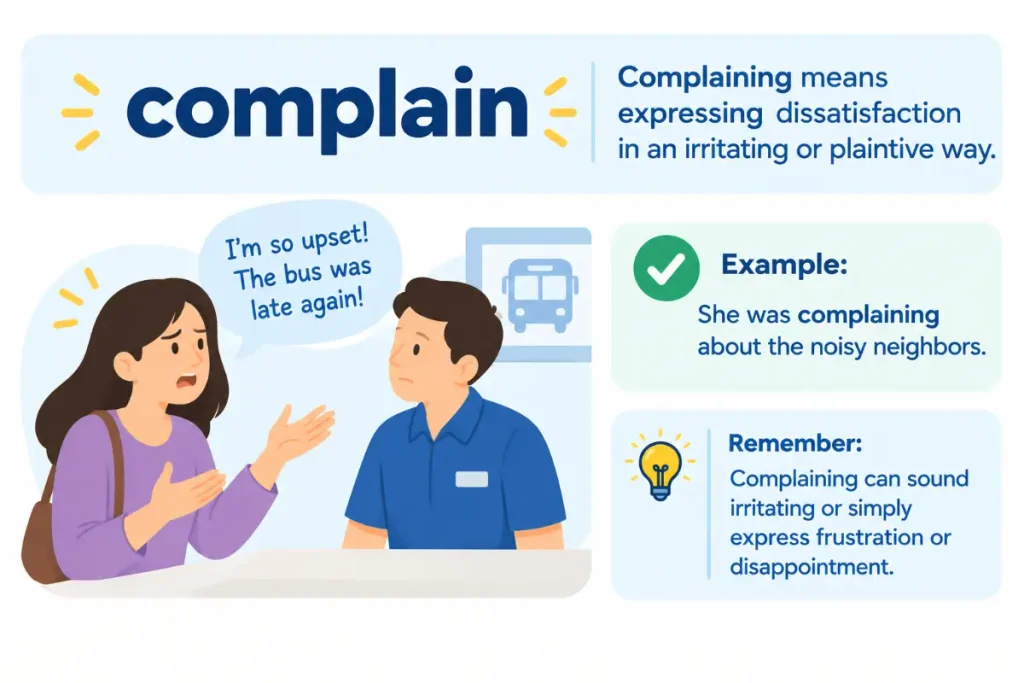
These words are similar but have different tones. Complaining is relatively neutral. It simply means expressing dissatisfaction or saying that something is wrong. Whiny is more negative. It suggests that the complaining sounds irritating, childish, overly persistent, or unnecessarily self-pitying.
Compare:
The customer was complaining about the long wait.
This doesn’t necessarily tell us whether the complaint was reasonable.
The customer was being whiny about the long wait.
This expresses a negative judgment about the customer’s manner.
The key distinction
Complaining describes the action. Whiny describes the tone or manner.
Whiny vs Annoying
Annoying is broader than whiny. Something can be annoying without being whiny:
The loud music was annoying.
Something can be whiny without necessarily being extremely annoying:
His voice sounded a little whiny.
Whiny specifically suggests a complaining or plaintive quality.
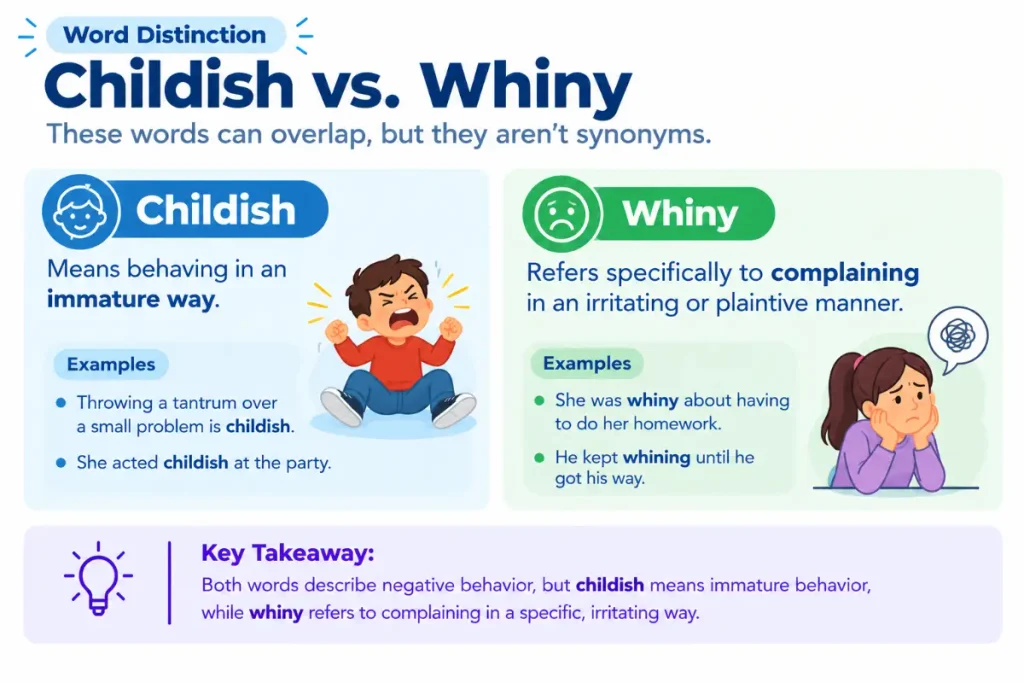
Whiny vs Childish
These words can overlap, but they aren’t synonyms. nChildish means behaving in an immature way. Whiny refers specifically to complaining in an irritating or plaintive manner.
For example:
His response was childish.
This could mean he refused to accept responsibility.
His response was whiny.
This suggests that he complained in an irritating way. Someone can be childish without being whiny, and someone can sound whiny without behaving in a generally childish way.
Synonyms for Whiny
The best synonym depends on the intensity and context. There isn’t one perfect replacement for every use of whiny.
Mild Alternatives
| Word/Phrase | Meaning | Tone | Example |
|---|---|---|---|
| complaining | Expressing dissatisfaction | Neutral | He’s been complaining about the schedule. |
| dissatisfied | Unhappy with something | Neutral | The customer was dissatisfied with the service. |
| unhappy | Not pleased | Neutral | She seemed unhappy with the decision. |
| discontented | Not satisfied | Formal | Employees appeared discontented with the policy. |
| frustrated | Upset because something isn’t working | Neutral | He sounded frustrated by the delay. |
| irritated | Slightly angry or annoyed | Neutral | She was irritated by the noise. |
Moderate Alternatives
| Word/Phrase | Meaning | Tone | Example |
|---|---|---|---|
| fussy | Hard to please or easily bothered | Casual | The baby was fussy all afternoon. |
| petulant | Irritably impatient or childish | Formal | His petulant response surprised everyone. |
| peevish | Easily annoyed and complaining | Formal | She sounded peevish during the meeting. |
| miserable | Very unhappy | Casual | He seemed miserable after the cancellation. |
| negative | Focused heavily on problems | Neutral | His comments were unusually negative. |
| critical | Expressing disapproval | Neutral/Formal | The review was highly critical. |
Stronger Alternatives
| Word/Phrase | Meaning | Tone | Example |
|---|---|---|---|
| irritating | Causing annoyance | Neutral | His constant complaints were irritating. |
| self-pitying | Focused excessively on one’s own problems | Negative | The post sounded self-pitying. |
| petty | Focused on small or unimportant issues | Negative | The argument became petty. |
| nagging | Repeatedly complaining or urging | Negative | The constant reminders became nagging. |
| murmuring | Speaking complaints in a low voice | Neutral | Employees were murmuring about the change. |
| grumbling | Complaining quietly or persistently | Casual | He was grumbling about the price. |
The important point is that these words aren’t exact replacements in every sentence. Whiny specifically emphasizes the sound, tone, or manner of complaining.
How to Sound Less Whiny in Writing
If you’re worried that an email, text, or post sounds whiny, focus on the facts and the solution rather than repeatedly emphasizing how unfair or frustrating something feels.
For example, this sounds more emotional:
I’ve been waiting forever, and nobody seems to care about fixing this problem.
A more neutral version is:
I’ve been waiting for an update and would appreciate knowing when the issue is expected to be resolved.
The second version communicates the same concern without making the tone sound overly emotional.
Three ways to make writing more neutral
- State the problem clearly.
- Avoid exaggerations such as “always” and “never” unless they’re accurate.
- Ask for a specific solution or next step.
This is especially useful for workplace communication.
Is Whiny a Negative Word?
Usually, yes. Whiny generally has a negative or critical tone. Calling someone whiny suggests that you think their complaining is excessive, irritating, immature, or unpleasant to hear. However, the word can be playful when someone uses it about themselves: I’m being whiny today because I didn’t get enough sleep. It can also be used affectionately or humorously in some family and friendship contexts. Tone and relationship matter.
Can You Use Whiny for Adults?
Yes. Whiny isn’t limited to children. You can describe an adult’s voice, behavior, or manner as whiny:
His voice sounded whiny during the interview.
She became whiny when the plans changed.
That said, calling an adult whiny can sound insulting. In professional or sensitive situations, a more specific and neutral description is often better.
Can Whiny Describe a Voice?
Yes. This is one of its common uses. A whiny voice is a voice that sounds complaining, high-pitched, plaintive, or irritating.
Examples:
- She spoke in a whiny voice.
- His whiny tone made the complaint sound less convincing.
- The character was written with an intentionally whiny voice.
In this context, whiny describes how the voice sounds rather than necessarily judging whether the complaint itself is justified.
Whiny vs Whiney: Common Mistakes
Mistake 1: Assuming Whiney Is the Standard Spelling
Because the base word is whine, it’s easy to write whiney.
Preferred:
whiny
Less common variant:
whiney
For polished American English, choose whiny.
Mistake 2: Using Whiny When You Mean Complaining
Not every complaint is whiny. Someone can make a reasonable complaint in a calm and professional way.
The employee complained about the scheduling error.
This doesn’t automatically mean:
The employee was whiny.
Whiny adds a judgment about the manner or tone of the complaint.
Mistake 3: Using Whiny in Formal Situations Without Considering Tone
Calling a person whiny can sound insulting.
Instead of:
The client was whiny.
A professional report might say:
The client expressed repeated concerns about the service.
That version is more objective.
Mistake 4: Confusing Whiny With Whining
Remember:
- whiny = adjective
- whining = verb or gerund
Correct:
His voice is whiny.
Correct:
He keeps whining.
Incorrect:
His voice is whining.
The last sentence could be possible in a very different construction, but it doesn’t normally express the same grammatical idea.
How to Remember Whiny
A simple memory trick is:
Whine → whiny
Drop the final e before adding -y.
Think of these pairs:
- shine → shiny
- noise → noisy
- spice → spicy
- whine → whiny
If you’re writing for an American audience and you’re stuck between whiny vs whiney, choose whiny.
What Is the Opposite of Whiny?
There isn’t one perfect antonym for whiny, because the opposite depends on what aspect you mean.
Possible opposites include:
- calm
- content
- patient
- positive
- cheerful
- reasonable
- composed
- good-natured
For example:
Instead of sounding whiny, she remained calm and composed.
Or:
He was content rather than whiny about the situation.
The best antonym depends on whether you’re contrasting tone, mood, attitude, or behavior.
Quick Comparison: Whiny, Whiney, and Whining
| Word | What it is | Meaning | Example |
|---|---|---|---|
| whiny | Adjective | Complaining in an irritating or plaintive way | He has a whiny voice. |
| whiney | Variant spelling | Same basic meaning as whiny | Her tone sounded whiney. |
| whining | Verb/gerund | Complaining repeatedly or in a whiny manner | Stop whining about the weather. |
| whine | Verb/noun | To complain or make a high-pitched sound | Don’t whine about it. |
| whiner | Noun | A person who whines | Nobody likes being called a whiner. |
Conclusion
When choosing between whiny vs whiney, whiny is the safest and most widely accepted choice, particularly in American English and polished writing. Both forms refer to a complaining, plaintive, or irritating manner, but whiney is much less common.
Remember the simple spelling pattern: whine → whiny. The final e is dropped before -y. Use whiny for schoolwork, professional writing, articles, emails, texts, and everyday communication unless you have a specific reason to use the less common variant.
Also keep in mind that whiny is more judgmental than neutral words such as complaining or frustrated. If you’re describing someone’s behavior in a professional setting, a more objective alternative may be the better choice.
Frequently Asked Questions
Is whiny or whiney correct?
Whiny is the standard and more widely preferred spelling, especially in American English. Whiney is a less common variant that you may encounter in informal writing.
How do you spell whiny?
The usual spelling is whiny, spelled W-H-I-N-Y. It comes from whine, with the final e removed before adding -y.
Is whiney a real word?
Yes, whiney is used as a variant spelling of whiny. However, it is much less common, so whiny is generally the better choice for standard and professional writing.
Which is correct, whiny or whiney?
Whiny is the better choice in most situations. If you’re writing for a US audience, using whiny will generally be the clearest and most familiar option.
What does whiny mean?
Whiny describes someone or something that sounds overly complaining, plaintive, or irritating. It can describe a person, voice, tone, behavior, or complaint.
What’s another way to say whiny?
Depending on the context, alternatives include complaining, fussy, dissatisfied, frustrated, petulant, peevish, negative, grumbling, and self-pitying. The best alternative depends on how strong or formal you want the description to be.
Is whiny an insult?
Whiny can be insulting because it usually carries a negative judgment about someone’s manner of complaining. It can also be used jokingly or self-deprecatingly, so the tone and context matter.
1 thought on “Whiny vs Whiney: Which Spelling Is Correct?”