
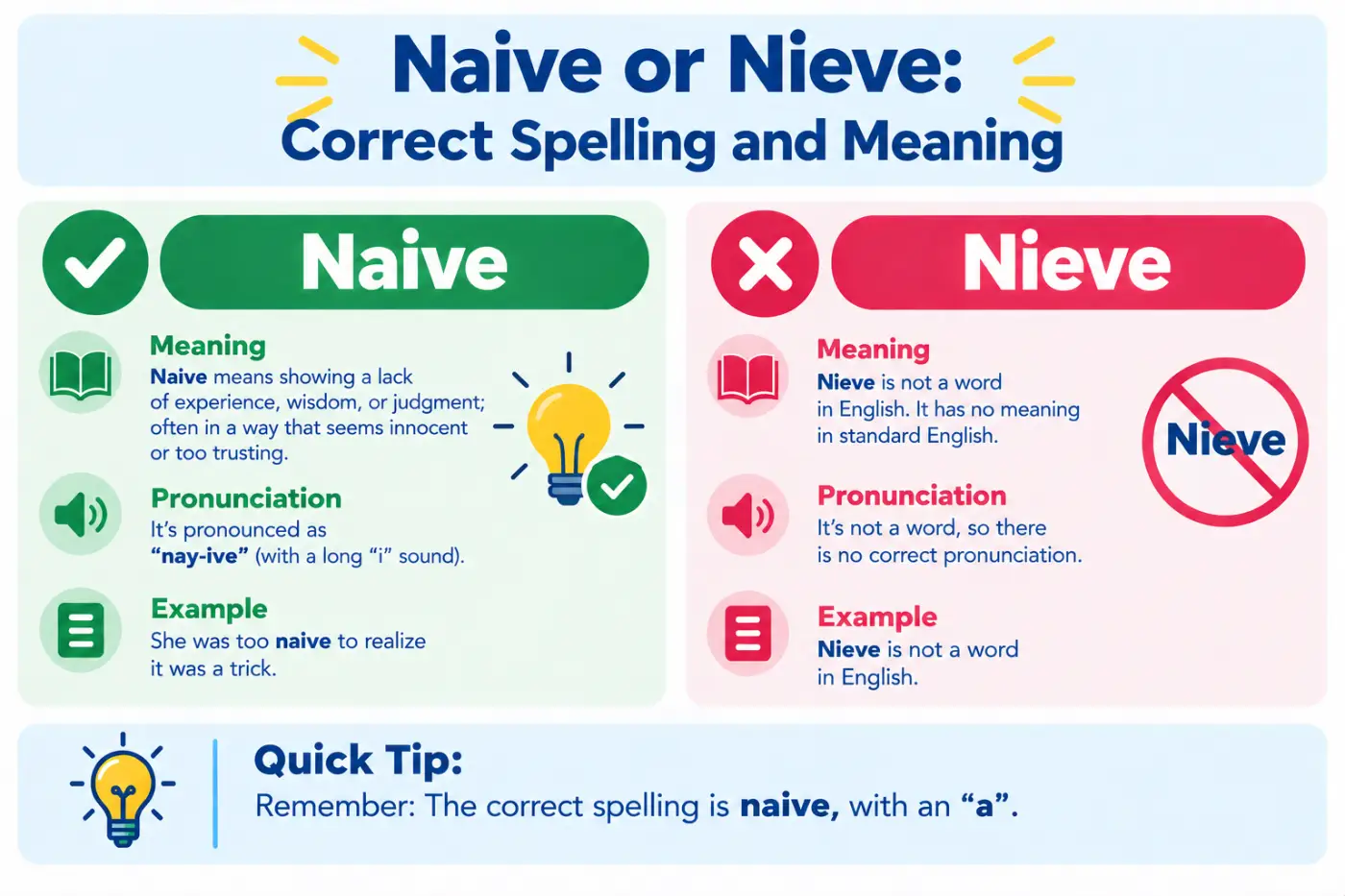
If you’re writing an email, essay, text, or social media post and aren’t sure whether to write naive or nieve, the correct English spelling is naive. You may also see it written as naïve, with a diaeresis over the “i.” Nieve is not the standard English spelling of this adjective.
Naive means lacking experience, knowledge, or good judgment about something. For example, you might say, “It was naive to believe that everyone would keep the promise.”
The confusion usually comes from the way naive is pronounced and the fact that the word originally came from French. This guide explains the difference, pronunciation, examples, common mistakes, and when to use each form.
Naive or Nieve: Which Is Correct?
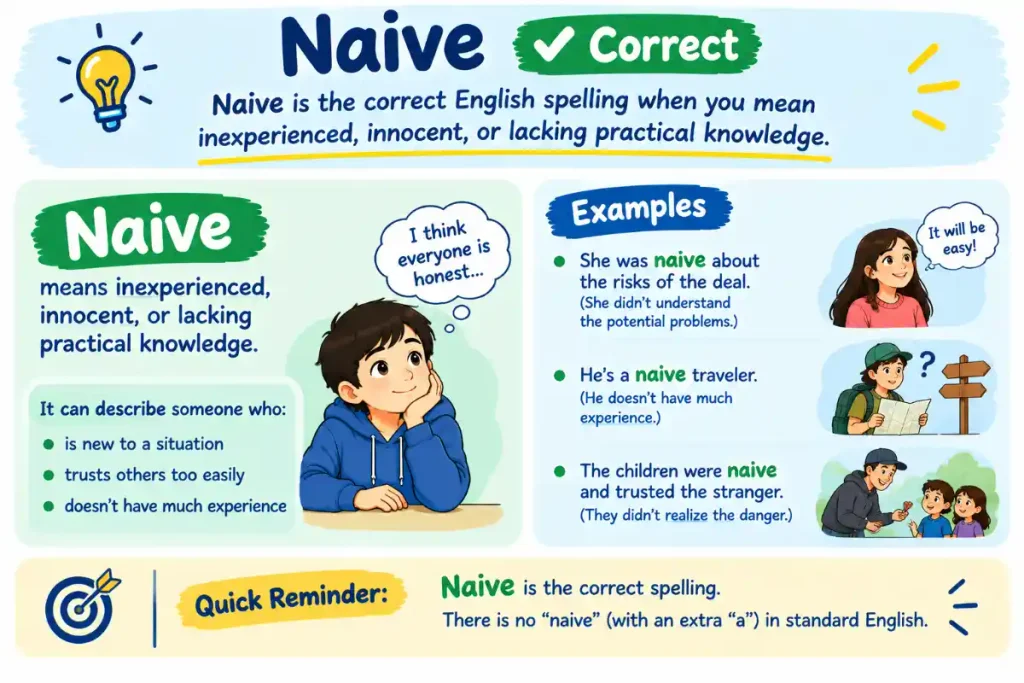
Naive is the correct English spelling when you mean inexperienced, innocent, or lacking practical knowledge.
| Spelling | Correct in standard English? | Meaning |
|---|---|---|
| naive | Yes | Inexperienced or lacking practical judgment |
| naïve | Yes | Same word; traditional spelling with a diaeresis |
| nieve | No, not as the standard English adjective | Usually a misspelling of naive |
In American English, naive is especially common because English often drops diacritical marks from borrowed words. Naïve is also correct and remains widely recognized.
Is “Nieve” a Word?
Nieve is not the standard English spelling of naive. If you’re describing someone as inexperienced or overly trusting, use naive or naïve. There are contexts in other languages where nieve has a different meaning. For example, nieve is the Spanish word for “snow.” That does not make it the correct spelling of the English adjective naive.
What Does Naive Mean?
Naive is an adjective that describes someone who lacks experience, knowledge, or practical judgment in a particular situation. It can also describe an idea, assumption, or approach that shows a lack of experience.
For example:
- A naive person may trust people too easily.
- A naive assumption may ignore important facts.
- A naive approach may seem simple because it doesn’t account for complications.
The word does not always mean that someone is unintelligent. A person can be highly educated or intelligent and still be naive about a particular subject because they have little experience with it.
Examples of Naive in a Sentence
- It was naive to think the project would be finished in one day.
- She was naive about how competitive the job market could be.
- His naive question helped the team notice a problem they had overlooked.
- I was naive to believe that the repair would be inexpensive.
- The new employee had a naive understanding of how the business worked.
- It would be naive to assume that every online review is genuine.
- Her parents thought she was too naive to travel alone.
- The proposal sounds naive because it doesn’t consider the cost.
- He admitted that his earlier expectations were naive.
- Don’t be naive about the risks of sharing personal information online.
- The student had a naive view of what academic research involves.
- It was a naive assumption that everyone would agree immediately.
How Do You Spell Naive?
The standard spelling is naive.
You may also spell it naïve. Both forms are accepted in English:
- naive — common modern spelling, especially in American English
- naïve — traditional spelling that preserves the French-style diaeresis
The letters are pronounced separately enough that the spelling can sometimes confuse learners. The diaeresis in naïve signals that the final vowel sound should not simply be treated as part of a single vowel combination.
Naive or Naïve?
Naive and naïve are both correct. In American English, naive is a common choice in everyday and professional writing.
For example:
It would be naive to ignore the evidence.
You could also write:
It would be naïve to ignore the evidence.
The meaning does not change.
Why Do People Spell Naive as Nieve?
The spelling nieve is likely a simple spelling error caused by the pronunciation of naive. English spelling does not always make pronunciation obvious, particularly with words borrowed from other languages. Someone who has heard the word but has rarely seen it written may guess that it is spelled nieve. The letters ie and ei cause confusion in many English words. However, the standard spelling of this word is naive, not nieve.
A useful way to remember it is:
NA + IVE = NAIVE
Not:
N + IEVE = NIEVE
Naive vs. Innocent
Naive and innocent can overlap, but they aren’t identical.
Innocent often suggests a lack of guilt, wrongdoing, or harmful intent. Naive focuses more on a lack of experience or realistic understanding.
Compare these examples:
- The child was innocent and had done nothing wrong.
- The child was naive about the dangers of talking to strangers online.
Someone can be innocent without being naive, and someone can be naive without being innocent.
Naive vs. Inexperienced
Naive and inexperienced are also related, but they carry slightly different meanings. Inexperienced simply means that someone has not had much experience with something. Naive can suggest that the person also has unrealistic expectations or lacks practical judgment.
For example:
She was inexperienced at managing a large team.
This is a neutral statement about experience.
She was naive about how difficult managing a large team would be.
This suggests that her understanding or expectations were unrealistic.
Naive vs. Gullible
Gullible means easily persuaded to believe something, especially something that is untrue or misleading. Naive has a broader meaning. Someone can be naive because they don’t understand how complicated a situation is. A gullible person is specifically too willing to believe what others tell them.
For example:
He was naive about the challenges of starting a business.
But:
He was gullible enough to believe the fake offer.
Quick Comparison
| Word | Main idea | Example |
|---|---|---|
| Naive | Lacking experience or practical understanding | She was naive about the industry. |
| Inexperienced | Having little experience | He was inexperienced in management. |
| Innocent | Not guilty or not intending harm | The child was innocent. |
| Gullible | Too easily persuaded or deceived | She was gullible enough to believe the claim. |
| Unsophisticated | Lacking knowledge or refinement | His understanding of the market was unsophisticated. |
Is Naive a Negative Word?
Naive can be negative, neutral, or mildly critical depending on context. Calling an idea naive often suggests that it is unrealistic or fails to consider important complications. However, describing someone as naive does not necessarily mean calling them stupid. The word usually points to limited experience or understanding, not a person’s overall intelligence.
For example:
Her naive question showed that she was new to the subject.
This can be neutral.
In contrast:
His naive plan ignored nearly every major expense.
This is clearly critical of the plan. Tone depends heavily on the situation and the way the word is used.
Is Naive Formal or Casual?
Naive works in both everyday and formal writing.
You can use it in:
- Everyday conversation
- Text messages
- Emails
- School essays
- Academic writing
- Workplace communication
- Reports
- Professional discussions
For example, in a professional email:
It may be naive to assume that the schedule won’t change.
In an academic context:
The study challenges the naive assumption that economic growth always benefits every group equally.
In casual conversation:
I was pretty naive when I first started working there.
Naive in American English
In US English, naive is a standard spelling. Naïve is also correct.
American writers often use the version without the diaeresis because English frequently simplifies accents and other marks in borrowed words.
There is no meaningful difference in the definition:
- naive = correct
- naïve = correct
- nieve = incorrect for this English meaning
You don’t need to change naive to naïve simply because the word originated in another language.
Naive: Part of Speech
Naive is an adjective.
It describes a person, idea, belief, expectation, assumption, or approach.
As an Adjective
- a naive student
- a naive assumption
- a naive approach
- a naive belief
- a naive question
- a naive understanding
You can also use it after a linking verb:
The proposal seems naive.
She was naive about the situation.
The noun form is naivety or naiveté, although naiveté is often preferred in formal writing.
What Is the Noun Form of Naive?
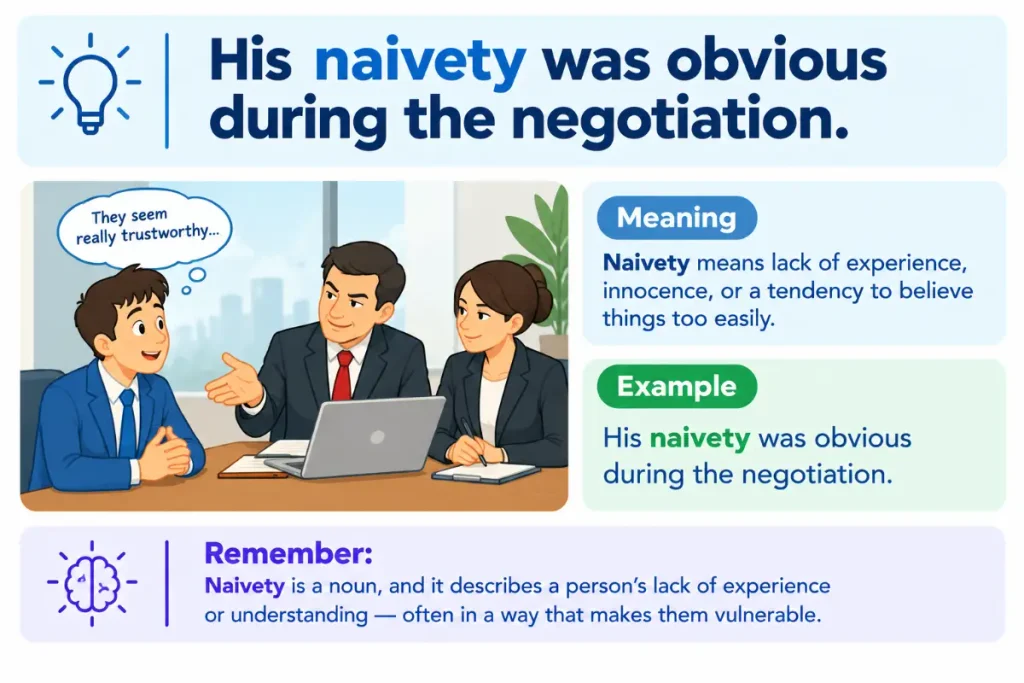
The noun forms are naivety and naiveté. Both refer to a lack of experience, sophistication, or practical understanding.
Examples:
- His naivety was obvious during the negotiation.
- Her naiveté made her easy to persuade.
- The proposal reflected some naivety about the costs involved.
Naiveté comes from French and is often pronounced approximately like “nah-ee-vuh-TAY.”
Word Origin of Naive
Naive comes into English from French naïf and naïve, which developed from Latin nativus, meaning “natural” or “innate.” The word originally carried the idea of being natural or innocent. Over time, its English meaning developed toward the modern sense of someone who lacks experience or worldly knowledge. The spelling naïve retains the diaeresis associated with the French spelling, while naive is the common simplified form in English.
Common Mistakes With Naive
Mistake 1: Writing Nieve
Incorrect:
He was nieve about the situation.
Correct:
He was naive about the situation.
Mistake 2: Assuming Naive Means Stupid
Naive does not directly mean stupid or unintelligent. A person can be very intelligent but naive about an unfamiliar subject.
Better:
She was naive about investing.
This tells the reader that she lacked experience in that area.
Mistake 3: Using Naive When Innocent Is More Accurate
If you mean that someone did not commit an offense, innocent is usually the appropriate word.
Less accurate:
The defendant was naive.
More accurate:
The defendant was innocent.
If you mean the person lacked experience or practical understanding, naive is more appropriate.
Mistake 4: Treating Naive and Gullible as Exact Synonyms
A naive person may be inexperienced without necessarily believing everything they hear.
A gullible person is particularly likely to accept false or questionable claims.
Naive Synonyms
The best synonym depends on what you want to emphasize. Some alternatives focus on inexperience, while others focus on trust, simplicity, or unrealistic expectations.
| Word/Phrase | Meaning | Tone | Example |
|---|---|---|---|
| Inexperienced | Lacking experience | Neutral | He was inexperienced in the field. |
| Unworldly | Lacking worldly experience | Mild | She seemed unworldly at first. |
| Unsophisticated | Lacking practical or advanced knowledge | Neutral/Formal | The approach was unsophisticated. |
| Innocent | Lacking knowledge of something or free from wrongdoing | Neutral | He was innocent of the risks involved. |
| Trusting | Inclined to trust others | Neutral | She was naturally trusting. |
| Gullible | Too easily persuaded or deceived | Negative | He was gullible about online offers. |
| Credulous | Too ready to believe something | Formal | The claim appealed to credulous readers. |
| Uninitiated | Not familiar with a subject or activity | Formal | The guide helps uninitiated users. |
| Unsuspecting | Unaware of a hidden problem or danger | Neutral | The unsuspecting customer accepted the offer. |
| Green | New or inexperienced | Casual | He’s still green at the job. |
| Unseasoned | Lacking experience | Formal | The unseasoned manager needed guidance. |
| Inexperienced-minded | Not a standard synonym | — | Avoid using this phrase. |
Not every synonym can replace naive in every sentence. For example, gullible is stronger and more specific because it suggests that someone is easily deceived.
How to Remember Naive or . Nieve
The easiest memory trick is to connect naive with the letters NA at the beginning:
NAIVE = NA + IVE
Think:
NAive is the NA-correct spelling.
Another useful trick is to remember that nieve belongs to other language contexts, including Spanish, where nieve means “snow.” For the English adjective describing someone who lacks experience, choose naive.
Is Naive Correct in an Essay?
Yes. Naive is perfectly acceptable in an essay when it accurately describes an inexperienced or unrealistic idea, belief, or person.
For example:
The argument is based on a naive assumption about consumer behavior.
In academic writing, make sure the word is supported by your explanation. If you mean something more specific, words such as inexperienced, unrealistic, oversimplified, or unsupported may communicate your meaning more precisely.
Is Naive Correct in a Resume?
Yes, naive is grammatically correct, but it is usually not a positive word for describing your own professional skills.
For example, writing:
I have a naive understanding of project management.
would suggest that your knowledge is limited. If you’re describing a lack of experience honestly, entry-level, developing, or new to may be more appropriate depending on the situation.
Naive or . Nieve: Quick Answer
| Question | Answer |
|---|---|
| Which spelling is correct? | Naive |
| Is naïve also correct? | Yes |
| Is nieve the standard English spelling? | No |
| What does naive mean? | Lacking experience, knowledge, or practical judgment |
| What part of speech is naive? | Adjective |
| Can naive be used in formal writing? | Yes |
| Does naive mean stupid? | No |
| Is naive the same as gullible? | No; gullible specifically suggests being too easily persuaded |
Quick Tips to Remember
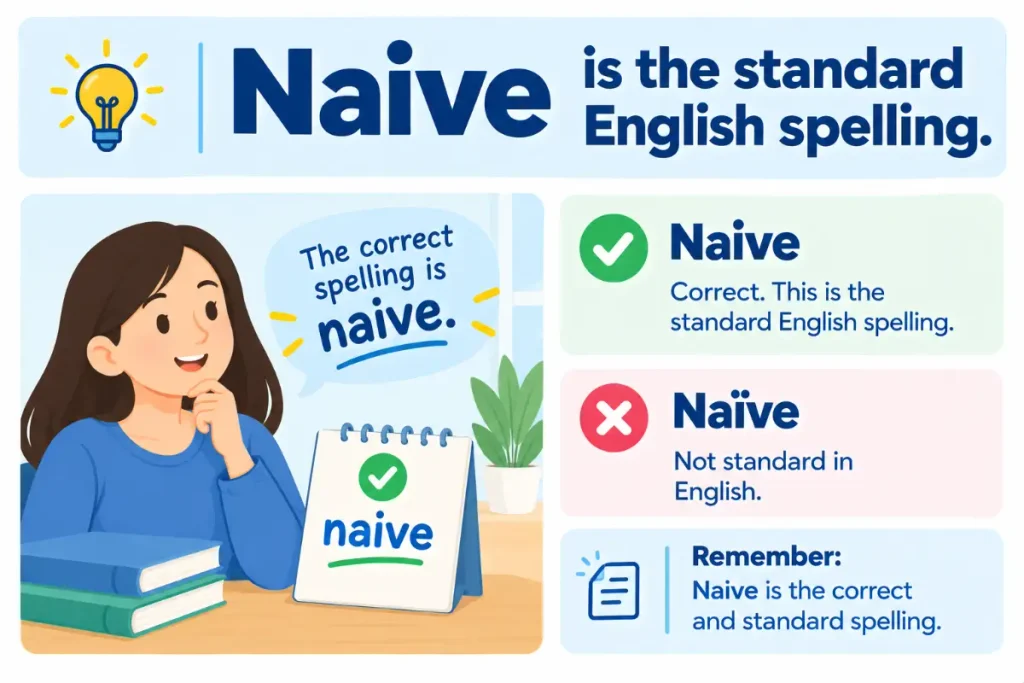
- Naive is the standard English spelling.
- Naïve is also correct.
- Nieve is not the standard English spelling for this meaning.
- Use naive to describe a lack of experience, knowledge, or practical judgment.
- Don’t automatically treat naive as a synonym for stupid.
- Use gullible when you specifically mean someone is too easily persuaded or deceived.
- Use inexperienced when you simply want to state that someone has limited experience.
- In American English, naive is a common spelling without the diaeresis.
Conclusion
The difference between naive or nieve is mainly a matter of correct spelling. When you want to describe someone or something as inexperienced, overly trusting, or lacking practical understanding, naive is the correct English form. Naïve is also correct, while nieve should not be used as the standard English spelling of this adjective.
Remember that naive does not automatically mean unintelligent. Its meaning depends on the person’s experience or understanding of a particular situation. When you need a more precise word, consider alternatives such as inexperienced, innocent, or gullible, depending on what you actually mean. For most American English writing, naive is a clear and natural choice.
Frequently Asked Questions
Which is correct, naive or nieve?
Naive is correct in standard English when you mean inexperienced, innocent, or lacking practical judgment. Naïve is also correct, while nieve is not the standard spelling for this meaning.
How do you spell naive?
The word is spelled naive. You may also write naïve, which is an accepted variant.
Is nieve a word in English?
Nieve is not the standard English spelling of naive. It can appear as a word or name in other linguistic contexts, but it should not be used as the English adjective meaning inexperienced.
What does naive mean?
Naive means lacking experience, knowledge, or practical understanding. It can describe a person, belief, assumption, idea, or approach.
Is naive a negative word?
Naive can be neutral or negative depending on context. It often suggests limited experience or unrealistic expectations, but it does not automatically mean unintelligent.
What is another word for naive?
Depending on the context, alternatives include inexperienced, innocent, trusting, unsophisticated, unworldly, gullible, and credulous. These words have different shades of meaning, so they aren’t always interchangeable.
Is naive the same as inexperienced?
Not exactly. Inexperienced simply means lacking experience, while naive can also suggest that someone’s expectations or understanding are unrealistic because of that lack of experience.
2 thoughts on “Naive or Nieve: Correct Spelling and Meaning”