
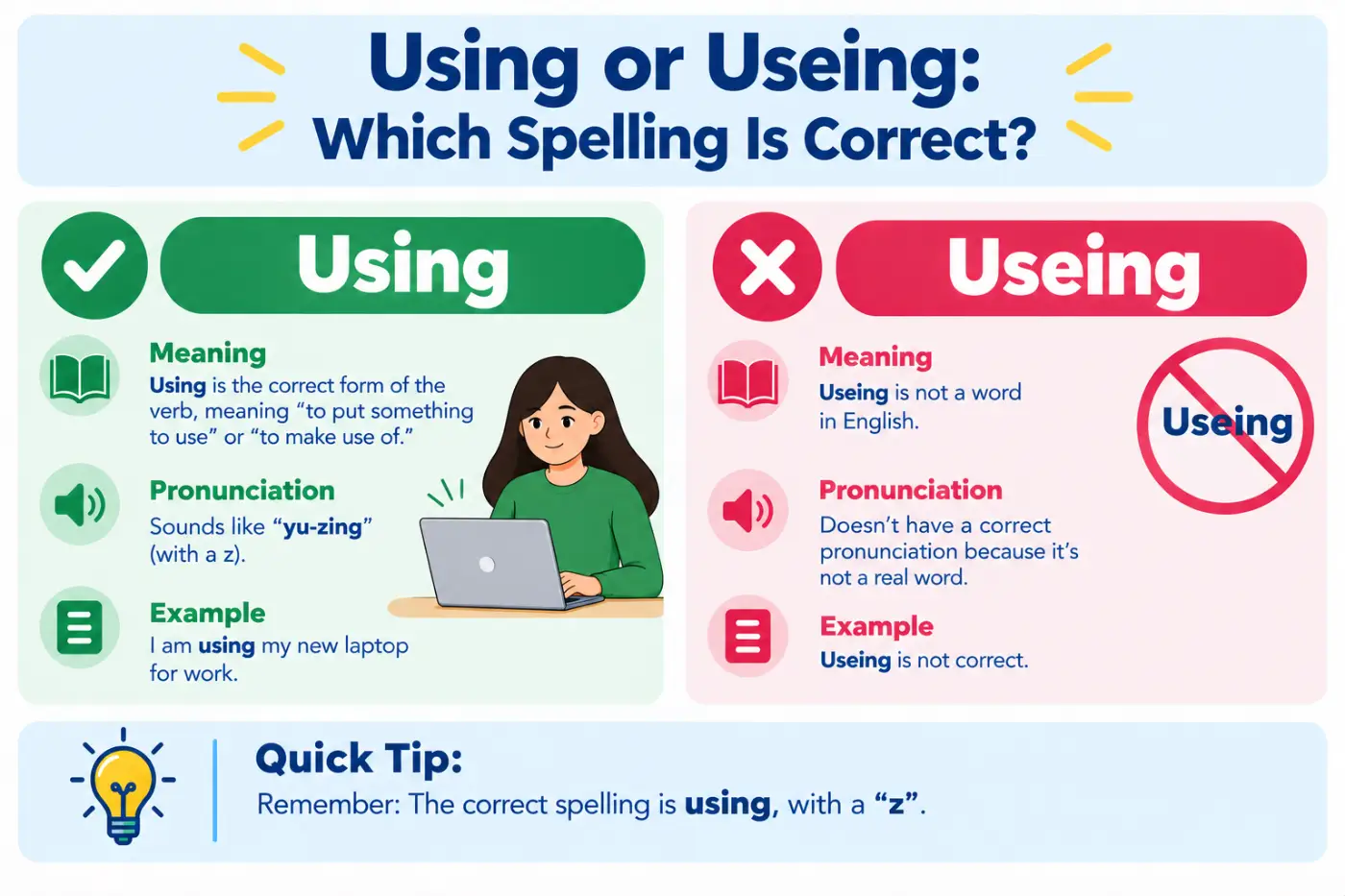
If you’re writing an email, school assignment, text, or social media post, you may wonder about using vs useing. The correct spelling is using, while useing is a common misspelling that is not accepted in standard English.
Using is the present participle and gerund form of the verb use. To form it correctly, drop the final e from use before adding -using, resulting in using.
Learning this simple spelling rule can help you avoid mistakes in everyday writing. This article explains the difference between using vs useing, provides clear examples, and offers an easy way to remember the correct spelling.
Using or Useing: Which Is Correct?
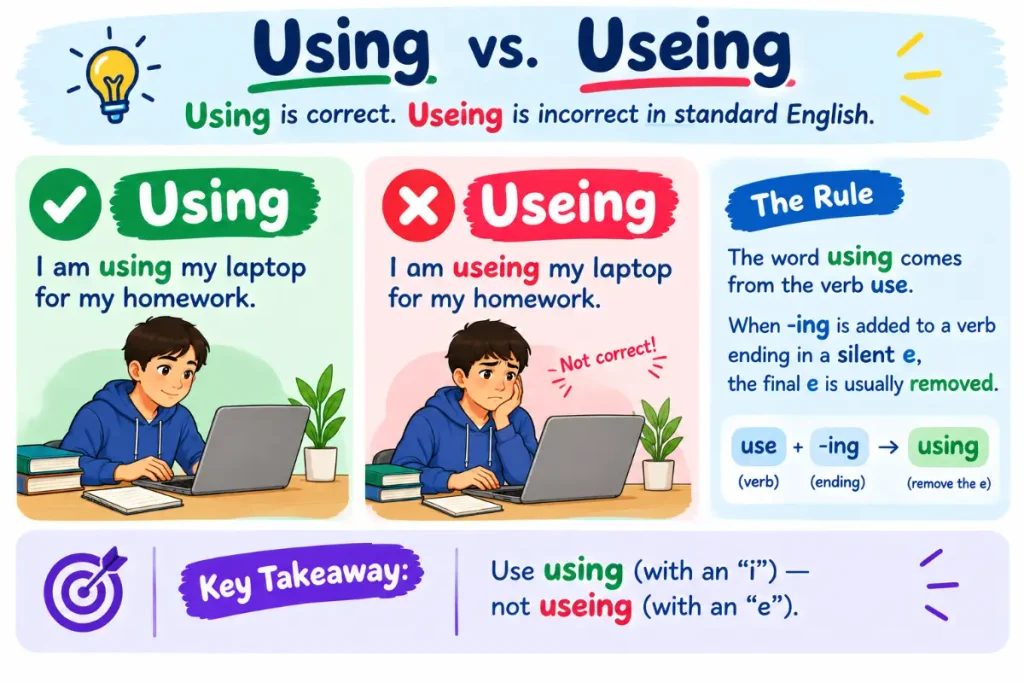
Using is correct. Useing is incorrect in standard English.
The word using comes from the verb use. When -ing is added to a verb ending in a silent e, the final e is usually removed:
- use → using
- make → making
- take → taking
- write → writing
- give → giving
So, the correct spelling is:
I am using my new computer.
Not:
I am useing my new computer.
Quick Answer
| Spelling | Correct? | Example |
|---|---|---|
| using | Yes | She is using her phone. |
| useing | No | She is useing her phone. |
What Does “Using” Mean?
Using means employing, operating, applying, or taking advantage of something for a particular purpose. It is a form of the verb use and can describe an action happening now or an activity considered generally.
For example:
- I’m using a calculator.
- She is using her time wisely.
- We are using a different method.
- He enjoys using his new camera.
The exact meaning depends on the sentence, but the spelling remains using, not useing.
Why Is “Using” Spelled Without the E?
The confusion comes from the spelling of the base verb use. The word use ends in a silent e. When -ing is added, English spelling rules normally drop the final silent e.
The pattern is:
use + ing → using
The e isn’t simply kept because it belongs to the original word. It is removed when the suffix -ing is added.
Compare these examples:
| Base verb | + -ing | Correct form |
|---|---|---|
| use | use + ing | using |
| make | make + ing | making |
| write | write + ing | writing |
| take | take + ing | taking |
| come | come + ing | coming |
| move | move + ing | moving |
This is why useing isn’t the standard spelling.
How Do You Spell “Using” Correctly?
Spell it as:
U-S-I-N-G
A simple way to remember it is:
USE → remove E → add ING → USING
Don’t write useing because the final e is dropped before -ing.
The Basic Rule
For many verbs ending in a silent e:
verb + ing = remove the final e + ing
Examples:
- dance → dancing
- hope → hoping
- smile → smiling
- close → closing
- drive → driving
- save → saving
- use → using
There are exceptions to English spelling rules, but use → using follows the regular pattern.
Is “Useing” a Word?
No. Useing is not the standard English spelling of the present participle or gerund of use. If you see useing in a text, it is almost certainly a spelling error for using.
For example:
Incorrect:
She is useing the new software.
Correct:
She is using the new software.
The same applies in formal and informal writing. Use using in emails, essays, resumes, reports, text messages, and other standard English writing.
Using in Real Sentences
Here are natural examples showing how using works in everyday English.
- I’m using my laptop to finish my homework.
- She is using a new recipe for dinner tonight.
- We are using the latest version of the software.
- He learned how to solve the problem by using a different method.
- Are you using this chair?
- They are using public transportation to get to work.
- I prefer using a pen instead of a pencil.
- The teacher explained the lesson by using several examples.
- She’s using her phone to take pictures.
- Try using less water when washing the dishes.
- The company is using a new system for customer support.
- He improved his writing by using shorter sentences.
Notice that using can appear in different grammatical structures. The spelling doesn’t change.
How “Using” Works in a Sentence
Using can function as a present participle or as a gerund.
“Using” as a Present Participle
A present participle often works with a form of be to create a progressive verb phrase.
Examples:
- I am using the computer.
- She is using my headphones.
- They were using the old system.
- We are using a different approach.
In these examples, using helps describe an action in progress.
“Using” as a Gerund
A gerund is an -ing form that functions as a noun.
Examples:
- Using a dictionary can help you learn new words.
- I enjoy using this app.
- Using public transportation can save time.
- She recommends using a pencil for the first draft.
Here, using refers to the activity itself.
Using vs. Use: What’s the Difference?
Use and using come from the same verb, but they have different grammatical forms.
| Word | Form | Example |
|---|---|---|
| use | Base verb | I use this computer every day. |
| using | -ing form | I am using this computer now. |
| used | Past tense/past participle | I used this computer yesterday. |
| uses | Third-person singular | She uses this computer every day. |
Use
I use this app every morning.
Using
Use using when the grammatical structure calls for the -ing form.
I am using this app right now.
Both are correct, but they aren’t interchangeable in every sentence.
Using vs. Used: What’s the Difference?
Using and used can look similar because both come from use, but they serve different purposes.
She is using the printer.
Used can describe a completed action:
She used the printer yesterday.
It can also be an adjective meaning something that has belonged to or been operated by someone before:
He bought a used car.
So:
- using = employing something, often as an ongoing activity
- used = past form of use or an adjective meaning previously owned/operated
Using vs. Useing in Different Types of Writing
The correct spelling doesn’t change based on the type of writing.
In a Professional Email
Use using:
I’m having trouble using the new software.
In an Academic Essay
Use using:
The researchers collected the data using a standard procedure.
On a Resume
Use using when describing skills or experience:
Experienced in using Microsoft Excel for data analysis.
In Text Messages
Even in casual writing, using is the standard spelling:
I’m using your charger right now.
On Social Media
You should also write using:
I’m using this recipe for the first time!
The informal nature of a message doesn’t make useing correct.
Common Mistakes With “Using”
The biggest mistake is keeping the final e from use when adding -ing.
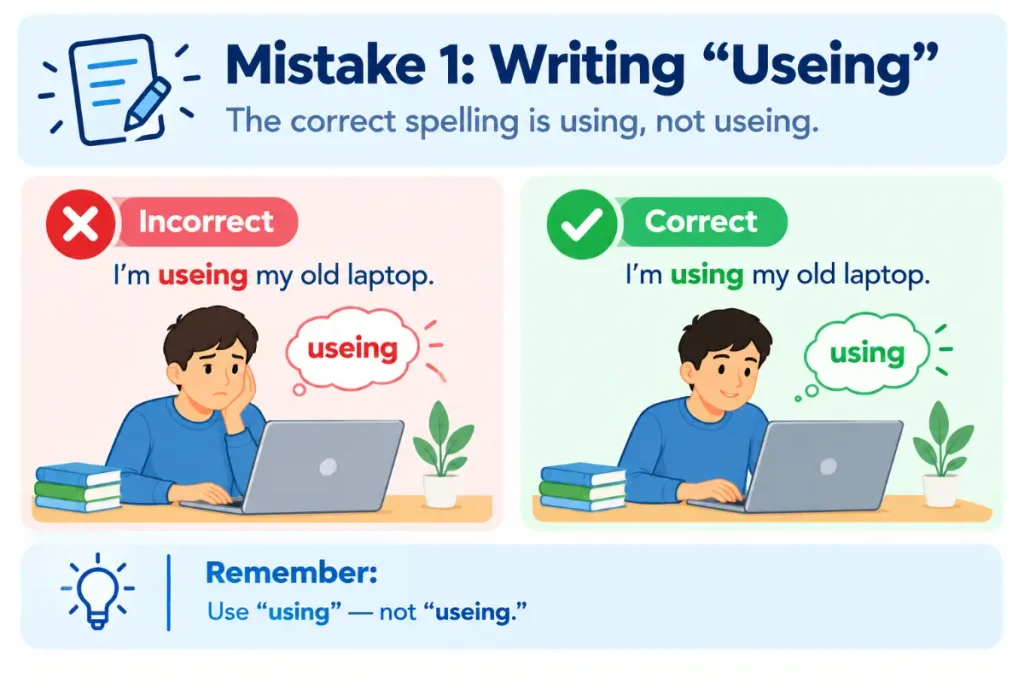
Mistake 1: Writing “Useing”
Incorrect:
I’m useing my old laptop.
Correct:
I’m using my old laptop.
Mistake 2: Adding an Extra E
The spelling useing has an unnecessary e between s and i.
Remember:
using = us + ing
The final e in use disappears.
Mistake 3: Confusing “Using” With “Use”
Some sentences require use, while others require using.
Correct:
I use this tool every day.
Correct:
I am using this tool right now.
Don’t choose between them based only on spelling. Look at how the word functions in the sentence.
Why Do People Spell It “Useing”?
People often write useing because they see the base word use and naturally try to attach -ing directly to it: use + ing = useing That seems logical at first glance, but English spelling rules change the form of many words when suffixes are added. For verbs ending in a silent e, the e is often removed before -ing.
That’s why we write:
- use → using
- make → making
- write → writing
- hope → hoping
rather than:
- useing
- makeing
- writeing
- hopeing
The spelling change makes these forms easier to recognize according to standard English spelling conventions.
Other Words That Follow the Same Pattern
Learning a few related examples can make using easier to remember.
Silent-E Verbs + “-ing”
| Base word | Incorrect | Correct |
|---|---|---|
| use | useing | using |
| make | makeing | making |
| write | writeing | writing |
| take | takeing | taking |
| give | giveing | giving |
| move | moveing | moving |
| drive | driveing | driving |
| hope | hopeing | hoping |
| save | saveing | saving |
| smile | smileing | smiling |
This pattern is especially useful for learners who are unsure whether the final e should remain.
Are There Exceptions to the Silent-E Rule?
Yes. English spelling has exceptions, so it’s better to think of this as a common spelling rule rather than a rule that works without exceptions. For example, verbs ending in -ee generally keep their letters when -ing is added:
- see → seeing
- agree → agreeing
- flee → fleeing
Some words also keep the e to preserve pronunciation or distinguish the word from another form. For use, however, there is no special exception. The standard form is simply:
use → using
“Using” in American English
Using is standard in American English and is also standard in British English. There is no major US-versus-UK spelling difference for this word.
| Variety | Correct spelling |
|---|---|
| American English | using |
| British English | using |
| Canadian English | using |
| Australian English | using |
So if you’re writing for a US audience, using is the form you should choose.
A Simple Memory Trick for “Using”
A quick memory trick is:
Drop the E, then add -ING.
Start with:
USE
Remove the final E:
US
Add ING:
USING
You can also remember this sentence:
Use the tool → I am using the tool.
If you remember that use loses its final e before -ing, you’ll avoid the spelling useing.
Correct vs. Incorrect Examples
| Incorrect | Correct |
|---|---|
| I am useing the computer. | I am using the computer. |
| She is useing a new app. | She is using a new app. |
| They are useing the old method. | They are using the old method. |
| He enjoys useing his camera. | He enjoys using his camera. |
| We’re useing a different approach. | We’re using a different approach. |
| Try useing this password. | Try using this password. |
The correction is the same each time: remove the extra e.
Quick Rule: Use → Using
If you’re unsure about using or useing, remember this formula:
USE − E + ING = USING
That’s all you need for this particular spelling question.
Three-Step Check
- Start with use.
- Remove the final e.
- Add -ing.
Result:
using
Not:
useing
Quick Tips to Remember the Correct Spelling
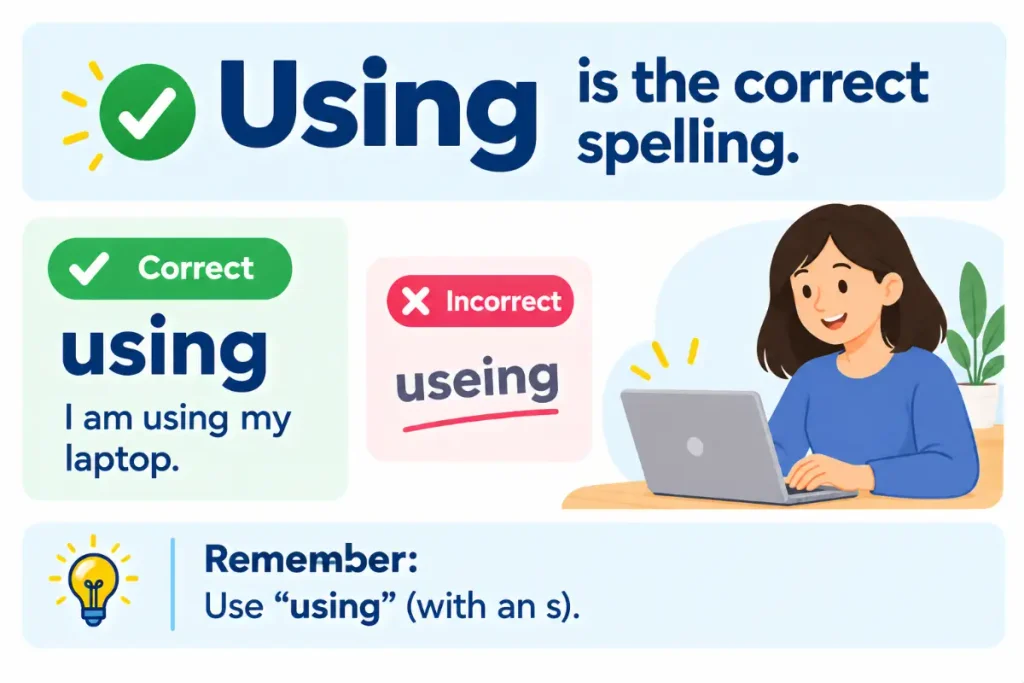
- Using is the correct spelling.
- Useing is a misspelling.
- Start with use.
- Drop the final e before adding -ing.
- The result is using.
- The same pattern appears in words such as making, writing, and taking.
- American and British English both use using.
- In professional, academic, and casual writing, choose using, never useing.
Conclusion
The correct spelling is using, not useing. The word comes from use, and the final silent e is dropped before the -ing ending is added. This gives us use + ing = using.
If you’re writing an email, essay, resume, text, or everyday message, using is the form you should choose. Useing is a common spelling mistake, but it’s easy to avoid once you remember the silent-e rule.
Whenever you’re unsure about using or useing, use the simple formula: use − e + ing = using. Remembering this pattern also helps with other verbs such as make → making, write → writing, and take → taking.
Frequently Asked Questions
Is “using” or “useing” correct?
Using is correct, while useing is a misspelling. The final e in use is dropped before adding -ing.
How do you spell “using”?
The correct spelling is using: U-S-I-N-G. Don’t include the final e from the base word use.
Why isn’t “useing” correct?
Useing is incorrect because the final silent e in use is removed before -ing is added. The result is using.
Is using a verb?
Using is an -ing form of the verb use. Depending on the sentence, it can function as a present participle or a gerund.
Is “useing” ever correct?
No, useing is not the standard spelling of the word. In standard English writing, use using instead.
Is “using” the same in American and British English?
Yes. Using is spelled the same in American and British English, so there is no regional spelling difference to worry about.
What’s an easy way to remember “using”?
Remember use → using: drop the final e before adding -ing. Think of it as USE − E + ING = USING.
2 thoughts on “Using or Useing: Which Spelling Is Correct?”