
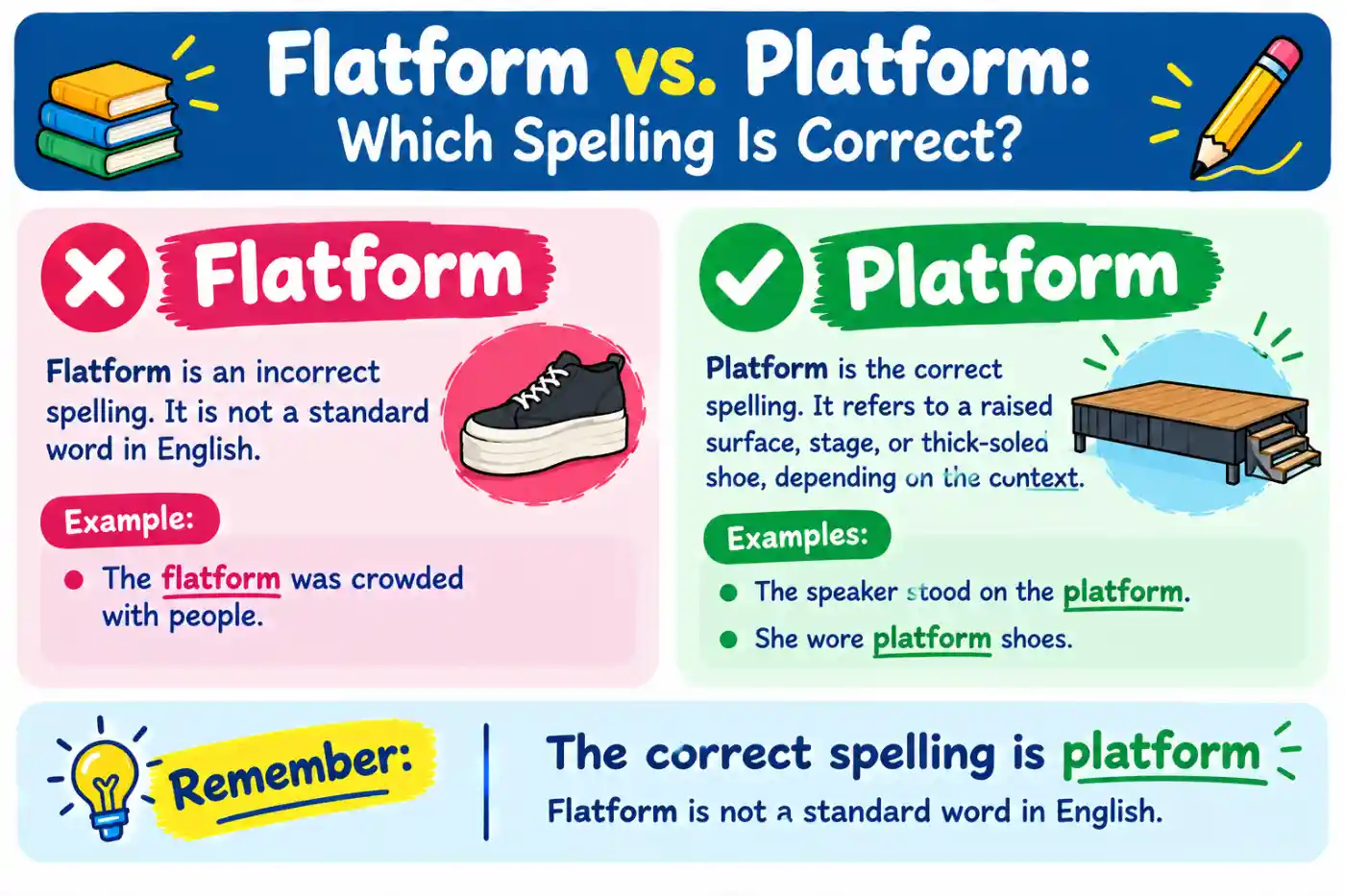
If you’re writing about shoes, a raised surface, or a website’s technology, you might wonder about flatform vs platform. The two spellings look similar, but they don’t have the same meaning. One is a footwear term, while the other has several common uses in everyday English.
Platform is the standard word for a raised surface, a digital service, or a system that supports an activity. Flatform is also a valid word, mainly used in fashion to describe shoes with thick, relatively flat soles.
Understanding the difference helps you choose the right word for your sentence, product description, school assignment, or professional writing. Here’s how to spell and use each term correctly.
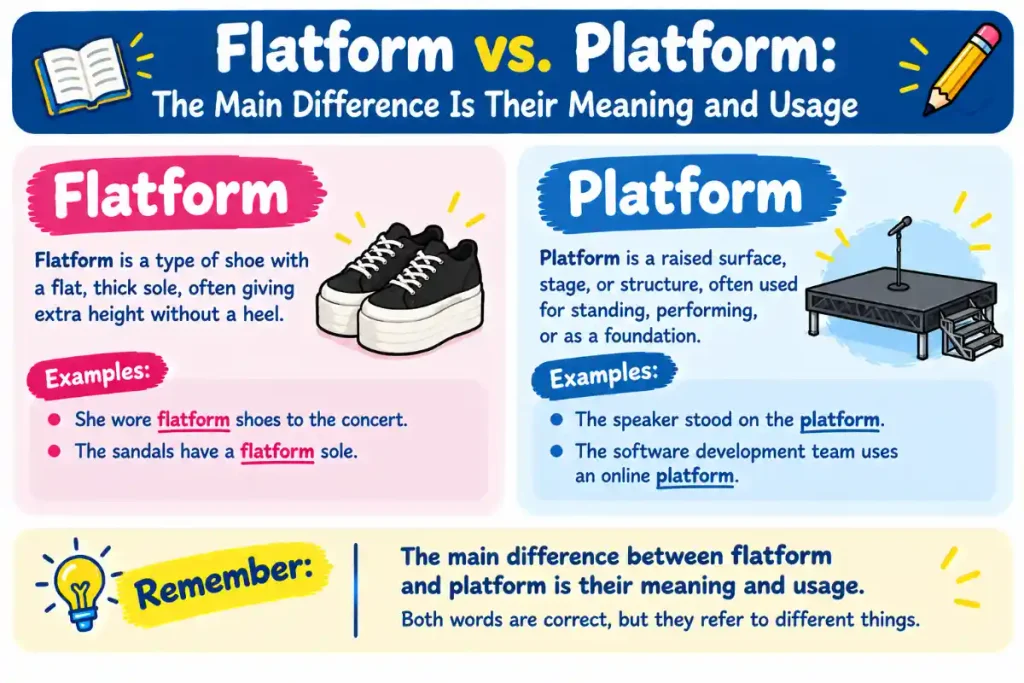
What Is the Difference Between Flatform and Platform?
The main difference between flatform and platform is their meaning and usage. Both words are correct, but they refer to different things.
| Word | Meaning | Common Use | Example |
|---|---|---|---|
| Platform | A raised surface or a system that supports an activity | Technology, transportation, politics, and footwear | She bought platform sandals. |
| Flatform | A shoe with a thick, mostly flat sole | Fashion and footwear | She wore flatform sneakers to the concert. |
The word platform has a much wider range of meanings. You might stand on a train platform, publish videos on a social media platform, or wear platform heels. The word flatform has a more specific meaning. In fashion, it describes footwear with a thick sole that stays relatively level from the heel to the toe rather than having a steep slope. The key is context. If you’re talking about a general surface or system, use platform. If you’re describing a particular style of shoe with a flat, thick sole, flatform may be the word you need.
What Does Platform Mean?
Platform is a noun with several meanings. Its exact definition depends on the situation, but it generally refers to a surface, structure, or system that supports something.
1. Platform in footwear
In fashion, a platform shoe has a thick sole that raises the foot above the ground. The sole may be level or higher at the heel, depending on the shoe’s design.
Examples include:
- Platform sneakers
- Platform sandals
- Platform boots
- Platform heels
- Platform dress shoes
Example: Maya wore black platform boots with her jeans.
Platform shoes can have a flat-looking base or a raised heel. The term describes the shoe’s elevated sole, not necessarily a completely level foot position.
2. Platform in technology
A platform can be a digital service or system that allows people to communicate, share information, or complete tasks.
Examples include social media platforms, online learning platforms, and software development platforms.
Example: Our teacher uses an online platform to share assignments.
3. Platform in transportation
A platform is a raised area where passengers wait to board a train or subway.
Example: We waited on the platform until the train arrived.
4. Platform in politics and business
A platform can describe a set of ideas, policies, or goals that a person or organization supports.
Example: The candidate explained her platform during the debate.
A business may also use the word to describe a system that supports its products or services.
These meanings show why platform is a common word in American English. Unlike flatform, it applies to many subjects beyond fashion.
What Does Flatform Mean?
Flatform is a fashion term for a shoe with a thick, relatively flat sole. The sole adds height without the steep heel-to-toe slope commonly associated with traditional high heels. The word combines the ideas of flat and platform. It describes the shoe’s shape rather than a digital service, political position, or raised transportation surface.
Common types of flatform shoes
Flatform sneakers
These shoes have thick soles that remain relatively level from the toe to the heel. They’re often worn with jeans, casual dresses, or everyday outfits. Flatform sandals
These sandals combine an elevated sole with a mostly even profile. They come in casual, sporty, and dressier designs.
Flatform loafers
These loafers feature a thick, level-looking sole and a more structured upper. They can work with trousers, skirts, and casual office outfits.
Example: I chose flatform sandals because I wanted extra height without a steep heel.
Flatform shoes are often associated with casual fashion, but designers also make dressier versions. The term describes the sole’s shape, not the shoe’s overall style.
Flatform vs Platform Shoes: What’s the Difference?
The distinction becomes clearer when you compare the two types of footwear directly.
| Feature | Flatform Shoes | Platform Shoes |
|---|---|---|
| Sole shape | Mostly level from toe to heel | May be level or sloped |
| Heel height | Usually has little difference between the front and back | May have a raised heel |
| Main purpose | Adds height with a relatively flat profile | Adds height and may change the shoe’s shape |
| Common styles | Sneakers, sandals, loafers | Heels, boots, sandals, sneakers |
| Foot position | Generally stays more level | May tilt forward, depending on the design |
| Typical example | Thick-soled flatform sneakers | Platform high heels |
The terms can overlap. A flatform shoe is generally a type of platform shoe because both have elevated soles. However, not every platform shoe qualifies as a flatform. For example, a sandal with a thick, level sole may be called a flatform sandal. A high heel with a raised front platform and a much higher heel may be called a platform heel instead. The distinction isn’t always strict in retail descriptions, so the shoe’s actual shape matters more than the label alone.
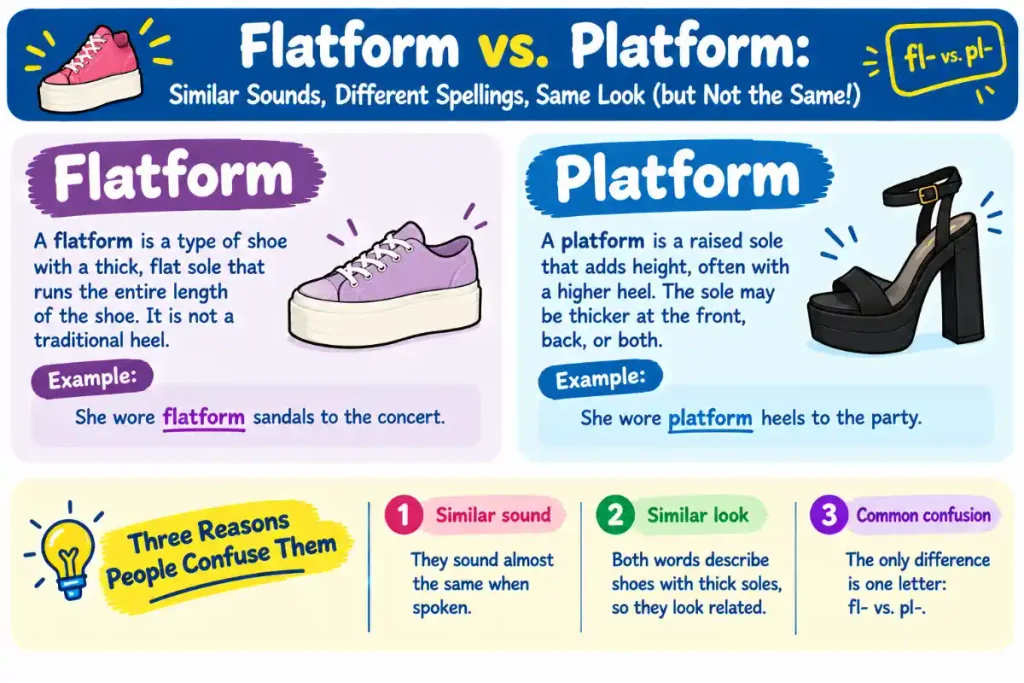
Why Are Flatform and Platform Easy to Confuse?
The words look and sound similar, and both can describe footwear with thick soles. Their spelling differs by just one letter: flatform begins with fl-, while platform begins with pl-. There are three main reasons people confuse them.
1. Both words describe elevated footwear
A platform shoe raises the foot above the ground. A flatform shoe does the same, but its sole generally remains level. Because both styles add height, shoppers may use the terms interchangeably even when describing different shapes.
2. Flatform is a less familiar word
Most English speakers encounter platform in many situations, from train stations to technology. Flatform appears mainly in fashion and footwear descriptions. Someone unfamiliar with the fashion term may assume that flatform is a misspelling of platform. However, it is an established term in footwear.
3. Shoe descriptions sometimes overlap
Retailers don’t always use footwear labels in exactly the same way. A chunky shoe might be described as a platform sneaker even if its sole is nearly flat. This overlap doesn’t make either word incorrect. It means you should consider the shoe’s design and the context in which the word appears.
Flatform vs Platform: 10 Examples in Real Sentences
These examples show how to use both words naturally in everyday American English.
Examples using flatform
- Shopping: I ordered a pair of white flatform sneakers for the summer.
- Fashion: Her flatform sandals added height without a steep heel.
- Product description: The store described the shoes as lightweight flatform loafers.
- Everyday conversation: Do you think these flatform shoes will go with my dress?
- Personal style: She prefers flatform boots because she likes their chunky, level soles.
Examples using platform
- Footwear: He wore platform sneakers to the music festival.
- Transportation: We met our friends on the train platform.
- Technology: The company launched a new platform for online classes.
- Politics: The candidate discussed her platform during the campaign.
- Shopping: These platform sandals have a higher heel than the pair I tried yesterday.
Notice that the first five sentences use flatform to describe footwear with a relatively level sole. The remaining examples show how platform works in different contexts.
Flatform vs Platform vs Flat Shoes
Another useful comparison is the difference between flatform shoes, platform shoes, and ordinary flat shoes.
| Shoe Type | Description | Example |
|---|---|---|
| Flatform | Thick, elevated sole with a mostly level profile | Flatform sandals |
| Platform | Elevated sole that may be level or sloped | Platform heels |
| Flat | Little or no heel elevation | Ballet flats |
A flat shoe doesn’t necessarily have a thick sole. Ballet flats, for example, generally sit close to the ground. Flatform shoes differ because they have a thick sole that adds noticeable height. Platform shoes also add height, but their soles can have different shapes.
Which shoe type should you choose?
Your choice depends on the style and shape you prefer.
- Choose flatforms if you like an elevated shoe with a relatively level sole.
- Choose platform heels if you want a raised front section combined with a higher heel.
- Choose flats if you prefer footwear with little elevation.
These are general style distinctions rather than strict rules. Comfort depends on the shoe’s fit, materials, construction, and how you use it.
Is Flatform a Real Word or a Misspelling?
Yes, flatform is a real word in fashion. It is not simply a misspelling of platform when used to describe footwear with a thick, relatively flat sole. However, flatform is not a general substitute for platform. Using it to describe a train station, a software service, or a political set of policies would normally be incorrect.
Consider these examples:
| Sentence | Correct? | Explanation |
|---|---|---|
| She bought flatform sandals. | Yes | Describes a footwear style. |
| We waited on the train flatform. | No | Use platform for the station area. |
| The company built a new digital flatform. | No | Use platform for the digital system. |
| He wore platform boots. | Yes | Describes elevated footwear. |
| The candidate presented her flatform. | No | Use platform for political policies. |
The best way to avoid mistakes is to consider the intended meaning before choosing the spelling.
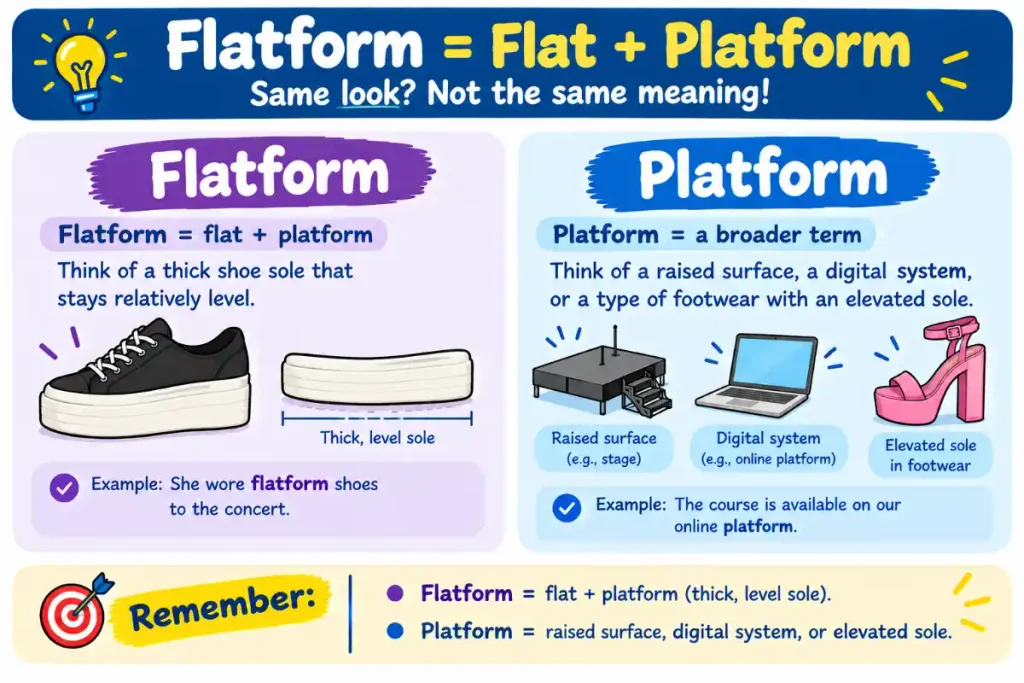
How to Remember the Difference
You don’t need to memorize a complicated spelling rule. A simple connection between the word and its meaning is enough.
- Flatform = flat + platform: Think of a thick shoe sole that stays relatively level.
- Platform = a broader term: Think of a raised surface, a digital system, or a type of footwear with an elevated sole.
Try this quick test: If you’re describing shoes with a thick, mostly level sole, flatform may fit. If you’re talking about a train station, a website, or a raised shoe sole in general, platform is usually the right choice. Remember that flatforms fall within the broader category of platform footwear, but the terms are not interchangeable in every situation.
Conclusion
Choosing between flatform and platform depends on what you’re describing. Both are valid words, but they serve different purposes. Platform is the broader term for a raised surface, a digital system, a set of political policies, or footwear with an elevated sole. Flatform is a more specific fashion term for shoes with thick soles that remain relatively level from the toe to the heel.
When comparing flatform vs platform, remember that a flatform is generally a type of platform shoe, but not every platform shoe is a flatform. Use flatform when the shoe’s level sole is important to the description, and use platform when discussing elevated footwear more generally or referring to another kind of platform. This simple distinction will help you choose the right word in product descriptions, everyday conversations, and professional writing.
Frequently Asked Questions
Is flatform or platform the correct spelling?
Both spellings are correct, but they have different uses. Flatform describes a footwear style with a thick, relatively level sole, while platform has broader meanings and also describes many other types of shoes.
What is the difference between flatform and platform shoes?
Flatform shoes generally have a thick sole that stays level from the toe to the heel. Platform shoes can have a level sole or a raised heel that creates a slope.
Is flatform a proper English word?
Yes, flatform is an established fashion term used to describe certain types of footwear. It is appropriate in shoe descriptions, fashion articles, and shopping discussions.
Are flatform shoes the same as flat shoes?
No. Flatform shoes have thick, elevated soles, while ordinary flat shoes usually have little heel elevation. Flatforms add height while keeping the foot relatively level.
Can I use platform instead of flatform?
Sometimes, but the meaning may become less specific. A flatform is generally a type of platform shoe, but platform alone doesn’t tell readers that the sole is relatively level.
Why are flatform shoes called flatforms?
The name combines flat and platform to describe a shoe with a thick, mostly level sole. The term highlights the difference between this shape and footwear with a more pronounced heel.
How do you use flatform in a sentence?
You can write, “She wore flatform sandals to the outdoor concert.” In this sentence, flatform describes the type of sandals she wore.
3 thoughts on “Flatform vs Platform: Which Spelling Is Correct?”