
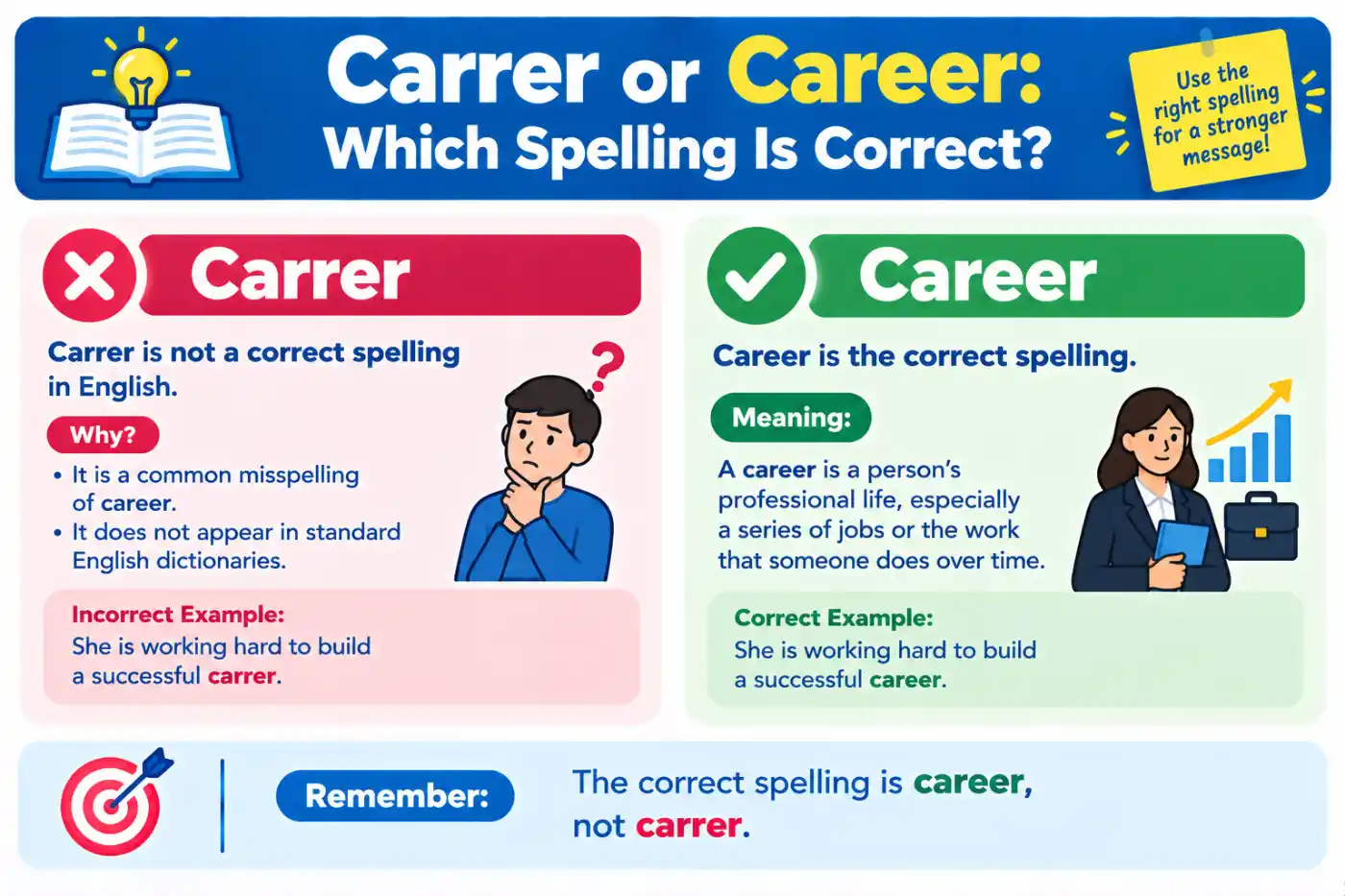
If you’re writing a resume, applying for a job, or describing your professional goals, you may wonder whether carrer or career is the correct spelling. The two words look similar, but only one is the standard English word for a person’s profession, work experience, or progress in a chosen field.
Career is the correct spelling. Carrer is a common misspelling of career in standard American English. Use career when discussing a job path, professional development, or the work someone does over time.
Knowing the difference helps you avoid spelling mistakes in resumes, cover letters, school assignments, and professional emails. This guide explains the meaning of career, why people misspell it as carrer, and how to use the correct word in everyday writing.
Carrer or Career: Which One Is Correct?
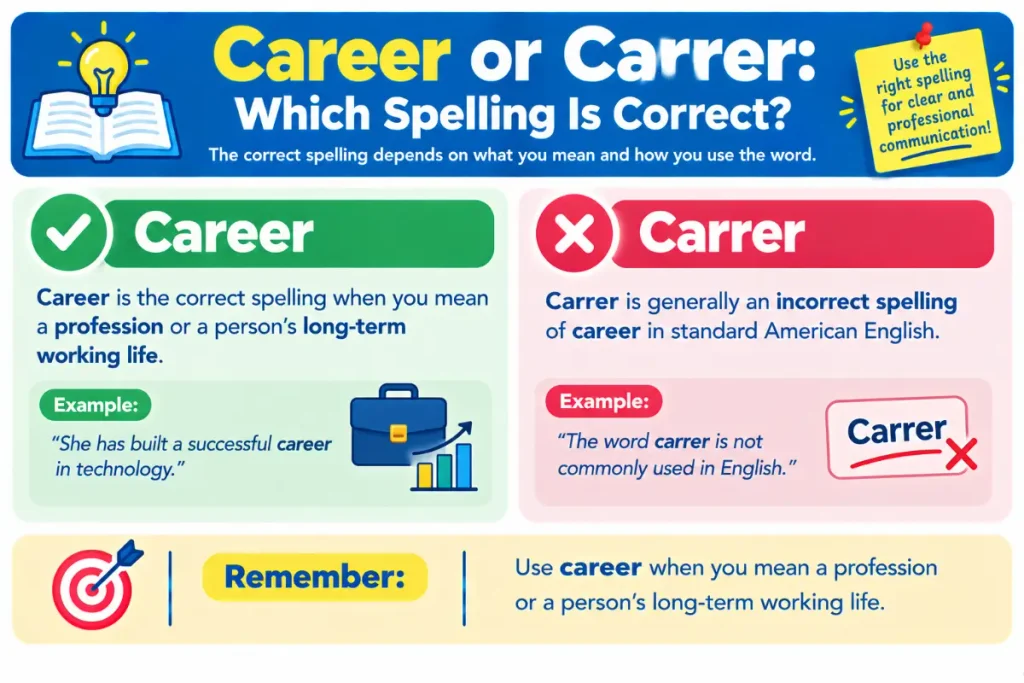
Career is the correct spelling when you mean a profession or a person’s long-term working life. Carrer is generally an incorrect spelling of career in standard American English.
| Word | Correctness | Meaning | Example |
|---|---|---|---|
| Career | Correct | A person’s profession or working life | She wants a career in nursing. |
| Carrer | Incorrect for this meaning | Common misspelling of career | Incorrect: He started a carrer in finance. |
The difference is simple: write career, not carrer, when talking about work, professional goals, or a chosen occupation.
For example:
- Correct: Marcus plans to build a career in engineering.
- Incorrect: Marcus plans to build a carrer in engineering.
The correct spelling matters in formal and informal writing. A spelling error may distract readers, especially when it appears in a job application or professional document.
What Does Career Mean?
The word career refers to a person’s profession, occupation, or progress through working life. It can describe a long-term professional path, a series of related jobs, or the work someone pursues over many years. A career may develop through education, training, experience, promotions, and changes in professional goals. It does not have to follow one straight path, and it does not always involve working for the same employer.
Career as a noun
Career is primarily used as a noun. It identifies a profession, a person’s working life, or achievements within a field.
Examples:
- Her career in education began after college.
- Daniel hopes to pursue a career in computer science.
- The athlete ended his professional career at age 35.
- My sister changed careers after working in retail for several years.
- The company helped employees develop their careers.
In each example, career describes a professional path or the work someone does over time.
What does it mean to build a career?
To build a career means to develop professional skills, gain experience, and work toward long-term goals. This process may include earning qualifications, taking on new responsibilities, or moving into a different role. For example, someone might begin as an assistant, gain experience, become a manager, and eventually lead a department. These steps can form part of a career. A career can also include several different occupations. A person who moves from teaching to business management may still be developing a successful career, even though the field has changed.
Why Do People Confuse Carrer and Career?
People often confuse carrer and career because the words contain nearly the same letters. The main difference is the second vowel: career contains two e’s after the initial c and a, while carrer has a different letter pattern. Several factors can cause this spelling mistake.
1. Similar letter patterns
English spelling can be confusing when words contain repeated vowels or unfamiliar letter combinations. Some writers accidentally replace the second e in career with an r, producing carrer.
Correct spelling: C-A-R-E-E-R Incorrect spelling: C-A-R-R-E-R
Remember that the correct word contains two consecutive e’s in the middle.
2. Typing too quickly
People sometimes type carrer when they intend to write career. This can happen when drafting a message quickly, completing an online application, or writing notes. Spell-checking tools may identify the error, but they do not always catch every mistake. Reviewing your writing before submitting it can help you find these errors.
3. Unfamiliarity with the word
Students and people learning English may not immediately recognize the correct spelling. Because carrer looks similar to career, they may assume both forms are acceptable. Reading the correct spelling in context and practicing it in sentences can make it easier to remember.
How to Spell Career Correctly
The easiest way to spell career correctly is to break the word into its individual letters. Career = C + A + R + E + E + R
Follow these simple steps:
- Begin with C-A-R.
- Add two e’s: C-A-R-E-E.
- Finish with R to form CAREER.
- Check that you have written six letters in the correct order.
You can also remember the spelling by connecting the word with professional development. For example, if you write about a career in medicine or a career in business, use the same spelling every time.
A simple memory trick
Think of the two e’s in career as part of the word’s middle:
- Career: C-A-R-E-E-R
- Carrer: C-A-R-R-E-R
The correct spelling has EE, not RR, in the middle.
Try writing the word three times in a sentence:
- I want a successful career.
- She is beginning her career.
- He changed his career path.
Practicing the word in meaningful sentences can help you remember it more easily than memorizing isolated letters.
Carrer vs. Career Examples in Real Sentences
Seeing the correct spelling in different situations helps you understand how to use career naturally. The following examples cover work, education, professional goals, and everyday conversation.
| No. | Example sentence | Context |
|---|---|---|
| 1 | She wants to pursue a career in nursing. | Career planning |
| 2 | He started his career as a software developer. | Employment |
| 3 | My brother is considering a career in law. | Education and work |
| 4 | The training program helped her advance her career. | Professional development |
| 5 | I hope to build a successful career in business. | Personal goals |
| 6 | The athlete had a long career in professional basketball. | Sports |
| 7 | She changed careers after discovering her interest in design. | Career change |
| 8 | My teacher encouraged me to explore different career options. | School |
| 9 | He received an award for his outstanding career in public service. | Professional achievement |
| 10 | The company offers career development opportunities to its employees. | Workplace |
| 11 | I’m updating my resume to apply for a new position in my career field. | Job application |
| 12 | Her career took a new direction when she moved into management. | Professional change |
Each sentence uses career correctly to describe work, professional development, or a person’s working life.
Incorrect and corrected examples
Here are a few common spelling mistakes and their corrections.
| Incorrect sentence | Correct sentence |
|---|---|
| She wants a carrer in medicine. | She wants a career in medicine. |
| He has had a successful carrer. | He has had a successful career. |
| I’m planning my future carrer. | I’m planning my future career. |
| My carrer goals have changed. | My career goals have changed. |
| She is starting a new carrer. | She is starting a new career. |
In each case, replace carrer with career. The meaning remains the same, but the corrected version follows standard English spelling.
Career vs Profession: What’s the Difference?
Career and profession are related words, but they do not always mean exactly the same thing. A career describes a person’s working life or professional journey. A profession usually refers to a particular type of occupation that may require specialized education, training, or qualifications.
| Word | Meaning | Example |
|---|---|---|
| Career | A person’s professional journey over time | She built a career in healthcare. |
| Profession | A specific occupation or field of work | Teaching is her profession. |
For example, a person may have a career in healthcare that includes working as a medical assistant, completing additional education, and becoming a healthcare administrator. Their career describes the broader journey, while each job or professional role describes a part of that journey. Both words are correct, but they serve different purposes. Choose the one that best expresses your intended meaning.
Career vs. Job: What Is the Difference?
The words career and job are also closely related. However, a job usually refers to a specific position or paid role, while a career describes a broader professional path.
| Word | Meaning | Example |
|---|---|---|
| Career | Long-term professional development or working life | He hopes to build a career in technology. |
| Job | A particular position or paid work | He found a job at a technology company. |
A person can have several jobs during one career. For example, someone interested in accounting might work as a bookkeeper, become an accountant, and later manage a finance team. These positions may form part of the same career path. The distinction is useful when writing about employment goals. Use job when discussing a specific opening or position, and use career when discussing long-term professional plans.
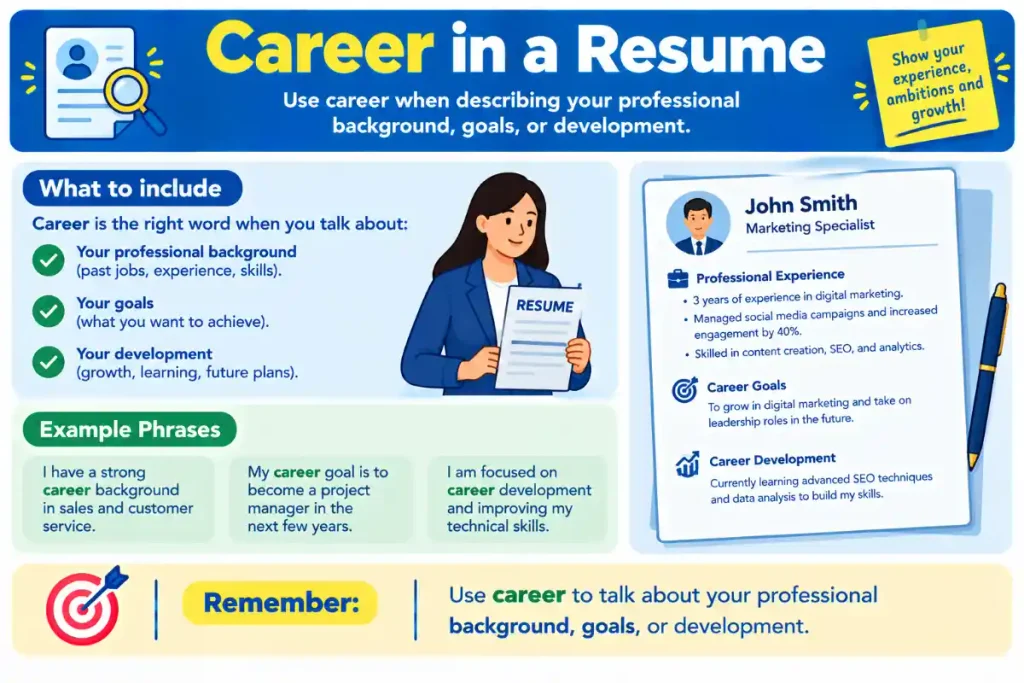
How to Use Career in Professional Writing
Because career is a common word in workplace communication, spelling it correctly is especially important in professional documents.
Career in a resume
Use career when describing your professional background, goals, or development.
Examples:
- Career Objective: Seeking an entry-level position in information technology.
- Career Summary: Experienced customer service professional with strong communication skills.
- Career Highlights: Led a team project that improved customer support.
A resume should present your qualifications clearly. Correct spelling helps keep the document professional and easy to read.
Career in a cover letter
A cover letter often explains why you want a position and how it fits your professional goals.
For example:
“I’m excited to apply for this position because it aligns with my long-term career goals in digital marketing.”
Here, career refers to the applicant’s professional plans.
Career in a professional email
You can use career when discussing development opportunities, training, or workplace goals.
For example:
“Thank you for sharing the career development opportunities available to the team.”
Another example is:
“I would appreciate the opportunity to discuss how this position could support my career growth.”
Both sentences use the correct spelling and suit a professional setting.
Career in academic writing
Students may use career when writing about future plans, professional interests, or the relationship between education and employment.
For example:
“My interest in biology has encouraged me to consider a career in environmental science.”
The spelling remains the same in academic, professional, and casual writing.
Related Words and Phrases That Use Career
Learning common expressions containing career can help you recognize the correct spelling and use the word more naturally.
| Word or phrase | Meaning | Example |
|---|---|---|
| Career path | The direction of someone’s professional development | She chose a career path in finance. |
| Career goals | Professional aims someone hopes to achieve | My career goals include becoming a manager. |
| Career change | A move into a different profession or field | He made a career change after ten years in sales. |
| Career growth | Progress in skills, responsibilities, or opportunities | The company supports career growth. |
| Career development | Activities that help someone improve professionally | Career development begins with setting clear goals. |
| Career opportunity | A chance to advance or enter a field | The internship offered a valuable career opportunity. |
| Career advice | Guidance about professional choices | I asked my mentor for career advice. |
| Career fair | An event where employers and job seekers connect | Students attended a career fair on campus. |
| Career counselor | A professional who helps people explore work options | A career counselor helped her identify suitable fields. |
| Career transition | A change in professional role or direction | His career transition required additional training. |
| Career achievement | An important professional accomplishment | Receiving the award was a major career achievement. |
| Career prospects | The likely opportunities for future professional progress | The degree may improve her career prospects. |
These phrases are common in job searches, education, workplace discussions, and professional planning. In every case, the word career retains the same spelling.
Is Career Spelled Differently in American and British English?
No. Career is spelled the same way in American and British English. The correct spelling is career in both varieties.
| English variety | Correct spelling | Example |
|---|---|---|
| American English | Career | She is pursuing a career in medicine. |
| British English | Career | She is pursuing a career in medicine. |
| Canadian English | Career | He plans to develop a career in engineering. |
| Australian English | Career | She began her career after university. |
Some English words have different American and British spellings, such as color and colour. However, career is not one of them. If you’re writing for a US audience, use career. You do not need to change its spelling to follow American English conventions.
Common Mistakes to Avoid When Writing Career
The most common mistake is writing carrer instead of career. However, writers can also misuse the word or confuse it with related terms.
Mistake 1: Using carrer in a resume
Incorrect: “Seeking a carrer in financial services.”
Correct: “Seeking a career in financial services.”
Always check the spelling of career in your resume, cover letter, and online job applications.
Mistake 2: Assuming carrer is an alternative spelling
Incorrect: “She started a carrer in education.”
Correct: “She started a career in education.”
Carrer is not a standard alternative spelling of career in American English. Use career when referring to someone’s professional life.
Mistake 3: Confusing career with job
Incorrect: “My career at the store ends at 5 p.m.” if you mean that your work shift ends at that time.
Better: “My shift at the store ends at 5 p.m.”
Use career for a broader professional journey. Use shift for a scheduled period of work and job for a specific position or role.
Mistake 4: Using career when profession is more precise
Consider these sentences:
- “Nursing is her profession.”
- “She has built a rewarding career in nursing.”
Both are correct. The first identifies her occupation, while the second describes her professional journey. Choose the word that matches the meaning you want to express.
Mistake 5: Relying only on spell-check
A spell-checking tool can help identify errors, but you should still review important documents yourself. A quick proofread can catch misspellings that remain in a resume, email, or school assignment.
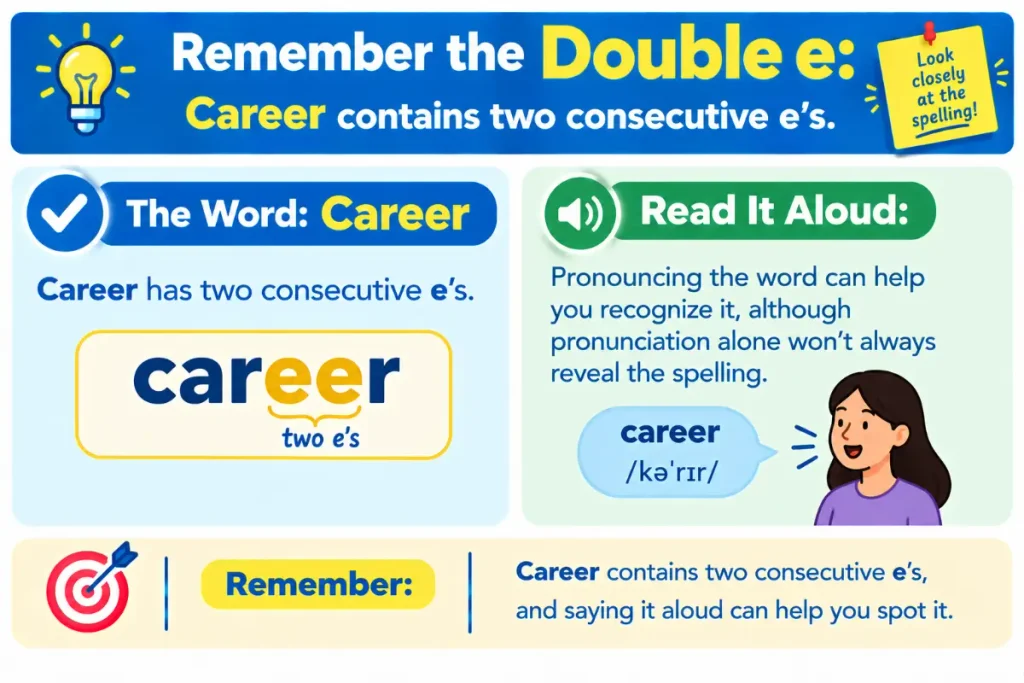
Quick Tips to Remember the Correct Spelling
Use these practical tips whenever you’re unsure about carrer or career.
- Remember the double e: Career contains two consecutive e’s.
- Read it aloud: Pronouncing the word can help you recognize it, although pronunciation alone won’t always reveal the spelling.
- Practice with phrases: Write career goals, career path, and career development to reinforce the correct form.
- Check professional documents: Review resumes, cover letters, and emails before submitting them.
- Use a dictionary: If you’re unsure about a word’s spelling or meaning, consult a reliable dictionary.
- Remember the distinction: Career refers to a person’s professional journey, while a job usually refers to a particular position.
The most useful rule is simple: whenever you mean someone’s profession or working life, write career.
Conclusion
Choosing between carrer or career is easy once you remember the correct spelling. Career is the standard English word for a person’s profession, working life, or long-term professional development. Carrer is a common misspelling and should not be used in place of the correct form in resumes, essays, emails, or everyday writing.
To avoid this mistake, remember the two consecutive e’s in career and practice using the word in familiar phrases such as career goals, career path, and career development. Also, keep in mind that American and British English use the same spelling. Whenever you write about professional ambitions, work experience, or future employment plans, choose career for clear, accurate, and professional communication.
Frequently Asked Questions
Is carrer or career correct?
Career is correct when referring to a profession, working life, or long-term professional development. Carrer is a common misspelling in standard American English.
How do you spell career correctly?
Spell it C-A-R-E-E-R. The word contains six letters, including two consecutive e’s in the middle.
Is carrer a real English word?
Carrer is not the standard English spelling for a person’s professional journey. In ordinary American English writing, use career instead.
What does career mean?
A career is a person’s profession, working life, or progress through professional roles over time. For example, someone may pursue a career in education, healthcare, or technology.
What is the difference between carrer and career?
The difference is spelling. Career is the correct standard form, while carrer is generally a misspelling when the intended meaning is a profession or working life.
Is career spelled differently in British English?
No. American and British English both use career. Unlike words such as color and colour, this word does not have a standard regional spelling variation.
How can I remember the spelling of career?
Remember that career contains two e’s together: C-A-R-E-E-R. Practicing phrases such as career goals and career development can also help you remember the correct spelling.
1 thought on “Carrer or Career: Which Spelling Is Correct?”