
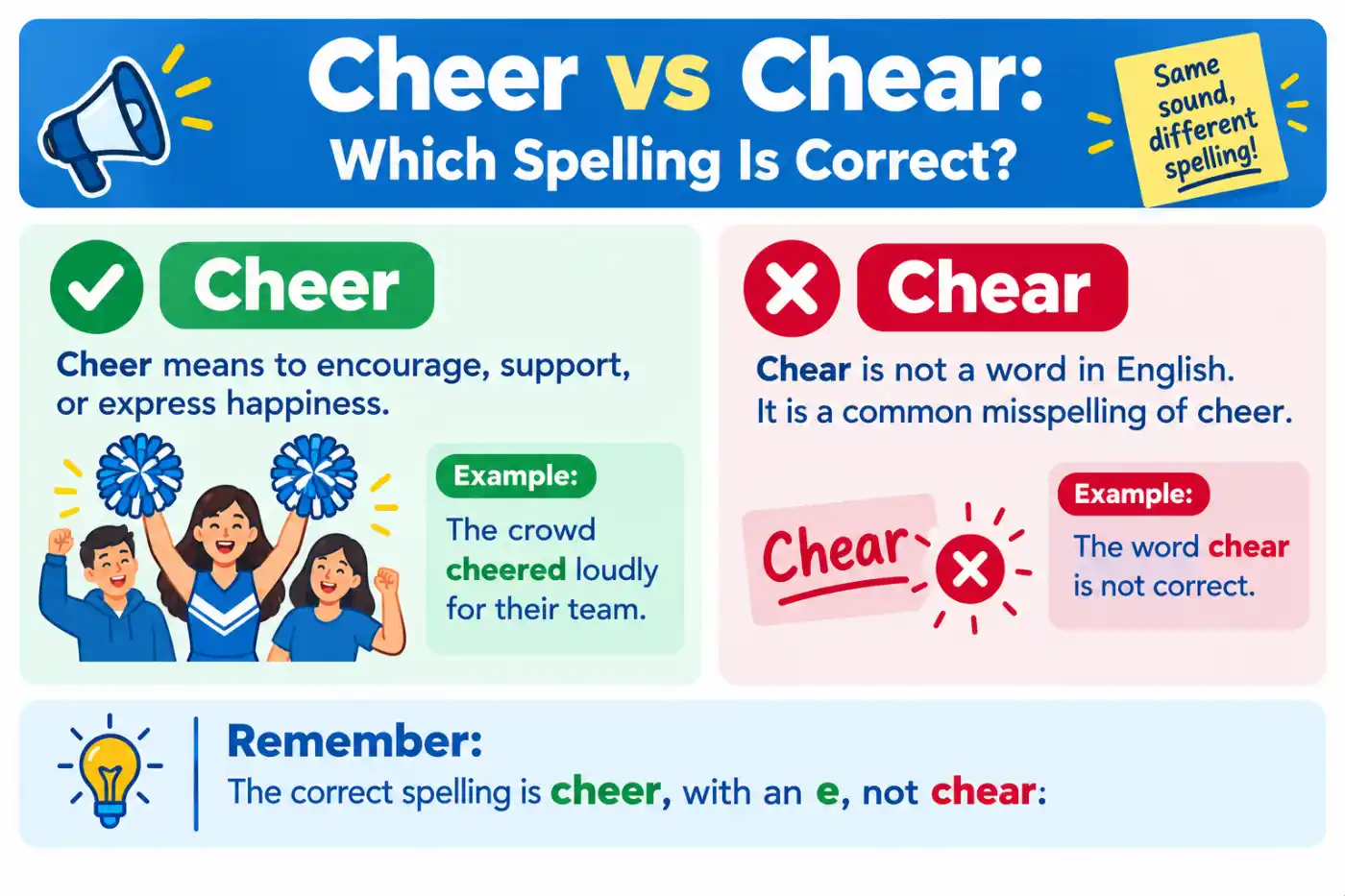
If you’re writing a message, school assignment, or social media post, you might wonder whether cheer vs chear is the correct spelling. The two words look similar, but only one is standard English.
Cheer is the correct spelling. Chear is a misspelling in standard English. The word cheer can mean to shout in support of someone, express happiness, or give encouragement.
You can use cheer as both a noun and a verb. For example, a crowd might give a loud cheer at a football game, or friends might cheer for someone who achieves a goal. This guide explains the meaning of cheer, why chear is incorrect, and how to use the correct spelling in everyday sentences.
Cheer vs Chear: What’s the Difference?
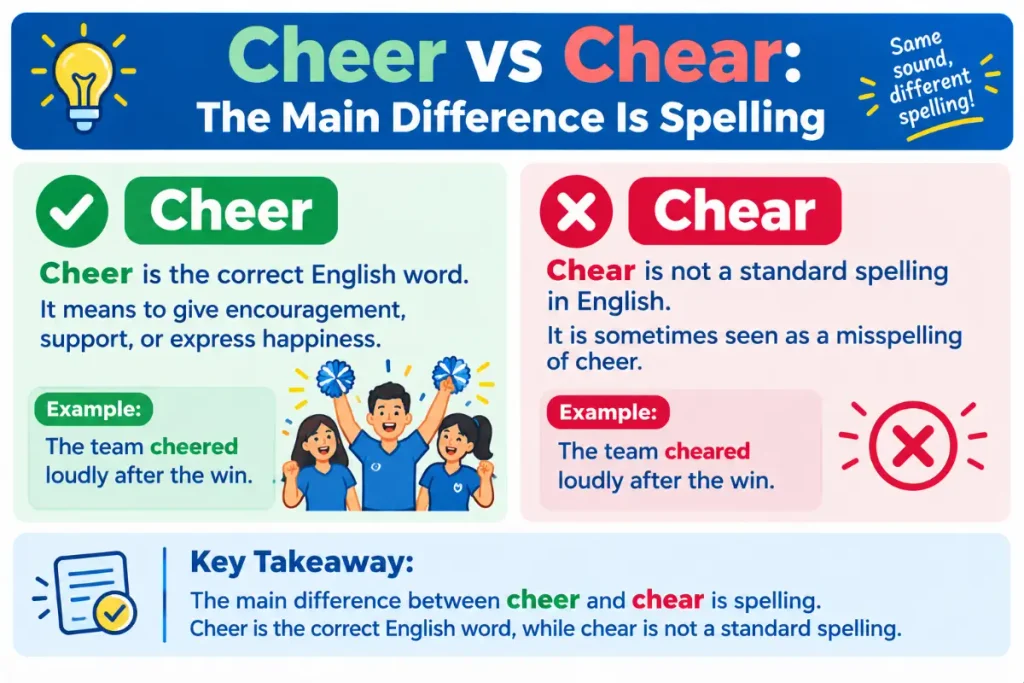
The main difference between cheer and chear is spelling. Cheer is the correct English word, while chear is not a standard spelling.
| Word | Correct or Incorrect? | Meaning | Example |
|---|---|---|---|
| Cheer | Correct | To encourage someone or express happiness | The fans cheer for their team. |
| Chear | Incorrect | A misspelling of cheer | Incorrect: The fans chear for their team. |
Use cheer in American English, British English, and other standard varieties of English.
What Does Cheer Mean?
Cheer has several related meanings. It can describe a happy feeling, a loud expression of support, or an action that encourages someone.
Common meanings include:
- To encourage: The students cheer for their classmates.
- To express happiness: The good news brought cheer to the family.
- To celebrate or support: The crowd gave a loud cheer when the player scored.
- To improve someone’s mood: Her kind words helped cheer me up.
The meaning depends on how the word appears in a sentence.
Why Is Chear Incorrect?
The spelling chear replaces the correct vowel combination eer with ear. Although both combinations appear in English words, only cheer is the standard spelling for this word.
For example:
- Correct: Everyone began to cheer when the team won.
- Incorrect: Everyone began to chear when the team won.
The easiest way to avoid this mistake is to remember the spelling of familiar words such as cheerful, cheerleader, and cheering.
How Do You Spell Cheer Correctly?
The correct spelling is C-H-E-E-R.
To remember it, focus on the double e in the middle of the word. The same spelling appears in related words such as cheerful and cheerfully.
| Word Form | Correct Spelling | Example |
|---|---|---|
| Base word | Cheer | We cheer for our friends. |
| Third-person singular | Cheers | She cheers for the home team. |
| Present participle | Cheering | The crowd is cheering loudly. |
| Simple past tense | Cheered | The audience cheered after the show. |
| Adjective | Cheerful | He has a cheerful personality. |
| Noun | Cheerfulness | Her cheerfulness brightened the room. |
These related forms all use the same basic spelling pattern.
Is Cheer a Noun or a Verb?
Cheer can be both a noun and a verb. Its role depends on how you use it in a sentence.
Cheer as a Noun
As a noun, cheer refers to a shout of support, a feeling of happiness, or an expression of encouragement.
Examples:
- The crowd gave a loud cheer after the final goal.
- Her message brought cheer to everyone in the office.
- The team’s cheer echoed throughout the stadium.
- Holiday decorations added cheer to the room.
- The children shouted a cheer for their teacher.
In these examples, cheer names a feeling or an expression of support.
Cheer as a Verb
As a verb, cheer describes the act of expressing support, showing happiness, or encouraging someone.
Examples:
- We cheer for our school at every game.
- The fans cheered when the players entered the field.
- Her friends cheered her on during the competition.
- The funny video cheered him up after a difficult day.
- Everyone cheered when the announcement was made.
The verb can describe both a physical action, such as shouting, and an emotional action, such as helping someone feel better.
Cheer vs Cheerful: What’s the Difference?
Cheer is a noun or verb, while cheerful is an adjective that describes someone or something that seems happy, positive, or pleasant.
| Word | Part of Speech | Meaning | Example |
|---|---|---|---|
| Cheer | Noun or verb | Happiness, support, or encouragement | The fans cheer for their team. |
| Cheerful | Adjective | Happy or positive | She has a cheerful attitude. |
| Cheerfully | Adverb | In a happy or positive manner | He greeted us cheerfully. |
Examples in Context
- Cheer: The audience gave a loud cheer.
- Cheerful: The cheerful child smiled at everyone.
- Cheerfully: She cheerfully welcomed the guests.
Use cheer when referring to support or encouragement. Use cheerful when describing a person’s mood, personality, or atmosphere.
Cheer vs Encourage: Which Word Should You Use?
Cheer often involves expressing support or excitement, while encourage usually means giving someone confidence, hope, or motivation.
| Word | Meaning | Example |
|---|---|---|
| Cheer | Express support or excitement | The fans cheered for the players. |
| Encourage | Give someone support or confidence | The teacher encouraged the students to keep trying. |
For example, a crowd might cheer for a runner during a race. A coach might encourage the runner to continue practicing after a disappointing performance. Use cheer when the focus is on showing support or expressing enthusiasm. Choose encourage when the focus is on helping someone feel confident or motivated.
Cheer vs Cheers: What’s the Difference?
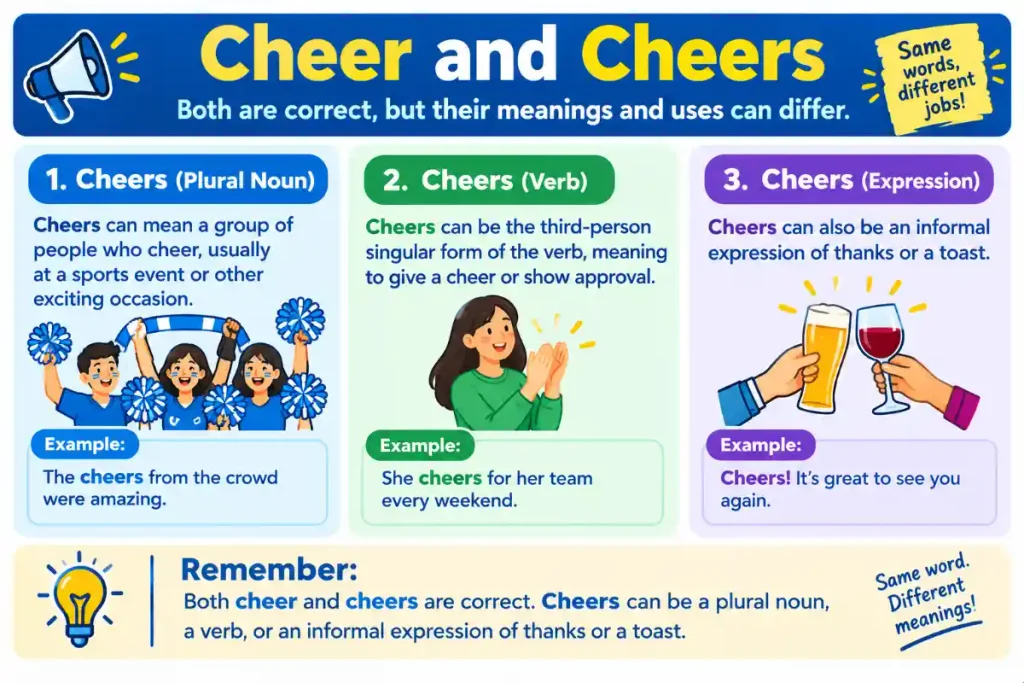
Cheer and cheers are both correct, but their meanings and uses can differ. Cheers can be the plural noun, the third-person singular form of the verb, or an informal expression of thanks or a toast.
| Word | Usage | Example |
|---|---|---|
| Cheer | Singular noun or base verb | One loud cheer filled the room. |
| Cheers | Plural noun | The crowd’s cheers filled the stadium. |
| Cheers | Verb form | She cheers for her friends. |
| Cheers | Informal expression | Cheers for helping me out! |
In American English, cheers is commonly used for a toast and is also familiar as a casual expression of thanks, though the latter use is more strongly associated with British English. Choose the form that matches the meaning and grammar of your sentence.
15 Example Sentences Using Cheer
The following examples show how to use cheer naturally in school, work, sports, and everyday situations.
- The students began to cheer when their teacher announced the field trip.
- We cheer for our favorite football team every Sunday.
- Her kind words brought cheer to the entire family.
- The crowd gave a huge cheer when the home team scored.
- My friends came to cheer me on during the race.
- The children cheered as the parade passed by.
- A cheerful greeting can make someone’s morning better.
- The coach encouraged the players to cheer for one another.
- The audience erupted in cheers after the performance.
- She tried to cheer up her brother after his difficult exam.
- The office decorations added holiday cheer to the workplace.
- Everyone cheered when the school announced its winning science project.
- He smiled and cheered for his teammate from the sidelines.
- The cheerful music helped improve everyone’s mood.
- Our neighbors came outside to cheer as the runners passed.
Notice that cheer changes form depending on the sentence. The base word is cheer, the past tense is cheered, and the adjective is cheerful.
Common Mistakes When Using Cheer
Writers sometimes misspell cheer or confuse it with a related word. These simple corrections can help you avoid common errors.
Mistake 1: Writing Chear Instead of Cheer
Incorrect: The fans began to chear loudly.
Correct: The fans began to cheer loudly.
Why: The standard spelling uses ee, not ea.
Mistake 2: Confusing Cheer With Cheerful
Incorrect: The room looked cheer after the decorations were added.
Correct: The room looked cheerful after the decorations were added.
Why: Use the adjective cheerful to describe the room’s atmosphere.
Mistake 3: Using the Wrong Verb Form
Incorrect: The crowd cheer yesterday.
Correct: The crowd cheered yesterday.
Why: Use cheered for an action that happened in the past.
Mistake 4: Confusing Cheer With Encourage
Less precise: The teacher cheered the student to study harder.
More natural: The teacher encouraged the student to study harder.
Why: Encourage is usually the better choice when someone gives advice or motivation rather than shouting support.
Mistake 5: Forgetting the Double E in Related Words
Incorrect: She is a great chearleader.
Correct: She is a great cheerleader.
Why: Cheerleader comes from cheer, so it retains the double e.
Is Cheer Spelled Differently in American and British English?
No. Cheer is spelled the same way in American and British English. The spelling chear is not a standard regional alternative.
| English Variety | Correct Spelling | Incorrect Spelling |
|---|---|---|
| American English | Cheer | Chear |
| British English | Cheer | Chear |
| Canadian English | Cheer | Chear |
| Australian English | Cheer | Chear |
Examples:
- American English: The fans cheered for the team.
- British English: The crowd cheered for the players.
- Australian English: Everyone cheered at the event.
The spelling remains the same across these varieties. Some expressions involving cheers may be more common in certain regions, but that does not change the spelling of the word itself.
Easy Ways to Remember Cheer vs Chear
If you often confuse these spellings, use these practical tips to remember the correct form.
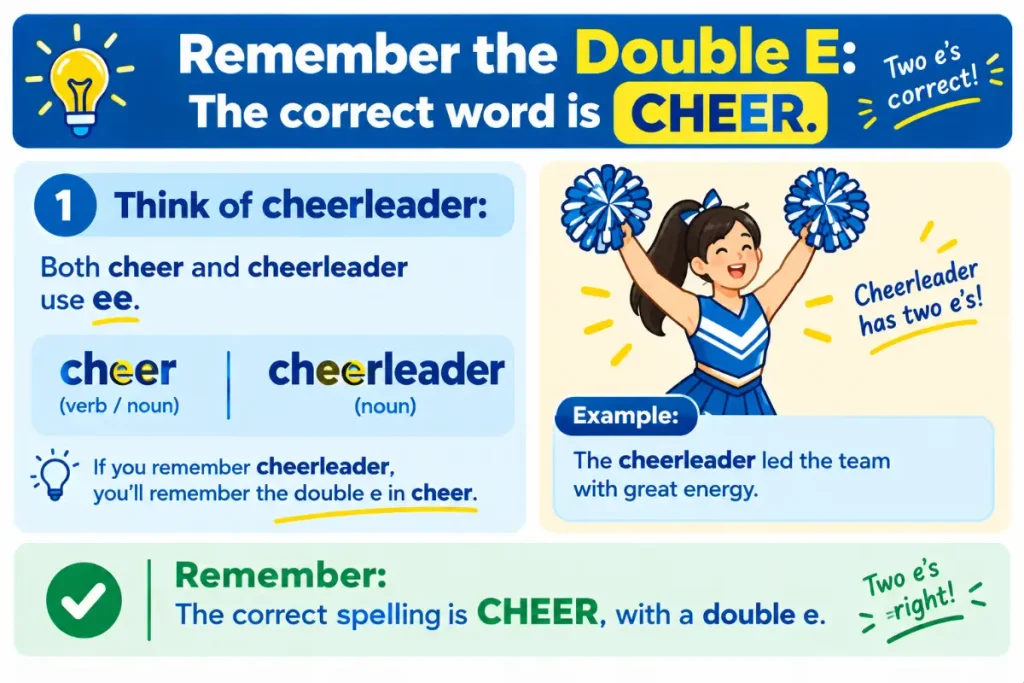
- Remember the double e: The correct word is C-H-E-E-R.
- Think of cheerleader: Both cheer and cheerleader use ee.
- Connect it with happiness: Think of a cheerful person cheering for a friend.
- Practice with a sentence: Write, “We cheer for our team,” to reinforce the spelling.
- Check related words: Words such as cheered, cheering, and cheerful all keep the same spelling pattern.
The main rule is simple: Use cheer, never chear, in standard English writing.
Conclusion
The difference between cheer vs chear is simple: cheer is the correct spelling, while chear is a misspelling in standard English. The word cheer can function as a noun or a verb and is commonly used to describe happiness, encouragement, and support.
You can use it when cheering for a sports team, encouraging a friend, describing a joyful atmosphere, or celebrating an achievement. Related words such as cheered, cheering, and cheerful also use the same double-e spelling.
To avoid mistakes, remember the letters C-H-E-E-R and practice using the word in everyday sentences. Whether you’re writing a school assignment, a professional email, or a social media post, choosing the correct spelling will make your writing clearer and more polished.
Frequently Asked Questions
1. Which is correct, cheer or chear?
Cheer is correct, and chear is a misspelling in standard English. Use cheer to describe encouragement, happiness, or expressions of support.
2. How do you spell cheer?
The correct spelling is C-H-E-E-R. Remember the double e in the middle of the word.
3. What does cheer mean?
Cheer can mean to express support, shout with excitement, or bring happiness. It can function as both a noun and a verb.
4. Is chear ever a correct spelling?
No, chear is not the standard spelling of the English word. The correct form is cheer in American and British English.
5. What is the difference between cheer and cheerful?
Cheer is a noun or verb related to support and happiness, while cheerful is an adjective describing someone or something that appears happy or positive.
6. What is the past tense of cheer?
The past tense of cheer is cheered. For example, “The fans cheered when their team won.”
7. How can I remember cheer vs chear?
Remember that cheer contains two e’s together. Related words such as cheering, cheered, and cheerful follow the same spelling pattern.
2 thoughts on “Cheer vs Chear: Which Spelling Is Correct?”