
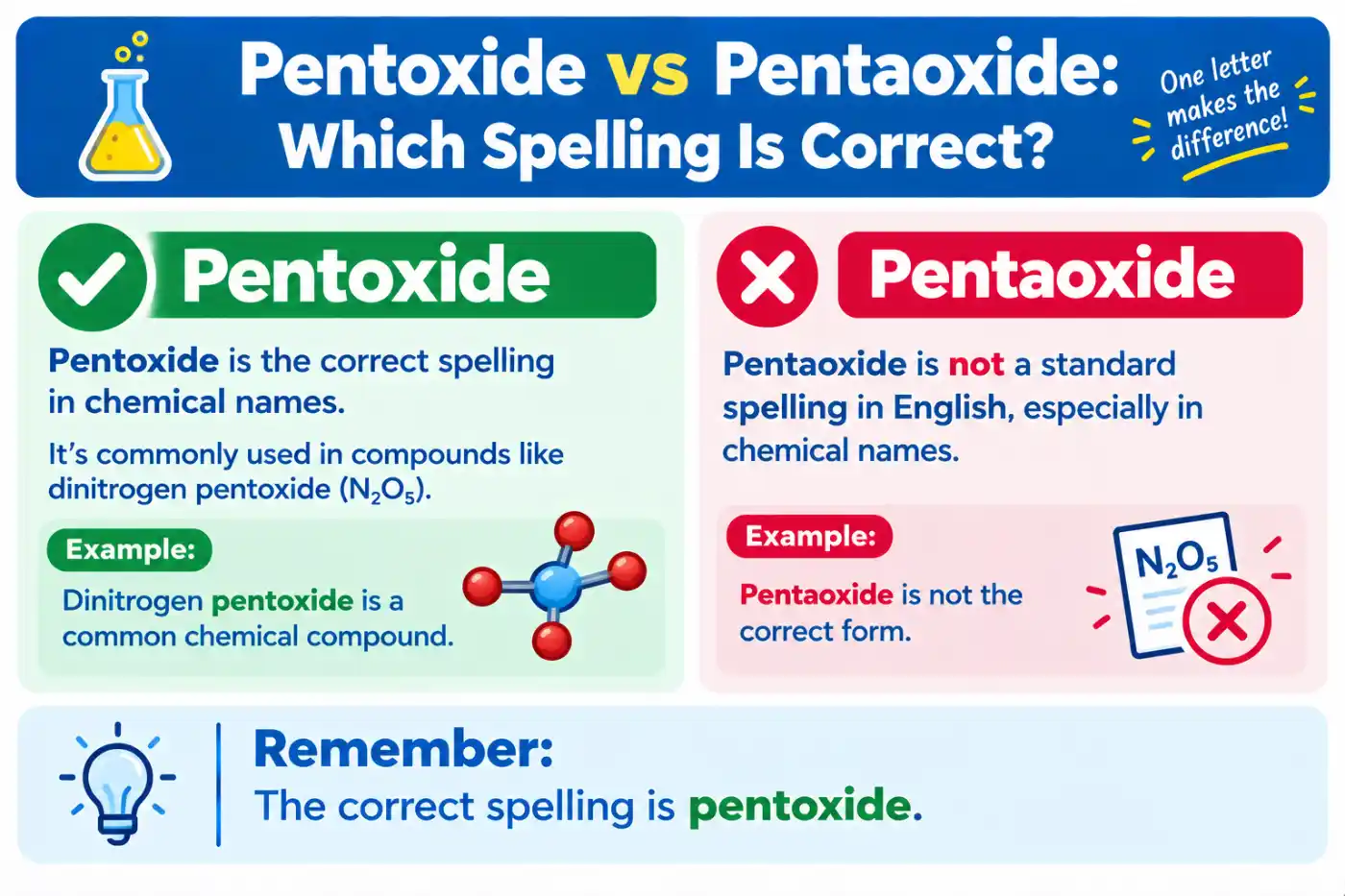
If you’re writing a chemistry assignment or reading a chemical formula, pentoxide vs pentaoxide can be confusing. Both spellings may look correct because the prefix penta- means five, but pentoxide is the standard form used in established chemical names, such as dinitrogen pentoxide.
Chemists use pentoxide because chemical naming conventions generally drop the final a from penta- before oxide. This pattern helps create familiar, consistent names for chemical compounds.
Understanding the difference between pentoxide and pentaoxide can help you avoid spelling mistakes in chemistry. This article explains the correct spelling, provides examples of chemical names, and explores related prefixes and common naming errors.
What Do Pentoxide and Pentaoxide Mean?
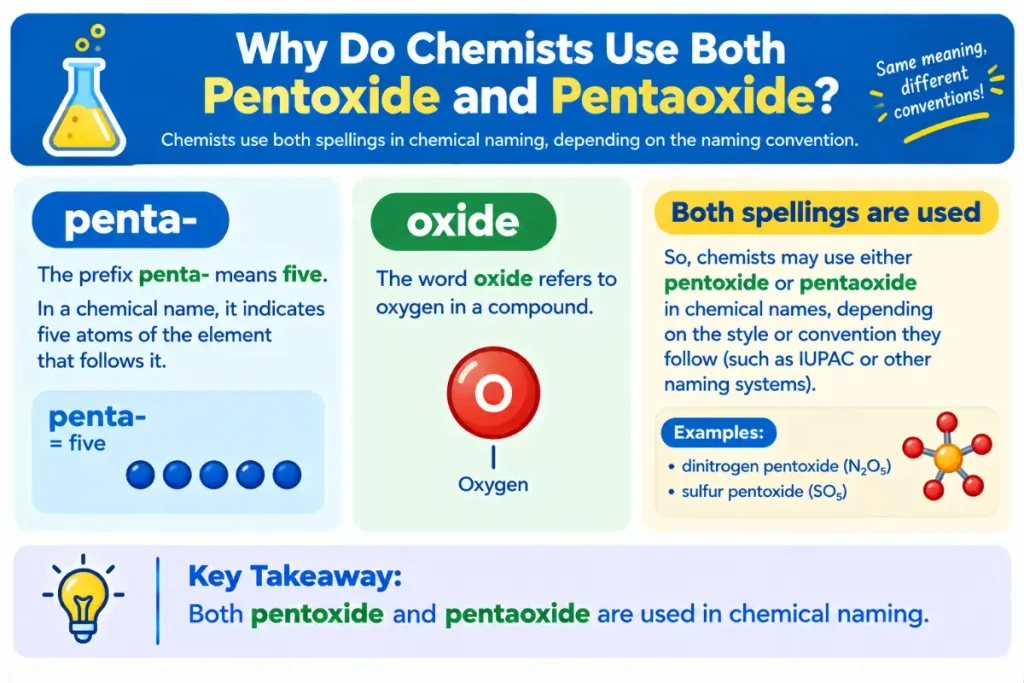
Chemists use both pentoxide and pentaoxide in chemical naming, depending on the naming convention. The prefix penta- means five. In a chemical name, it indicates five atoms of the element that follows it. The word oxide refers to oxygen in a compound.
Strict IUPAC compositional nomenclature generally retains the final vowel of numerical prefixes. Under this convention, chemists prefer pentaoxide, although they widely use pentoxide in familiar chemical names.
What Does Pentoxide Mean?
Pentoxide is a traditional, widely used form of a chemical name that indicates five oxygen atoms in the relevant molecular formula or formula unit.
Examples include:
- Dinitrogen pentoxide: A familiar name for the compound N₂O₅.
- Phosphorus pentoxide: A common name associated with phosphorus oxides, especially the composition represented by P₂O₅.
- Vanadium pentoxide: A familiar name for the compound V₂O₅.
These names appear in chemistry textbooks, scientific writing, and reference materials. The spelling is not simply an accidental misspelling; it is an established naming form.
What Does Pentaoxide Mean?
Pentaoxide keeps the final a in the prefix penta-. This spelling follows the general rule in IUPAC compositional nomenclature, which retains the final vowels of numerical prefixes before a following vowel.
For example, chemists can name N₂O₅ dinitrogen pentaoxide under this convention.
This name identifies two nitrogen atoms and five oxygen atoms. The prefix di- indicates two, while penta- indicates five.
Why Are Pentoxide and Pentaoxide Both Used?
The two spellings appear because chemical naming practices have not always used the same approach to vowel retention. Many introductory chemistry resources teach that the final a in penta- is dropped before oxide. This produces the familiar form pentoxide. Other naming references follow the stricter IUPAC approach, which retains the vowel and uses pentaoxide. The International Union of Pure and Applied Chemistry (IUPAC) publishes recommendations for systematic chemical naming. Its guide to inorganic nomenclature states that chemists generally retain the final vowels of multiplicative prefixes, with monoxide as a special exception. This explains why you may encounter both forms in chemistry classes, reference books, and scientific databases.
Does Pentaoxide Break the Spelling Rules?
No. Pentaoxide is consistent with strict IUPAC compositional naming conventions. The extra a is retained rather than removed.
However, pentoxide is also an established form in common chemical usage. The choice depends on the naming convention required by your textbook, teacher, publication, or reference source.
For example:
- Traditional name: dinitrogen pentoxide
- Strict compositional name: dinitrogen pentaoxide
Both names refer to N₂O₅ in these examples.
Pentoxide vs Pentaoxide: Examples in Chemical Names
The following table illustrates how the two naming forms may appear in chemistry.
| Formula | Commonly Used Name | Form Retaining the Prefix Vowel |
|---|---|---|
| N₂O₅ | Dinitrogen pentoxide | Dinitrogen pentaoxide |
| P₂O₅ | Diphosphorus pentoxide | Diphosphorus pentaoxide |
| V₂O₅ | Divanadium pentoxide | Divanadium pentaoxide |
| I₂O₅ | Diiodine pentoxide | Diiodine pentaoxide |
These examples illustrate the spelling pattern rather than prescribing one universally preferred name for every compound. The appropriate systematic name may depend on the applicable nomenclature rules and the compound’s actual structure.
Example 1: Dinitrogen Pentoxide
The formula N₂O₅ contains two nitrogen atoms and five oxygen atoms.
- Di- indicates two nitrogen atoms.
- Penta- indicates five oxygen atoms.
- Oxide identifies the oxygen-containing component of the name.
The familiar name is dinitrogen pentoxide. Under strict prefix-retention rules, dinitrogen pentaoxide is also used.
Example 2: Phosphorus Pentoxide
The name phosphorus pentoxide is widely used for a phosphorus oxide commonly represented by the empirical formula P₂O₅. The actual molecular formula of the familiar molecular form is P₄O₁₀.
This is an example of why chemical naming requires more than spelling alone. A common name may not communicate the complete molecular composition as directly as a systematic name.
Pentoxide vs Pentaoxide: What’s the Main Difference?
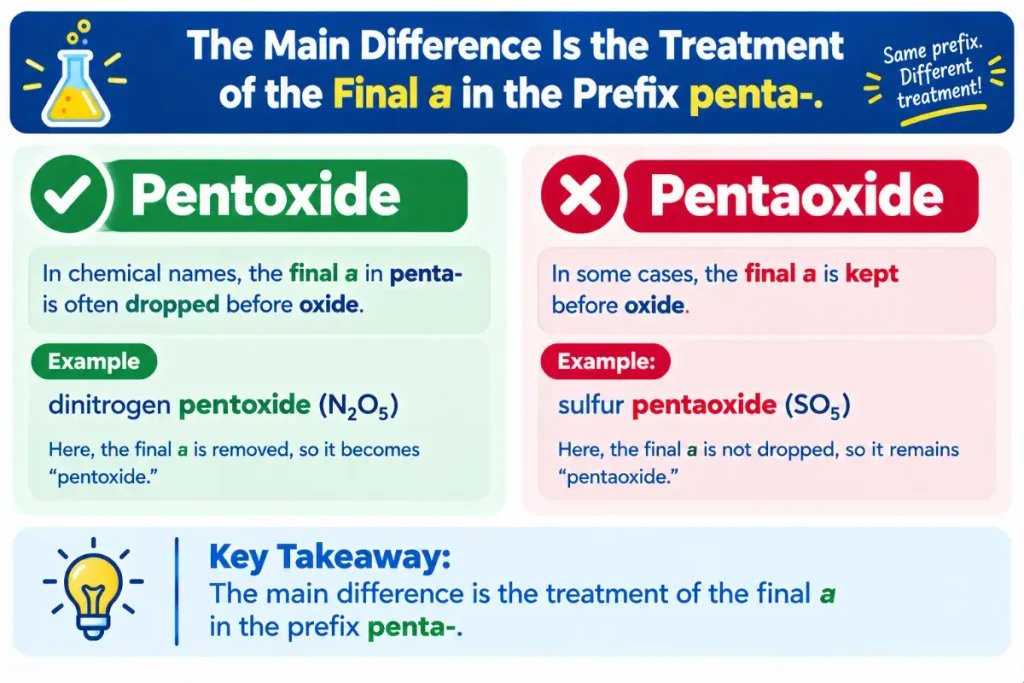
The main difference is the treatment of the final a in the prefix penta-.
| Feature | Pentoxide | Pentaoxide |
|---|---|---|
| Spelling | Omits the a | Retains the a |
| Naming tradition | Common, established form | Strict prefix-retention form |
| Chemical context | Common compound names and educational materials | Systematic compositional nomenclature |
| General meaning | Indicates five oxygen atoms in the relevant composition | Indicates five oxygen atoms in the relevant composition |
| Is it automatically incorrect? | No | No |
The most important point is that the choice is a matter of chemical nomenclature, not a simple right-versus-wrong spelling distinction.
How Do Chemical Prefixes Work?
Chemical prefixes indicate how many atoms of an element are represented in a molecular compound’s name. Learning the basic prefixes helps explain why the spelling of pentoxide and pentaoxide can differ.
| Number | Prefix | Example |
|---|---|---|
| 1 | Mono- | Carbon monoxide, CO |
| 2 | Di- | Carbon dioxide, CO₂ |
| 3 | Tri- | Sulfur trioxide, SO₃ |
| 4 | Tetra- | Dinitrogen tetroxide, N₂O₄ |
| 5 | Penta- | Dinitrogen pentoxide, N₂O₅ |
| 6 | Hexa- | Sulfur hexafluoride, SF₆ |
| 7 | Hepta- | Iodine heptafluoride, IF₇ |
| 8 | Octa- | Octasulfur, S₈, in elemental nomenclature |
These prefixes help distinguish compounds containing different numbers of atoms. The exact name must still follow the appropriate naming rules for the type of compound.
Why Is Monoxide Different?
Monoxide is a well-established exception to the general rule of retaining the final vowel of a numerical prefix.
For example, chemists call CO carbon monoxide, not carbon monooxide. Standard chemical naming follows this shortened form because chemists have established it through common usage.
This exception is one reason you should not assume that every chemical name follows the same vowel pattern.
Common Mistakes When Writing Pentoxide or Pentaoxide
Mistake 1: Calling Pentaoxide Always Incorrect
Incorrect claim: Pentaoxide is never acceptable.
Better explanation: Pentaoxide follows strict IUPAC compositional naming conventions, while pentoxide is a widely established conventional form.
Mistake 2: Calling Pentoxide Always Incorrect
Incorrect claim: Pentoxide is always a spelling error.
Better explanation: Pentoxide is common in established chemical names and introductory chemistry materials.
Mistake 3: Ignoring the Required Naming Convention
A chemistry assignment may require a particular systematic naming method. Using a familiar name when a strict compositional name is expected can lead to an answer that does not match the requested convention.
Tip: Follow your course’s stated naming rules, and use a consistent convention throughout your work.
Mistake 4: Confusing the Prefix With the Formula
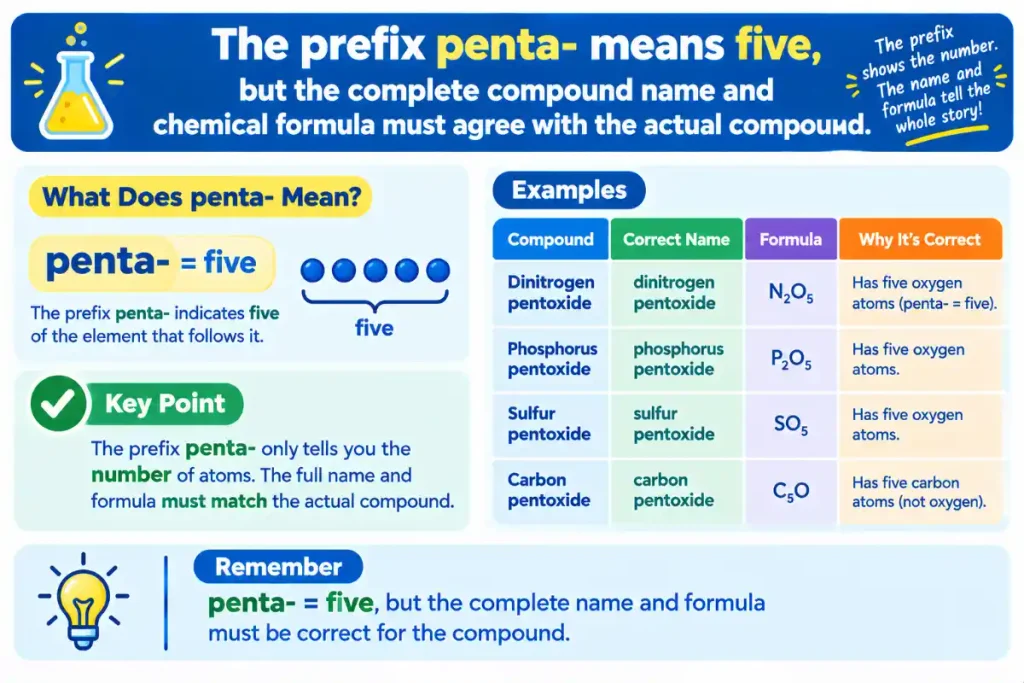
The prefix penta- means five, but the complete compound name and chemical formula must agree with the actual compound.
For N₂O₅, the name identifies two nitrogen atoms and five oxygen atoms. Do not assume that a name with penta- always tells you the total number of atoms in the entire molecule; it specifies the count associated with that prefix.
Conclusion
The difference between pentoxide vs pentaoxide comes down to chemical naming conventions. Pentoxide is a familiar and widely established form in chemical names, while pentaoxide follows the general IUPAC rule of retaining the final vowel in a numerical prefix. Neither form should be labeled universally incorrect without considering the naming system and context.
If you’re writing a school assignment, follow the convention your teacher or textbook requires. For formal chemical naming, consult the applicable IUPAC guidance. Remember that penta- means five, and use the compound’s formula to confirm that the name accurately represents its composition. Understanding this distinction will help you read chemical names more confidently and avoid treating a difference in nomenclature as a simple spelling mistake.
Frequently Asked Questions
1. Which is correct, pentoxide or pentaoxide?
Both forms are used in chemical naming. Pentoxide is common in established compound names, while pentaoxide follows strict IUPAC compositional nomenclature, which generally retains the final vowel of numerical prefix
2. Is pentaoxide a real word?
Yes. Pentaoxide is used in systematic chemical nomenclature. It is not simply an invented or universally incorrect spelling.
3. Why is pentoxide spelled without an a?
The form pentoxide reflects a traditional naming convention that drops the final a from penta- before oxide. It remains common in familiar chemical names.
4. What does the prefix penta- mean in chemistry?
The prefix penta- means five. In a compositional chemical name, it indicates five atoms of the element or component that follows it.
5. Is dinitrogen pentoxide the same as dinitrogen pentaoxide?
Yes. Both names can refer to N₂O₅. The difference is the naming convention used to handle the final vowel in penta-.
6. Should I use pentoxide or pentaoxide in a chemistry exam?
Use the naming convention taught in your course or specified in the exam instructions. If the question requires strict IUPAC compositional nomenclature, pentaoxide follows the general vowel-retention rule; many introductory courses and references use the familiar form pentoxide.
7. Is phosphorus pentoxide the same as phosphorus pentaoxide?
Both names are used for phosphorus oxide material commonly represented by the empirical formula P₂O₅. For precise chemical identification, consider the actual molecular formula and the naming convention required.
1 thought on “Pentoxide vs Pentaoxide: Which Spelling Is Correct?”