
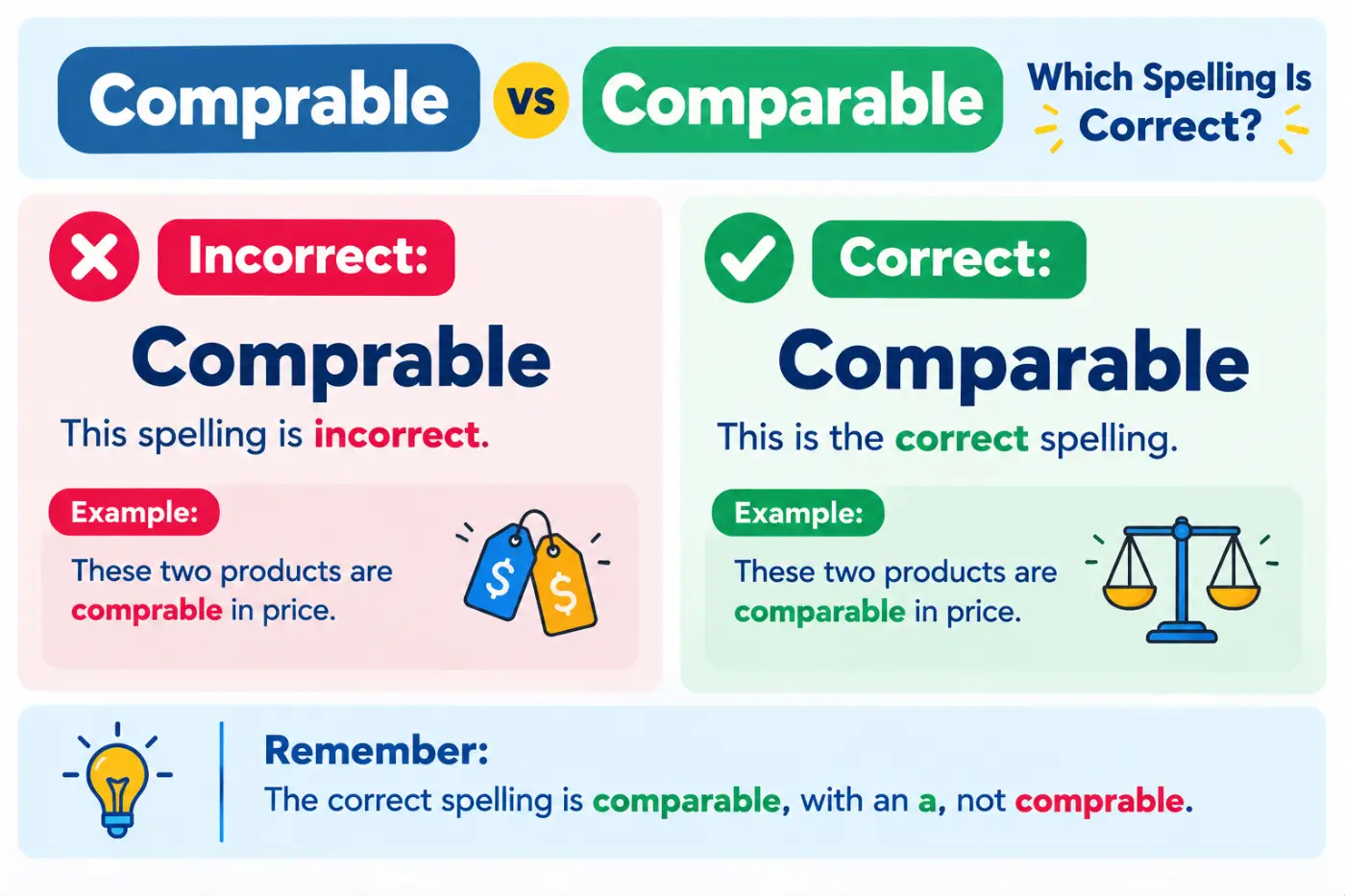
If you’re writing an email, school assignment, or product review, you might wonder whether comprable vs comparable is the correct spelling. The two words look similar, but only one is standard English.
Comparable is the correct spelling. Comprable is a misspelling and should not be used in standard American English. Comparable means similar enough to be compared, especially in terms of quality, size, value, or features.
For example, you might say, “The two laptops offer comparable performance.” This means their performance is similar enough to make a fair comparison.
The confusion usually happens because people accidentally leave out the letter a after the p in comparable. Below, you’ll learn the correct spelling, its meaning, how to use it in sentences, and how it differs from similar words such as similar, equivalent, and comparable’s commonly confused alternatives.
What Is the Difference Between Comprable and Comparable?
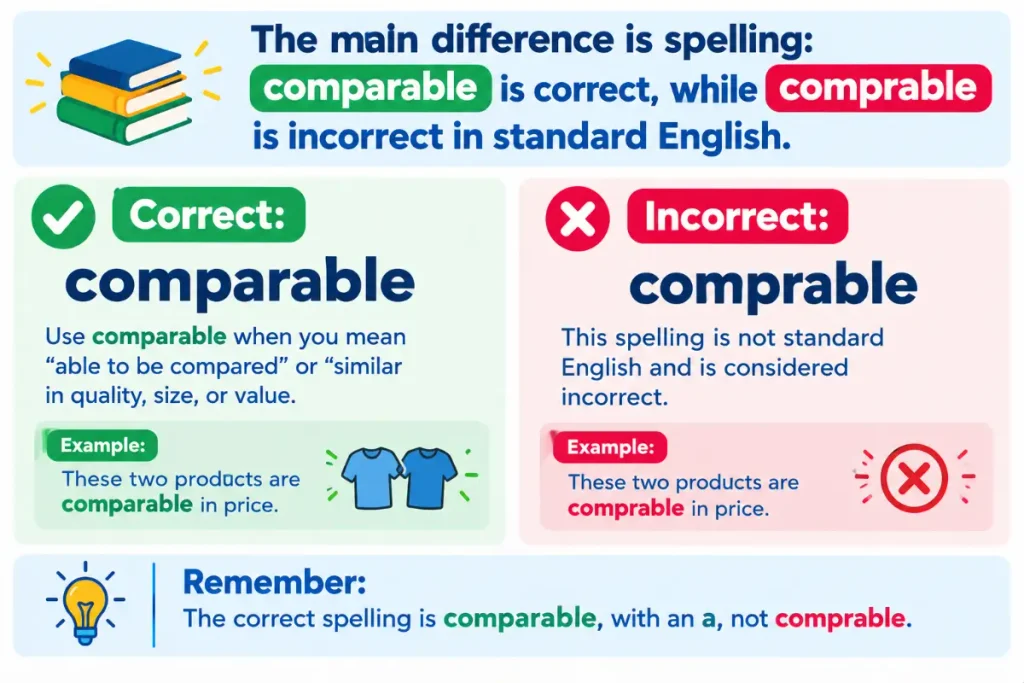
The main difference is spelling: comparable is correct, while comprable is incorrect in standard English.
| Word | Correct or Incorrect? | Meaning | Example |
|---|---|---|---|
| Comparable | Correct | Similar enough to be compared | These phones have comparable features. |
| Comprable | Incorrect | Misspelling of comparable | Incorrect: The two phones have comprable features. |
Use comparable in American English, British English, and other standard varieties of English. The spelling does not change between these varieties.
What Does Comparable Mean?
Comparable is an adjective that describes two or more things that are similar enough to compare meaningfully. The things do not have to be exactly alike. They only need to share relevant qualities, such as price, size, performance, quality, or experience.
For example:
- The two apartments have comparable rental prices.
- Her test score was comparable to her classmate’s score.
- The new phone offers comparable battery life.
- The two job offers include comparable benefits.
In each example, comparable highlights a similarity that makes a comparison useful.
Why Is Comprable Incorrect?
The word comprable leaves out the a that appears after the p in comparable.
The correct spelling follows this pattern:
- Compare + able = comparable
- Comprable = incorrect spelling
The base word is compare. When you form comparable, you retain the a in the word’s spelling. Remembering the connection to compare can help you avoid leaving out a letter.
How Do You Spell Comparable Correctly?
The correct spelling is C-O-M-P-A-R-A-B-L-E: comparable. A simple way to remember it is to start with the word compare. The adjective comparable shares the same spelling pattern at the beginning.
Follow these steps:
- Write the base word: compare.
- Recognize that the word relates to making a comparison.
- Add the ending -able to form comparable.
- Check that the a after p is present.
Here are related forms that can help reinforce the spelling:
| Word | Part of Speech | Example |
|---|---|---|
| Compare | Verb | We compare prices before buying a car. |
| Comparison | Noun | The comparison helped us choose a laptop. |
| Comparable | Adjective | The two laptops have comparable prices. |
| Comparably | Adverb | The products are comparably priced. |
| Comparability | Noun | The report examines the comparability of the results. |
These words belong to the same word family, but each serves a different grammatical purpose.
Examples of Comparable in Sentences
Seeing comparable in different contexts makes its meaning easier to understand. It commonly appears in discussions about prices, performance, education, business, and everyday decisions.
Here are 15 original examples.
Everyday Examples
- The two grocery stores offer comparable prices on most items.
- My old phone had comparable battery life to my new one.
- These jackets provide comparable warmth during cold weather.
- The two apartments have comparable amounts of living space.
- Their travel experiences were comparable in cost and length.
School and Education Examples
- The students earned comparable scores on the final exam.
- Both schools offer comparable opportunities for extracurricular activities.
- The two research projects produced comparable results.
- Her reading level is comparable to that of other students in her grade.
- The teacher selected comparable examples to explain the lesson.
Work and Business Examples
- The company offers salaries comparable to those of other local employers.
- We need comparable sales figures before evaluating the two stores.
- The new software delivers performance comparable to the older system.
- Both job candidates have comparable levels of experience.
- The revised proposal includes benefits comparable to those in the original agreement.
Notice that comparable does not mean the things are identical. It means they are similar in the specific way being discussed.
Comparable vs Similar: What’s the Difference?
Comparable and similar are close in meaning, but they emphasize different ideas. Similar means alike in some way. Comparable usually suggests that the things share enough relevant qualities to be compared meaningfully.
| Word | Meaning | Example |
|---|---|---|
| Comparable | Similar enough for a meaningful comparison | The two cars have comparable fuel efficiency. |
| Similar | Alike in some features or qualities | The two cars have similar designs. |
When Should You Use Comparable?
Use comparable when you want to evaluate or measure things against each other.
Examples:
- The two homes have comparable market values.
- The candidates have comparable work experience.
- These products offer comparable levels of protection.
The word often appears in business, academic, financial, and technical writing.
When Should You Use Similar?
Use similar when you simply want to point out a resemblance.
Examples:
- The sisters have similar interests.
- Your answer is similar to mine.
- The two paintings use similar colors.
Quick tip: Use similar for a general resemblance. Use comparable when the resemblance matters for a comparison or evaluation.
Comparable vs Equivalent: Which Word Is Better?
Comparable and equivalent can both describe relationships between things, but they do not mean exactly the same thing. Equivalent means equal in value, function, meaning, or effect for a particular purpose.
| Word | Main Meaning | Example |
|---|---|---|
| Comparable | Similar enough to compare | The two plans have comparable monthly costs. |
| Equivalent | Equal in value, function, or effect | The two payments are equivalent in value. |
For example, two smartphones may have comparable camera quality without offering identical features. However, two measurements may be considered equivalent if they represent the same quantity in different units. Use comparable when the things share important similarities. Use equivalent when you mean that they are equal or serve the same purpose under the relevant conditions.
Comparable vs Commensurate: How Are They Different?
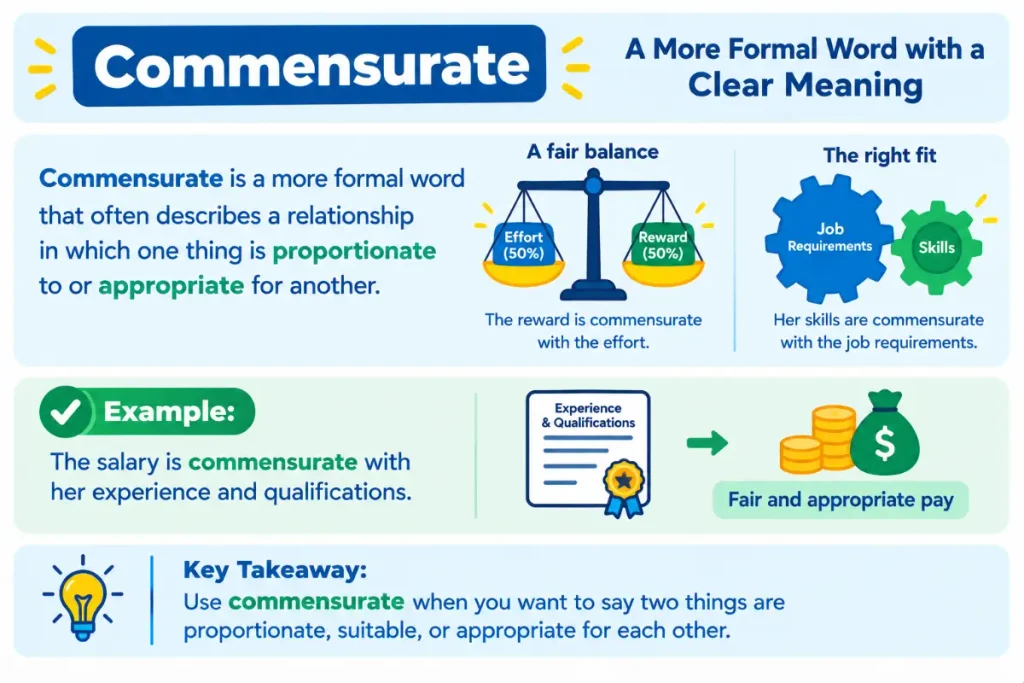
Commensurate is a more formal word that often describes a relationship in which one thing is proportionate to or appropriate for another.
| Word | Meaning | Example |
|---|---|---|
| Comparable | Similar enough to compare | The two positions offer comparable responsibilities. |
| Commensurate | Proportionate or appropriate in relation to something else | The salary should be commensurate with the responsibilities. |
For example, a job applicant might look for compensation comparable to that offered by similar employers. A company might also offer compensation commensurate with an employee’s experience and duties. The words overlap in some professional contexts, but they are not interchangeable in every sentence.
What Are Some Synonyms for Comparable?
Several words can replace comparable, depending on the intended meaning and context. Some emphasize general similarity, while others suggest closeness in value or function.
| Word or Phrase | Meaning | Example |
|---|---|---|
| Similar | Alike in some ways | The designs are similar. |
| Alike | Having common features | The rooms look alike. |
| Equivalent | Equal in value or function | The methods are equivalent. |
| Comparable in quality | Similar in standard | Both brands are comparable in quality. |
| Close | Similar in value or degree | Their scores were close. |
| Nearly equal | Almost the same in value | The bids were nearly equal. |
| Analogous | Similar in a relevant way | The process is analogous to the old method. |
| Matching | Closely corresponding | The stores offer matching prices. |
| On par with | At a similar level | The service is on par with its competitors. |
| Nearly identical | Almost exactly alike | The designs are nearly identical. |
Choose a synonym that matches the relationship you want to describe. For instance, nearly identical suggests a much closer match than comparable, while related may indicate a connection without implying that two things can be evaluated on the same basis.
Is Comparable Used Differently in American and British English?
No. Comparable is spelled the same way in American and British English. Both varieties use comparable to describe things that are similar enough to compare. The misspelling comprable is not a standard regional alternative.
Examples in American English:
- The two products have comparable prices.
- The company offers comparable employee benefits.
Examples in British English:
- The two products have comparable prices.
- The company offers comparable employee benefits.
You can use the same spelling in Canadian and Australian English as well.
Common Mistakes When Using Comparable
Writers sometimes misspell comparable or use it when another word would be more accurate. Understanding these common errors can help you write more clearly.
Mistake 1: Leaving Out the A
Incorrect: The two options are comprable in price.
Correct: The two options are comparable in price.
The correct spelling includes the a after the p.
Mistake 2: Treating Comparable as Identical
Incorrect: The two phones are comparable, so they must have exactly the same features.
Correct: The two phones have comparable performance, although their features differ.
Comparable things can differ in many ways. They only need to share relevant qualities for the comparison being made.
Mistake 3: Using Comparable When You Mean Equal
Unclear: The two payments are comparable in value.
More precise, if they have exactly the same value: The two payments are equivalent in value.
Comparable does not automatically mean equal. If exact equality matters, use equal or equivalent when appropriate.
Mistake 4: Using Comparable Without Naming the Relevant Quality
Vague: The two products are comparable.
Clearer: The two products are comparable in price and battery life.
Adding the specific quality helps readers understand the basis of the comparison.
Mistake 5: Confusing Comparable and Comparison
Incorrect: The comparable between the two reports was useful.
Correct: The comparison between the two reports was useful.
Comparable is an adjective, while comparison is a noun. Use comparison when referring to the act or result of comparing.
How to Remember the Correct Spelling of Comparable
Use these simple tips to remember comparable, not comprable.
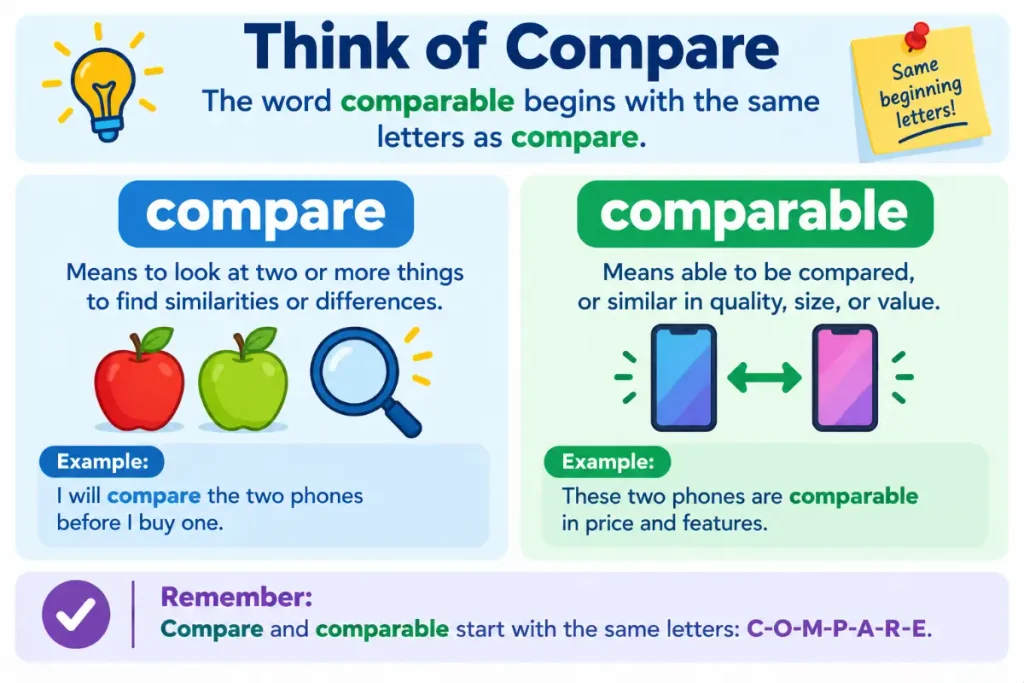
- Think of compare. The word comparable begins with the same letters as compare.
- Remember the missing-letter trap. Do not leave out the a after the p.
- Break the word into parts. Think of compare and the ending -able.
- Read it aloud. Saying “comparable” while spelling it can help reinforce the complete word.
- Practice with a sentence. Write, “These two products have comparable prices,” to remember both the spelling and meaning.
A useful memory sentence is: “I can compare two things when they are comparable.
Conclusion
The correct spelling is comparable, not comprable. The word describes things that are similar enough to compare in areas such as price, quality, performance, size, or value. It is commonly used in everyday conversation, school assignments, business reports, product reviews, and professional communication.
To avoid the spelling mistake, remember that comparable begins with the same letters as compare. Always include the a after the p. Also, choose your words carefully: similar describes a general resemblance, while equivalent suggests equality in value or function. Understanding these distinctions will help you use the correct spelling and express comparisons more clearly in your writing.
Frequently Asked Questions
Is comprable a real word?
No. Comprable is a misspelling of comparable and is not accepted as standard English. Use comparable in formal and informal writing.
How do you spell comparable correctly?
The correct spelling is comparable, spelled C-O-M-P-A-R-A-B-L-E. Remember to include the a after the p.
What does comparable mean?
Comparable means similar enough to be compared meaningfully. It often describes things that have similar prices, qualities, sizes, values, or performance.
Which is correct, comprable vs comparable?
Comparable is correct, while comprable is incorrect. The correct word contains an a after the p.
What is another word for comparable?
Depending on the context, alternatives include similar, equivalent, alike, analogous, and on par with. The best choice depends on whether you mean general similarity, equality, or a close match in quality.
Is comparable the same as equivalent?
No. Comparable means similar enough to compare, while equivalent means equal in value, function, meaning, or effect for a particular purpose.
Is comparable spelled differently in British English?
No. American and British English both use comparable. Comprable is not a standard spelling in either variety.
1 thought on “Comprable vs Comparable: Which Spelling Is Correct?”