
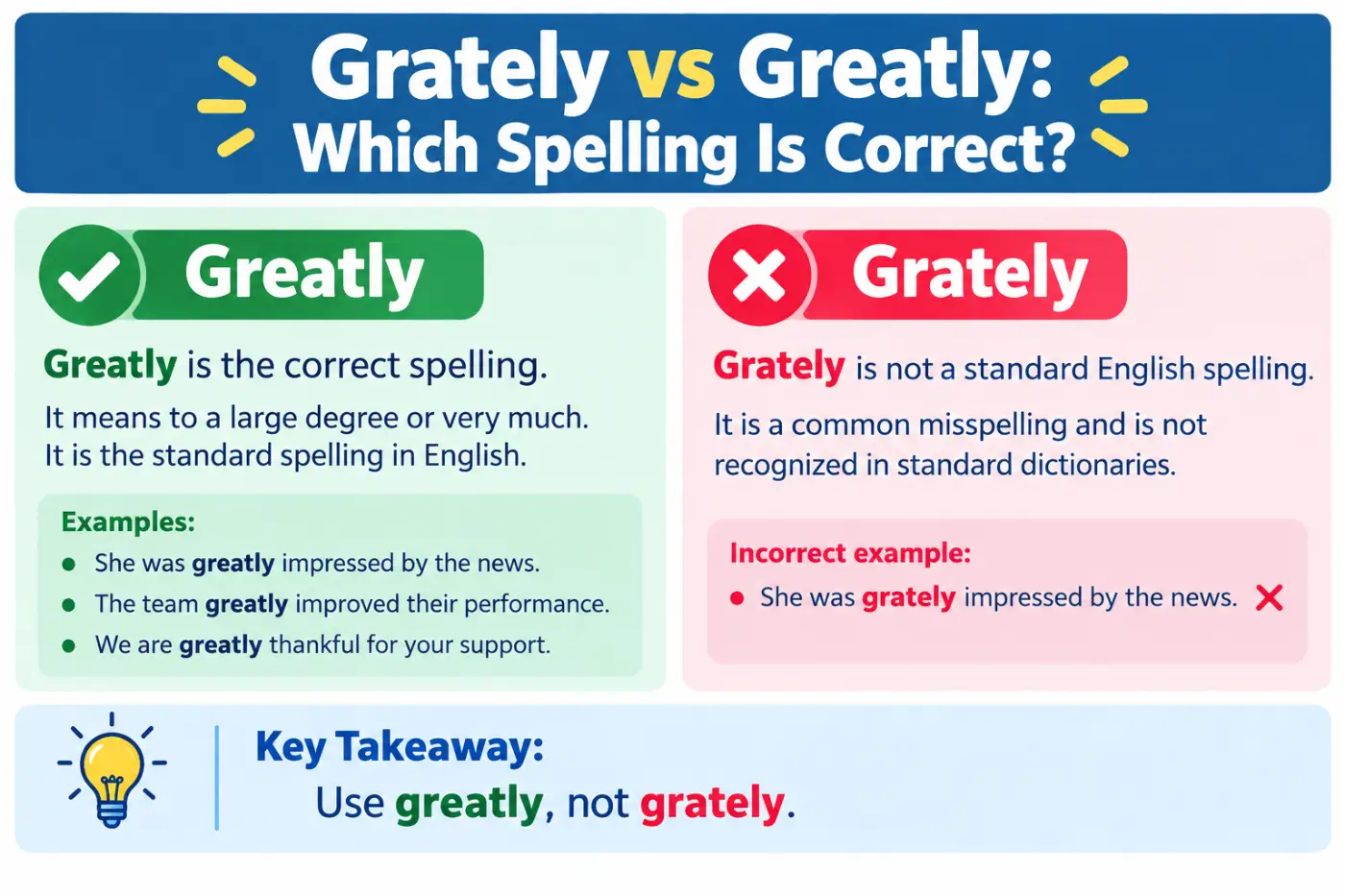
If you’re writing an email, school assignment, or professional message, you may wonder about grately vs greatly. The two words look similar, but only one is a standard English spelling.
Greatly is the correct spelling. It is an adverb that means very much, significantly, or to a large degree. Grately is a misspelling and should not be used in standard English writing. You can use greatly to describe changes, feelings, improvements, or the extent of an action. For example, “Your advice greatly improved my writing” means the advice improved the writing significantly.
Understanding why greatly is correct will help you avoid spelling errors in everyday conversations, academic assignments, and professional documents. This guide explains the meaning, spelling rules, examples, common mistakes, and related words.
Grately vs Greatly: What’s the Difference?
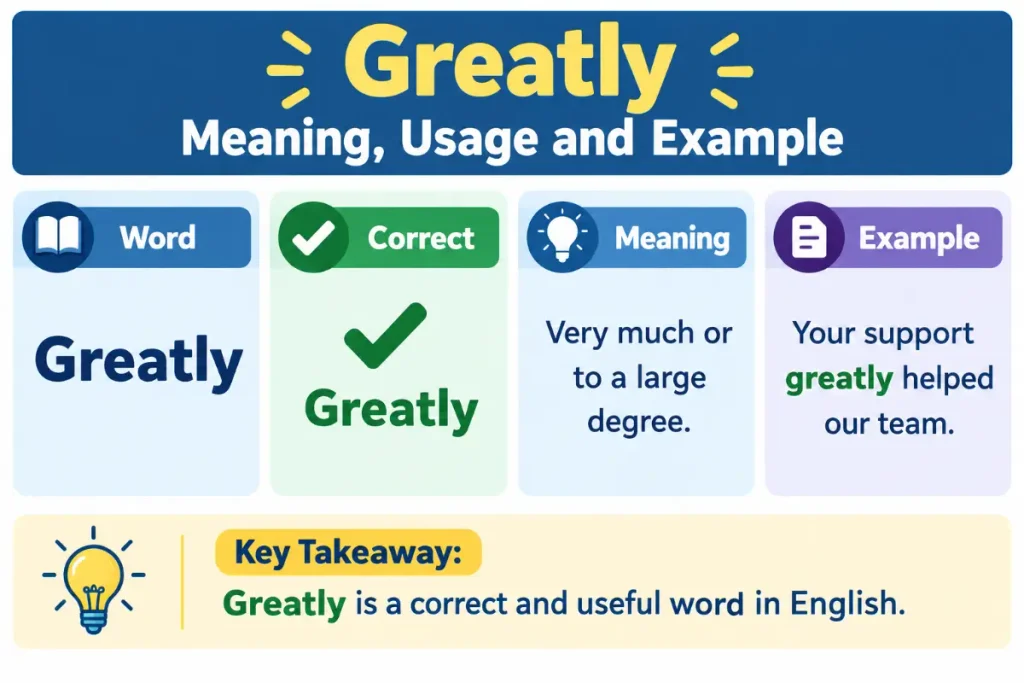
Greatly is the correct spelling, while grately is incorrect in standard English. The correct word comes from the adjective great and uses the suffix -ly to form an adverb. It describes the degree or extent of an action, change, or feeling.
| Word | Correct or Incorrect? | Meaning | Example |
|---|---|---|---|
| Greatly | Correct | Very much or to a large degree | Your support greatly helped our team. |
| Grately | Incorrect | Misspelling of greatly | Incorrect: Your support grately helped our team. |
Use greatly in American English, British English, and other standard varieties of English. There is no regional spelling difference between these forms.
What Does Greatly Mean?
Greatly means very much, considerably, or to a significant degree. It emphasizes the extent of an action, feeling, improvement, or change.
Here are some common uses:
- Significantly: The new system greatly reduced waiting times.
- Very much: I greatly appreciate your help.
- To a large degree: Her confidence has greatly improved.
- Considerably: The cost of repairs greatly exceeded our estimate.
- Strongly: The decision greatly influenced the final outcome.
The exact meaning depends on the sentence, but greatly generally emphasizes that something happened to a notable extent.
Why Is Grately Incorrect?
The spelling grately leaves out the second e in greatly. The correct word retains the full base word great before adding -ly.
The spelling pattern is:
- Great + ly = greatly
- Grate + ly = grately (not the standard spelling of the intended adverb)
Although grate is a real English word, it has a different meaning, such as shredding food or producing a harsh sound. It does not provide the correct spelling for the adverb meaning “very much.”
For example:
- Correct: The new schedule greatly improved productivity.
- Incorrect: The new schedule grately improved productivity.
How Do You Spell Greatly Correctly?
The correct spelling is greatly, with great followed by ly. To remember the spelling, write the adjective great first. Then add the suffix -ly to form the adverb.
| Word | Part of Speech | Example |
|---|---|---|
| Great | Adjective | We had a great experience. |
| Greatly | Adverb | We greatly enjoyed the experience. |
The adjective great describes a noun, while the adverb greatly usually modifies a verb, an adjective, or another adverb.
Why Does Great Become Greatly?
Many English adjectives form adverbs by adding -ly. The word great follows this pattern without changing its spelling.
Examples include:
- Great → greatly
- Careful → carefully
- Slow → slowly
- Quick → quickly
- Recent → recently
Notice that greatly keeps the complete spelling of great. You should not remove the second e or replace the ending with a different spelling.
Examples of Greatly in Real Sentences
The best way to learn a word is to see how people use it in different situations. These examples show how greatly works in everyday, academic, and professional English.
Everyday Examples
- I greatly enjoyed our family trip to California.
- Your kind words greatly lifted my spirits.
- The weather greatly affected our weekend plans.
- She greatly values the time she spends with her friends.
- Regular practice greatly improved his cooking skills.
School and Academic Examples
- Reading every day greatly improved the student’s vocabulary.
- The new teaching method greatly increased classroom participation.
- The research findings greatly influenced the final report.
- Better study habits can greatly improve academic performance.
- The discovery greatly expanded our understanding of the subject.
Work and Business Examples
- The updated software greatly reduced the time needed to process orders.
- Your feedback greatly helped us improve the presentation.
- The new training program greatly benefited our employees.
- Clear communication can greatly reduce workplace confusion.
- The company greatly expanded its customer service team.
Personal and Social Examples
- I greatly appreciate everything you’ve done for me.
- Her confidence has greatly increased since joining the debate club.
- The unexpected gift greatly surprised my sister.
- Their support greatly encouraged the volunteers.
- The experience greatly changed my perspective on teamwork.
In each sentence, greatly emphasizes the extent of an action, feeling, or change. It makes the meaning stronger without changing the basic action described by the verb.
Greatly vs Great: What’s the Difference?
Great is an adjective, while greatly is an adverb. They are related, but they serve different grammatical purposes. Use great to describe a person, place, thing, or experience. Use greatly to explain the degree to which an action or change occurs.
| Word | Part of Speech | Function | Example |
|---|---|---|---|
| Great | Adjective | Describes a noun | She gave a great presentation. |
| Greatly | Adverb | Modifies an action or describes extent | She greatly improved her presentation. |
When Should You Use Great?
Use great when describing the quality, size, importance, or extent of something.
Examples:
- We had a great time at the concert.
- She is a great teacher.
- The project was a great success.
When Should You Use Greatly?
Use greatly when explaining how much something happens or how strongly something affects a situation.
Examples:
- We greatly enjoyed the concert.
- She greatly influenced her students.
- The project greatly improved the company’s reputation.
Quick rule: If you’re describing a noun, great may be the right choice. If you’re describing the degree of an action or change, greatly may fit better.
Greatly vs Significantly: Which Word Is Better?
Greatly and significantly can have similar meanings. Both can describe a substantial change or effect, but their tone and use may differ. Greatly is a flexible word for general writing, while significantly often sounds more precise in formal, academic, or analytical contexts.
| Word | Meaning | Typical Use | Example |
|---|---|---|---|
| Greatly | Very much or to a large degree | Everyday and professional writing | The changes greatly improved the service. |
| Significantly | To an important or substantial degree | Formal, academic, and analytical writing | The changes significantly improved the results. |
Consider these examples:
- The new schedule greatly reduced delays.
- The new schedule significantly reduced delays.
- Her advice greatly influenced my decision.
- The findings significantly affected the research conclusions.
Both words can be correct in these contexts. However, significantly may carry a more specific meaning in statistical or scientific writing. In research, statistical significance has a technical meaning that should not be confused with a large or important effect.
Greatly vs Highly: What’s the Difference?
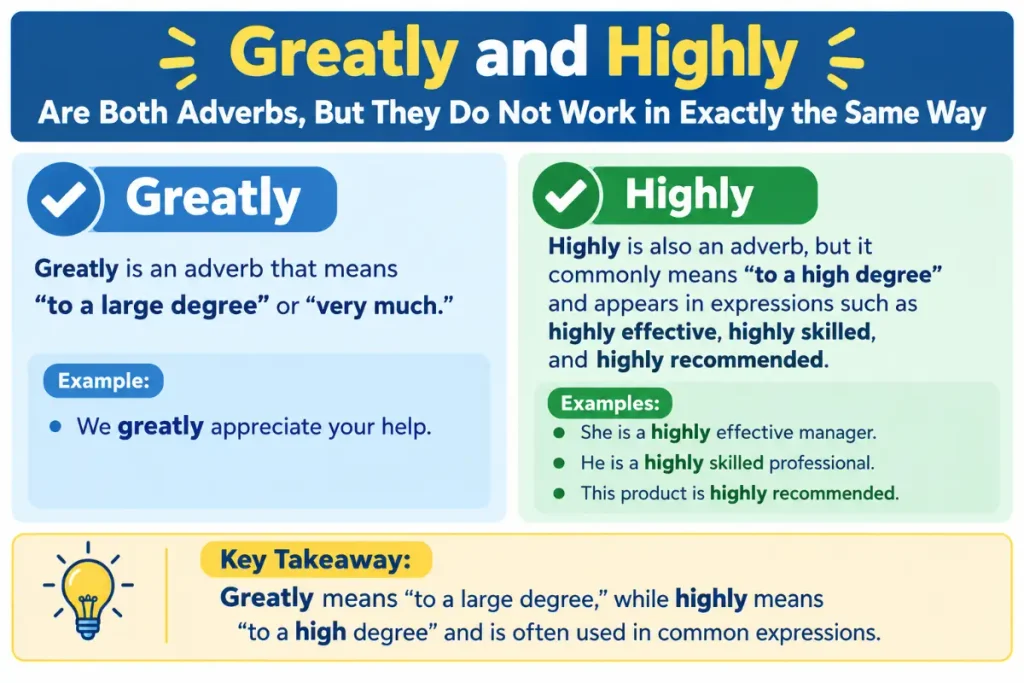
Greatly and highly are both adverbs, but they do not work in exactly the same way. Highly commonly means to a high degree and appears in expressions such as highly effective, highly skilled, and highly recommended.
| Word | Common Use | Example |
|---|---|---|
| Greatly | Emphasizes the extent of an action or change | The new policy greatly improved safety. |
| Highly | Emphasizes a high level, quality, or degree | The new policy was highly effective. |
More examples:
- I greatly appreciate your patience.
- She is highly skilled at solving problems.
- The experience greatly changed his outlook.
- The book is highly recommended for beginners.
Although the words sometimes overlap, they are not always interchangeable. You would normally say “I greatly appreciate your help,” rather than “I highly appreciate your help,” because the first expression sounds more natural in standard English.
What Are Some Synonyms for Greatly?
Several words and phrases can replace greatly, depending on the context. The best alternative depends on whether you’re describing an improvement, an effect, a feeling, or the extent of an action.
| Word | Meaning | Example |
|---|---|---|
| Significantly | To a large degree | Costs significantly decreased. |
| Considerably | By a large amount | Her confidence considerably increased. |
| Substantially | To an important degree | Changes substantially improved performance. |
| Remarkably | In a noticeable way | Her skills remarkably improved. |
| Dramatically | In a major way | Sales dramatically increased. |
| Exceptionally | To an unusually high degree | The team performed exceptionally well. |
| Profoundly | Deeply or strongly | The experience profoundly affected him. |
| Extensively | To a great extent | The issue was extensively discussed. |
| Immensely | To a very great degree | We immensely enjoyed the visit. |
| Tremendously | By a very large amount | The program tremendously helped the community. |
Some alternatives fit only certain contexts. For example, deeply works well with feelings, while dramatically often describes a major change. Extensively usually refers to breadth or scope rather than emotional intensity. Choose a synonym that matches the meaning you want to convey instead of replacing greatly automatically.
Common Mistakes When Using Greatly
The spelling error grately is common enough to cause confusion, but writers can also misuse greatly in sentences.
Mistake 1: Writing Grately Instead of Greatly
Incorrect: We grately appreciate your support.
Correct: We greatly appreciate your support.
Why: The standard spelling retains the complete base word great before adding -ly.
Mistake 2: Using Greatly to Describe a Noun Directly
Incorrect: She is a greatly teacher.
Correct: She is a great teacher.
Why: The adjective great describes the noun teacher. The adverb greatly does not perform that role.
Mistake 3: Using Highly When Greatly Sounds More Natural
Less natural: I highly appreciate your help.
More natural: I greatly appreciate your help.
Why: English uses certain adverb-verb combinations more naturally than others. Greatly appreciate is a common, natural expression.
Mistake 4: Using Greatly Without a Clear Meaning
Vague: The project greatly changed.
Clearer: The project greatly improved the way our team tracks expenses.
Why: The second sentence explains the nature of the change. Adding context makes the statement more useful.
Mistake 5: Confusing Greatly With Greatly Appreciated
Both forms can be correct in different sentence structures.
- Active: I greatly appreciate your help.
- Passive: Your help is greatly appreciated.
In the first sentence, greatly modifies appreciate. In the second, it modifies appreciated. Both express a strong level of appreciation.
Is Greatly Used Differently in American and British English?
No. Greatly is the standard spelling in both American and British English. Unlike words such as color and colour, which have regional spelling differences, greatly does not change spelling based on location.
| Variety of English | Correct Spelling | Example |
|---|---|---|
| American English | Greatly | The change greatly improved the service. |
| British English | Greatly | The change greatly improved the service. |
| Canadian English | Greatly | The change greatly improved the service. |
| Australian English | Greatly | The change greatly improved the service. |
If you’re writing for an American audience, use greatly in school assignments, resumes, professional emails, reports, and online content. The same spelling works for readers in other English-speaking regions.
Easy Ways to Remember the Correct Spelling
If you often confuse grately and greatly, use these simple techniques to remember the correct form.
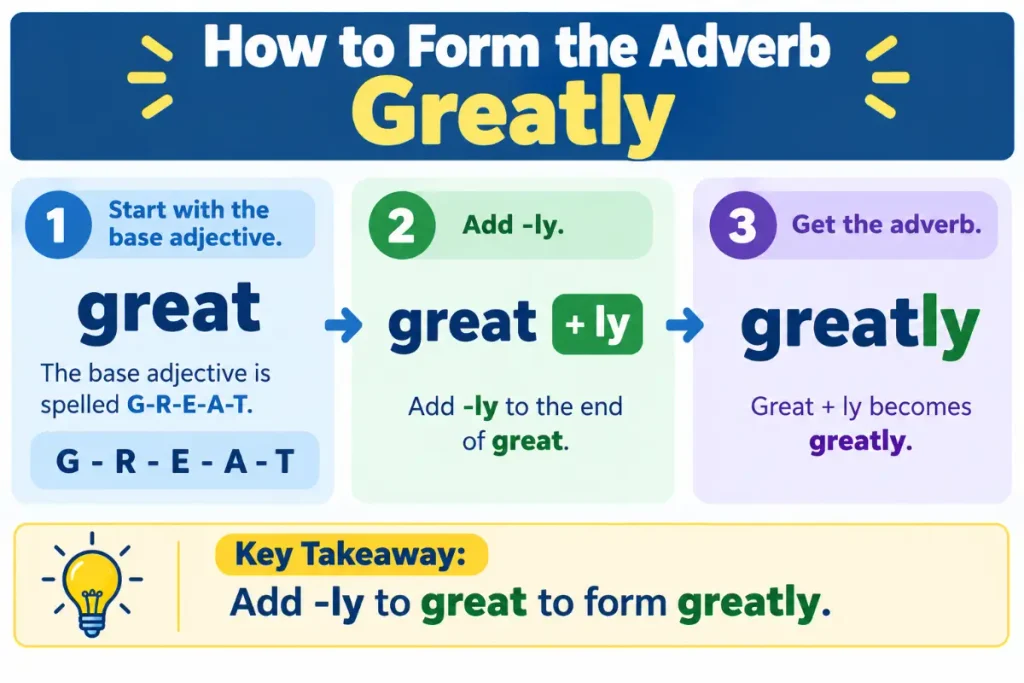
- Start with great. The base adjective is spelled G-R-E-A-T.
- Add -ly. Great + ly becomes greatly.
- Keep both e’s. Do not remove the second e from great.
- Connect it with a familiar phrase. Remember “I greatly appreciate your help.”
- Check the meaning. If you mean “very much” or “to a large degree,” the word you need is usually greatly.
The easiest rule is to remember that great + ly = greatly.
Conclusion
The correct spelling is greatly, not grately. Although the two forms look similar, only greatly is accepted in standard English when you mean very much, significantly, or to a large degree. It works naturally in everyday conversations, academic assignments, business emails, and professional reports.
Remember that greatly comes from the adjective great with the suffix -ly. Keeping the complete base word makes the spelling easy to understand and remember. You can also use alternatives such as significantly, considerably, or substantially when they better match your intended meaning. Whenever you’re unsure about grately vs greatly, choose greatly to keep your writing clear, accurate, and professional.
Frequently Asked Questions
1. Which is correct, grately or greatly?
Greatly is correct. Grately is a misspelling and should not be used in standard English writing.
2. How do you spell greatly?
Spell it G-R-E-A-T-L-Y. It comes from the adjective great with the suffix -ly added.
3. What does greatly mean?
Greatly means very much, considerably, or to a large degree. For example, “The new system greatly improved efficiency” means the system improved efficiency significantly.
4. Is grately a real English word?
No, grately is not a standard English word with the intended meaning of “very much.” The correct spelling is greatly.
5. Can I use greatly in formal writing?
Yes. Greatly is suitable for academic papers, business reports, professional emails, and other formal writing. For example, “The findings greatly contributed to our understanding of the issue.”
6. What is another word for greatly?
Common alternatives include significantly, considerably, substantially, profoundly, and immensely. The best choice depends on the sentence and the degree of emphasis you want.
7. Why do people confuse grately and greatly?
The words look similar, and the second e in greatly is easy to overlook when typing quickly. Remembering the base word great helps you retain the correct spelling.
1 thought on “Grately vs Greatly: Which Spelling Is Correct?”