
If you’re writing an email and want to tell someone you’ll contact them later, you may wonder whether to write “touchbase” or “touch base.” The confusion is common because the phrase sounds like one word when spoken.
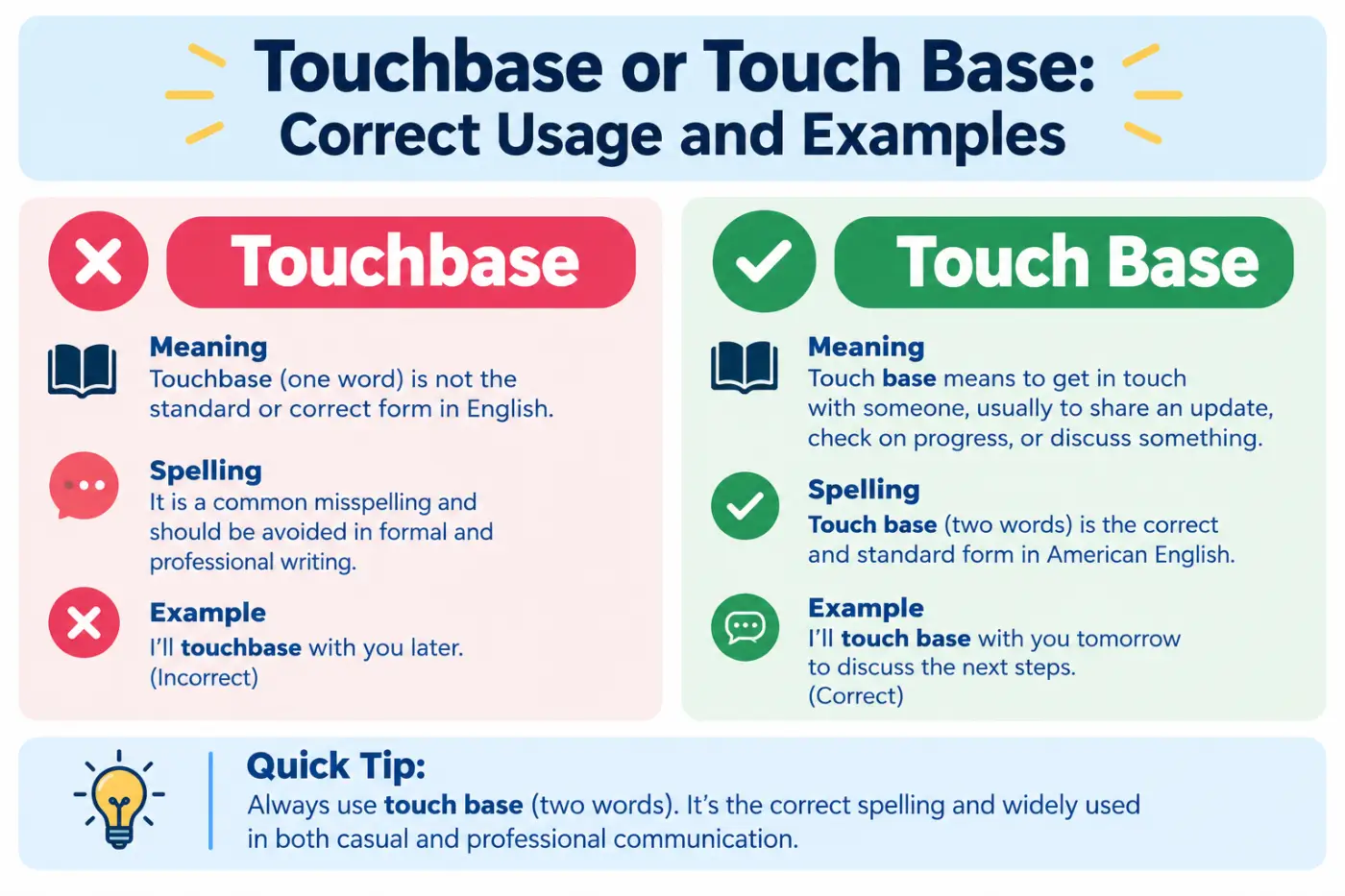
The correct form in standard American English is touch base—two words. “Touchbase” is generally considered incorrect when you use the expression as a verb.
“Touch base” means to contact someone briefly, usually to share information, check progress, or discuss something.
This guide explains the meaning of touch base, why the spelling causes confusion, how to use it correctly, and which alternatives work best in professional and everyday communication.

What Does “Touch Base” Mean?
“Touch base” is an informal or conversational expression that means to contact someone briefly. The purpose is usually to exchange information, ask for an update, confirm something, or discuss a matter.
For example:
I’ll touch base with you tomorrow about the project.
Here, the speaker means that they will contact the other person tomorrow to discuss the project. The phrase can describe communication through several methods, including:
- Phone calls
- Text messages
- Video meetings
- In-person conversations
- Workplace messaging apps
The phrase does not usually imply a long conversation. It often suggests a quick check-in.
Simple definition of touch base
Touch base means to contact or communicate with someone briefly, usually to discuss an issue or get an update.
Touchbase or Touch Base: Which Is Correct?
“Touch base” is the correct standard spelling when you’re using the phrase as a verb.
| Form | Correct? | Example |
|---|---|---|
| touch base | Yes | I’ll touch base with Sarah tomorrow. |
| touchbase | No, in standard usage | I’ll touchbase with Sarah tomorrow. |
| touched base | Yes | I touched base with the manager. |
| touching base | Yes | I’m touching base about the schedule. |
| touches base | Yes | She touches base with her team every Friday. |
The key rule is simple: write touch base as two separate words. Touchbase” sometimes appears in informal writing, usernames, business names, or other special contexts, but it is not the standard spelling of the common English expression.
Why Is “Touch Base” Sometimes Written as One Word?
The confusion comes mainly from pronunciation. When people say “touch base” quickly, the two words can sound almost like a single unit. English also contains many phrases that have changed from two words into one word over time. For example, “website” and “notebook” are now established compounds. That pattern can make people assume that “touch base” should also become “touchbase.” However, standard usage has retained the two-word form. Another reason is workplace communication. “Touch base” appears frequently in emails, meetings, and business conversations, so people often see or hear it without thinking about its individual words.
For standard American English, use:
- “Let’s touch base next week.”
- “I’ll touch base with you later.”
- “Can we touch base about the budget?”
Avoid:
- “Let’s touchbase next week.”
- “I’ll touchbase with you later.”
- “Can we touchbase about the budget?”
How Do You Use “Touch Base” in a Sentence?
“Touch base” usually works as a verb phrase. You can change the tense depending on when the communication happens.
Present tense
Use “touch base” or “touches base” for regular or current actions.
- I touch base with my supervisor every Monday.
- She touches base with the sales team each morning.
- We usually touch base before the meeting.
Past tense
Use “touched base” for an action that already happened.
- I touched base with John yesterday.
- We touched base about the new schedule.
- She touched base with her teacher after class.
Future tense
Use “will touch base” when the communication will happen later.
- I’ll touch base with you tomorrow.
- We will touch base after the interview.
- I’ll touch base with the team next week.
Present continuous
Use “touching base” when describing an ongoing or planned action.
- I’m touching base about your application.
- We’re touching base with the client this afternoon.
- She’s touching base with the department manager.
Examples of “Touch Base” in Real Sentences
Here are natural examples from everyday, school, and workplace situations.
- I’ll touch base with you tomorrow about the schedule.
- Can we touch base after lunch?
- I wanted to touch base about your recent email.
- She touched base with her manager before making the decision.
- Let’s touch base next week and review the results.
- I’ll touch base with the team before the presentation.
- We touched base yesterday to discuss the new deadline.
- He plans to touch base with his professor after class.
- I’ll touch base once I have more information.
- The sales manager touches base with each employee every Friday.
- We should touch base before submitting the application.
- Thanks for touching base and keeping me updated.
- I just wanted to touch base about tomorrow’s meeting.
- Let’s touch base later if you have any questions.
- She touched base with her friend before making travel plans.
These examples show that the expression works in both professional and casual situations.
“Touch Base With” vs. “Touch Base About”
Two common structures are “touch base with” and “touch base about.” They serve different purposes.
Touch base with someone
Use “touch base with” to identify the person you are contacting.
I’ll touch base with my manager tomorrow.
Here, “my manager” is the person being contacted.
Touch base about something
Use “touch base about” to identify the subject of the conversation.
I’ll touch base about the project tomorrow.
You can also use both:
I’ll touch base with my manager about the project tomorrow.
This structure is especially common in professional communication.
Is “Touch Base” Formal or Informal?
“Touch base” is widely understood in American English, but it has a conversational and somewhat informal tone.
It works well in:
- Workplace emails
- Team messages
- Internal business communication
- Friendly professional conversations
- Text messages
- Everyday conversations
It may sound less appropriate in highly formal writing, such as a legal document, academic paper, or formal report. In those situations, a more direct verb can make the sentence clearer.
For example:
Conversational:
I wanted to touch base about the report.
More direct:
I wanted to discuss the report.
The choice depends on your audience and purpose.
Is “Touch Base” Appropriate in a Professional Email?
Yes. “Touch base” is common in American workplace communication, especially when the writer wants to suggest a brief conversation or check-in.
For example:
Hi Mark,
I wanted to touch base about the upcoming presentation. Could we talk sometime tomorrow?
This sounds natural in many workplaces.
However, don’t use the phrase simply because it sounds professional. A direct verb can often make an email clearer.
Compare:
I wanted to touch base regarding the schedule.
with:
I wanted to discuss the schedule.
The second version is shorter and more specific. Both can be correct.
For a more formal email
Consider these alternatives:
- I wanted to discuss…
- I wanted to follow up on…
- I would like to review…
- I wanted to check on…
- I would like to speak with you about…
- I am writing regarding…
These choices are often better when communicating with someone outside your organization or in a particularly formal setting.
Touch Base or Follow Up
“Touch base” and “follow up” can have similar meanings, but they aren’t always interchangeable.
Follow up” often means taking another action after an earlier conversation, request, event, or message.
| Phrase | Main idea | Example |
|---|---|---|
| Touch base | Make brief contact | I’ll touch base with you tomorrow. |
| Follow up | Continue or act on something previously discussed | I’ll follow up on your request tomorrow. |
For example:
I’ll touch base with Maria tomorrow.
This simply means you’ll contact Maria.
I’ll follow up with Maria tomorrow.
This suggests that you’re continuing something that happened earlier.
Touch Base or Check In
“Check in” is another close alternative.
Check in” often sounds more natural in casual conversation, while “touch base” is especially common in workplace communication.
Compare:
I’ll check in with you tomorrow.
I’ll touch base with you tomorrow.
Both can mean that you’ll contact the person tomorrow.
“Check in” can also suggest asking about someone’s condition or progress:
I wanted to check in and see how you’re doing.
“Touch base” more often focuses on exchanging information or discussing a specific matter:
I wanted to touch base about the project.
Touch Base or Get in Touch
“Get in touch” means to contact someone, but it does not necessarily suggest a brief conversation.
For example:
Please get in touch if you have any questions.
This simply asks the person to contact you.
By contrast:
Let’s touch base next week.
This usually suggests a planned conversation or check-in. Get in touch” can also sound more neutral and direct, making it useful when you don’t want the workplace feel that “touch base” can sometimes have.
Better Alternatives to “Touch Base”
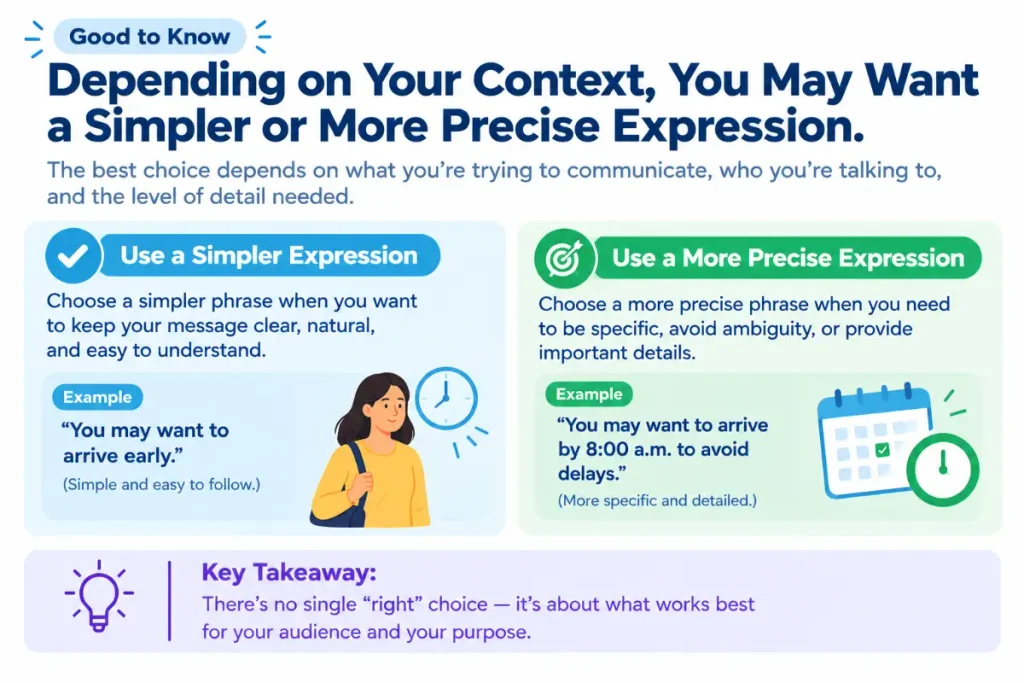
Depending on your context, you may want a simpler or more precise expression.
| Alternative | Tone | Example |
|---|---|---|
| Contact | Neutral | I’ll contact you tomorrow. |
| Get in touch | Neutral | Please get in touch if you need help. |
| Check in | Casual | I’ll check in tomorrow. |
| Follow up | Professional | I’ll follow up next week. |
| Talk | Casual | Let’s talk tomorrow. |
| Speak | Neutral | I’d like to speak with you. |
| Discuss | Professional | I’d like to discuss the report. |
| Connect | Professional | Let’s connect next week. |
| Reach out | Professional/casual | I’ll reach out tomorrow. |
| Communicate | Formal | We need to communicate regularly. |
| Consult | Formal | I’ll consult with the team. |
| Confer | Formal | The managers will confer before deciding. |
| Review | Professional | Let’s review the proposal tomorrow. |
| Meet | Neutral | Let’s meet next week. |
| Follow through | Professional | I’ll follow through on the request. |
The best choice depends on what you actually mean. If you mean “contact someone briefly,” “check in” may be more natural. If you mean “talk about a specific subject,” “discuss” is often clearer.
“Touch Base” for Work Emails
Workplace emails often use this phrase to introduce a request for a conversation.
Friendly professional
I wanted to touch base about the project timeline. Do you have a few minutes this afternoon?
Direct and professional
I’d like to discuss the project timeline. Are you available this afternoon?
Formal
I would like to discuss the project timeline and review the next steps.
All three versions can work. The best option depends on your relationship with the recipient and the level of formality required.
“Touch Base” in Texting and Casual Conversation
The phrase is not limited to business settings. People also use it in casual communication.
For example:
I’ll touch base with you later.
Let’s touch base when you get home.
I’ll touch base after I hear back from them.
That said, “touch base” can sometimes sound more businesslike than necessary in a personal text. A friend might naturally say:
I’ll text you later.
or:
I’ll call you later.
Simple wording is often the best wording.
Is “Touchbase” Ever Correct?
For the standard English expression, no. If you mean the verb phrase that means “contact someone briefly,” write “touch base” as two words. You may occasionally see “touchbase” used as a brand name, username, product name, or other proper name. Those special uses do not change the standard spelling of the expression.
So if you’re writing a normal sentence, use:
Let’s touch base tomorrow.
Not:
Let’s touchbase tomorrow.
Common Mistakes With “Touch Base”
Mistake 1: Writing “touchbase”
Incorrect:
I’ll touchbase with you tomorrow.
Correct:
I’ll touch base with you tomorrow.
The phrase contains two words.
Mistake 2: Using the wrong past tense
Incorrect:
I touch based with her yesterday.
Correct:
I touched base with her yesterday.
The past tense applies to “touch,” while “base” stays unchanged.
Mistake 3: Adding an unnecessary preposition
People sometimes write unnecessarily complicated versions such as:
I’ll touch base in regards to the project.
A simpler option is:
I’ll touch base about the project.
Or:
I’ll discuss the project with you.
Mistake 4: Using it when a more precise verb is available
“Touch base” is broad. If you know exactly what you want to do, a specific verb can improve your sentence.
Instead of:
I wanted to touch base about the report.
You could write:
I wanted to review the report.
Or:
I wanted to discuss the report.
Mistake 5: Assuming it always means a long meeting
“Touch base” generally suggests brief communication. If you need a detailed meeting, “meet to discuss” or “schedule a meeting” may communicate your intention more clearly.
Is “Touch Base” an Idiom?
Yes. “Touch base” is an idiomatic expression because its meaning is not simply the literal combination of “touch” and “base.” A literal interpretation would involve physically touching a base. In the idiomatic expression, however, it means to make contact or communicate with someone. The phrase is especially familiar in American English and is common in workplace communication.
Where Did the Phrase “Touch Base” Come From?
“Touch base” is generally associated with baseball. In baseball, a runner must touch the bases while moving around the field. The modern expression developed from that sports-related idea and came to mean making contact or checking in with someone. Today, you don’t need to know the baseball connection to understand the phrase. It functions as an established idiom in everyday American English.
American English vs. British English
“Touch base” is used in both American and British English. The spelling remains the same: touch base. The phrase is particularly common in American business communication, but British speakers also use it. There is no standard American-versus-British spelling difference such as the differences found in words like “color” and “colour.” The important point is that “touch base” should remain two words in standard usage.
Can You Use “Touch Base” in an Essay?
You can, but it depends on the type of essay. In an informal or personal essay, “touch base” may be perfectly natural. In academic writing, a more precise phrase is often preferable.
For example:
The researchers touched base with participants before the next stage.
This may be understandable, but a more formal version could be:
The researchers contacted the participants before the next stage.
Academic writing generally benefits from direct, specific language.
Can You Use “Touch Base” on a Resume?
It’s usually better to avoid the phrase on a resume unless it appears in a specific context that requires it.
Instead of saying:
Touched base with clients about project updates.
You could write:
Communicated with clients about project updates.
Or:
Coordinated project updates with clients.
Resume language works best when it clearly describes an action and its purpose.
A Simple Rule to Remember
If you’re unsure about “touchbase or touch base,” remember this:
Touch base = two words.
Think of it as a verb phrase:
touch + base
The tense changes the first word:
- touch base
- touched base
- touching base
- touches base
But “base” does not become attached to “touch.”
Quick Comparison: Correct and Incorrect Forms
| Incorrect | Correct |
|---|---|
| touchbase | touch base |
| touchbased | touched base |
| touchingbase | touching base |
| touchesbase | touches base |
| I’ll touchbase later. | I’ll touch base later. |
| We touchbased yesterday. | We touched base yesterday. |
When in doubt, keep the two words separate.

When Should You Use “Touch Base”?
Use “touch base” when you want to say that you will make brief contact with someone, especially to discuss a topic, exchange information, or check progress.
It works particularly well when:
- You already know the person.
- You expect a short conversation.
- You are checking progress.
- You need to discuss a specific matter.
- You’re communicating in a workplace or casual setting.
Choose a different expression when you need to be more precise.
For example:
- Use “contact” for a neutral description.
- Use “follow up” when continuing an earlier matter.
- Use “discuss” when you want to focus on a topic.
- Use “check in” for a friendly or casual check.
- Use “meet” when you specifically mean an appointment or meeting.
Conclusion
When deciding between touchbase or touch base, choose “touch base.” The standard expression is written as two words and means to contact someone briefly, usually to discuss an issue, exchange information, or check progress.
“Touch base” works naturally in many American English conversations and workplace emails. However, it isn’t always the clearest choice. Depending on your meaning, words such as “discuss,” “follow up,” “check in,” or “contact” may communicate your idea more directly.
The easiest rule is to remember that “touch” carries the verb tense: touch base, touched base, and touching base. Keep “base” separate, and you’ll have the standard form every time.
Frequently Asked Questions
Is “touchbase” one word or two?
“Touch base” is two words. “Touchbase” is not the standard spelling of the common English expression.
Is “touch base” correct English?
Yes, “touch base” is correct English. It means to contact someone briefly, usually to exchange information or discuss something.
What does “touch base” mean in a text?
In a text, “touch base” usually means to contact or talk to someone briefly. For example, “I’ll touch base later” means “I’ll contact you later.”
Is “touch base” formal or informal?
“Touch base” is generally conversational and somewhat informal. It works well in many professional settings, but more direct words such as “discuss,” “contact,” or “follow up” may suit highly formal writing better.
What’s another way to say “touch base”?
Common alternatives include “check in,” “contact,” “get in touch,” “follow up,” “connect,” “reach out,” and “discuss.” The best alternative depends on the exact meaning and context.
Which is correct, “touchbase or touch base”?
“Touch base” is correct when you’re using the expression as a verb. Write it as two words in standard American English.
Can I say “touched base”?
Yes. “Touched base” is the correct past-tense form. For example, “I touched base with my manager yesterday.”
2 thoughts on “Touchbase or Touch Base: Correct Usage and Examples”