
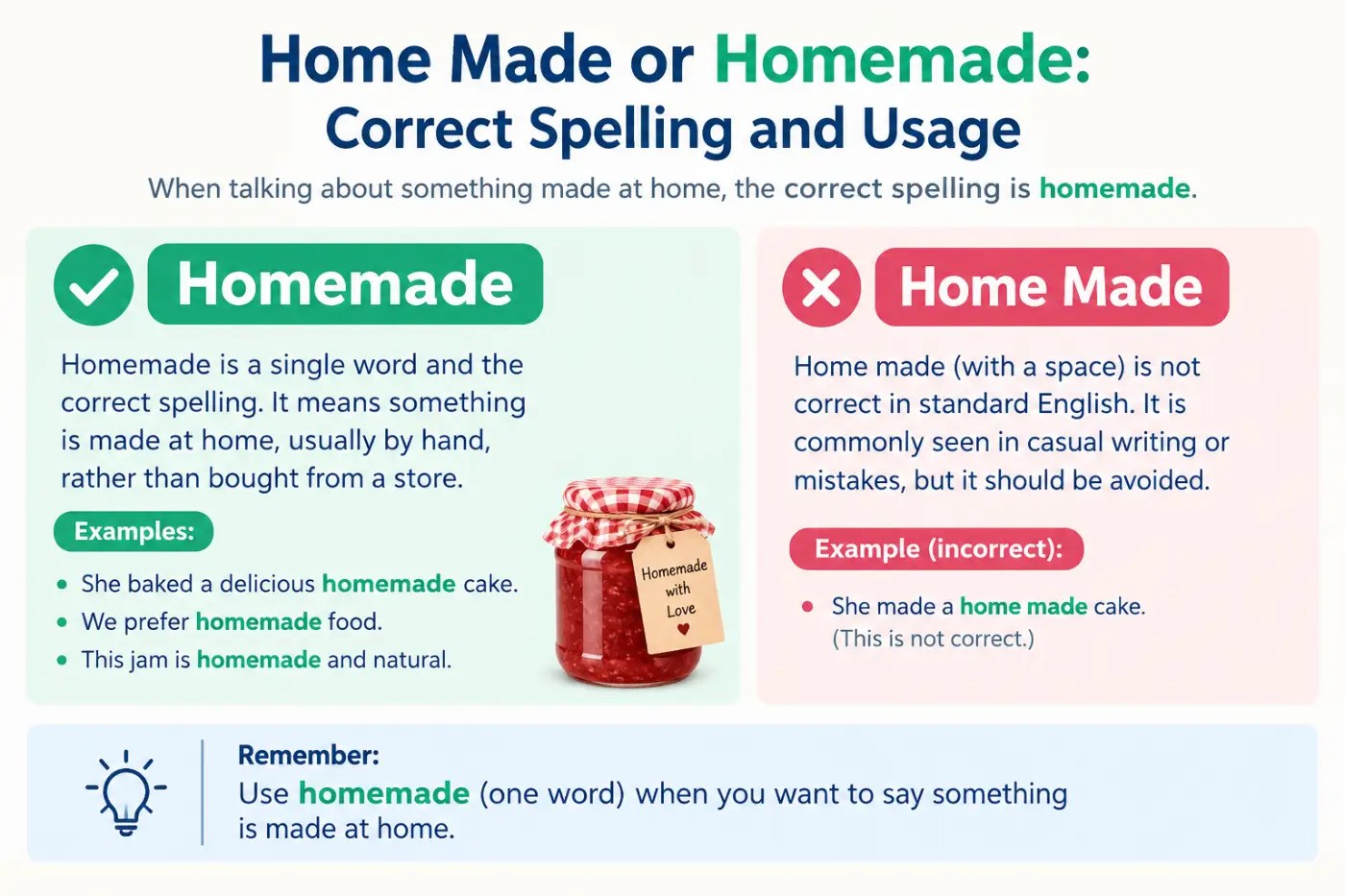
If you’re writing a recipe, product description, text message, or social media post, you may wonder whether to write home made or homemade. The two forms look almost identical, but standard American English strongly favors one spelling.
Homemade is the standard and most common spelling when you mean something made at home rather than commercially produced. Home made can sometimes appear when the words function separately, but it is uncommon in modern standard English.
This guide explains the difference, shows real examples, and covers related questions such as whether “homemade” is one word, how to use it before a noun, and what alternatives work in formal writing.
Is “Home Made” or “Homemade” Correct?
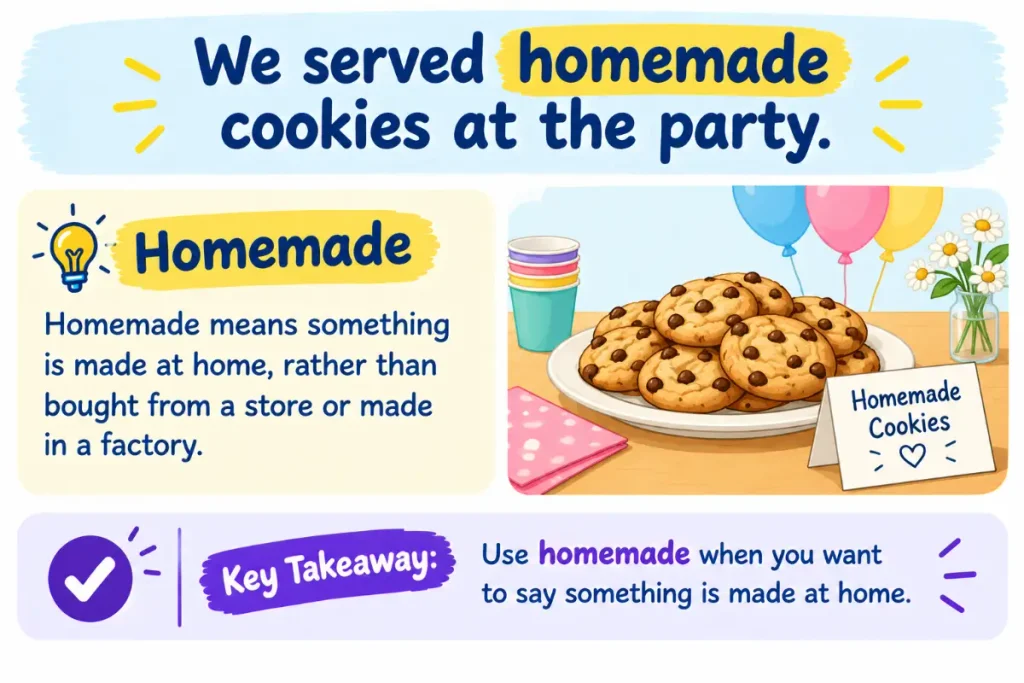
Homemade is the standard spelling in American English when the word means “made at home.”
Examples:
- We served homemade cookies at the party.
- She brought homemade bread to dinner.
- I prefer homemade soup to canned soup.
- He sells homemade candles online.
The spelling home made is generally not the preferred choice when you are using the word as the adjective meaning “made at home.”
| Form | Standard use | Example |
|---|---|---|
| homemade | Standard adjective | We ate homemade pizza. |
| home made | Rare or context-dependent | The phrase may be split when “home” and “made” have separate grammatical roles. |
| home-made | Older or less common hyphenated form | Some older texts use home-made bread. |
For everyday American writing, homemade is the safest choice.
What Does “Homemade” Mean?
Homemade means made at home rather than manufactured or prepared commercially. It can describe food, drinks, crafts, decorations, gifts, clothing, and many other things. For example, homemade food is prepared at home instead of being bought as a ready-made commercial product. A homemade card is created by someone at home rather than purchased from a store. The word does not necessarily mean that a person made something entirely from raw materials. A homemade cake, for example, can include ingredients purchased from a grocery store.
Simple definition
Homemade means made at home, usually by an individual rather than by a commercial manufacturer. The word often suggests something personal, handmade, or prepared in a home setting.
Why Is “Homemade” One Word?
English often combines two words into a single compound word when they develop a common meaning together. Homemade is one of these compounds.
The word combines:
- home — a place where someone lives
- made — produced or prepared
Together, homemade describes something produced at home.
Similar compounds include:
- homemade
- handmade
- homemade-style
- homegrown
- homemade-looking
Not every combination of “home” and another word becomes one word, so spelling depends on the established usage of the particular expression.
How Do You Use “Homemade” in a Sentence?
“Homemade” usually works as an adjective. It describes a noun and normally comes before that noun.
Before a noun
- We made homemade bread for breakfast.
- She gave me a homemade gift.
- They served homemade ice cream after dinner.
- He brought a homemade dessert to the office.
- I bought a homemade-looking decoration for the party.
It can also appear after a linking verb.
- The cookies are homemade.
- This sauce is homemade.
- The decorations were homemade.
- Everything at the dinner was homemade.
Home Made vs. Homemade: What’s the Difference?
The main difference is spelling and grammatical use. When you want to describe something that someone made at home, homemade is normally the correct modern form.
For example:
We had homemade cake for dessert.
Here, “homemade” acts as one adjective describing “cake.” Writing “home made cake” is not the standard choice for this meaning.
| Feature | Homemade | Home made |
|---|---|---|
| Spelling | One word | Two words |
| Common in American English | Yes | No |
| Typical grammatical role | Adjective | Separate words in special contexts |
| Example | homemade bread | Usually avoid this form |
| Best choice for everyday writing | Yes | Usually no |
For most writing, simply remember: homemade = one word.
Is “Homemade” One Word?
Yes. Homemade is normally written as one word.
Correct:
- homemade cookies
- homemade pizza
- homemade sauce
- homemade gifts
- homemade decorations
- homemade bread
Usually incorrect for standard modern usage:
- home made cookies
- home made pizza
- home made sauce
If you’re unsure, the one-word spelling homemade is the natural choice in American English.
10 Examples of “Homemade” in Real Sentences
Here are examples from everyday situations:
- My grandmother makes homemade jam every summer.
- We brought homemade brownies to the school event.
- This restaurant serves homemade pasta.
- She posted a recipe for homemade tomato sauce.
- I gave my friend a homemade birthday card.
- They enjoy making homemade decorations for the holidays.
- He prefers homemade meals during the week.
- The family prepared homemade lemonade for the picnic.
- She sells homemade crafts at the local market.
- Nothing beats the smell of homemade bread in the kitchen.
These examples show that “homemade” works naturally with both food and non-food items.
“Homemade” vs “Handmade”
Homemade and handmade have related meanings, but they aren’t interchangeable in every situation. Handmade emphasizes how something was made: by hand rather than mainly by machine.
Compare these examples:
- She made homemade cookies.
- She sells handmade jewelry.
The cookies are homemade because she prepared them at home. The jewelry is handmade because she crafted it by hand.
Something can be both:
She sells homemade, handmade decorations at the holiday market.
Quick comparison
| Word | Main idea | Example |
|---|---|---|
| Homemade | Made at home | homemade soup |
| Handmade | Made by hand | handmade jewelry |
| Commercial | Made for sale on a larger scale | commercial bread |
| Store-bought | Purchased from a store | store-bought cookies |
“Homemade” vs “Homegrown”
These words also have different meanings. Homemade means made or prepared at home. Homegrown usually means grown at home or produced locally, especially food or plants.
Examples:
- We made homemade salsa.
- We used homegrown tomatoes to make the salsa.
The salsa is homemade because someone prepared it. The tomatoes are homegrown because someone grew them.
“Homemade” vs “DIY”
DIY stands for “do it yourself.” It describes something a person makes, repairs, or completes without hiring a professional for the task. “Homemade” focuses on making something at home.
For example:
- I made a homemade birthday cake.
- I built a DIY bookshelf.
The first sentence focuses on the cake being made at home. The second focuses on completing the project yourself.
Is “Home-Made” Correct?
Home-made is understandable and may appear in some older writing, style traditions, or dictionaries. However, homemade is the normal modern spelling in American English. If you’re writing a website, email, school assignment, recipe, advertisement, or social media post for a US audience, use homemade. The hyphenated form isn’t usually necessary.
Preferred
homemade bread
Less common
home-made bread
Usually avoid
home made bread
The one-word form is simple and widely recognized.
Can “Homemade” Be Used in Formal Writing?
Yes. Homemade is a standard English word, so there’s no grammatical problem with using it in formal writing when it accurately describes something.
For example:
The event featured homemade desserts prepared by local families.
However, in highly formal or technical writing, you may sometimes want a more precise expression. Depending on the context, alternatives include:
- prepared at home
- made at home
- locally prepared
- individually prepared
- home-prepared
For example:
The study examined meals prepared at home.
This may sound more precise than “homemade meals” in an academic context.
Better Alternatives to “Homemade”
The best alternative depends on what you want to emphasize.
| Alternative | Meaning | Tone | Example |
|---|---|---|---|
| Made at home | Produced in a home | Neutral | This bread was made at home. |
| Home-prepared | Prepared at home | Formal | Participants reported eating more home-prepared meals. |
| Handmade | Made by hand | Everyday | She sells handmade cards. |
| DIY | Made or completed yourself | Casual | He built a DIY planter. |
| Handcrafted | Carefully made by hand | Polished | They sell handcrafted furniture. |
| Locally made | Made in a local area | Neutral | We support locally made products. |
| Home-cooked | Food cooked at home | Everyday | We had a home-cooked dinner. |
| Home-baked | Food baked at home | Specific | She brought home-baked bread. |
| Homegrown | Grown at home | Everyday | We used homegrown tomatoes. |
| Self-made | Created by oneself | Different meaning | He became a self-made entrepreneur. |
These aren’t perfect substitutes in every sentence. Choose one based on the exact meaning you want.

“Homemade” vs “Home-Cooked”
For food, homemade and home-cooked can overlap, but they emphasize slightly different ideas. Homemade means made at home. Home-cooked specifically refers to food that someone cooks at home.
Compare:
I love homemade bread.
This means the bread was made at home.
I love home-cooked meals.
This emphasizes meals cooked at home. Homemade” can describe more than food, while “home-cooked” normally refers to food.
Common Mistakes With “Homemade”
1. Writing “home made” as the default spelling
Many writers separate the words because the phrase clearly contains “home” and “made.” Modern standard usage, however, normally combines them.
Preferred: homemade cookies
Less standard: home made cookies
2. Adding an unnecessary hyphen
The spelling “home-made” can be found in some sources, but it is not the usual modern American form.
Preferred: homemade cake
3. Confusing “homemade” with “handmade”
Not everything handmade is homemade.craftsperson might make a handmade item in a workshop or studio. “Homemade” specifically points to a home setting.
4. Using “homegrown” for something prepared at home
A tomato grown in your backyard can be homegrown. A salad made from that tomato can be homemade. The words describe different stages of production.
5. Treating “homemade” as a noun
“Homemade” normally functions as an adjective.
Correct:
She sells homemade candles.
Instead of treating “homemade” alone as the object, use a noun:
She sells homemade products.
American English vs British English
The spelling homemade is widely recognized in both American and British English. The main point is that it is normally written as one word.
American English commonly uses:
homemade cookies
British English also commonly uses:
homemade biscuits
The noun in the second example reflects a regional vocabulary difference. “Biscuits” and “cookies” don’t always refer to the same thing in American and British English, but the spelling of “homemade” remains familiar in both varieties.
What Is the Opposite of “Homemade”?
There isn’t one single perfect antonym in every context. Depending on the situation, useful opposites include:
- commercially made
- commercially produced
- factory-made
- store-bought
- mass-produced
- manufactured
For example:
I prefer homemade bread to store-bought bread.
Here, store-bought gives the clearest contrast because it means purchased from a store. For manufacturing, mass-produced may be more appropriate:
The artist prefers handmade furniture to mass-produced pieces.
The right opposite depends on the specific meaning.
When Should You Use “Homemade”?
Use homemade when you want to communicate that something was made or prepared at home. It works especially well in:
Recipes
This homemade pasta sauce takes less than an hour to prepare.
Everyday conversation
My dad makes great homemade pizza.
Social media
Sharing my homemade cookies with everyone today!
Product descriptions
Our market features homemade jams and baked goods.
School writing
The family prepared homemade meals throughout the week.
Workplace communication
We brought homemade treats to celebrate the team’s success.
The word is natural in both casual and professional contexts when the meaning fits.

Quick Rule to Remember
If you mean “made at home,” write “homemade” as one word.
Think of it this way:
home + made → homemade
Examples:
- homemade food
- homemade cake
- homemade gift
- homemade card
- homemade sauce
If you’re writing for a US audience, this simple rule will cover almost every ordinary use.
Conclusion
For most everyday writing, homemade is the correct choice when you mean “made at home.” It is normally written as one word in American English, without a space or hyphen.
The word works naturally for food, crafts, gifts, decorations, and many other things. Just remember that “homemade” focuses on the place where something was made, while words such as “handmade,” “homegrown,” and “home-cooked” highlight different aspects.
If you’re choosing between home made or homemade for a recipe, email, school assignment, product description, or social post, choose homemade. It’s clear, natural, and the standard spelling most US readers expect.
Frequently Asked Questions
Is “home made” correct or “homemade”?
Homemade is the standard spelling when you mean something made at home. The two-word form is uncommon for this meaning in modern American English.
Is homemade one word or two words?
Homemade is one word. Use it as an adjective to describe something made or prepared at home.
How do you spell homemade correctly?
The standard spelling is homemade, with no space and normally no hyphen.
Is “home-made” grammatically correct?
Home-made is understandable and appears in some older or variant usage, but homemade is the preferred modern spelling for most American English writing.
What is another word for homemade?
Depending on the context, alternatives include home-prepared, handmade, home-cooked, home-baked, DIY, and handcrafted. The best choice depends on what you want to emphasize.
What is the difference between homemade and handmade?
Homemade emphasizes that something was made at home, while handmade emphasizes that it was made by hand. An item can be both homemade and handmade.
Is homemade formal or informal?
Homemade works in both casual and formal writing. In highly formal or academic contexts, phrases such as “prepared at home” or “home-prepared” may offer greater precision.
2 thoughts on “Home Made or Homemade: Correct Spelling and Usage”