
If you’ve ever stopped while writing a text, email, essay, or social media post and wondered whether to use loose or lose, you’re not alone. These two words look and sound similar, but they have completely different meanings.
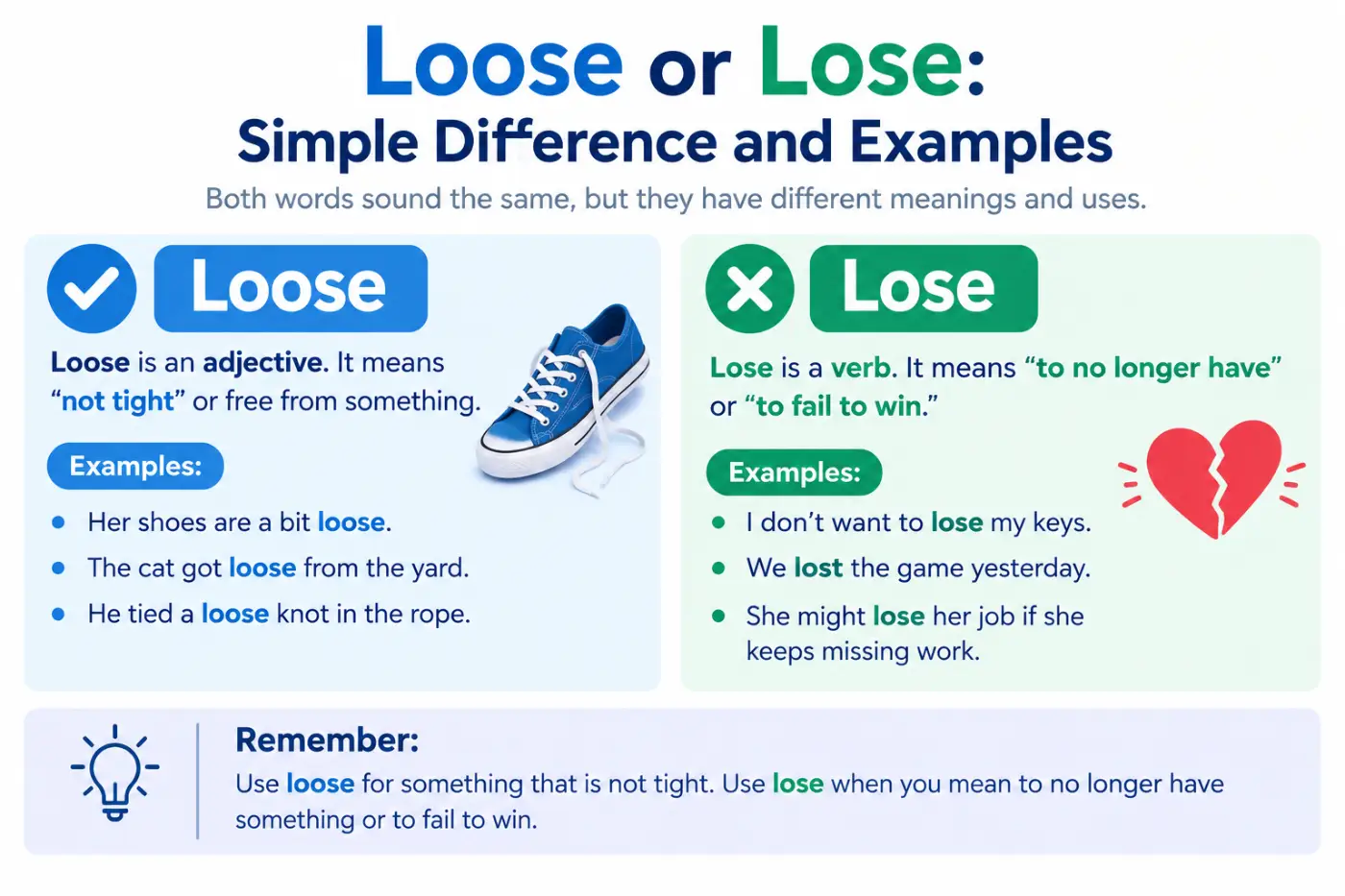
The quick answer is simple: loose usually means not tight, while lose means to misplace something, fail to win, or no longer have something.
This guide explains the difference between loose and lose, shows you how to use each word correctly, and gives you simple examples and memory tricks so you can choose the right word with confidence.
Loose or Lose: What’s the Difference?
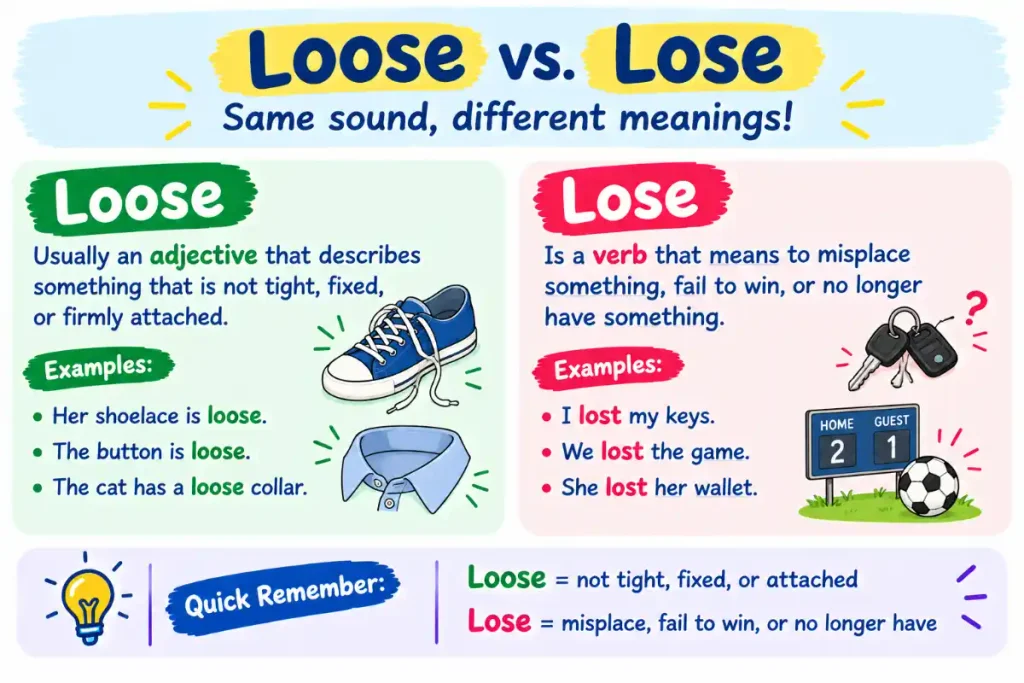
Loose is usually an adjective that describes something that is not tight, fixed, or firmly attached. Lose is a verb that means to misplace something, fail to win, or no longer have something.
| Word | Part of Speech | Main Meaning | Example |
|---|---|---|---|
| Loose | Usually an adjective | Not tight or firmly attached | My shirt feels loose. |
| Lose | Verb | Misplace, fail to win, or no longer have | Don’t lose your keys. |
The easiest way to remember the distinction is:
- Loose = not tight
- Lose = misplace or fail to keep
For example:
- The screw is loose.
- Don’t lose the screw.
The first sentence describes the condition of the screw. The second describes an action involving the screw.
What Does Loose Mean?
Loose generally means something is not tight, secure, or firmly attached. It can describe clothing, objects, connections, rules, and even physical arrangements.
Loose as an adjective
The most common use of loose is as an adjective.
Examples:
- These pants are too loose.
- One of the buttons on my coat is loose.
- The dog got loose from the yard.
- The cable connection feels loose.
- She prefers loose clothing.
- There is a loose page inside the notebook.
Loose can also describe something that has been released or is no longer controlled.
For example, you might hear:
The dog is loose.
Here, loose means the dog is free rather than safely contained.
Loose as a verb
Loose can also function as a verb, although this use is less common in everyday American English. As a verb, it means to release or set free.
Example:
- The hunter loosed the arrow.
In ordinary conversation, however, people are much more likely to use words such as “release” or “let go.”
What Does Lose Mean?
Lose is a verb with several common meanings. It can mean to misplace something, fail to win, be deprived of something, or stop having something.
Lose something
Use lose when you cannot find something you had before.
Examples:
- I always lose my keys.
- Don’t lose your phone.
- She lost her wallet at the store.
- He doesn’t want to lose his backpack.
The past tense of lose is lost.
| Present | Past | Example |
|---|---|---|
| lose | lost | I might lose my ticket. |
| lose | lost | I lost my ticket yesterday. |
Notice that the past tense is not “losed.” The correct form is lost.
Lose a game or competition
Lose can also mean the opposite of win.
Examples:
- Our team might lose the game.
- They lost the championship.
- I don’t like to lose.
- The team played well but lost by two points.
Lose something you once had
Lose can describe something that is no longer available or present.
Examples:
- He lost his job last year.
- She doesn’t want to lose her opportunity.
- The company could lose an important customer.
- I don’t want to lose touch with my friends.
Why Do People Confuse Loose and Lose?
The confusion comes mainly from their similar spelling and pronunciation. Both words contain the letters “loo,” and their sounds are close enough to cause mistakes in quick speech or writing. However, they don’t have the same vowel sound.Loose rhymes with words such as “moose” and “goose.”Lose sounds more like “news” and “choose.” A useful pronunciation reminder is:
- Loose: /luːs/
- Lose: /luːz/
The final sound is different. Loose ends with an s sound, while lose ends with a z sound.
Loose vs. Lose: Correct Examples
Seeing the words side by side makes the difference easier to understand.
| Loose | Lose |
|---|---|
| My shoes are loose. | I don’t want to lose my shoes. |
| The handle is loose. | Don’t lose the handle. |
| His jacket is loose. | He could lose his jacket. |
| The knot is loose. | Be careful not to lose the rope. |
| The dog got loose. | The owner might lose track of the dog. |
The basic pattern is straightforward: Loose describes a condition. Lose describes an action or result.
10+ Examples of Loose in a Sentence
Here are natural examples of loose in everyday American English:
- My new shoes feel a little loose.
- The screw is loose, so the chair wobbles.
- She likes wearing loose shirts during the summer.
- One of the wires came loose.
- The dog broke free and ran loose around the neighborhood.
- The lid is loose and needs to be tightened.
- He tied the rope with a loose knot.
- The tooth became loose after the accident.
- The papers were loose inside the folder.
- The jacket looks loose around the shoulders.
- Make sure the connection isn’t loose.
- The horse got loose from the fence.
10+ Examples of Lose in a Sentence
Here are common examples of lose:
- Don’t lose your house keys.
- I don’t want to lose my phone.
- Our team could lose the game tonight.
- She lost her wallet on the bus.
- Try not to lose your place in the book.
- He doesn’t want to lose his job.
- We might lose power during the storm.
- I always lose track of time when I’m reading.
- They lost the final match.
- She was afraid she would lose her chance.
- Please don’t lose this receipt.
- He lost his train of thought during the presentation.
Loose or Lose in Everyday Writing
Choosing between the two becomes easier when you look at what the sentence is trying to say.
Use loose for clothing
If something isn’t tight, use loose.
- This shirt is too loose.
- I prefer loose jeans.
- The waistband feels loose.
Use lose for belongings
If you might misplace something, use lose.
- I don’t want to lose my wallet.
- Don’t lose your keys.
- She tends to lose her sunglasses.
Use lose for games
If you don’t win, use lose.
- We don’t want to lose the game.
- They lost the match.
- Our team lost by one point.
Use loose for something that isn’t secure
If something isn’t firmly attached, use loose.
- The door handle is loose.
- This screw is loose.
- The wire became loose.
Common Mistakes With Loose and Lose
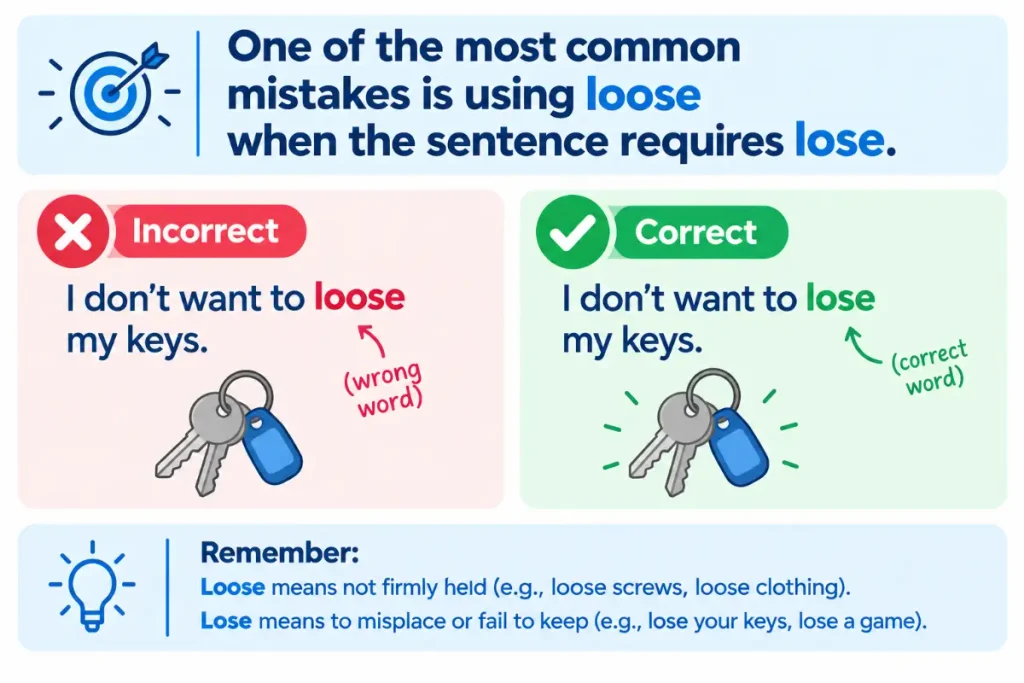
One of the most common mistakes is using loose when the sentence requires lose.
Incorrect: Don’t loose your keys.
The correct sentence is: Don’t lose your keys. The meaning is “Don’t misplace your keys,” so lose is the correct verb.
Incorrect: My shoes are lose.
The correct sentence is: My shoes are loose. Here, you’re describing shoes that aren’t tight, so loose is correct.
Incorrect: We don’t want to loose the game.
The correct sentence is: We don’t want to lose the game. A game can be won or lost, so use lose.
Incorrect: The screw is lose.
The correct sentence is: The screw is loose. The screw isn’t firmly attached, so loose describes its condition.
Loose vs. Lose vs. Lost
A related source of confusion is the word lost. Lose is the present-tense verb:
- I might lose my keys.
Lost is the past tense:
- I lost my keys yesterday.
Loose is a different word:
- My keys are not attached to the key ring, so they are loose.
Here’s a quick comparison:
| Word | Meaning | Example |
|---|---|---|
| Loose | Not tight or secure | The button is loose. |
| Lose | Misplace or fail to win | Don’t lose the button. |
| Lost | Past tense of lose | I lost the button. |
Loose or Lose: A Simple Memory Trick
A quick trick can help you remember the difference. Think of the extra O in loose as giving the word more “room.” Something loose has extra room and isn’t tight.
- Loose → not tight
- Lose → misplace or fail to win
You can also connect loose with goose because they rhyme:
loose → goose
Then remember:
Lose → lost
If you can replace the word with “misplace,” “fail to win,” or “no longer have,” you probably need lose. If you can replace it with “not tight” or “not firmly attached,” you probably need loose.
Is Loose an Adjective or a Verb?
Loose is most commonly an adjective.
Examples:
- loose clothing
- a loose screw
- a loose connection
- a loose knot
It can also be a verb meaning “to release,” but that use is relatively uncommon in everyday American English.
Is Lose a Verb?
Yes. Lose is a verb.
It can describe several actions or situations:
- losing an object
- losing a competition
- losing an opportunity
- losing contact
- losing something you previously had
Examples:
- I don’t want to lose my ticket.
- They might lose the game.
- She doesn’t want to lose the opportunity.
Loose or Lose in Professional Writing
Both words are completely acceptable in professional writing. The important thing is choosing the one that matches your meaning.
Resume and job applications
Use lose when discussing something being lost or reduced:
- The new process helped the company lose fewer customers.
Use loose when describing something that isn’t tight or fixed:
- The equipment had a loose connection.
Professional emails
Examples:
- “Please check the loose cable before the meeting.”
- “I don’t want to lose the original document.”
Academic writing
The same distinction applies in essays and academic work:
- “The researchers found a loose connection between the two variables.”
- “The team could lose access to the data.”
There is no special academic spelling for either word.
Loose or Lose in Texting and Casual Conversation
The distinction stays the same in texts, social media posts, and everyday conversation.
For example:
- “Don’t lose your keys 😂”
- “These shoes are too loose.”
- “We can’t lose this game!”
- “The handle is loose.”
Casual writing may contain spelling mistakes, but the standard forms remain loose and lose.
Words Related to Loose
Depending on the context, related words for loose include:
- relaxed
- slack
- free
- open
- unfixed
- unsecured
- detached
- baggy
- flexible
- unfastened
These aren’t perfect substitutes in every sentence.
For example, baggy works well for clothing, while slack works better for a rope or cable.
Words Related to Lose
Depending on the context, lose can relate to:
- misplace
- forfeit
- fail
- surrender
- miss
- waste
- drop
- forget
- give up
- be deprived of
Again, context matters.
For example, “misplace” works when you can’t find an object, while “forfeit” usually refers to giving up or losing something because of a rule or condition.
Antonyms of Loose and Lose
The opposite of loose depends on the meaning. For loose meaning “not tight,” possible antonyms include:
- tight
- secure
- firm
- fastened
- fixed
Example:
- The screw is loose.
- The screw is tight.
For lose, the opposite depends on the context.
- Lose a game → win a game
- Lose an object → find an object
- Lose something you had → keep or retain it
This is why one single antonym doesn’t always work for lose.

Quick Rule: Loose or Lose?
Use this quick test before choosing the word: Does it mean “not tight”?
Use loose. Does it mean “misplace something”?
Use lose. Does it mean “fail to win”?
Use lose. Does it mean “not firmly attached”?
Use loose.
Examples:
- A loose button
- Lose a button
- A loose belt
- Lose your belt
- A loose connection
- Lose the connection
- Lose a game
- A loose knot
Conclusion
The difference between loose or lose becomes much easier once you connect each word with its main meaning. Loose describes something that isn’t tight, secure, or firmly attached. Lose is a verb used when you misplace something, fail to win, or no longer have something.
Remember the simple rule: loose means not tight, while lose means misplace or fail to win. If you’re talking about a shirt, screw, knot, or connection that isn’t secure, choose loose. If you’re talking about keys, a game, an opportunity, or something you no longer have, choose lose.
With that distinction in mind, you’ll be able to spot the correct word quickly in emails, schoolwork, professional writing, texts, and everyday conversation.
Frequently Asked Questions
What is the difference between loose and lose?
Loose usually means not tight, secure, or firmly attached. Lose is a verb meaning to misplace something, fail to win, or no longer have something.
Which is correct, loose or lose?
Both are correct words, but they have different meanings. Use loose for something that isn’t tight and lose for misplacing something or failing to win.
How do you spell lose?
The correct spelling is lose, with one “o” after the “l.” Its past tense is lost.
How do you spell loose?
The correct spelling is loose, with two “o”s. It usually describes something that isn’t tight or firmly attached.
Is it “lose weight” or “loose weight”?
The correct phrase is lose weight. Lose is the verb used for reducing or no longer having something, while loose means not tight.
Is it “loose your keys” or “lose your keys”?
The correct phrase is lose your keys. If you misplace your keys, you lose them.
Is “loose” a verb?
Yes, loose can be a verb meaning to release or set free, although this use is less common in everyday American English. Most often, loose works as an adjective.
2 thoughts on “Loose or Lose: Simple Difference and Examples”