

If you’ve ever typed nosey or nosy and wondered which spelling is correct, you’re not alone. Both forms appear in English, but nosy is the standard and more common spelling in American English. Nosey is also recognized as a variant, although it is used less frequently in US writing.
The word nosy describes someone who is overly curious about other people’s private business or affairs. While the meaning is straightforward, the two spellings can create uncertainty because nosey looks like a natural spelling based on the word nose. Understanding the difference can help you choose the form that best fits standard American English.
In this guide, you’ll learn what nosy means, how nosey is used as a variant, and which spelling you should prefer in everyday and formal writing. You’ll also see clear examples that show how the word works in sentences, making it easier to use the correct form with confidence.

Nosey or Nosy: Which Is Correct?
Nosy is the preferred spelling in American English. Nosey is also a valid variant, especially in some British English contexts, but nosy is the safer choice for most US readers.
| Spelling | Status | Best use |
|---|---|---|
| nosy | Standard and common in US English | American writing and everyday use |
| nosey | Accepted variant | Informal writing and some British usage |
For a US audience, choose nosy when you want the most familiar spelling.
Is “Nosey” Wrong?
No. Nosey isn’t simply a misspelling. It is an established spelling variant of nosy. However, spelling conventions differ by dictionary, region, and publication. If you’re writing for an American audience, nosy generally looks more natural.
What Does Nosy Mean?
Nosy means overly interested in other people’s private business or personal affairs. Someone who asks too many personal questions, tries to find out information that isn’t their business, or pays too much attention to what others are doing may be described as nosy.
For example:
My neighbor is friendly, but sometimes she’s a little nosy.
The word usually has a negative meaning, although people sometimes use it jokingly among friends.
Simple Definition
Nosy: Too interested in other people’s private matters. The word can describe a person, a question, a comment, or behavior.
- a nosy neighbor
- a nosy coworker
- a nosy question
- a nosy relative
- nosy behavior
Why Are Nosy and Nosey Confused?
The confusion comes partly from the word nose. The adjective nosy developed from the idea of someone metaphorically putting their nose into other people’s business. Because nose ends with an e, some writers naturally spell the adjective nosey. English spelling does not always work by simply adding a suffix to the original word, though. Over time, both nosy and nosey became established forms. For American readers, nosy is the more familiar choice.
How Do You Spell Nosy?
The most common American spelling is:
N-O-S-Y: nosy
Examples:
- Don’t be nosy.
- He asked a nosy question.
- My sister can be pretty nosy.
- I don’t want to sound nosy, but what happened?
You may also see nosey, especially in informal writing or British English.
Nosy vs. Nosey: What’s the Difference?
The main difference is spelling rather than meaning. Both words describe someone who shows too much interest in other people’s private affairs.
Meaning
Both nosy and nosey mean overly curious about someone else’s business.
Usage
Nosy is more common in American English. Nosey is also understood by American readers, but it is less common.
Tone
Both forms have the same informal tone. Neither spelling makes the word more formal.
Example
- My coworker asked a nosy question.
- My coworker asked a nosey question.
Both sentences have the same meaning, but nosy is generally the better choice for US English.
Nosy or Nosey in American English
For American English, nosy should usually be your first choice. If you’re writing a school assignment, blog post, email, social media post, or other content for US readers, nosy will look familiar and natural. That doesn’t make nosey incomprehensible or automatically incorrect. It simply means that nosy follows the spelling most US readers expect.
US English Example
My brother gets nosy whenever we start talking about family plans.
Informal Example
Don’t get nosy. I’ll tell you when I’m ready.
Nosy or Nosey in British English
British English also uses nosy, while nosey appears as a variant. Regional spelling preferences can vary, so you shouldn’t treat nosey as an error simply because nosy is more common in American English. If your audience includes readers from different English-speaking countries, either form will usually be understood from context. For a US-focused publication, however, nosy is the clearest default.
What Part of Speech Is Nosy?
Nosy is an adjective.
An adjective describes a person, thing, or behavior. In this case, nosy describes someone or something that shows too much curiosity about private matters.
Examples:
- She is nosy.
- That’s a nosy question.
- His nosy behavior annoyed everyone.
- We have a nosy neighbor.
The noun is usually nosiness, which means the quality or habit of being nosy.
Her nosiness made the conversation uncomfortable.
The related adverb nosily is possible but uncommon in everyday American English.
10 Examples of Nosy in Real Sentences
Here are natural examples showing how Americans might use nosy in everyday situations.
- My neighbor is friendly, but he can be nosy sometimes.
- She asked a nosy question about my salary.
- I wasn’t trying to be nosy; I was just curious.
- The kids became nosy when they saw the wrapped packages.
- Don’t be nosy about their personal relationship.
- His nosy coworker kept asking where he was going after work.
- My aunt gets nosy whenever someone mentions dating.
- She gave me a nosy look when I walked into the room.
- The reporter avoided asking questions that felt too nosy.
- I know you’re curious, but asking about someone’s finances can seem nosy.
These examples also show an important point: nosy often describes behavior that crosses a social boundary.
Nosy vs. Curious
Nosy and curious are related, but they don’t have the same tone. Curious usually means wanting to know or learn something. It can be completely positive or neutral. Nosy suggests that someone is too interested in information that isn’t really their business.
| Word | Meaning | Tone | Example |
|---|---|---|---|
| Curious | Wanting to know something | Neutral or positive | I’m curious about how it works. |
| Nosy | Too interested in another person’s private affairs | Usually negative | He’s being nosy about my finances. |
Compare these sentences:
I’m curious about your new job.
This sounds friendly and interested.
I’m nosy about your new job.
This sounds unnatural because nosy usually refers to excessive or inappropriate interest. A useful rule is simple: curious seeks information; nosy crosses a boundary.
Nosy vs. Inquisitive
Inquisitive means interested in learning or asking questions. It can describe someone who likes to explore ideas and gain knowledge. Nosy has a more negative sense because it usually involves someone else’s personal business.
| Word | Typical meaning | Tone |
|---|---|---|
| Curious | Interested in finding something out | Neutral |
| Inquisitive | Eager to learn or ask questions | Usually positive or neutral |
| Nosy | Too interested in private matters | Negative or teasing |
| Intrusive | Entering someone’s privacy without welcome | Strongly negative |
For example:
The student is inquisitive and asks thoughtful questions.
But:
The student was nosy and kept asking about the teacher’s private life.
The first sentence praises curiosity. The second criticizes it.
Nosy vs. Intrusive
Intrusive is stronger than nosy. A nosy person may ask an uncomfortable question. An intrusive person may go further and interfere with someone’s privacy or personal space.
For example:
She was being nosy when she asked how much I paid for my house.
But:
His intrusive behavior made me uncomfortable.
Use intrusive when you want to emphasize that someone’s behavior crosses a more serious personal boundary.
Nosy vs. Prying
Prying is another close alternative. To pry means to try to discover information about someone else’s private life, especially when that information isn’t being offered.
- nosy describes a person or behavior.
- prying often describes questions, attention, or attempts to obtain private information.
Examples:
My coworker was being nosy.
My coworker kept asking prying questions.
Both sentences criticize unwanted curiosity.
Synonyms for Nosy
There isn’t one perfect synonym for every situation. Some alternatives sound playful, while others sound much more critical.
| Word/Phrase | Meaning | Tone | Example |
|---|---|---|---|
| Curious | Interested in knowing something | Neutral | I’m curious about your plans. |
| Inquisitive | Eager to ask or learn | Neutral/positive | She’s an inquisitive student. |
| Prying | Trying to learn private information | Negative | He asked a prying question. |
| Intrusive | Invading someone’s privacy | Strong negative | That question felt intrusive. |
| Meddlesome | Interfering in other people’s affairs | Negative | His meddlesome habits annoyed us. |
| Interfering | Getting involved without being wanted | Negative | Stop interfering in their argument. |
| Snooping | Secretly looking for information | Negative | Someone was snooping around my desk. |
| Snoopy | Too curious about private matters | Informal | My little brother is snoopy. |
| Busybody | A person who interferes in others’ affairs | Negative | The neighborhood busybody knew everything. |
| Nosey | Variant spelling of nosy | Informal | Don’t be nosey. |
| Personal | Focused on private matters | Neutral/negative depending on context | That’s a personal question. |
| Overcurious | Excessively curious | Negative | His overcurious questions were uncomfortable. |
| Meddling | Interfering in a situation | Negative | Her meddling caused problems. |
| Probing | Seeking detailed information | Neutral/negative | The interviewer asked probing questions. |
| Invasive | Entering someone’s privacy | Strong negative | Some questions can feel invasive. |
| Questioning | Asking for information | Neutral | His questioning continued for several minutes. |
| Investigative | Seeking information systematically | Formal/neutral | The journalist used investigative methods. |
| Interrogative | Relating to questioning | Formal | The sentence has an interrogative form. |
| Eavesdropping | Listening to a private conversation | Negative | Eavesdropping is disrespectful. |
| Snooping around | Looking for information secretly | Informal/negative | He was snooping around the office. |
Some of these words are not interchangeable in every sentence. Curious, for instance, can be positive, while intrusive usually carries a much stronger negative meaning.

Nosy Alternatives by Intensity
The best replacement depends on how strongly you want to criticize someone’s behavior.
Mild
- curious
- inquisitive
- interested
- wondering
These words can sound neutral or even positive.
Moderate
- nosy
- prying
- snoopy
- overcurious
- probing
These choices suggest that someone’s interest may be inappropriate or excessive.
Strong
- intrusive
- invasive
- meddlesome
- interfering
- snooping
These words suggest a clearer violation of privacy or unwanted involvement.
Formal Alternatives to Nosy
Nosy is an informal word. In professional or academic writing, a more precise alternative may work better. Depending on the context, consider:
- intrusive
- invasive
- overly inquisitive
- excessively curious
- prying
- interfering
For example, instead of:
The manager asked a nosy question.
A more formal version might be:
The manager asked an overly personal question.
Or:
The manager asked an intrusive question.
The best choice depends on what actually happened.
Is Nosy a Rude Word?
Nosy can sound rude because it criticizes someone’s behavior. However, people also use it playfully with friends and family.
For example:
You’re so nosy!
A close friend might say this jokingly.
But:
My supervisor is nosy.
This could sound like a serious criticism, especially in a workplace conversation. If you want to sound polite, replace nosy with a softer phrase such as:
- “I don’t mean to ask a personal question…”
- “If you don’t mind me asking…”
- “I’m just curious…”
- “You don’t have to answer if you’d rather not.”
Is Nosy Appropriate in Professional Writing?
Nosy is usually too informal for formal professional writing. In an email or report, consider a more precise phrase.
Instead of:
The customer complained about a nosy employee.
You could write:
The customer complained that the employee asked overly personal questions.
This version sounds more professional and explains the problem without using a casual label. For workplace communication, the best replacement often depends on whether you mean personal, intrusive, prying, or interfering.
Is Nosy Appropriate for School Writing?
It depends on the type of assignment. For a formal essay, nosy may sound too conversational unless the topic calls for informal language. In creative writing, dialogue, personal narratives, and informal assignments, it can fit naturally.
For example:
My nosy neighbor always wanted to know what was happening on our street.
That sentence works well in a story because the word gives the character a clear personality.
Common Mistakes With Nosy
Mistake 1: Assuming Nosey Is Always Wrong
Nosey is an accepted variant, so calling it an outright spelling error isn’t accurate. For American English, though, nosy is the preferred choice.
Mistake 2: Using Nosy as a Positive Synonym for Curious
The two words overlap, but nosy usually carries a negative or teasing meaning.
Better:
I’m curious about your new project.
Less natural:
I’m nosy about your new project.
Mistake 3: Using Nosy in Formal Writing Without Considering Tone
The word is conversational. A formal document may benefit from a more precise term such as intrusive, overly personal, or prying.
Mistake 4: Confusing Nosy With Snooping
These words are related but not identical. Nosy often involves asking personal questions or showing too much interest. Snooping can involve secretly looking for information.
Mistake 5: Thinking the Word Means “Having a Big Nose”
Nosy does not normally mean that someone has a large nose. Its modern everyday meaning relates to excessive curiosity about other people’s affairs.
How to Remember the Spelling
For American English, remember this simple pattern: nose → nosy The spelling drops the final e before adding -y. Similar spelling patterns occur with other English words where a final silent e disappears before a suffix beginning with a vowel-like sound. If you’re writing for US readers and you’re unsure about nosey or nosy, choose nosy.
Nosey or Nosy in Texting and Social Media
Both spellings can appear in casual online conversations, but nosy is still a common choice in American English.
Examples:
Stop being so nosy 😂
My friends are getting nosy about my plans.
Okay, maybe I’m a little nosy.
Because texting is informal, people may use either spelling without much concern. If you’re writing a caption or post for a broad US audience, nosy remains the straightforward option.
What Is the Opposite of Nosy?
The closest opposite depends on the context. Possible contrasts include:
- private
- discreet
- respectful
- reserved
- uninterested
- nonintrusive
For example:
She’s very discreet and never asks about people’s private lives.
That’s a natural contrast with someone who is nosy.
Nosey or Nosy: Quick Answer
If you need the shortest possible rule, use this:
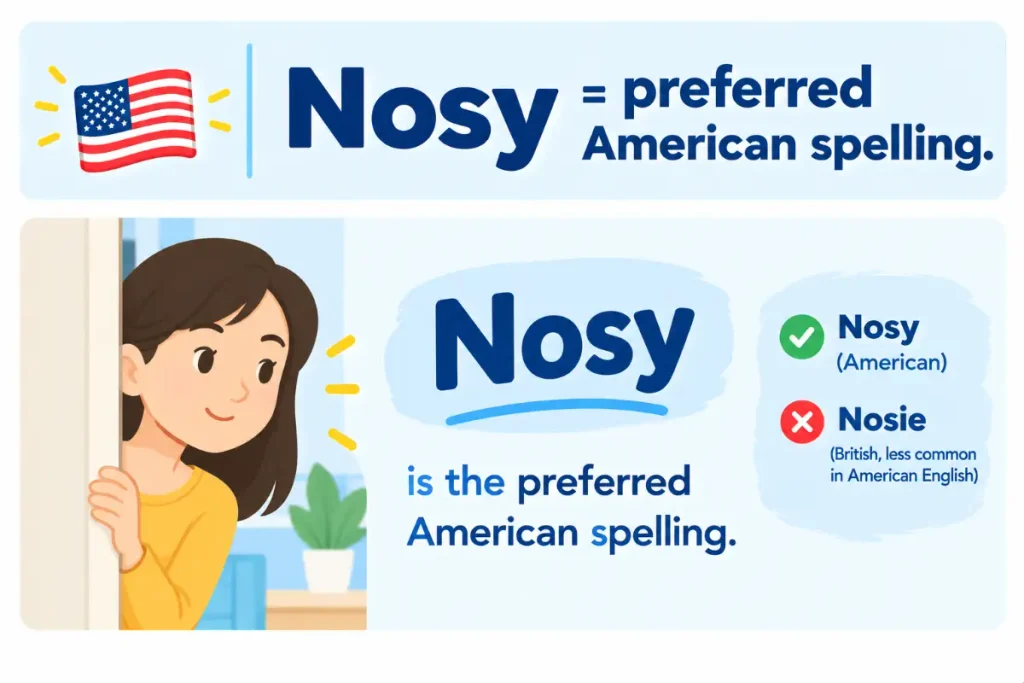
- Nosy = preferred American spelling
- Nosey = accepted spelling variant
- Both mean overly interested in another person’s private business
- Curious is usually more neutral or positive
- Intrusive is stronger and more negative
- Nosy is informal, so choose a more precise alternative for formal writing when appropriate
Conclusion
When choosing nosey or nosy, American English readers will generally expect nosy. Both spellings refer to someone who shows too much interest in other people’s private affairs, and nosey remains a valid variant rather than a simple spelling mistake.
The bigger issue is often meaning and tone. Curious sounds neutral or positive, while nosy can suggest that someone’s questions have crossed a personal boundary. Stronger words such as prying, intrusive, and invasive can describe more serious forms of unwanted curiosity.
For everyday US writing, nosy is the safest and most natural spelling. Use it in casual conversation, texts, and informal writing, and choose a more precise alternative when a professional or formal tone calls for one.
Frequently Asked Questions
Which is correct, nosey or nosy?
Both spellings are accepted, but nosy is the more common and preferred spelling in American English. Nosey is a recognized variant.
How do you spell nosy in American English?
The usual American spelling is nosy, spelled N-O-S-Y. This is the form most US readers will expect.
What does nosy mean?
Nosy means being too interested in another person’s private affairs or asking questions that aren’t really your business.
Is nosey a misspelling?
No. Nosey is an established spelling variant, not simply a typo. However, nosy is generally the better choice for American English.
Is nosy the same as curious?
Not exactly. Curious usually describes a neutral or positive desire to know something, while nosy suggests excessive or unwanted interest in someone’s private business.
What is a polite way to say nosy?
Depending on the situation, you can use phrases such as overly curious, asking personal questions, or intrusive. “I’m just curious” can also sound softer than calling someone nosy.
Is nosy formal or informal?
Nosy is an informal adjective. It works well in conversation, texting, social media, and casual writing, but a more precise term may work better in formal or professional writing.
1 thought on “Nosey or Nosy: Which Spelling Is Correct?”