
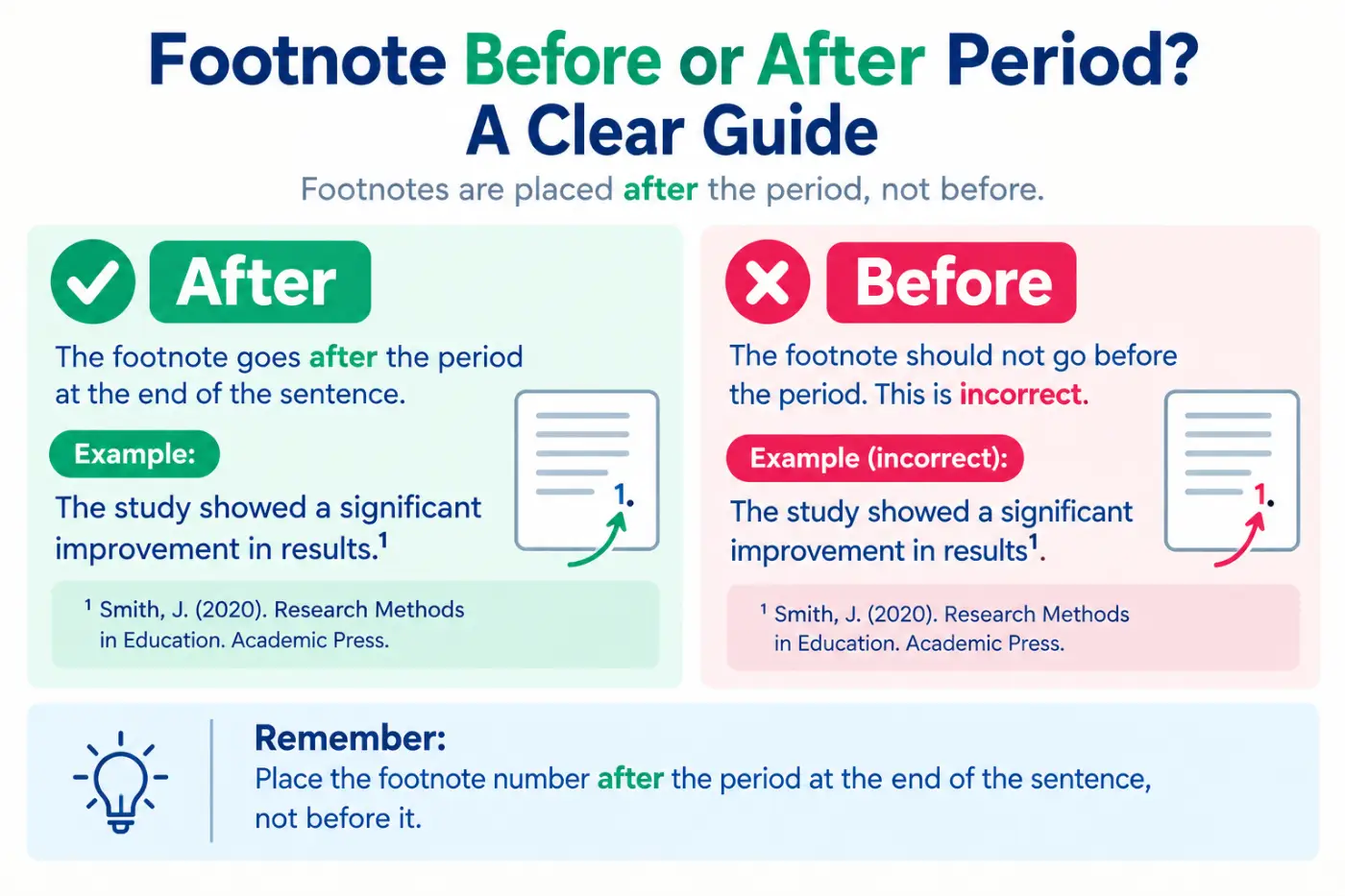
When adding a footnote to an essay, research paper, book, or other formal document, it is important to know where the footnote number should appear. One common question is whether the number belongs before the period or after it. Although the difference may seem small, correct footnote placement helps keep formal writing clear and consistent.
In most academic and professional writing, the footnote number goes after the period when the footnote supports the entire sentence. For example: The study produced unexpected results.¹ This is generally preferred over placing the number before the period: The study produced unexpected results¹.
However, footnote placement can vary depending on what the note supports and which style guide you are following. Some style guides have specific rules for footnotes, citations, and punctuation. Understanding these guidelines can help you place footnote numbers correctly and avoid common formatting mistakes in academic and professional writing.
Should a Footnote Go Before or After a Period?
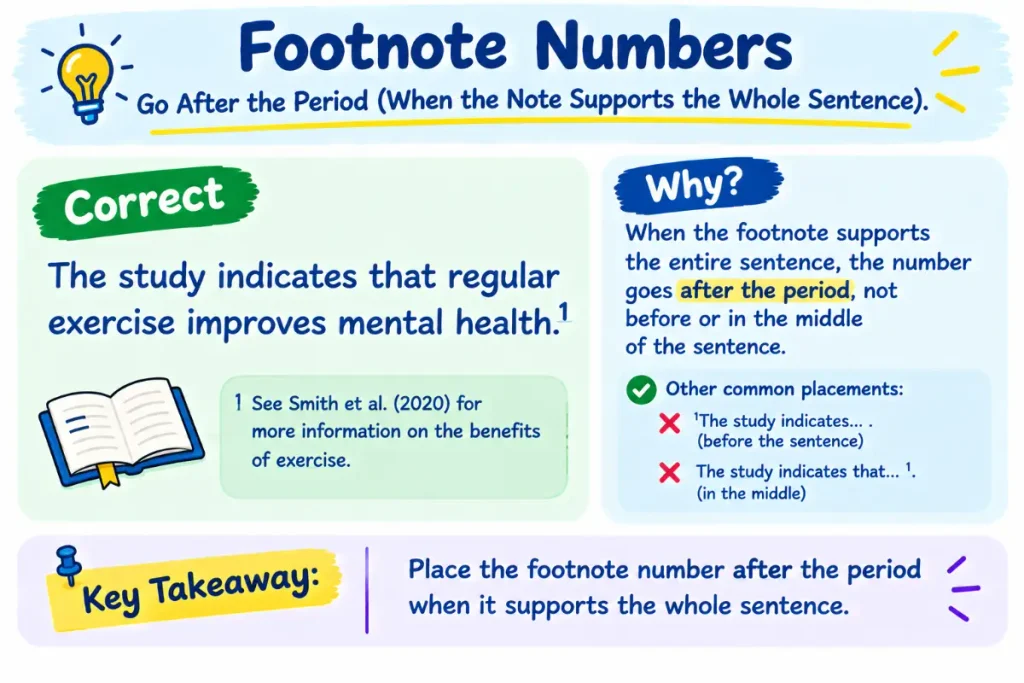
A footnote number normally goes after the period when the note supports the entire sentence.
For example:
The company changed its hiring policy in 2025.¹
The period comes first, followed by the superscript footnote number. This approach is common in academic writing, especially under styles such as Chicago. Footnote numbers usually appear at the end of the sentence or clause they document, after the punctuation.
Correct
The author published the book in 1998.¹
Usually incorrect
The author published the book in 1998¹.
The second version places the note marker before the period, which is not the usual placement when the note applies to the complete sentence.
Why Does the Footnote Number Go After the Period?
The main reason is clarity. Punctuation marks complete the sentence, while the footnote number acts as a reference to additional information.
Consider this example:
The museum opened its new exhibit in June.¹
The reader first sees the complete sentence. The superscript number then signals that a note provides supporting information. Placing the number after the punctuation also creates a consistent visual pattern in formal writing. Readers can quickly identify where the sentence ends and where the reference marker begins.
Footnote Before or After Period: The Basic Rule
A simple rule can help you remember the placement:
If the footnote supports the whole sentence, put the footnote number after the period.
| Situation | Typical placement | Example |
|---|---|---|
| Note supports the whole sentence | After the period | The report was released in May.¹ |
| Note supports a specific word or phrase | Near the relevant text, depending on style | The term “redlining”¹ has a specific historical meaning. |
| Note follows a quotation | Usually after the punctuation | “The results were significant.”¹ |
| Note follows a question | After the question mark | Did the policy work?¹ |
| Note follows an exclamation | After the exclamation point | The results were remarkable!¹ |
Your required style guide should always take priority if it gives a specific rule.
How to Use Footnote Numbers Correctly
Footnotes usually use small superscript numbers in the main text. The corresponding note appears at the bottom of the page.
For example:
The researcher reached a different conclusion.¹
At the bottom of the page, the corresponding note might provide the source or additional explanation. The number in the text connects the reader to the numbered note. Keep the numbering consistent throughout the document. In many academic systems, notes continue in numerical order:
The first claim needs a source.¹ The second claim also needs support.²
The notes at the bottom of the pages correspond to numbers 1 and 2.
When Should a Footnote Number Come Before Punctuation?
There are situations in which placement can vary, particularly when a footnote refers to a specific word, phrase, or part of a sentence rather than the entire sentence.
For example:
The term “New Deal”¹ describes a group of programs introduced during the 1930s.
Here, the note may specifically explain or document the term “New Deal.” However, style guides differ on how they handle these cases. Some recommend placing the note number at the end of the relevant clause or sentence, while others allow more precise placement. The safest approach is to follow the style guide required by your school, publisher, journal, or workplace.
Footnote Placement in Chicago Style
The Chicago Manual of Style commonly places footnote numbers after punctuation.
For example:
The architect completed the building in 1912.¹
If a note applies to an entire sentence, the note number normally appears after the sentence’s punctuation. Chicago also uses superscript note numbers in the main text and corresponding numbered notes.
Example
The building became a local landmark after its restoration.¹
The footnote marker comes after the period rather than before it. Chicago’s rules can become more detailed when notes relate to quotations, parentheses, multiple punctuation marks, or specific portions of a sentence. For formal academic work, use the edition and instructions specified by your institution.
Footnote Placement in MLA Style
MLA generally favors parenthetical citations rather than traditional footnotes for ordinary source documentation. However, MLA does allow notes for supplementary information. When you use a note, its placement should follow MLA’s rules and the purpose of the note. If your instructor specifically asks for footnotes, check the assignment instructions before deciding where to place the marker. The important point is that you should not automatically apply a Chicago rule to every MLA document.
Footnote Placement in Academic Writing
In an academic paper, footnotes can provide sources, explanations, comments, or additional information. When the note supports an entire sentence, place the footnote marker after the sentence’s punctuation in most common footnote systems.
For example:
Researchers have studied this issue for more than three decades.¹
If your professor provides a required style guide, use that guide instead of relying on a general rule. This matters because academic styles can differ in their treatment of citations and notes.
What About Footnotes After Question Marks?
The footnote number generally comes after the question mark when the note supports the entire question.
Example
Did the researchers reach the same conclusion?¹
The question mark ends the sentence. The superscript number follows it. The same principle generally applies to exclamation points.
Example
The results were completely unexpected!¹
The exclamation point comes first, followed by the footnote marker.
What About Footnotes After Quotation Marks?
Quotation marks can make footnote placement confusing because several punctuation marks may appear together. When a footnote supports a complete sentence that ends with a quotation, the note marker generally comes after the sentence-ending punctuation.
For example:
The historian described the event as “a turning point.”¹
The period appears before the closing footnote number. If the note specifically relates to only part of the quotation, placement may depend on the style guide and the structure of the sentence.
Footnotes and Parentheses
Parentheses can create another placement question.
For example:
The policy was introduced in 2005
If the footnote supports the whole sentence, the marker normally follows the sentence-ending period. If the note applies only to the material inside the parentheses, a style guide may recommend a different position. The key question is: What exactly does the note support?
Footnote Before or After Period in a Sentence?
For most ordinary sentences, remember this pattern:
Sentence.¹
Not:
Sentence¹.
Here are a few examples:
- The company opened its first office in Chicago.¹
- The research team published its findings in 2024.²
- The author revised the second edition several years later.³
- The university changed its admission policy.⁴
In each example, the period comes before the footnote number because the note supports the sentence as a whole.
10 Examples of Correct Footnote Placement
The following examples show how footnotes typically appear in everyday academic and professional writing.
- The original agreement was signed in 1985.¹
- The researchers published their findings the following year.²
- The school introduced the program during the fall semester.³
- The company moved its headquarters to Texas.⁴
- The author discusses this issue in greater detail in Chapter 4.⁵
- The city approved the proposal after several public meetings.⁶
- The court issued its decision in April.⁷
- The museum added the painting to its permanent collection.⁸
- The organization changed its name in 2010.⁹
- The report includes data from more than 50 locations.¹⁰
The important pattern remains the same: when the note supports the entire sentence, the punctuation normally comes before the footnote number.

Common Mistakes With Footnote Placement
Footnote errors often happen because writers aren’t sure what the number refers to. A few mistakes appear repeatedly.
Putting the number before the period
A common mistake looks like this:
The study was published in 2020¹.
For a note supporting the complete sentence, the more typical form is:
The study was published in 2020.¹
Treating every style guide the same
Chicago, MLA, APA, and other systems do not use notes in exactly the same way.
Don’t assume that one citation rule works for every assignment.
Adding unnecessary footnotes
Not every sentence needs a footnote. Use notes when you need to document a source, provide useful supplementary information, or meet the requirements of a particular style
Using inconsistent placement
Once you choose the appropriate style, apply its rules consistently throughout your document.
Confusing footnotes with endnotes
Footnotes appear at the bottom of the page. Endnotes appear in a designated notes section, usually at the end of a chapter or document. Both can use numbered references, but their placement and formatting requirements may differ depending on the style.
Footnotes vs. Endnotes
Footnotes and endnotes serve similar purposes, but their locations differ.
| Feature | Footnotes | Endnotes |
|---|---|---|
| Location | Bottom of the page | End of a section or document |
| Main-text marker | Usually superscript | Usually superscript |
| Purpose | Sources or additional information | Sources or additional information |
| Reader access | Immediate | Requires turning to the notes section |
| Common use | Academic and publishing | Books and longer documents |
The punctuation rule for the marker is generally based on the citation or note style rather than simply on whether the note is a footnote or an endnote.
Footnotes vs. In-Text Citations
A footnote is not the same as an in-text citation. A footnote uses a superscript number that directs readers to a note. An in-text citation places source information directly in the sentence or parentheses.
For example, a footnote system might look like:
The study produced significant findings.¹
An author-date system could instead use a parenthetical citation such as:
The study produced significant findings
Different academic styles prefer different systems, so check the requirements for your assignment.
A Quick Way to Remember Footnote Placement
Use this simple memory trick: Finish the sentence first, then add the footnote number. Think of the order as: Sentence → punctuation → footnote
For example:
The report was published last year.¹
This rule works well for the most common situation: a footnote that supports the entire sentence. When a note applies to a particular word or phrase, check the relevant style guide for the preferred placement.
Does the Footnote Number Go Before or After the Period?
The footnote number usually goes after the period when it refers to the entire sentence.
Correct:
The results support the original theory.¹
The period ends the sentence, and the superscript number points readers to the note.
Is It Ever Correct to Put a Footnote Before the Period?
Yes, placement can vary when a note refers to a specific word, phrase, or clause, or when a particular style guide gives a different instruction. For a footnote supporting an entire sentence, however, placing the marker after the period is the standard approach in many systems.
Should Footnotes Go After Commas and Other Punctuation?
When the note applies to the whole clause or sentence, the marker generally follows the punctuation.
For example:
The proposal was approved, despite several objections.¹
The comma remains part of the sentence, while the footnote marker follows the sentence-ending period. Specific placement can vary when the note refers to only part of a sentence, so consult your required style guide for unusual cases.
Do Footnote Numbers Go Before or After Quotation Marks?
The answer depends on the punctuation and citation style involved. In many common footnote systems, the note marker follows the punctuation that ends the quoted sentence.
For example:
“The project was successful.”¹
However, quotation and note placement can become more complicated when the note applies only to a particular part of quoted material. In those cases, follow the style guide you’re using.
Can You Use Footnotes in a Resume?
You usually don’t need footnotes on a standard resume. Resumes should present information directly and efficiently. If you’re preparing a CV, academic publication list, legal document, or research-focused application, notes may sometimes have a legitimate purpose. Follow the formatting requirements for that specific document.
Can You Use Footnotes in an Essay?
Yes. Footnotes are common in certain types of essays, especially those that follow Chicago-style documentation. Before adding them, check your instructor’s requirements. Some classes require MLA or APA instead, where traditional footnotes may have a more limited role.
Footnote Placement for Professional Writing
Professional documents don’t always require footnotes, but they can be useful in reports, policy documents, white papers, and research-based materials. If a footnote supports a complete sentence, the typical pattern is:
The company changed its policy in response to new regulations.¹
Keep notes useful and easy to follow. Avoid adding a footnote simply because a sentence contains information.
The Difference Between a Footnote and a Citation
A citation identifies the source of information. A footnote is a note connected to the main text through a superscript number. A footnote can contain a citation, but it can also contain additional explanation or commentary.
For example:
The researchers reached a different conclusion.¹
The corresponding footnote might contain the publication details for the source.\ This distinction helps explain why footnote placement follows the rules of the note system rather than the rules for every type of citation.
Final Rule for Footnote Placement
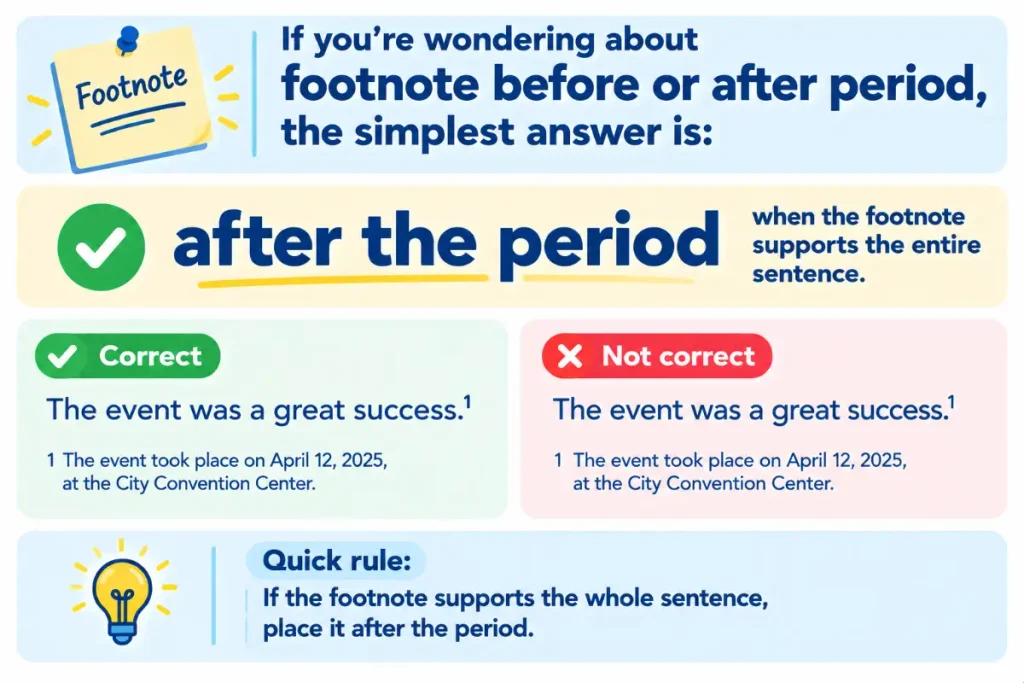
If you’re wondering about footnote before or after period, the simplest answer is: after the period when the footnote supports the entire sentence.
Use this pattern:
Complete sentence.¹
Conclusion
The punctuation closes the sentence, and the superscript number points the reader to the related note. This placement is common in formal academic and professional writing, but individual style guides can have specific rules for special situations. If the footnote refers only to a particular word, phrase, or clause, don’t rely on the basic rule alone. Check the style guide your school, publisher, journal, or organization requires. Once you know the required system, apply its rules consistently throughout the document.
In conclusion, the placement of a footnote marker in relation to a period depends largely on the style guide being followed. In most common academic and professional writing styles, the footnote number is placed after the period at the end of a sentence. This makes the main sentence easier to read while clearly showing that the footnote provides additional information or a source.
However, rules can vary between style guides and institutions. Some formats may have specific requirements for placing footnote markers before or after punctuation, so writers should always check the relevant guidelines. Consistency is especially important when preparing academic papers, research articles, or professional documents. Overall, placing the footnote after the period is generally the safest and most widely accepted choice when no specific style has been provided. By following the required style guide and using footnotes consistently, writers can keep their work clear, organized, and properly documented.
Frequently Asked Questions
Does a footnote go before or after a period?
A footnote number usually goes after the period when it supports the entire sentence. The typical format is “Sentence.¹”
Is it footnote before or after period in academic writing?
In many academic styles that use footnotes, the number goes after the period when the note applies to the whole sentence. Always follow your required style guide.
Should a footnote go before or after a question mark?
When the note supports the entire question, the footnote number generally follows the question mark.
Does the footnote number go before or after quotation marks?
Placement depends on the punctuation and style guide, but a note supporting a complete quoted sentence commonly follows the sentence-ending punctuation.
Can a footnote number come before a period?
It can in some specific contexts, particularly when the note relates directly to a particular word or phrase. However, for a note supporting an entire sentence, after the period is the usual choice.
Is a footnote the same as an in-text citation?
No. A footnote uses a numbered note, usually shown as a superscript in the main text. An in-text citation places source information directly within the text or parentheses.
What’s the easiest way to remember footnote placement?
Remember: finish the sentence, add the punctuation, then add the footnote number. For a complete sentence, the common pattern is “Sentence.¹”
1 thought on “Footnote Before or After Period? A Clear Guide”