
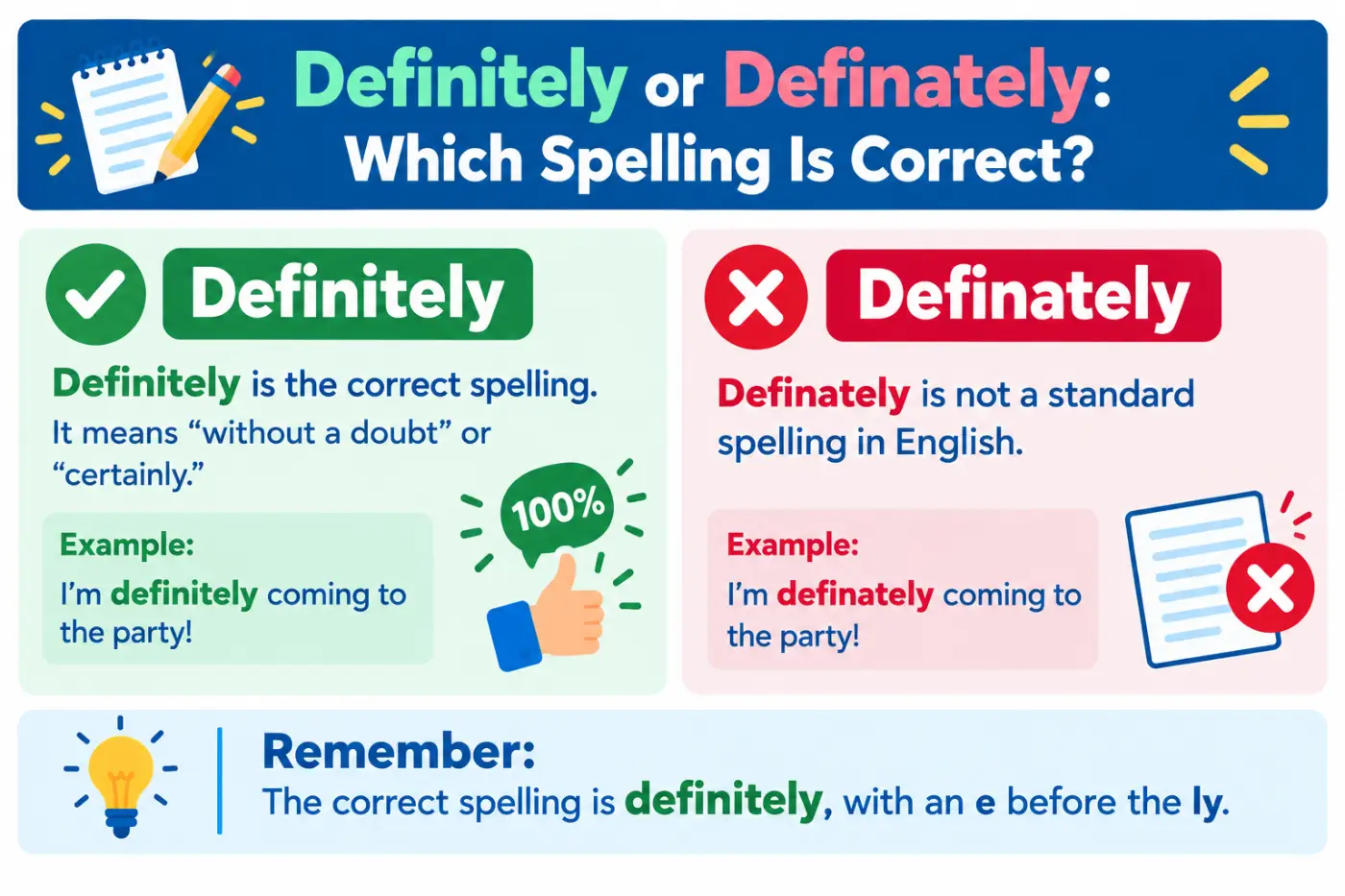
If you’re writing an email, completing a school assignment, or posting on social media, you may wonder whether definately or definitely is the correct spelling. Both forms look similar, and the way people pronounce the word can make the spelling confusing. However, only one is accepted in standard American English.
Definitely is the correct spelling. Definately is a common misspelling and should not appear in formal or professional writing.
The word definitely is an adverb that means certainly, without doubt, or clearly. People use it to express confidence, confirm information, or show that something is certain to happen.
Learning the correct spelling can help you communicate more clearly and avoid mistakes in everyday writing. This guide explains the meaning of definitely, why people misspell it, how to use it in sentences, and which alternatives work best in different situations.
Definitely or Definately: Which Is Correct?
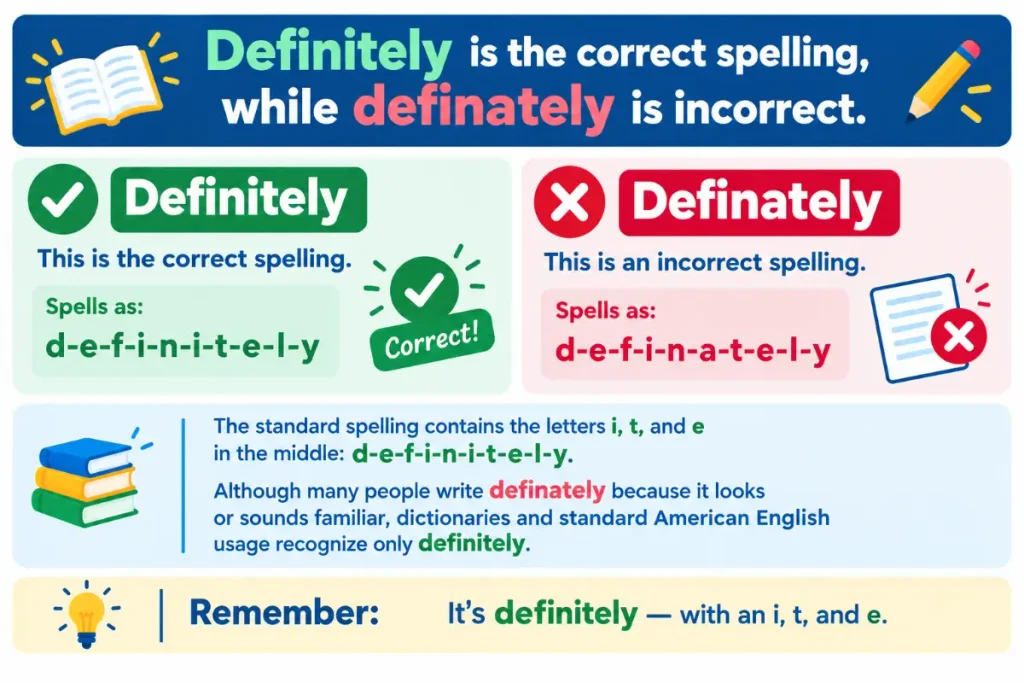
Definitely is the correct spelling, while definately is incorrect. The standard spelling contains the letters i, t, and e in the middle: d-e-f-i-n-i-t-e-l-y. Although many people write definately because it looks or sounds familiar, dictionaries and standard American English usage recognize only definitely.
| Spelling | Correct or Incorrect? | Explanation |
|---|---|---|
| Definitely | Correct | Standard English spelling |
| Definately | Incorrect | Common spelling mistake |
| Definatly | Incorrect | Missing letters |
| Definetely | Incorrect | Incorrect vowel placement |
| Definitly | Incorrect | Missing the second e |
Correct: I will definitely attend the meeting tomorrow.
Incorrect: I will definately attend the meeting tomorrow.
Remember that the correct form always includes the sequence finite after the initial letters: definitely.
What Does Definitely Mean?
Definitely means certainly, without doubt, or in a way that leaves no question about something. It expresses confidence, agreement, or certainty about an action, statement, or situation. People commonly use this word in conversations, emails, academic writing, and professional communication.
Examples of Definitely in Everyday English
- I will definitely visit my grandparents this weekend.
- She is definitely the right person for the job.
- We should definitely try that new restaurant.
- He definitely understood the instructions.
- This is definitely a better solution.
In each example, definitely adds certainty to the statement.
Different Meanings Depending on Context
Although the central meaning remains the same, definitely can communicate slightly different ideas depending on how someone uses it.
| Meaning | Explanation | Example |
|---|---|---|
| Certainly | Something will happen | I will definitely call you. |
| Without doubt | Something is clearly true | She is definitely talented. |
| Strong agreement | Showing complete agreement | Definitely! That’s a great idea. |
| Firm confirmation | Confirming a decision | We are definitely moving next month. |
| Strong emphasis | Making a statement more confident | This is definitely worth reading. |
Why Do People Misspell Definitely as Definately?
Many English speakers accidentally write definately because the pronunciation and spelling do not always seem to match. The confusion usually comes from three common reasons.
1. Confusion About the Vowels
The middle of definitely contains several vowels close together. Writers sometimes replace the correct letters with an a, producing the incorrect form definately.
The correct spelling is:
D-E-F-I-N-I-T-E-L-Y
The incorrect spelling is:
D-E-F-I-N-A-T-E-L-Y
The difference is the letter i in the correct version instead of a.
2. Pronunciation Influences Spelling
In everyday American English, people often pronounce words quickly and reduce unstressed vowel sounds. As a result, the middle of definitely may not sound as clear as it looks in writing. Someone who relies only on pronunciation may choose the wrong vowel. This is why remembering the written form is more reliable than guessing from sound.
3. Typing Quickly
People often make spelling mistakes when writing text messages, social media posts, or emails in a hurry. Because definately looks familiar, writers may not notice the error immediately. Spell-checking tools can help, but learning the correct spelling makes it easier to catch mistakes independently.
How to Spell Definitely Correctly
The easiest way to spell definitely is to break the word into smaller parts.
Definite + ly = Definitely
The word comes from definite, with the suffix -ly added to form an adverb.
Follow these steps:
- Start with the word definite.
- Keep its original spelling.
- Add -ly to the end.
- Write the complete word as definitely.
This method works because the base word already contains the correct vowel sequence.
Break the Word Into Smaller Parts
| Part | Letters |
|---|---|
| Beginning | Def |
| Middle | Init |
| Ending | Ely |
| Complete word | Definitely |
The full spelling is D-E-F-I-N-I-T-E-L-Y.
A useful trick is to remember that definitely contains the word finite.
- Definite
- Finite
- Definitely
This connection helps you remember the correct middle letters.
Is Definitely an Adverb?
Yes. Definitely is an adverb because it modifies a verb, an adjective, or another adverb. It explains how certain something is or emphasizes the strength of a statement.
Here are some examples:
| Sentence | What Definitely Modifies |
|---|---|
| I will definitely return. | The verb phrase will return |
| She is definitely happy. | The adjective happy |
| He definitely works quickly. | The verb works and the statement’s certainty |
| That is definitely correct. | The adjective correct |
Definitely vs. Definite
These two words are related, but they serve different grammatical purposes.
| Word | Part of Speech | Meaning | Example |
|---|---|---|---|
| Definite | Adjective | Clear, certain, or specific | We need a definite answer. |
| Definitely | Adverb | Certainly or without doubt | I definitely agree. |
Definite describes a noun, while definitely adds certainty to a statement.
For example:
- Correct: We have a definite plan.
- Correct: We will definitely follow the plan.
- Incorrect: We have a definitely plan.
Understanding this difference helps prevent grammatical mistakes.
15 Examples of Definitely in Sentences
The best way to understand a word is to see how people use it in different situations. Here are 15 original examples featuring definitely in everyday American English.
Everyday Conversation
- I will definitely bring some snacks to the party.
- That movie is definitely worth watching.
- You should definitely ask your teacher for advice.
- She definitely knows how to make everyone feel welcome.
- We are definitely going to enjoy the weekend.
School and Academic Writing
- The new study method will definitely help students understand the lesson.
- I will definitely review my notes before the exam.
- This book is definitely useful for beginners.
- The experiment definitely supports our original explanation.
Workplace and Professional Communication
- I will definitely send the updated report by Friday.
- Our team should definitely discuss the new proposal.
- She is definitely qualified for the position.
- We will definitely consider your suggestions during the next meeting.
Texting and Social Media
- Definitely! I would love to join you.
- That was definitely one of the best moments of the day.
These examples show that definitely works in casual conversations as well as formal and professional communication.
Definitely vs. Certainly: What’s the Difference?
Definitely and certainly are close synonyms. Both express confidence, but they can create slightly different tones depending on the situation. Definitely often sounds direct and conversational, while certainly can sound slightly more formal or polite.
| Word | Meaning | Tone | Example |
|---|---|---|---|
| Definitely | Without doubt | Direct and conversational | I will definitely attend. |
| Certainly | Without doubt | Neutral or formal | I will certainly attend. |
When Should You Use Definitely?
Use definitely when you want to express strong confidence or agreement.
Examples:
- I definitely recommend this book.
- We should definitely discuss the issue.
- She is definitely the best choice for this project.
When Should You Use Certainly?
Use certainly when you want a slightly more formal or polite expression.
Examples:
- I would certainly appreciate your assistance.
- The company will certainly review your application.
- We can certainly arrange another meeting.
Both words are correct. Your choice depends on the tone you want to create.
Definitely vs. Absolutely: What’s the Difference?
Absolutely is another common alternative to definitely. Both express strong agreement or certainty, but absolutely can sound more emphatic.
| Word | Meaning | Tone | Example |
|---|---|---|---|
| Definitely | Certainly or without doubt | Confident | I will definitely help you. |
| Absolutely | Completely or unquestionably | Strong and emphatic | I will absolutely help you. |
Use definitely for ordinary confirmation and absolutely when you want to emphasize your agreement.
Examples:
- I definitely agree with your suggestion.
- I absolutely agree with your suggestion.
Both sentences communicate agreement, but the second places stronger emphasis on it.
25 Alternatives to Definitely
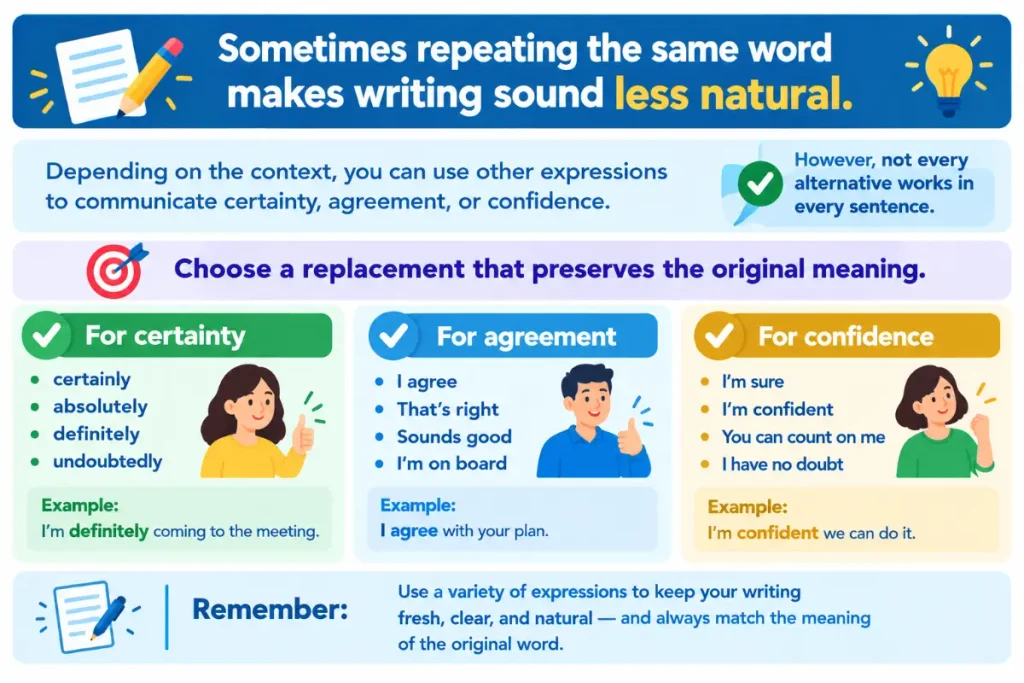
Sometimes repeating the same word makes writing sound less natural. Depending on the context, you can use other expressions to communicate certainty, agreement, or confidence. However, not every alternative works in every sentence. Choose a replacement that preserves the original meaning.
Simple and Everyday Alternatives
| Word/Phrase | Meaning | Tone | Example |
|---|---|---|---|
| Certainly | Without doubt | Neutral | I will certainly help. |
| Absolutely | Completely or unquestionably | Strong | Absolutely, I agree. |
| Surely | With confidence | Conversational | Surely, you remember him. |
| Clearly | In an obvious way | Neutral | She clearly understands. |
| Undoubtedly | Without any doubt | Formal | He is undoubtedly qualified. |
| For sure | Certainly | Casual | I’ll be there for sure. |
| Of course | Naturally or certainly | Friendly | Of course, you can join us. |
| No doubt | Without uncertainty | Conversational | She will succeed, no doubt. |
Formal and Professional Alternatives
| Word/Phrase | Meaning | Tone | Example |
|---|---|---|---|
| Unquestionably | Without room for doubt | Formal | She is unquestionably capable. |
| Indisputably | Impossible to reasonably dispute | Formal | The evidence is indisputably important. |
| Inarguably | Not open to reasonable argument | Formal | This is inarguably a major achievement. |
| Assuredly | With confidence | Formal | We will assuredly review the proposal. |
| Decidedly | Clearly or noticeably | Formal | The new approach is decidedly better. |
| Beyond doubt | Completely certain | Formal | Her experience is beyond doubt. |
| Without question | Certainly | Neutral | He is the right candidate, without question. |
| In fact | Used to emphasize or clarify a statement | Neutral | In fact, we already completed the project. |
Casual and Conversational Alternatives
| Word/Phrase | Meaning | Tone | Example |
|---|---|---|---|
| You bet | Certainly or yes | Casual | You bet, I’ll help you. |
| For certain | Without doubt | Conversational | We will meet again, for certain. |
| No question | Definitely or unquestionably | Casual | She is the right choice, no question. |
| You can count on it | A confident promise | Friendly | You can count on it. |
| Without a doubt | Completely certain | Neutral | He is talented without a doubt. |
| 100 percent | Completely or fully | Informal | I agree 100 percent. |
| Most certainly | Very confidently | Polite | I will most certainly attend. |
| Positively | Certainly or definitely | Neutral | I positively remember that day. |
| For sure | Certainly | Informal | That’s a good idea for sure. |
Which Alternative Should You Choose?
The best replacement depends on your sentence.
- For everyday conversation: Use absolutely, of course, or for sure.
- For professional emails: Use certainly, without question, or most certainly.
- For academic writing: Use undoubtedly or unquestionably when the evidence supports certainty.
- For strong agreement: Use absolutely or 100 percent in informal communication.
- For confident statements: Use clearly or beyond doubt when appropriate.
Remember that words such as clearly and in fact are not exact synonyms in every context. They may emphasize a statement in a different way.
Words Related to Definitely
Understanding related words can make it easier to choose the right form in a sentence.
| Word | Part of Speech | Meaning | Example |
|---|---|---|---|
| Definite | Adjective | Clear or certain | We need a definite answer. |
| Definitely | Adverb | Certainly | I definitely agree. |
| Definition | Noun | The meaning of a word | Check the definition first. |
| Define | Verb | To explain the meaning | Please define the term. |
| Definitive | Adjective | Final, authoritative, or conclusive | This is the definitive answer. |
| Definitively | Adverb | In a final or conclusive way | The issue was definitively resolved. |
| Definiteness | Noun | The quality of being clear or certain | The proposal lacks definiteness. |
| Indefinite | Adjective | Not clearly fixed or limited | The meeting has an indefinite date. |
| Indefinitely | Adverb | For an unlimited or unspecified period | The event was postponed indefinitely. |
These words share a common root, but they have different meanings and grammatical functions.
Definitely or Definitively: What’s the Difference?
Definitely means certainly or without doubt. Definitively means in a final, conclusive, or authoritative way.
| Word | Meaning | Example |
|---|---|---|
| Definitely | Certainly | I will definitely attend the event. |
| Definitively | In a conclusive way | The investigation definitively answered the question. |
More examples:
- I definitely want to learn another language.
- The court definitively settled the dispute.
- She is definitely interested in the opportunity.
- The research did not definitively prove the theory.
Use definitely to express certainty. Use definitively when describing a final or conclusive result.
What Is the Opposite of Definitely?
The best antonym for definitely depends on the meaning of the sentence. Since definitely expresses certainty, its opposites generally communicate doubt, uncertainty, or possibility.
Here are some useful alternatives:
| Antonym | Meaning | Example |
|---|---|---|
| Possibly | Maybe something can happen | I could possibly attend. |
| Perhaps | Maybe | Perhaps we should wait. |
| Maybe | Possibly | Maybe she will call later. |
| Uncertainly | In an unsure way | He answered uncertainly. |
| Doubtfully | With doubt | She looked at the proposal doubtfully. |
| Not necessarily | Not always or certainly | That is not necessarily true. |
| Unlikely | Not expected to happen | Rain is unlikely tomorrow. |
| Probably not | Most likely not | I will probably not attend. |
For example:
- Definitely: I will definitely join the team.
- Possibly: I could possibly join the team.
- Unlikely: I am unlikely to join the team.
These expressions communicate different levels of confidence, so choose one that accurately reflects your meaning.
Can You Use Definitely in Formal Writing?
Yes. Definitely is a standard English word that works in both formal and informal writing. However, the best choice depends on the purpose and tone of your document.
Definitely in Professional Emails
You can use definitely to confirm plans, express agreement, or communicate confidence.
Examples:
- I will definitely send the revised document tomorrow.
- We will definitely consider your recommendations.
- I can definitely attend the scheduled meeting.
For more formal situations, certainly or unquestionably may sometimes sound more appropriate.
Definitely in Academic Writing
Definitely is grammatically correct in academic writing, but writers should use it carefully. Academic arguments should rely on evidence rather than unsupported expressions of certainty.
For example:
Less precise: This experiment definitely proves the theory.
More precise: The experiment provides strong evidence supporting the theory.
The second sentence is more suitable when the results support a theory but do not establish it conclusively.
Definitely in Resumes
You can spell definitely correctly in a resume, but the word rarely adds useful information to professional achievements.
Instead of writing:
- I am definitely a hardworking employee.
Consider:
- I consistently meet deadlines and complete projects efficiently.
The revised version provides more meaningful information about your skills.
Definitely in Text Messages
Definitely is perfectly natural in texting.
Examples:
- Definitely! See you tomorrow.
- I definitely want to come.
- That sounds like a great idea. Definitely!
In casual conversations, you can also use absolutely, for sure, or of course.
Common Mistakes to Avoid When Using Definitely
Even though definitely is a simple word, writers often make spelling and usage mistakes. Here are some common problems and their corrections.
1. Writing Definately Instead of Definitely
This is the most common mistake.
- Incorrect: I definately agree with you.
- Correct: I definitely agree with you.
Remember that the correct spelling contains an i rather than an a in the middle.
2. Writing Definetely
Some writers place the vowels in the wrong order.
- Incorrect: She will definetely arrive early.
- Correct: She will definitely arrive early.
Always check the sequence of letters in the middle.
3. Confusing Definitely With Definitively
These words are related but have different meanings.
- Incorrect for the intended meaning: I will definitively attend the party.
- Better: I will definitely attend the party.
Use definitively when you mean that something happens in a final or conclusive way.
4. Using Definitely When You Mean Possibly
Definitely expresses certainty, while possibly expresses possibility.
- Incorrect for uncertain meaning: I will definitely visit if I have time.
- Better: I may visit if I have time.
The second sentence communicates uncertainty more accurately.
5. Repeating Definitely Too Often
Using the same adverb several times can make writing sound repetitive.
For example:
Repetitive: I will definitely attend. I definitely want to see everyone, and I will definitely bring food.
Improved: I will certainly attend. I look forward to seeing everyone, and I’ll bring some food.
Vary your wording when appropriate, but don’t replace definitely with an alternative that changes your meaning.
Easy Tricks to Remember the Correct Spelling
If you frequently confuse definitely and definately, these simple memory tricks can help.
1. Remember the Word Finite
The word definitely contains finite.
- Definite
- Finite
- Definitely
Remembering this connection makes it easier to avoid adding an incorrect a.
2. Start With Definite
Instead of memorizing the entire word, remember its base form.
Definite + ly = Definitely
This is one of the simplest ways to remember the correct spelling.
3. Focus on the Middle Letters
The correct sequence is:
I-N-I-T-E
Avoid changing the second vowel to a.
4. Practice With Short Sentences
Writing a few examples can help you become more familiar with the correct spelling.
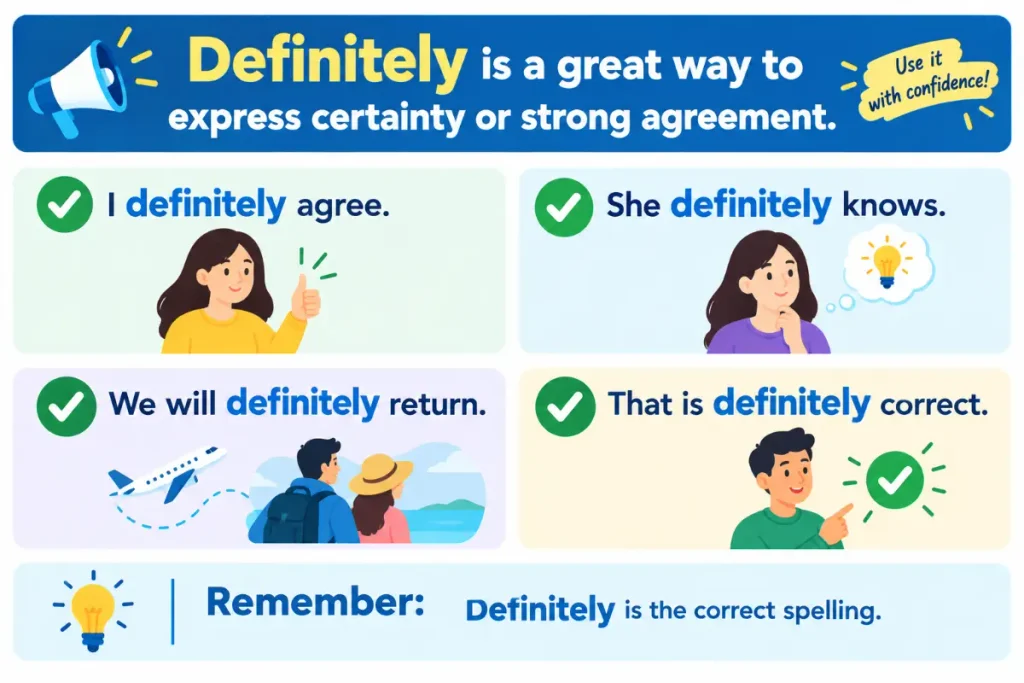
- I definitely agree.
- She definitely knows.
- We will definitely return.
- That is definitely correct.
5. Read Before Sending
Before submitting an assignment or sending a professional email, check the spelling of words that you commonly misspell.
A quick review can prevent simple errors from appearing in your writing.
Conclusion
Choosing the correct spelling makes your writing clearer and more professional. When comparing definately or definitely, always remember that definitely is the correct form. The alternative, definately, is a common spelling error that comes from confusion about the vowels in the middle of the word.
An easy way to remember the spelling is to start with the adjective definite and add -ly to create definitely. You can also remember the word finite hidden inside its spelling. Use definitely when expressing certainty, confirming information, or showing strong agreement. With regular practice and careful proofreading, you can avoid this common mistake and use the word confidently in emails, school assignments, professional documents, and everyday conversations.
Frequently Asked Questions
1. Is It Definitely or Definately?
Definitely is correct. Definately is a common spelling mistake and is not accepted as the standard spelling in American English.
2. How Do You Spell Definitely Correctly?
The correct spelling is D-E-F-I-N-I-T-E-L-Y. Remember the base word definite and add the suffix -ly.
3. What Does Definitely Mean?
Definitely means certainly, without doubt, or unquestionably. For example, “I will definitely attend the meeting” expresses confidence that the speaker will attend.
4. Why Do People Spell Definitely as Definately?
People often write definately because they confuse the vowel sounds in the middle of the word. The correct spelling contains an i, not an a.
5. Is Definitely a Formal or Informal Word?
Definitely works in both formal and informal English. However, words such as certainly or unquestionably may be more suitable in some professional or academic contexts.
6. What Is Another Word for Definitely?
Common alternatives include certainly, absolutely, undoubtedly, unquestionably, and without a doubt. The best choice depends on the sentence and intended tone.
7. Is Definitely an Adverb?
Yes. Definitely is an adverb that expresses certainty or emphasizes a statement. For example, “She definitely understands the instructions.”
2 thoughts on “Definitely or Definately: Which Spelling Is Correct?”