
If you’re writing about a payment plan, a loan, or a purchase you want to pay off over time, you may wonder whether instalments or installments is the correct spelling. Both forms are correct, but the right choice depends on the type of English you’re using. American English uses installments, while British English generally uses instalments.
An installment is one of a series of payments made over time to pay for something. For example, if you buy a laptop and agree to pay for it in six monthly payments, each payment is an installment in American English.
The main difference between instalments and installments is regional spelling. Use installments for American audiences and instalments for British audiences. Both spellings have the same meaning and are used in financial agreements, payment plans, and everyday communication.
Understanding this spelling difference can help you write more clearly in financial documents, business emails, academic assignments, and everyday messages. This article explains the meanings, spelling rules, sentence examples, common mistakes, and regional differences between the two forms.
What Does Instalments or Installments Mean?
Both instalments and installments refer to separate payments made at different times to pay off a total amount. These payments usually follow an agreed schedule, such as weekly, monthly, quarterly, or annually. For example, someone who purchases furniture for $1,200 might agree to pay $200 each month for six months. Each $200 payment is an installment. The word can also refer to a part of a larger series, such as a book, television program, or movie franchise. However, the financial meaning is especially common in discussions about loans, purchases, and payment agreements.
Here are the main details:
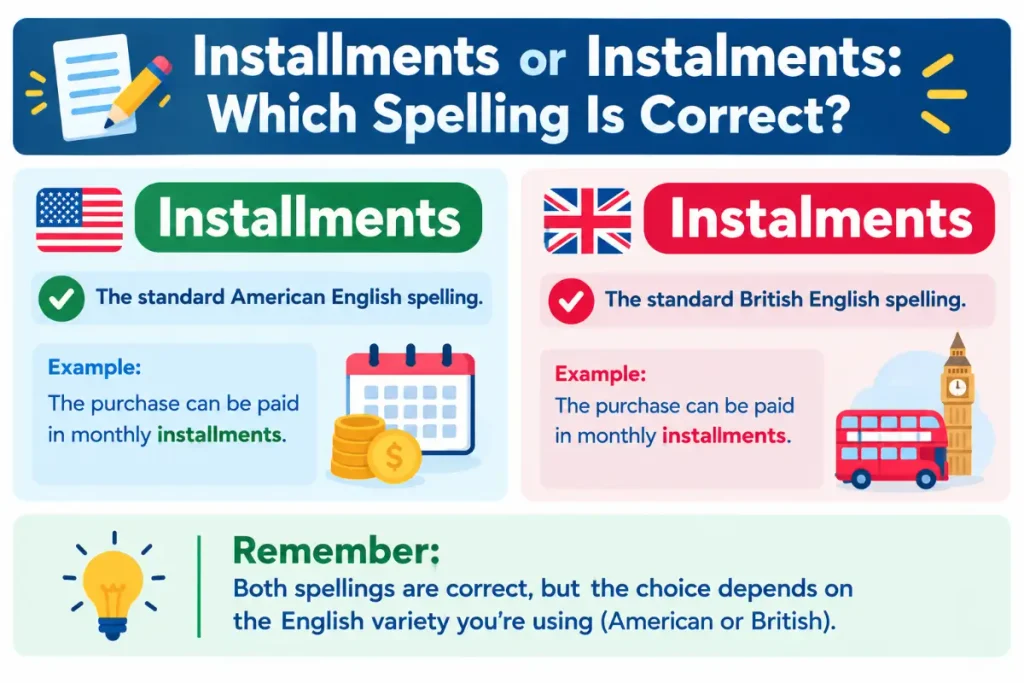
- Installments: The standard American English spelling.
- Instalments: The standard British English spelling.
- Meaning: Individual payments made as part of a larger amount owed.
- Part of speech: Noun.
- Plural form: Installments or instalments, depending on the regional spelling.
- Singular form: Installment or instalment.
The spelling changes, but the pronunciation and meaning remain essentially the same.
Instalments vs. Installments: What’s the Difference?
The difference between these words comes down to regional spelling conventions. American English generally doubles the letter l in installment, while British English typically uses one l in instalment.
| Feature | Installments | Instalments |
|---|---|---|
| English variety | American English | British English |
| Spelling | Two l’s | One l |
| Meaning | Scheduled partial payments | Scheduled partial payments |
| Pronunciation | Essentially the same | Essentially the same |
| Common usage | US financial writing | UK financial writing |
| Singular form | Installment | Instalment |
| Example | Monthly installments | Monthly instalments |
Neither spelling is universally wrong. Each is appropriate in its own regional context.
Which Spelling Should American Writers Use?
American writers should generally use installments. This spelling appears in US financial communication, retail agreements, consumer lending materials, and general American English writing.
For example:
- The customer agreed to pay the balance in twelve monthly installments.
- Our company offers interest-free installments on selected products.
- She made the final installment on her car loan last week.
If you’re writing an American English article, business proposal, school assignment, or customer email, choose installments for consistency.
Which Spelling Should British Writers Use?
British writers generally use instalments. The single-l form follows common British spelling conventions and appears in British financial and commercial writing.
Examples include:
- The buyer paid for the furniture in monthly instalments.
- Customers can spread the cost over six instalments.
- The final instalment is due at the end of December.
British spelling is also relevant to readers in other English-speaking regions that follow British conventions, although usage can vary by country, organization, and publication.
Why Do Instalments and Installments Have Different Spellings?
English spelling varies across regions because American and British English developed different conventions over time. Many words that end in -ment or contain doubled consonants follow different patterns in the two varieties. The difference between instalment and installment is one example of this variation. American English often retains or uses a doubled consonant in forms such as installment. British English generally writes instalment with one l. Both forms remain established spellings.
You can see similar regional differences in words such as:
| American English | British English |
|---|---|
| Traveling | Travelling |
| Canceled | Cancelled |
| Enrollment | Enrolment |
| Installment | Instalment |
| Fulfill | Fulfil |
These examples do not all follow one universal spelling rule. English spelling has several historical patterns, and individual words sometimes preserve different forms. The best approach is to learn the accepted spelling of each word and follow the conventions of your intended audience.
How to Use Installments and Instalments Correctly
Both spellings function as plural nouns. They describe two or more payments that form part of a larger financial obligation. The singular noun refers to one payment, while the plural noun refers to multiple payments.
Singular and Plural Forms
| Form | American English | British English |
|---|---|---|
| Singular | Installment | Instalment |
| Plural | Installments | Instalments |
Examples:
- Singular: The first installment is due on November 1.
- Plural: The remaining installments are due each month.
- Singular: She missed an instalment on her loan.
- Plural: The final three instalments must be paid by March.
Remember that the spelling of the singular form determines the spelling of the plural form. American English uses installment and installments, while British English generally uses instalment and instalments.
Common Phrases With Installments
The word frequently appears in expressions related to payment schedules and financial agreements.
Common phrases include:
- Monthly installments
- Equal installments
- Installment payments
- Installment plan
- Payment by installments
- Interest-free installments
- Installment loan
- Final installment
- First installment
- Installment agreement
British writers can use the corresponding single-l spelling in these expressions. For example, an American retailer might advertise an installment plan, while a British retailer might describe the same arrangement as an instalment plan.
Instalments or Installments in Real Sentences
Examples make the regional spelling difference easier to understand. The following sentences use the words in financial, educational, professional, and everyday situations.
American English Examples
- Shopping: I bought a new refrigerator and agreed to pay for it in twelve monthly installments.
- Banking: The bank calculated the monthly installments based on the loan amount and repayment period.
- Business: Our company allows eligible customers to purchase equipment through an installment plan.
- Education: The student paid the tuition fees in three installments instead of paying the full amount at once.
- Email: Please confirm that you received the first installment of the payment.
- Everyday life: We saved money each month to cover the remaining installments on our furniture.
- Car purchase: He chose a longer repayment period to make his monthly installments more manageable.
- Online shopping: The website offers installment payments for selected purchases.
- Rent and services: The customer agreed to pay the outstanding balance in two installments.
- Financial planning: Before accepting the loan, she reviewed the amount and due date of every installment.
British English Examples
- The first instalment of the loan must be paid by the end of the month.
- Customers may divide the total cost into six monthly instalments.
- He paid the final instalment and completed the purchase.
- The company sent a reminder about the upcoming instalment.
- The agreement explains when each instalment is due.
These examples demonstrate that both spellings work in the same grammatical contexts. Your choice depends on the regional variety of English you are following.
Installments or Installment Payments
The expressions installments and installment payments are closely related, but they serve slightly different purposes in a sentence. Installments is a concise term for the individual payments in a payment schedule. Installment payments emphasizes the payments themselves, often in financial or commercial explanations.
| Expression | Meaning | Example |
|---|---|---|
| Installments | Separate portions of an amount paid over time | The installments are due monthly. |
| Installment payments | Payments made according to a scheduled plan | The store accepts installment payments. |
| Installment plan | An arrangement for paying over time | We selected a six-month installment plan. |
| Installment loan | A loan repaid through scheduled payments | She applied for an installment loan. |
These expressions are all common in American English. British English generally uses instalments, instalment payments, instalment plan, and instalment loan. Choose the expression that best communicates your intended meaning rather than repeating the same wording throughout a document.
Installments or Payments: What’s the Difference?
Installments and payments are related, but they are not always interchangeable. A payment is money transferred to someone to purchase a product, settle a debt, or pay for a service. An installment is one part of a larger amount paid according to an arrangement or schedule.
| Word | Meaning | Example |
|---|---|---|
| Payment | Money given in exchange for something or to settle an obligation | I made a payment toward my credit card balance. |
| Installment | One scheduled part of a larger amount | My next installment is due on Friday. |
For example, if you pay $500 for a product in one transaction, you have made a payment. If you agree to pay $100 each month for five months, each scheduled $100 amount is an installment. Every installment is a payment, but not every payment is an installment.
Installments or Deposits: What’s the Difference?
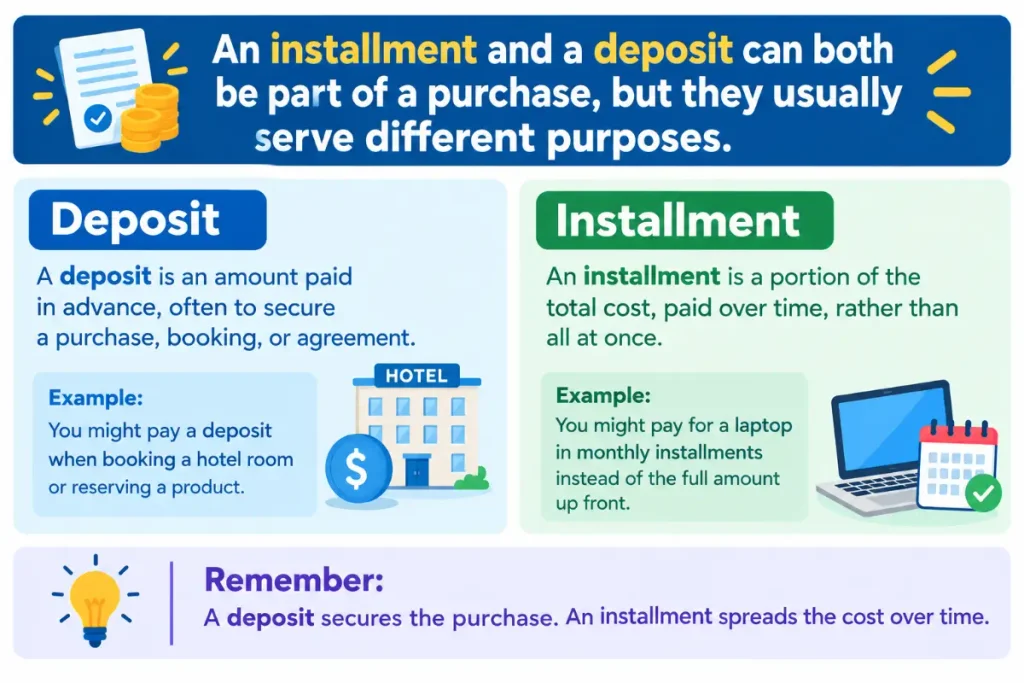
An installment and a deposit can both be part of a purchase, but they usually serve different purposes. A deposit is an amount paid in advance, often to secure a purchase, booking, or agreement. An installment is one of several payments made under a payment schedule. Consider buying a car. You might pay a deposit when signing the purchase agreement and then make monthly installments toward the remaining balance.
| Term | Main purpose | Example |
|---|---|---|
| Deposit | An initial or advance payment | She paid a deposit to reserve the car. |
| Installment | A scheduled payment toward the total amount | She pays monthly installments on the remaining balance. |
The precise meaning of a deposit depends on the agreement. It may be refundable or nonrefundable, and it may or may not reduce the amount owed. Always check the terms before assuming how the money will be applied.
Installments vs. Subscriptions: What’s the Difference?
An installment plan and a subscription can both involve recurring payments, but they generally work differently. An installment plan usually divides the cost of a purchase or debt into a set number of payments. A subscription typically provides ongoing access to a product or service in exchange for recurring fees.
| Feature | Installment plan | Subscription |
|---|---|---|
| Purpose | Pay off a purchase or debt | Maintain access to a service or product |
| Payment schedule | Often a fixed number of payments | Usually recurring until canceled or ended |
| Typical example | Paying for a laptop over six months | Paying monthly for a streaming service |
| End point | Often specified in the agreement | Depends on the subscription terms |
The distinction matters when explaining financial arrangements. A monthly charge is not automatically an installment simply because it repeats every month. Some products combine recurring access with payment obligations, so the specific contract determines how the arrangement works.
What Is an Installment Plan?
An installment plan allows a buyer to divide the cost of a purchase into multiple payments rather than paying the entire amount at once. For example, a store might offer a $600 purchase with six monthly payments of $100, assuming there are no additional fees or interest charges. Installment plans may be available for products such as furniture, electronics, appliances, vehicles, and other large purchases. The exact terms depend on the retailer, lender, and agreement.
Before choosing a plan, consider these factors:
- Total cost: Check how much you will pay over the entire term.
- Interest: Determine whether the plan charges interest.
- Fees: Look for setup fees, late fees, or other charges.
- Payment dates: Confirm when each payment is due.
- Late-payment terms: Understand the consequences of missed payments.
- Early repayment: Check whether you can pay the remaining balance early and whether fees apply.
An installment plan can make a large expense easier to budget for, but smaller monthly payments do not necessarily mean a lower overall cost.
Common Mistakes When Using Instalments or Installments
The most common mistake is choosing the spelling that does not match the intended variety of English. Other errors involve confusing installments with different types of payments.
1. Mixing American and British Spellings
Inconsistent:
The customer paid three instalments before making the final installment.
Consistent American English:
The customer paid three installments before making the final installment.
Consistent British English:
The customer paid three instalments before making the final instalment.
Consistency makes a document easier to read and helps maintain a professional tone.
2. Treating the British Spelling as Incorrect
Incorrect assumption: Instalments is always a misspelling.
Correct understanding: Instalments is a standard British English spelling. American English generally uses installments.
Do not automatically correct the British form in a document written for a British audience.
3. Using the Wrong Singular Form
Incorrect for standard American English: The first instalment is due tomorrow.
Preferred American form: The first installment is due tomorrow.
Preferred British form: The first instalment is due tomorrow.
The British version is not grammatically incorrect. The correction depends on the style of English required.
4. Confusing an Installment With the Total Amount
An installment is one portion of the total amount, not necessarily the full balance.
Unclear: The entire purchase costs four installments.
Clearer: The purchase will be paid off in four installments.
The revised sentence explains that the buyer will make four separate payments.
5. Assuming Every Installment Plan Is Interest-Free
An installment plan does not automatically mean that a purchase is free of interest or extra charges.
Misleading: All installment plans let you pay without extra costs.
More accurate: Some installment plans are interest-free, while others charge interest or fees. Check the agreement instead of assuming every plan has the same terms.
American vs. British English: How to Stay Consistent
If you write for different audiences, the simplest approach is to choose a regional spelling style before you begin. American English generally uses installments. British English generally uses instalments. Both are accepted forms, and neither changes the meaning of the word.
Follow these guidelines:
- For US websites: Use installments.
- For American school assignments: Follow the instructor’s required style, usually American English.
- For US business emails: Use installments unless a company style guide says otherwise.
- For British publications: Use instalments.
- For international documents: Follow the organization’s preferred spelling convention.
- For quotations: Preserve the original spelling when quoting a source directly.
You should also check related words in the same document. For instance, a US document might use installment plan, enrollment, and traveling, while a British document might use instalment plan, enrolment, and travelling.
These are general patterns rather than rules that apply identically to every English-speaking country. Canadian, Australian, and other regional conventions can differ by word and publication.
What Are Some Alternatives to Installments?
The best alternative depends on what you want to describe. If you mean scheduled payments, you can use terms such as payments, scheduled payments, or partial payments. If you mean the arrangement itself, payment plan may be more suitable.
| Alternative | Meaning | Example |
|---|---|---|
| Payments | Money paid for a purchase or obligation | The payments are due every month. |
| Partial payments | Payments covering portions of a total amount | The company accepted partial payments. |
| Scheduled payments | Payments arranged for specific dates | Scheduled payments begin in January. |
| Monthly payments | Payments made each month | Monthly payments fit the budget. |
| Regular payments | Payments made at recurring intervals | Regular payments continue for a year. |
| Payment plan | An arrangement for paying over time | We agreed to a payment plan. |
| Repayments | Payments made to return borrowed money | Loan repayments start next month. |
| Loan payments | Payments made toward a loan | Loan payments are due on the fifth. |
| Deferred payments | Payments postponed until a later time | The agreement allows deferred payments. |
| Lump-sum payment | One payment covering the full amount due | She chose a lump-sum payment instead. |
These alternatives are related rather than exact synonyms. For example, deferred payments emphasizes a delay, while lump-sum payment refers to paying the full amount at once. For everyday American English, monthly payments or payment plan may sound more natural than installments in some contexts. In a loan agreement, however, installments may be the more precise term.
How to Remember the Correct Spelling
A simple way to remember the difference is to associate the spelling with the audience.
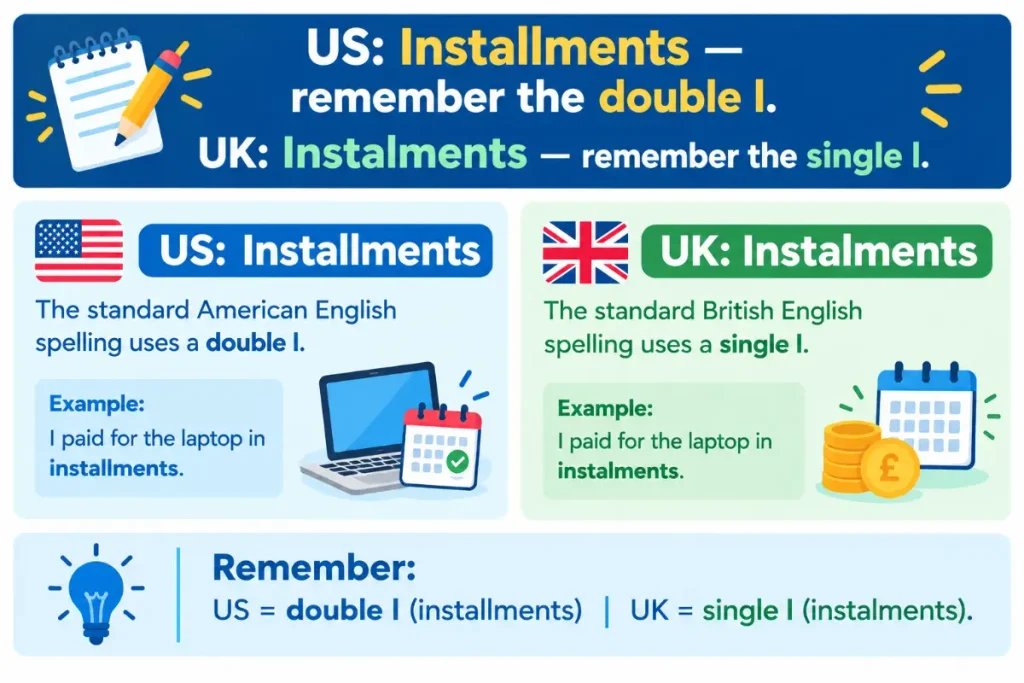
- US: Installments — remember the double l.
- UK: Instalments — remember the single l.
- Same meaning: Both forms describe payments made in parts over time.
- Check the style: Use the spelling that matches the rest of your writing.
You can also use your spell-checking settings to help. Select American English for a US-focused document or British English for a British-focused document. A spell-checker may flag the other regional spelling, but that does not mean the word is universally incorrect.
If you’re editing a document written by someone else, check the overall style before changing every instance. Consistent regional spelling is more important than forcing one country’s convention onto every audience.
Conclusion
The choice between instalments or installments depends on your audience and the spelling convention you follow. Both words have the same meaning: separate payments made over time to cover a larger amount. American English generally uses installments, while British English generally uses instalments.
For US readers, use installments in articles, emails, school assignments, business documents, and financial explanations. If you’re writing for a British audience, instalments is the usual choice. Neither form is universally wrong, so avoid treating a valid regional spelling as a mistake.
The most important rule is consistency. Choose the appropriate spelling for your audience, check related words in your document, and use the term that clearly describes the payment arrangement. By following these simple guidelines, you can write about installment plans and scheduled payments with greater clarity and confidence.
Frequently Asked Questions
Is instalments or installments correct?
Both spellings are correct. Installments is standard American English, while instalments is generally used in British English.
How do Americans spell installments?
Americans generally spell the word installments, with two l’s. Use this form in US business writing, financial documents, and everyday communication.
Is instalments a British spelling?
Yes. Instalments is a standard British English spelling that refers to scheduled portions of a larger payment.
Do instalments and installments mean the same thing?
Yes. Both words refer to separate payments made over time to cover a total amount. Their difference is regional spelling, not meaning.
Is installment one word or two?
Installment is one word in American English, and instalment is one word in British English. Both can form compounds such as installment plan and instalment plan.
What is the plural of installment?
The American English plural is installments. The British English plural is instalments. Both forms follow their respective singular spellings.
What is another word for installments?
Depending on the context, alternatives include payments, partial payments, monthly payments, and scheduled payments. Use payment plan when referring to the arrangement rather than to the individual payments.