
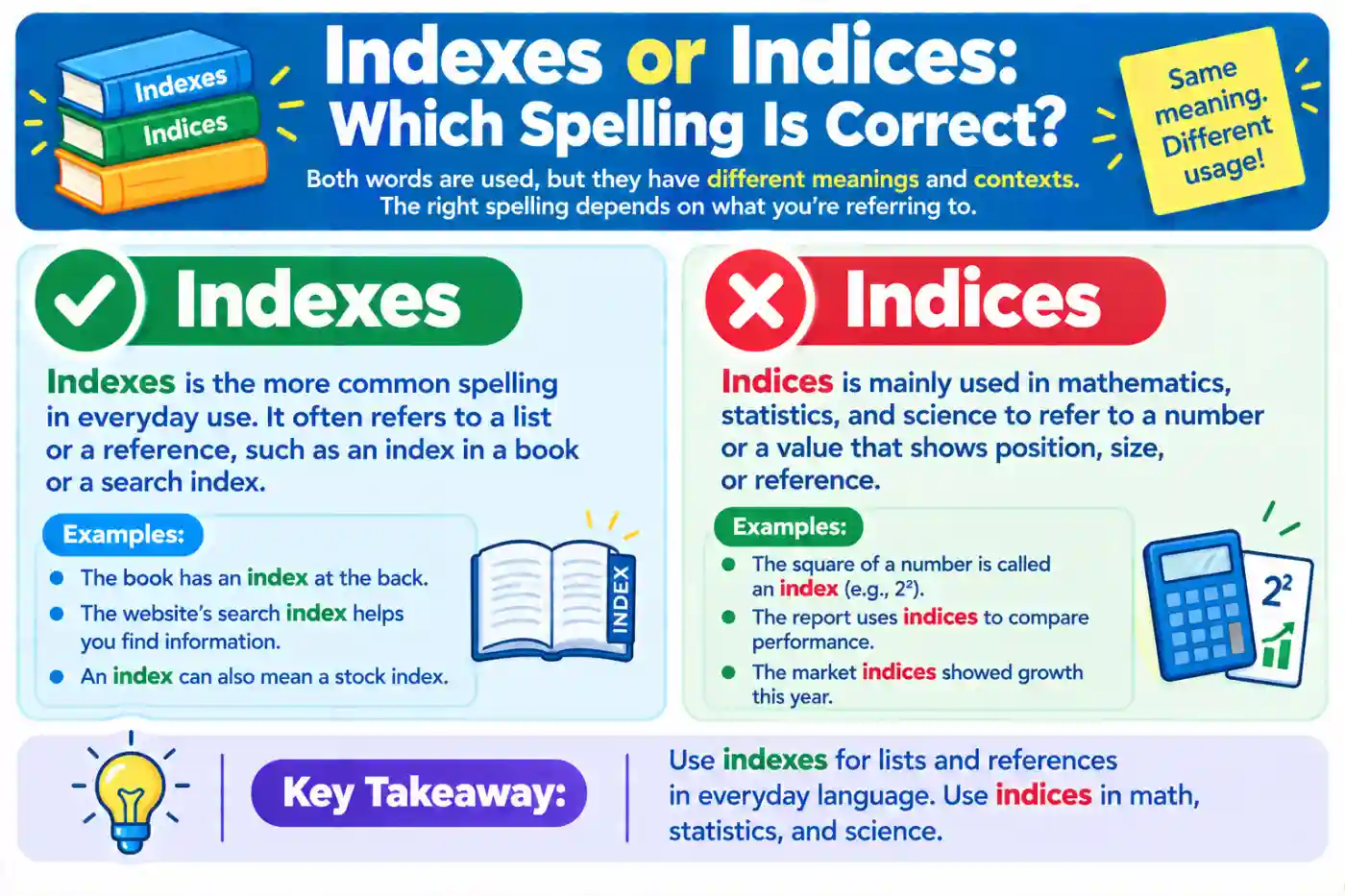
If you’re writing a report, organizing data, or discussing the plural of index, you may wonder whether to use indexes or indices. Both spellings are correct in English, but the better choice often depends on the context, audience, and type of writing.
Indexes and indices are both accepted plural forms of index. In American English, indexes is common in everyday writing, business documents, and general references, while indices often appears in mathematics, science, economics, and technical writing.
Although the two words share the same singular form, their usage can vary across different fields. Choosing the right one helps you communicate clearly and match your audience’s expectations.
This article explains the difference between indexes and indices, provides practical examples, compares their use in American English, and answers common questions about which plural form to choose.
Indexes or Indices: What’s the Difference?
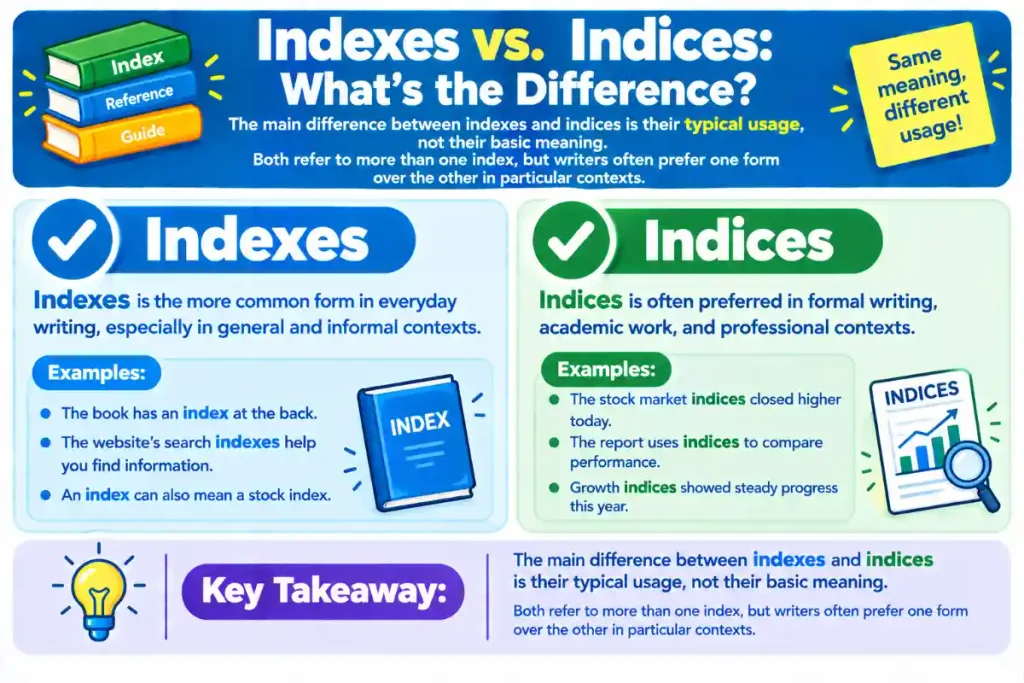
The main difference between indexes and indices is their typical usage, not their basic meaning. Both refer to more than one index, but writers often prefer one form over the other in particular contexts. An index can be a list of topics in a book, a statistical measure, a database structure, or a mathematical quantity. The plural form you choose may depend on which meaning you intend.
| Word | Part of speech | Meaning | Common usage |
|---|---|---|---|
| Index | Singular noun | One list, measure, or indicator | One index of economic activity |
| Indexes | Plural noun | Two or more lists, measures, or indicators | Book indexes and database indexes |
| Indices | Plural noun | Two or more lists, measures, or indicators | Mathematical indices and stock market indices |
For example:
- Indexes: The library maintains separate indexes for its history and science collections.
- Indices: The researcher compared several mathematical indices to identify a pattern.
Both sentences use the correct plural form. The difference lies in the context and the convention the writer follows.
When Should You Use Indexes?
Use indexes when you want a straightforward plural that works well in general American English. It is especially useful when discussing books, databases, search systems, and collections of information.
Examples include:
- The publisher updated the indexes in both editions.
- Our website uses multiple indexes to organize its content.
- The librarian checked the indexes for relevant names.
- The database administrator created new indexes to improve search performance.
In these examples, indexes sounds natural and clearly communicates that more than one index exists. For most everyday writing, you can choose indexes without worrying about sounding incorrect or informal.
When Should You Use Indices?
Use indices when the context calls for a traditional or field-specific plural. This form is especially common in mathematics, physics, economics, and some areas of finance.
Examples include:
- The mathematician calculated the indices for each variable.
- Several economic indices showed changes in consumer activity.
- The textbook explains how indices work in tensor notation.
- The analyst compared major market indices before preparing the report.
In technical writing, indices may match the terminology readers expect. However, the preferred form can vary by discipline, publication, or organization.
Quick rule: Choose indexes for general use and indices when your subject area or established style calls for it. Both forms are correct.
Is Indexes or Indices Correct in American English?
Both indexes and indices are correct in American English. Neither spelling is universally wrong, and you do not need to treat one as the American form and the other as exclusively British. American writers use indexes in ordinary contexts, including books, websites, and databases. They also use indices in technical discussions, particularly in mathematics, economics, and scientific research.
Consider these examples:
- The editor reviewed the indexes at the back of the books.
- The economist examined several price indices.
- The software engineer rebuilt the database indexes.
- The professor explained the properties of matrix indices.
All four sentences are acceptable in American English.
The key is to consider your intended meaning and audience. If you are writing for a general audience, indexes is often the simpler choice. If you are preparing a mathematical paper or working in a field that consistently uses indices, follow that convention.
Do British English and American English Use Different Forms?
British and American English both recognize indexes and indices. The difference is not a strict national spelling rule. Some British publications favor indices in technical or formal contexts, but American publications use it too. Likewise, indexes appears in British writing.
The subject often matters more than the country.
| Context | Common choice | Notes |
|---|---|---|
| General writing | Indexes | Clear and widely understood |
| Book references | Indexes | Common in publishing and library work |
| Database management | Indexes | Standard in much software documentation |
| Mathematics | Indices | Common in many mathematical contexts |
| Economics | Both | Depends on the measure and publication style |
| Stock markets | Both | Usage varies by institution and publication |
| Scientific research | Both | Follow the terminology of the field |
If you are writing for an American audience, you can use either form when appropriate. Do not change a correct technical term simply because you are writing in American English.
What Does Indexes Mean?
Indexes is the plural form of index. It refers to two or more lists, indicators, measures, or structures that help people organize, locate, or interpret information. The word index has several meanings, so its plural form can refer to different things.
Indexes in Books and Publishing
In publishing, an index is an alphabetical list of names, subjects, or other important terms, usually placed at the end of a book. It helps readers find specific information quickly. When a book has more than one such list, you can refer to them as indexes.
Examples:
- The editor checked the indexes for spelling errors.
- The reference books contain detailed indexes of historical figures.
- The new edition includes indexes for both authors and subjects.
- The librarian used the indexes to locate information about early American history.
In these sentences, indexes describes lists that make information easier to find.
Indexes in Computing and Databases
In computing, an index is a data structure that helps a system find information more efficiently. Database indexes can improve searches and data retrieval when they suit the queries being performed. The plural indexes is common in database documentation and software development.
Examples:
- The developer created indexes for frequently searched columns.
- The database uses several indexes to locate customer records.
- The team removed unused indexes during system maintenance.
In technical documentation, consistency is important. If your software documentation uses indexes, keep that form throughout the document unless a specific term or external standard requires something else.
Indexes in General Research
Researchers may use indexes to measure changes, compare results, or organize information.
For example:
- The study examined indexes of public health across several regions.
- The team compared different indexes before selecting a measurement method.
- The report includes indexes that summarize changes in business activity.
In research writing, either plural may work. Check whether the field or the source material uses a particular convention.
What Does Indices Mean?
Indices is another plural form of index. It has the same basic plural meaning as indexes, but it is particularly common in technical and academic contexts. The word often appears when a writer discusses mathematical notation, economic measurements, or scientific variables.
Indices in Mathematics
In mathematics, an index can identify a position, variable, term, or element in a mathematical expression. The plural indices appears frequently in textbooks and technical discussions.
For example:
- The student learned how indices represent positions in an array.
- The professor explained the rules for manipulating indices in algebra.
- The equation contains several indices that identify different variables.
The precise meaning depends on the branch of mathematics. In some contexts, index may refer to a subscript, an exponent-related quantity, or a specific mathematical measure. Do not assume that every mathematical use of index means exactly the same thing. Follow the terminology used in your course or reference.
Indices in Economics
Economists use indexes and indices to describe measures that track changes in prices, production, employment, and other economic conditions. For instance, a price index can show how the cost of a group of goods changes over time. Several such measures may be called price indices.
Examples:
- Economists compared the price indices for different regions.
- The report discussed changes in major economic indices.
- Researchers examined several indices of consumer confidence.
In economics, both indexes and indices appear in published writing. A particular institution may prefer one form, so follow its established terminology when preparing a report.
Indices in Finance
Financial writers often use indices when referring to market benchmarks and groups of securities.
For example:
- Investors followed several international stock market indices.
- The report compared the performance of major market indices.
- The analyst reviewed the indices before preparing the market summary.
However, indexes is also correct in financial writing. The choice may depend on the publication, institution, or name of a particular measure. When discussing an officially named financial benchmark, use its established name rather than changing the wording to match your personal preference.
Indexes or Indices: Examples in Real Sentences
The easiest way to understand the difference between indexes and indices is to see how writers use both forms in real-world situations. The following original examples show common contexts in which each plural may appear.
| Context | Example sentence | Why it works |
|---|---|---|
| School | The teacher asked students to compare the indexes in two reference books. | Refers to lists in books. |
| Library | The librarian updated the indexes after adding new materials. | Describes multiple information-finding lists. |
| Publishing | The editor checked the indexes before approving the final edition. | Uses a common publishing term. |
| Technology | The engineer rebuilt the database indexes after reorganizing the records. | Fits common computing usage. |
| Website | Search engines use indexes to help retrieve relevant pages. | Refers to organized digital information. |
| Mathematics | The student learned how indices identify different terms in the expression. | Fits mathematical terminology. |
| Economics | The researcher compared several economic indices. | Fits a common academic convention. |
| Finance | The report discussed the performance of international market indices. | Uses a common financial form. |
| Science | The team analyzed several indices to compare experimental results. | Works in a technical context. |
| Business | The manager reviewed the indexes used in the company’s reports. | Uses the general plural naturally. |
| Research | The authors selected indexes that matched their research goals. | Uses a broad, general term. |
| Data analysis | The analyst compared the indices across different datasets. | Fits a technical discussion. |
These examples demonstrate that neither spelling is limited to one setting. The surrounding subject and the writer’s preferred convention help determine the most natural choice.
More Examples With Indexes
Here are additional sentences using indexes in everyday and professional writing.
- The new reference guide includes indexes for names, places, and subjects.
- Our team created separate indexes for each category of documents.
- The librarian checked the indexes before ordering additional copies.
- The website’s search system relies on indexes to retrieve stored information.
- The database administrator removed several outdated indexes.
Each sentence uses indexes to describe multiple lists or data structures.
More Examples With Indices
The following sentences use indices in academic or technical contexts.
- The researcher compared the indices used in earlier studies.
- The mathematics lesson covered the properties of different indices.
- Several economic indices reflected changes in the market.
- The scientist calculated the indices needed for the analysis.
- The report examined how the selected indices changed over time.
These examples use indices naturally, although indexes could also be suitable in some of the same contexts.
Why Are Indexes and Indices Both Correct?
The existence of two plural forms may seem unusual, but English has many nouns with more than one accepted plural. The word index entered English through Latin. Its plural forms reflect different patterns of word formation and usage.
The ending -es creates the regular English plural indexes. The form indices follows the Latin plural pattern associated with certain words ending in -ex or -ix. Over time, English has retained both forms. Writers now use them according to convention, context, and personal or editorial preference.
The Regular English Plural: Indexes
English commonly forms plurals by adding -s or -es to a singular noun.
Examples include:
- Box → boxes
- Church → churches
- Class → classes
- Index → indexes
Because index ends in x, the regular plural takes -es. This pattern makes indexes easy to understand and apply.
The Traditional Latin Plural: Indices
The form indices reflects a traditional Latin plural pattern. Similar forms appear in other English words that retain Latin-based plural forms.
For example:
| Singular | Plural | Common context |
|---|---|---|
| Index | Indices | Mathematics and technical writing |
| Matrix | Matrices | Mathematics and computing |
| Vertex | Vertices | Geometry and computer graphics |
| Appendix | Appendices | Academic and formal writing |
Some of these words also have regular English plural forms. Their preferred forms depend on meaning, context, and convention. The important point is that indices is not a misspelling of indexes. It is an established plural form in English.
Indexes or Indices: Which One Should You Use?
If both forms are correct, the best choice depends on what you are writing and who will read it. Use the following recommendations to choose confidently.
For School Essays and Assignments
For a general English essay, indexes is a clear and natural choice when you mean multiple lists or information-finding tools.
Example: “The reference books contain indexes that help students locate important topics.”
For a mathematics or economics assignment, check the vocabulary used by your textbook or teacher. If the material consistently uses indices, follow that convention. The goal is to use correct terminology and remain consistent throughout your assignment.
For Professional Emails
In workplace emails, indexes often sounds straightforward and familiar.
Example:
“The team has updated the indexes in our document database.”
If you are writing to economists, mathematicians, or financial analysts, indices may fit the subject better.
Example:
“The report compares the performance of several economic indices.”
Neither choice is inherently more professional. Clarity and context matter more than choosing the less familiar form.
For Technical Documentation
Technical writing should follow established terminology. Software developers, data engineers, and database administrators commonly use indexes when discussing database structures.
For example:
“Create indexes on frequently queried columns when testing shows that they improve performance.”
However, mathematical documentation may use indices for variables, subscripts, or other mathematical elements.
If a technical standard, programming language, or documentation style guide specifies a form, follow that guidance.
For Academic and Scientific Writing
Academic writers should consider the terminology used in their discipline and in the publication they are preparing for. A mathematics paper may use indices, while a paper discussing book references or database systems may use indexes.
For example:
- General research: “The authors compared several indexes.”
- Mathematical research: “The proof considers all possible indices.”
Both sentences are correct. The second uses indices in a technical mathematical context.
For Social Media and Casual Conversation
In everyday conversation, indexes is usually a simple and natural option.
You might say:
“The website has indexes for all its archived articles.”
In a conversation about financial markets, however, you might hear someone refer to stock market indices.
Both forms are understandable. You do not need to correct someone who uses one accepted form instead of the other.
Common Mistakes When Using Indexes or Indices
Although both forms are correct, writers can still make mistakes when choosing between them.
Mistake 1: Assuming Indices Is Always Correct
Some writers believe that indices is the only proper plural because it follows Latin.
That belief is incorrect. English accepts indexes as a standard plural form.
Incorrect claim: “Indexes is always wrong.”
Correct explanation: Both indexes and indices are accepted plurals of index.
Mistake 2: Assuming Indexes Is Too Informal
Indexes is not limited to casual writing. It appears in professional documents, publishing, computing, and other formal contexts.
For example:
“The database administrator reviewed the indexes before releasing the update.”
This sentence is suitable for technical documentation when indexes matches the terminology being used.
Mistake 3: Switching Between Forms Without a Reason
Using both forms in one document is not automatically wrong. However, switching between them without a clear reason may confuse readers.
For example:
“The report compares three economic indices. The next section explains how the indexes were calculated.”
This wording may be acceptable if the writer deliberately distinguishes two types of measures. If both phrases refer to the same things, using one form consistently would be clearer.
Better approach: Choose the form that suits your subject and use it consistently unless a specific term requires otherwise.
Mistake 4: Treating Indices as Singular
Indices is plural, not singular.
Incorrect: “The indices shows a steady increase.”
Correct: “The indices show a steady increase.”
Because indices refers to more than one item, it normally takes a plural verb.
Compare:
- Singular: The index shows a steady increase.
- Plural: The indices show a steady increase.
- Plural: The indexes show a steady increase.
The same subject-verb agreement rule applies to both plural forms.
Mistake 5: Confusing Indexes With Other Technical Terms
An index can mean different things in different fields. Writers sometimes assume that every technical use has the same meaning. For example, a book index helps readers locate information, while a database index helps software retrieve data. A mathematical index may identify a position or component in a notation system. Before selecting a plural, make sure you understand the meaning of the underlying noun.
Indexes or Indices or Index: A Quick Grammar Guide
Understanding the singular and plural forms makes it easier to use the word correctly.
| Form | Number | Example |
|---|---|---|
| Index | Singular | The index contains all the relevant topics. |
| Indexes | Plural | The indexes contain all the relevant topics. |
| Indices | Plural | The indices contain all the relevant measurements. |
How Do You Make Index Plural?
You can form the plural of index in two accepted ways:
- Add -es to create indexes.
- Use the traditional plural indices.
Both forms are correct, so the choice depends on context and convention.
Can You Use Indexes and Indices in the Same Sentence?
Yes, you can use both forms in one sentence if they refer to different things or if the context clearly explains the distinction.
For example:
“The librarian updated the book indexes, while the economist reviewed the market indices.”
This sentence is clear because each plural form appears in a distinct context.
If both words refer to the same type of item, however, using one form consistently is usually better.
Related Words: Indexes, Indices, Matrices, and Appendices
Understanding similar plural forms can help you recognize patterns in English. Several nouns have regular English plurals as well as traditional forms that come from Latin or other historical patterns.
| Singular | Regular or alternative plural | Traditional plural | Typical usage |
|---|---|---|---|
| Index | Indexes | Indices | Lists, measures, technical quantities |
| Matrix | Matrixes | Matrices | Mathematics, computing, general use |
| Appendix | Appendixes | Appendices | Books, documents, anatomy |
| Vertex | Vertexes | Vertices | Geometry and technical contexts |
| Formula | Formulas | Formulae | General use and some scientific contexts |
The forms in the table are not always interchangeable in every specialized context. A field may strongly favor one plural form.
For example, matrices is common in mathematics, while formulas is widely used in general American English. Traditional forms may remain common in certain technical or academic settings.
The same principle applies to indexes and indices: learn the accepted alternatives, then follow the convention that fits your subject.
Are There Synonyms for Indexes or Indices?
There is no single synonym that works for every meaning of index. The best alternative depends on whether you mean a list, a measurement, a database structure, or a mathematical term.
Here are some useful alternatives for specific contexts.
| Word or phrase | Meaning | Best context | Example |
|---|---|---|---|
| Lists | Collections of items | General writing | The books contain lists of key topics. |
| Catalogs | Organized records of items | Libraries and collections | The library maintains catalogs of its holdings. |
| Directories | Organized lists used to locate information | Computing and organizations | The website has directories of archived resources. |
| Registers | Official or systematic records | Administration | The office maintains registers of applications. |
| Inventories | Lists of available items or resources | Business and supply management | The company reviewed its inventories. |
| Benchmarks | Standards used for comparison | Finance and performance analysis | The analyst compared several benchmarks. |
| Indicators | Measures that provide information about a condition | Research and economics | The report includes economic indicators. |
| Measures | Quantities or methods used to evaluate something | Research and statistics | The team compared several measures. |
| Metrics | Quantifiable measures of performance or change | Business and technology | The team reviewed its performance metrics. |
| Ratios | Comparisons between quantities | Mathematics and finance | The report examined several financial ratios. |
| Tables | Organized arrangements of data | Research and reference material | The appendix includes tables of results. |
| Data structures | Methods of organizing data | Computing | The program uses data structures to organize records. |
These alternatives can improve clarity, but they do not always mean the same thing as indexes or indices.
or example, an indicator may measure a particular condition, while a database index is a specific structure used to retrieve information. Choose a substitute only when it preserves the intended meaning.

Quick Tips for Choosing the Correct Form
Use these simple rules when deciding between indexes and indices.
- Choose indexes for general writing. It is a clear, widely accepted plural.
- Choose indices when your field prefers it. Mathematics, economics, and scientific writing often use this form.
- Follow the style guide. A publisher, instructor, or organization may specify a preferred form.
- Keep your writing consistent. Avoid unnecessary switching between the two forms.
- Check subject-verb agreement. Both plural forms take plural verbs.
- Consider the meaning. A book index, database index, and mathematical index may follow different conventions.
If you are unsure, indexes is a sensible default for general American English. If you are writing for a specialized audience, check the terminology commonly used in that field.
Conclusion
Choosing between indexes or indices is easier when you understand that both forms are correct. They share the same singular form, index, and both refer to more than one list, measure, or information-organizing structure.
In general American English, indexes is a practical choice for everyday writing, publishing, and database discussions. Indices is especially common in mathematics, economics, and other technical fields, although usage varies by discipline and publication.
The most important rule is to consider your audience and follow established terminology. If your textbook, workplace, or style guide consistently uses one form, follow that convention. Otherwise, choose the form that sounds natural in context and use it consistently.
With these guidelines, you can use both plural forms confidently in school assignments, professional documents, technical reports, and everyday communication.
Frequently Asked Questions
1. Which is correct, indexes or indices?
Both indexes and indices are correct plural forms of index. Use indexes for general writing and indices when it better fits a technical context or established style.
2. Is indices more formal than indexes?
Not necessarily. Indices is common in some academic and technical fields, but indexes also appears in formal and professional writing. The subject and accepted terminology matter more than formality alone.
3. Is indexes correct in American English?
Yes, indexes is correct in American English. It is common in publishing, general writing, and computing, although indices is also accepted.
4. What is the plural of index in mathematics?
Indices is a common plural in mathematics, particularly when discussing mathematical notation and related concepts. However, the appropriate form can depend on the specific topic or convention.
5. Should I write stock market indexes or indices?
Both expressions are correct. Financial publications and institutions use both forms, so follow the terminology used by your source or organization.
6. Can I use indexes and indices interchangeably?
Often, yes, because both are plural forms of index. However, technical fields may prefer one form, so check the context before substituting one for the other.
7. What is the singular form of indices?
The singular form is index. For example, “The index measures changes in prices” is singular, while “The indices measure changes in prices” is plural.
1 thought on “Indexes or Indices: Which Spelling Is Correct?”