
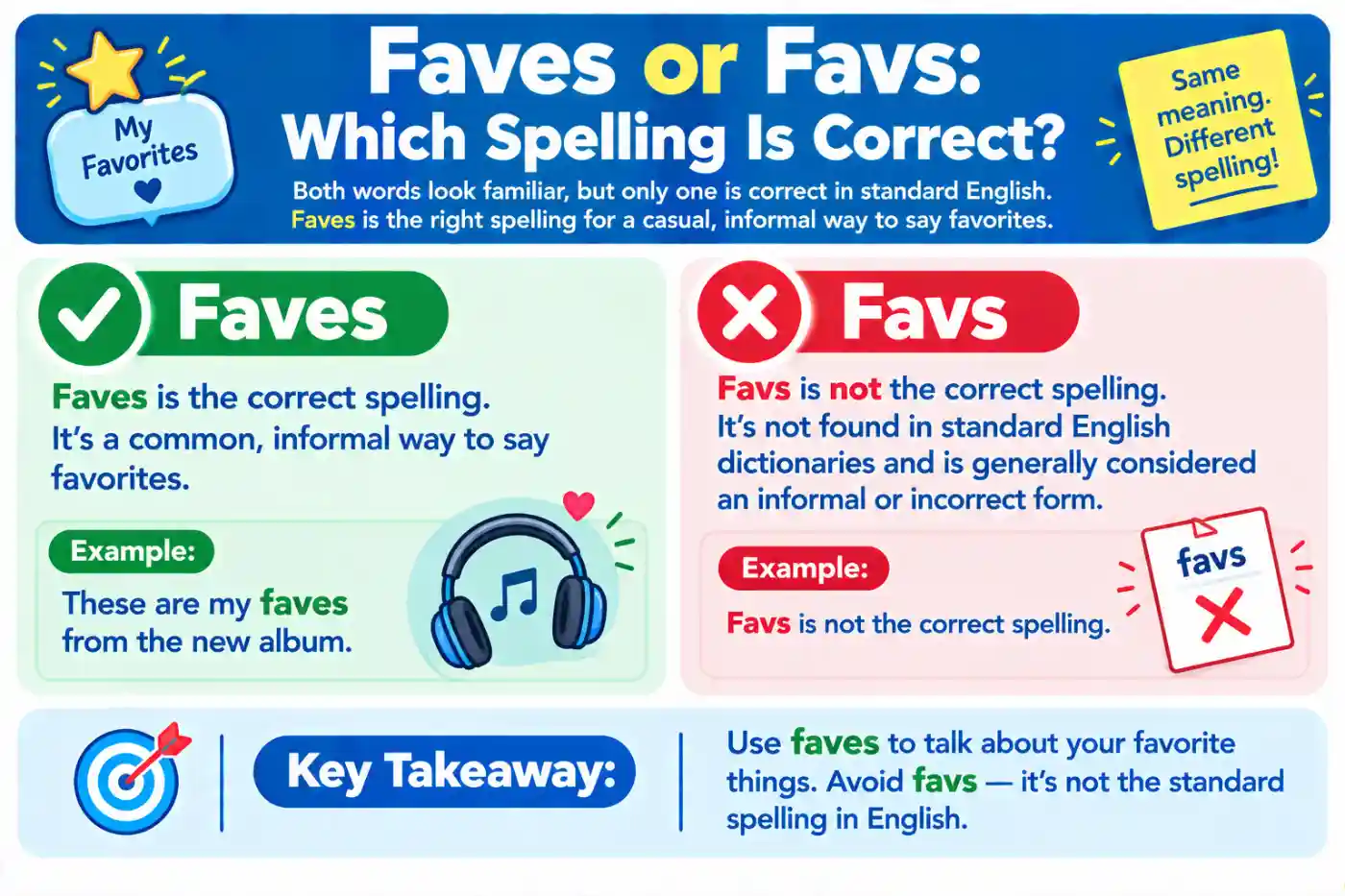
If you’re writing a text, social media post, or casual message, you may wonder whether faves or favs is the correct spelling. Both forms are used as informal alternatives to favorites, especially when people talk about their favorite songs, movies, foods, or products. The main difference is spelling and style rather than meaning.
Both faves and favs are acceptable informal spellings of favorites. Faves follows a more familiar pronunciation-based spelling, while favs shortens the word more sharply and often appears in digital communication.
Although both forms work in casual settings, they may not suit every situation. Understanding their tone, usage, and differences can help you choose the right form for your audience.
This article explains the meanings of faves and favs, shows how to use them in sentences, compares them with similar words, and identifies when to use favorites instead.
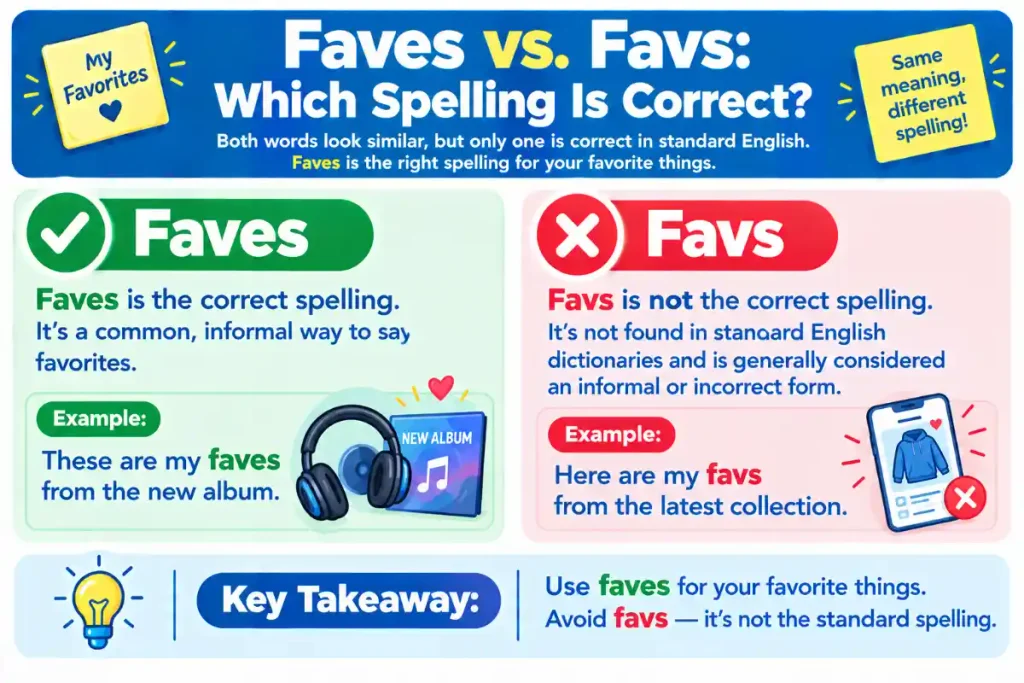
What Do Faves and Favs Mean?
Faves and favs both mean favorites. People use these informal plural nouns to refer to things they like best or prefer over other options. The words commonly appear in conversations about entertainment, food, fashion, hobbies, shopping, and personal interests.
For example:
- Faves: These are my faves from the new album.
- Favs: Here are my favs from the latest collection.
- Favorites: These are my favorite songs from the new album.
All three sentences communicate a similar idea. However, faves and favs have a casual tone, while favorites works in both everyday and more formal writing. The word faves is the plural of fave, an informal shortening of favorite. Similarly, favs is a shortened plural form that uses the abbreviation fav. Neither informal spelling changes the basic meaning of the original word.
Faves or Favs: What’s the Difference?
The primary difference between faves and favs is how writers shorten and spell the word favorite. Both forms communicate the same general idea, but their appearance and tone can differ slightly.
| Feature | Faves | Favs |
|---|---|---|
| Singular form | Fave | Fav |
| Full word | Favorite | Favorite |
| Meaning | Favorite things or people | Favorite things or people |
| Tone | Informal and conversational | Informal and concise |
| Common contexts | Blogs, captions, casual writing | Text messages, online lists, short labels |
| Formal writing | Usually avoid | Usually avoid |
| Standard spelling of the full word | Favorite | Favorite |
These differences are tendencies, not strict rules. Neither form belongs exclusively to a particular platform or type of conversation.
When Should You Use Faves?
Use faves when you want a casual, readable alternative to favorites. The spelling makes the word’s familiar pronunciation more apparent and can fit naturally into captions, blog posts, and everyday conversations.
Examples:
- These are my faves from the summer playlist.
- I shared my skincare faves with my friends.
- Which of these books are your faves?
- Here are five of my all-time faves.
The spelling works particularly well when you want an informal but easy-to-read tone.
When Should You Use Favs?
Use favs when you want a shorter, compact alternative to favorites. It can work well in text messages, short social media captions, lists, and informal digital communication.
Examples:
- Send me your top five favs.
- These are my favs from the new collection.
- I saved all my holiday favs in one folder.
- Which tracks are your favs?
The shorter form is convenient when space matters or when you’re writing a quick message. However, neither spelling is universally better. Your audience, personal style, and purpose should guide your choice.
Is Faves or Favs the Correct Spelling?
Both faves and favs are recognized informal forms of favorites. Neither is a spelling mistake when used in an appropriate casual context. The best choice depends on what you’re writing.
- Use faves for a familiar, conversational style.
- Use favs for a shorter, more compact style.
- Use favorites for standard spelling in professional, academic, and formal writing.
For example, a social media caption might say, “My weekend faves,” while a professional report would be better with “My favorite products.” The full word favorites is the safest choice when you want standard written English. In American English, favorite is the standard singular spelling, and favorites is its plural form.
Is Faves Incorrect?
No. Faves is an established informal spelling of favorites. It is suitable for casual communication, personal writing, and many social media contexts.
For example:
“My travel faves include quiet beaches and small mountain towns.”
This sentence sounds natural in an informal blog post or personal caption. In a formal travel report, however, “My favorite destinations include quiet beaches and small mountain towns” would be more appropriate.
Is Favs Incorrect?
No. Favs is also used as an informal shortening of favorites. It is especially convenient in brief messages and online lists.
For example:
“Check out my favs from this month’s book club.”
The sentence is easy to understand and appropriate for a casual setting. For a school assignment or professional document, use favorites instead.
Why Are Faves and Favs Both Used?
English speakers frequently shorten familiar words in everyday conversation and digital communication. These shortened forms save space and can make messages sound relaxed and personal. The word favorite is a natural candidate for shortening because people often discuss their preferred things in casual settings.
Consider these examples:
- “What’s your favorite movie?” becomes “What’s your fave movie?”
- “These are my favorite songs” becomes “These are my faves.”
- “Here are my favorite products” becomes “Here are my favs.”
The shortened forms are especially useful when the meaning is clear from context.
The Role of Informal Language
Informal English does not always follow the same spelling and style conventions as formal writing. People use abbreviations, contractions, slang, and shortened words to communicate quickly. For instance, writers commonly use pics for pictures, info for information, and fave or fav for favorite. These forms are not necessarily errors. Their suitability depends on the situation.
The Influence of Digital Communication
Text messages, online communities, and social platforms encourage brief, conversational language. A shorter word can fit naturally into a caption or a quick exchange.
For example:
- “My Sunday faves!”
- “Drop your music favs below.”
- “These are my current skincare faves.”
Such phrases are easy to understand in informal settings. However, the use of a shortened form online does not automatically make it appropriate for every audience.
How to Use Faves and Favs in Sentences
Both words function mainly as informal plural nouns. They refer to multiple favorite things, people, choices, or activities. The following examples show how to use each form naturally.
Examples With Faves
- Music: These are my faves from the artist’s latest album.
- Food: Pizza and tacos remain two of my all-time faves.
- Books: I added three new faves to my reading list.
- Movies: Which of these classic films are your faves?
- Fashion: She posted her fall fashion faves on her blog.
- Travel: Small coastal towns are among my travel faves.
- Beauty: My skincare faves include a gentle cleanser and moisturizer.
- School: These are my faves from the books we read in class.
- Hobbies: Painting and gardening are two of my weekend faves.
- Shopping: I put my favorite finds in a list of holiday faves.
Each example uses faves as a plural noun referring to preferred items or activities.
Examples With Favs
- Music: I saved my favorite tracks in a playlist of my favs.
- Texting: Send me your top three movie favs.
- Shopping: These are my favs from the new clothing collection.
- Reading: I keep a list of my book club favs.
- Travel: Mountains and lakes are two of my vacation favs.
- Food: These desserts are my favs at the local bakery.
- Entertainment: I shared my TV show favs with my friends.
- Social media: My weekend favs are finally here!
- Photography: I selected my favs from yesterday’s photo shoot.
- Everyday life: Coffee and a good book are two of my morning favs.
These examples show that favs can describe a wide range of personal preferences.
Examples Using the Full Word Favorites
The full word is often better when clarity and a standard writing style matter.
- My favorite subject in school is science.
- The report lists our customers’ favorite products.
- Please select your favorite option from the menu.
- Her favorite books include several historical novels.
- We collected feedback about the team’s favorite activities.
These sentences work in casual conversation as well as more formal contexts.
Fave or Fav: What’s the Difference?
Fave and fav are singular informal forms of favorite. Their plural forms are faves and favs.
| Feature | Fave | Fav |
|---|---|---|
| Number | Singular | Singular |
| Meaning | One favorite | One favorite |
| Plural | Faves | Favs |
| Style | Informal | Informal and compact |
| Example | This song is my fave. | This song is my fav. |
Both singular forms are understandable, and neither is inherently incorrect in informal writing.
Examples:
- “This is my fave restaurant in town.”
- “That song is my current fav.”
- “She’s my fave author.”
- “He’s one of my favs.”
Notice that fave and fav can refer to a person as well as an object, depending on the context. For standard writing, use favorite instead of either shortened form.

Faves or Favorites: Which Should You Choose?
The main difference between faves and favorites is formality. Both can refer to preferred things, but favorites is the standard form and works across a wider range of situations.
| Context | Recommended wording | Example |
|---|---|---|
| Text message | Faves or favs | These are my favs. |
| Social media caption | Faves or favs | My summer faves! |
| Personal blog | Faves or favorites | My travel faves this year |
| School essay | Favorites | My favorite books are historical novels. |
| Professional email | Favorites | These are the team’s favorite options. |
| Academic paper | Favorites, if relevant | Participants selected their favorite images. |
| Business report | Favorites, if appropriate | Customers identified their favorite products. |
In Text Messages
Both shortened forms are appropriate in casual text messages.
For example:
“Hey, send me your favorite songs. I want to add some of your favs to my playlist.”
You could also write:
“Send me your music faves.”
Both versions communicate the same idea.
On Social Media
Faves and favs work naturally in captions, informal lists, and personal posts.
Examples include:
- “My current beauty faves.”
- “Weekend favs you need to try.”
- “Five of my favorite books this month.”
The best choice depends on the style of your account and the people who follow it. Consistency can make your writing feel more polished.
In Professional Writing
Use favorites in workplace communication, business documents, and professional presentations unless you are deliberately using a casual voice.
For example:
Informal: Here are my favs from the latest product range.
Professional: Here are my favorite products from the latest range.
The second version is clearer and more suitable for most workplace documents.
In Academic Writing
Students should generally use favorite or favorites in essays and assignments when the word is relevant.
For example:
Informal: My faves from the reading list were the historical novels.
Academic or standard: My favorite books from the reading list were the historical novels. If you’re writing a research paper, follow the assignment’s instructions and use precise language appropriate to the subject.
Faves or Favs in American English
In American English, favorite and favorites are the standard spellings. Fave, fav, faves, and favs are informal alternatives. American writers should also recognize the British spelling favourite, which uses an additional u.
| American English | British English | Informal forms |
|---|---|---|
| Favorite | Favourite | Fave, fav |
| Favorites | Favourites | Faves, favs |
The standard regional spelling changes, but the general meaning remains the same.
For example:
- US: My favorite movies are comedies.
- UK: My favourite films are comedies.
- Informal US: My movie faves are comedies.
The shortened forms are not always tied to one country, and usage can vary among individuals and online communities. The main point is to use the standard regional spelling when you need the full word.
Common Mistakes When Using Faves and Favs
Although both forms are useful, writers sometimes use them in ways that do not suit the sentence or audience.
1. Using Informal Forms in Formal Writing
Informal shortened words can make a formal document sound too casual.
Less suitable: My favs from the research are listed below.
Better: My favorite findings are listed below.
In this example, findings may be even more precise than favorites, depending on the intended meaning.
2. Confusing Singular and Plural Forms
Use fave or fav for one favorite and faves or favs for multiple favorites.
- Singular: This is my fave.
- Plural: These are my faves.
- Singular: That is my fav.
- Plural: Those are my favs.
The context and number of items determine which form you need.
3. Assuming One Informal Form Is Always Correct
Neither faves nor favs is the only acceptable informal choice. Both communicate the same general idea. Choose one that suits your tone, and avoid switching between forms without a reason if you’re writing a consistent series of posts or captions.
4. Using Shortened Forms Without Clear Context
Readers may not understand an abbreviation if the surrounding sentence does not make its meaning clear. For example, a heading such as “My Favs” may be understandable on a personal blog, but it may be unclear in a technical document. Use favorites when the audience needs a more explicit label.
5. Treating Faves and Favs as Formal Synonyms
Although these forms mean approximately the same thing, they do not have the same level of formality as favorites. A casual caption can use faves, but a formal report should generally use favorites or a more specific word.
6. Confusing Favorites With Favorites Lists
The word favorites can refer to preferred things, but in some contexts it can also describe people or teams expected to win a competition.
For example:
“The home team is the favorite to win.”
Here, favorite means the most likely winner, not simply something someone likes best. The shortened forms fave and fav are less suitable in formal sports reporting.
What Are Some Alternatives to Faves and Favs?
The best alternative depends on what you mean by faves or favs. In many situations, favorites works perfectly well. In others, a more specific word makes your meaning clearer.
| Word or phrase | Meaning | Tone | Example |
|---|---|---|---|
| Favorites | Things liked best | Neutral | These are my favorites. |
| Preferred choices | Options someone prefers | Formal | These are my preferred choices. |
| Top picks | Best or most appealing selections | Casual | Here are my top picks. |
| Best-loved | Especially liked | Warm | These are her best-loved books. |
| Go-to choices | Reliable options used often | Casual | These are my go-to products. |
| Best bets | Choices considered promising | Conversational | These are your best bets. |
| Picks | Selected options | Neutral | Here are my picks. |
| Selections | Chosen items | Formal | Review the final selections. |
| Preferences | Things someone tends to favor | Neutral | We recorded customer preferences. |
| Top choices | Most preferred options | Neutral | These are our top choices. |
| Recommendations | Suggestions for others | Neutral | Here are my recommendations. |
| Must-haves | Items considered essential | Casual | These are my travel must-haves. |
| Standouts | Items that attract attention | Neutral | These are the standout products. |
| Bests | The best items in a group | Context-dependent | These are the bests of the season. |
| Favorites list | A list of preferred items | Neutral | I updated my favorites list. |
| Personal picks | Selections based on individual taste | Casual | These are my personal picks. |
| Top-rated options | Choices with high ratings | Neutral | Compare the top-rated options. |
| Most-loved items | Items that receive a lot of affection or approval | Warm | These are our most-loved items. |
| Preferred items | Items someone favors | Formal | Select your preferred items. |
| Best options | Choices that fit a goal or need | Neutral | These are the best options for beginners. |
These alternatives are not exact synonyms in every context. For example, recommendations usually means suggestions for other people, while favorites describes personal preferences. Likewise, top-rated options refers to ratings rather than personal taste. Choose the word that reflects your intended meaning instead of replacing faves or favs automatically.
What Is the Origin of Fave and Fav?
Fave developed as an informal shortening of favorite. English speakers often shorten familiar words to make everyday conversation more relaxed and efficient. The form fav follows the same general pattern but uses a more compact spelling. Writers can then add -s to form the plural faves or favs. Both forms reflect a common feature of informal English: speakers and writers adapt longer words for quick communication. The full word favorite has a longer history and comes through French from Latin roots associated with favor and preference. However, you do not need to know the word’s history to use its shortened forms correctly. The practical distinction remains simple: fave and fav are informal singular forms, while faves and favs are their informal plurals.
Quick Tips for Choosing Between Faves and Favs
Use these simple guidelines when deciding which spelling to choose.
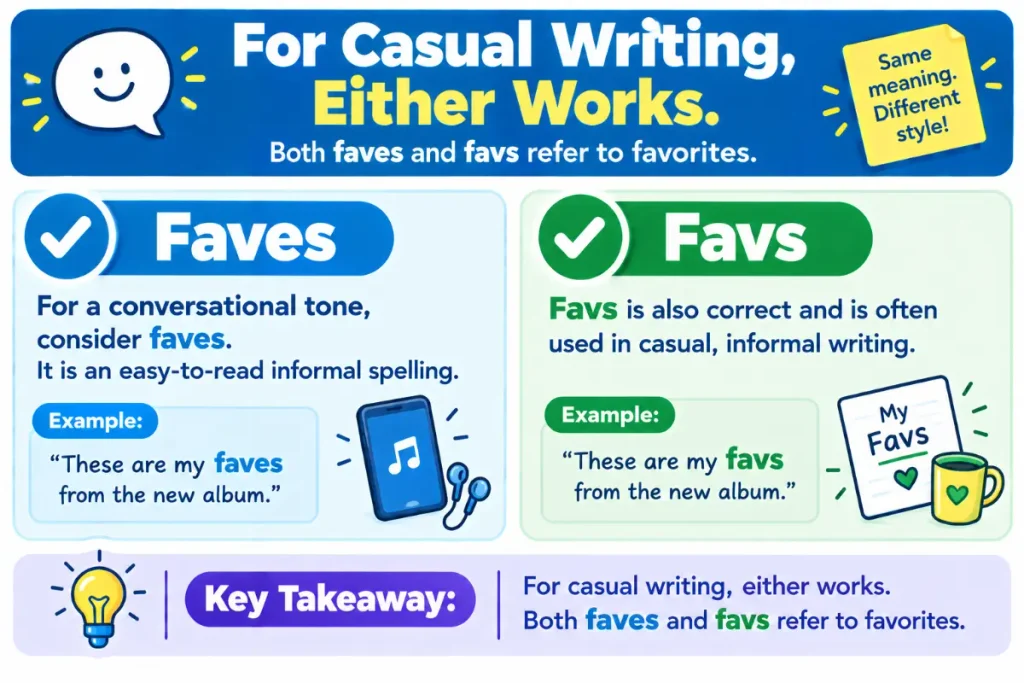
- For casual writing, either works. Both faves and favs refer to favorites.
- For a conversational tone, consider faves. It is an easy-to-read informal spelling.
- For a compact label, consider favs. It works well in short captions and messages.
- For formal writing, use favorites. The full word is appropriate for school, work, and academic contexts.
- Check the singular and plural. Use fave or fav for one item and faves or favs for several.
- Consider your audience. If readers might not recognize an abbreviation, choose the full word.
- Stay consistent. Using one form throughout a caption or informal article can make the writing easier to follow.
Remember that these are practical style suggestions, not strict spelling rules. The right choice depends on the sentence and the level of formality you want.
Conclusion
Choosing between faves or favs is mainly a matter of personal style and context. Both are informal alternatives to favorites, and both work well in casual conversations, text messages, social media captions, and personal lists. Faves offers a familiar, conversational appearance, while favs provides a shorter, more compact form.
Neither spelling is universally better, so consider your audience and the tone you want to create. If you’re writing a quick message or sharing your favorite songs, either option is fine. For professional emails, school assignments, academic writing, and formal documents, choose favorite or favorites instead.
The easiest rule to remember is that fave and fav are singular, while faves and favs are plural. When you need a standard, widely accepted form, favorites remains the safest choice in American English.
Frequently Asked Questions
Are faves or favs correct?
Both faves and favs are acceptable informal spellings of favorites. Use favorites when standard or formal writing is required.
What does faves mean?
Faves means favorite things, people, or choices. For example, “These are my faves from the new album” means these are the songs the speaker likes best.
What does favs mean?
Favs is an informal plural form of fav, which stands for favorite. People commonly use it in casual messages, captions, and online lists.
Is faves more correct than favs?
No. Neither spelling is universally more correct than the other in informal writing. The two forms have essentially the same meaning, although individual writers may prefer one style.
What is the singular form of faves or favs?
The singular forms are fave and fav. For example, “This is my fave movie” and “This is my fav movie” both mean that the speaker likes the movie best.
Should I use faves or favs in a professional email?
Use favorites in most professional emails because it is the standard form. You can use faves or favs when the message is deliberately casual and the audience is comfortable with informal language.
What is another word for faves or favs?
Favorites, top picks, preferred choices, and personal picks are useful alternatives. The best choice depends on whether you mean personal preferences, recommendations, or the strongest options.
2 thoughts on “Faves or Favs: Which Spelling Is Correct?”