
Have you ever written a message saying you are excited about an upcoming vacation, a new job, or a special event, only to wonder if you should use excited or exited? These two words look and sound similar, but they have very different meanings. Choosing the wrong one can change the meaning of your sentence completely.
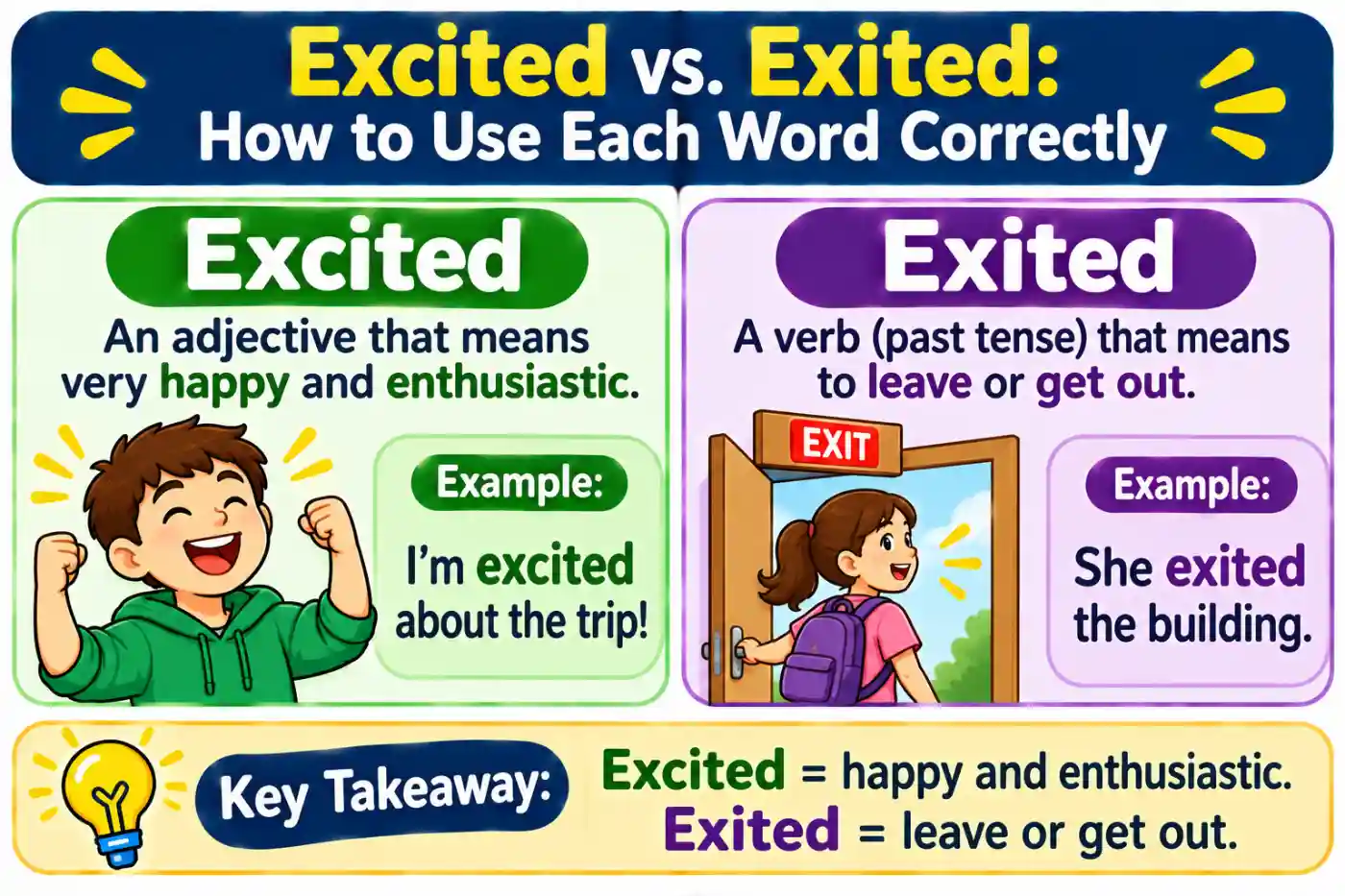
The good news is that excited and exited are both correct English words. However, they are not interchangeable. Excited describes a feeling of happiness, enthusiasm, or eagerness, while exited is the past tense of the verb exit, meaning someone left a place or situation.
Excited means feeling enthusiastic, happy, or eager about something. Exited means left a place, building, vehicle, or situation. The correct choice depends on whether you are describing an emotion or an action.
For example, you might be excited about starting a new job, but you exited the office after finishing your first day. Understanding this difference will help you choose the right word in emails, conversations, school assignments, and everyday writing.
What Is the Difference Between Excited and Exited?
The main difference between excited and exited is their meaning and grammatical function. Although they differ by only one letter, they communicate two separate ideas.
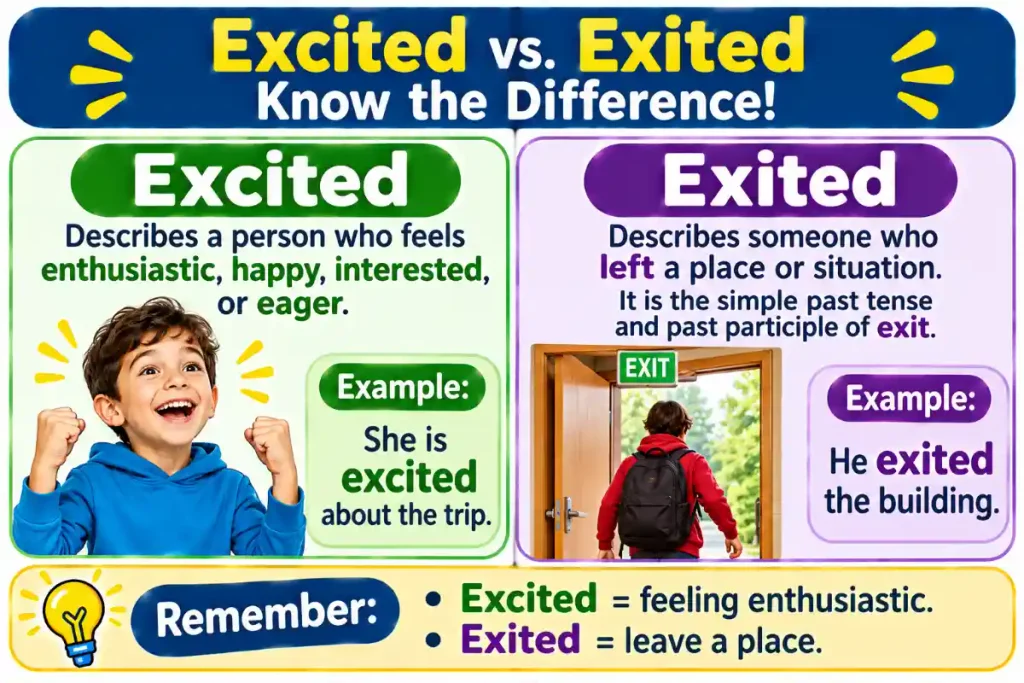
- Excited: Describes a person who feels enthusiastic, happy, interested, or eager.
- Exited: Describes someone who left a place or situation. It is the simple past tense and past participle of exit.
Here is a quick comparison:
| Word | Part of Speech | Meaning | Example |
|---|---|---|---|
| Excited | Adjective | Feeling enthusiastic or happy | I am excited about my vacation. |
| Exited | Verb | Left a place or situation | She exited the building. |
The easiest way to understand the difference is to remember that excitement is an emotion, while exiting is an action.
Consider these examples:
- Correct: I am excited about the concert tonight.
- Correct: We exited the concert hall after the show.
- Incorrect: I am exited about the concert tonight.
- Incorrect: We excited the concert hall after the show.
The first incorrect sentence uses a verb form where an adjective is needed. The second uses an adjective instead of the past-tense verb exited.
What Does Excited Mean?
Excited is an adjective that describes a feeling of happiness, enthusiasm, anticipation, or eagerness. People use it when they look forward to something enjoyable or feel strongly interested in an upcoming experience. It can describe emotions connected to personal events, professional opportunities, entertainment, travel, school activities, and everyday experiences.
For example:
- I am excited about my upcoming birthday.
- The children were excited to visit the zoo.
- She feels excited about her new position.
- We are excited to announce our latest project.
- Everyone was excited when the team won the championship.
In each sentence, excited communicates a positive emotional response.
When Should You Use Excited?
Use excited when describing how someone feels about something.
Common situations include:
1. Special occasions
People often use excited to express happiness about celebrations and important events.
- I’m excited about my graduation ceremony.
- My family is excited for the holiday season.
2. Career opportunities
Excited is common in professional communication when someone welcomes a new opportunity.
- I am excited to begin my new role.
- We are excited about working with your company.
3. Travel and vacations
Use excited when someone looks forward to visiting a new place or taking a trip.
- My parents are excited about their trip to California.
- We are excited to explore New York City.
4. School and education
Students and teachers can use excited to describe enthusiasm about learning or participating in activities.
- The students were excited about the science fair.
- I am excited to start my college classes.
5. Everyday conversations
Excited also works naturally in casual messages and conversations.
- I’m so excited to see you!
- Are you excited about the weekend?
What Does Exited Mean?
Exited is the past tense and past participle of the verb exit. It means that someone or something left a particular place, building, vehicle, website, or situation. Unlike excited, exited does not describe an emotion. It describes an action that has already happened.
For example:
- The passengers exited the airplane.
- She exited the office at 5 p.m.
- The students exited the classroom quietly.
- He exited the website without saving his work.
- We exited the highway at the next intersection.
In these examples, exited explains where someone went or what they left.
When Should You Use Exited?
Use exited when describing someone or something leaving a location or situation.
1. Buildings and rooms
- The employees exited the building after the meeting.
- He exited the classroom before the bell rang.
2. Vehicles
- The passengers exited the bus at the final stop.
- She exited the car and walked toward the entrance.
3. Roads and highways
- We exited the highway near the shopping center.
- The driver exited at the wrong interchange.
4. Websites and applications
- I accidentally exited the application before saving my document.
- She exited the online meeting after the presentation.
5. Events and situations
- The company exited the market last year.
- The player exited the competition after the first round.
These examples show that exited refers to leaving rather than feeling enthusiastic.
Why Are Excited and Exited Confusing?
The words excited and exited often confuse English learners and native speakers because they have similar spellings and pronunciations. Both words contain the letters e, i, t, e, and d. Their main spelling difference is the letter c in excited. However, their meanings come from different base words:
- Excited comes from excite.
- Exited comes from exit.
The verb excite means to create enthusiasm or strong interest. Its past-tense form is excited. The verb exit means to leave a place or situation. Its past-tense form is exited.
Look at the difference:
| Base Word | Past Form | Meaning |
|---|---|---|
| Excite | Excited | Made someone enthusiastic or eager |
| Exit | Exited | Left a place or situation |
Another reason for confusion is pronunciation. In many American English accents, the words sound very similar in ordinary conversation. However, the context usually makes their meanings clear.
For example:
- The children were excited about the trip.
- The children exited the bus.
The first sentence describes an emotion. The second describes an action.
Excited vs Exited: Correct and Incorrect Usage
Understanding how these words work in sentences is the best way to avoid common mistakes. The following table shows how to use each word correctly.
| Incorrect Sentence | Correct Sentence | Explanation |
|---|---|---|
| I am exited about the party. | I am excited about the party. | Excited describes enthusiasm. |
| She excited the building. | She exited the building. | Exited means she left. |
| We are exited to meet you. | We are excited to meet you. | Excited expresses eagerness. |
| He excited the classroom. | He exited the classroom. | Exited describes leaving. |
| They are exited about their vacation. | They are excited about their vacation. | Excited describes a feeling. |
| The passengers excited the plane. | The passengers exited the plane. | Exited describes getting out. |
Remember that both words are correct English. The mistake happens when writers use one in a situation that requires the other.
20 Examples of Excited and Exited in Real Sentences
Examples make it easier to recognize the difference between these words. The following sentences cover work, school, travel, family life, technology, and everyday conversations.
Examples of Excited
- Work: I am excited to start my new job next Monday.
- School: The students were excited about their upcoming field trip.
- Travel: My family is excited about visiting Florida this summer.
- Email: We are excited to share the latest updates with our customers.
- Conversation: Are you excited about watching the basketball game tonight?
- Celebration: Everyone was excited when the birthday cake arrived.
- Shopping: She was excited to receive her new laptop.
- Social media: I’m excited to announce that I have graduated from college!
- Sports: The fans were excited after their favorite team won.
- Everyday life: My little brother is excited about learning how to ride a bicycle.
Examples of Exited
- Work: The manager exited the conference room after the meeting.
- School: The teacher exited the classroom when the lesson ended.
- Travel: We exited the airport and waited for our ride.
- Driving: My father exited the highway at the next intersection.
- Technology: I accidentally exited the program without saving my changes.
- Conversation: She exited the group chat after the discussion ended.
- Shopping: The customer exited the store without making a purchase.
- Sports: The player exited the field after the final whistle.
- Public safety: Everyone exited the building through the main doors.
- Everyday life: He exited the elevator on the fourth floor.
These examples demonstrate that excited describes a feeling, while exited describes leaving.
Excited vs Exciting: What’s the Difference?
Another common source of confusion is the difference between excited and exciting. Although both words come from the verb excite, they perform different jobs in a sentence. Excited describes how a person feels. Exciting describes something that creates enthusiasm, interest, or enjoyment.
Compare these examples:
- I am excited about the football game.
- The football game was exciting.
In the first sentence, the speaker describes a personal feeling. In the second, the speaker describes the experience.
| Word | Meaning | Example |
|---|---|---|
| Excited | Feeling enthusiastic | She is excited about the concert. |
| Exciting | Causing enthusiasm | The concert was exciting. |
| Excite | To create enthusiasm | The announcement will excite the audience. |
| Excitement | A feeling of enthusiasm | The children showed great excitement. |
More Examples of Excited and Exciting
- The children were excited about the exciting school event.
- I feel excited because the upcoming trip sounds exciting.
- She was excited to watch the exciting final match.
- The exciting news made everyone excited.
Quick tip: Use excited for the person experiencing the emotion and exciting for the thing creating that emotion.
Excited vs Exited vs Exhilarated
The word exhilarated is another term that can appear in conversations about strong positive feelings. Although it is not a direct spelling variation of excited or exited, it has a related meaning.
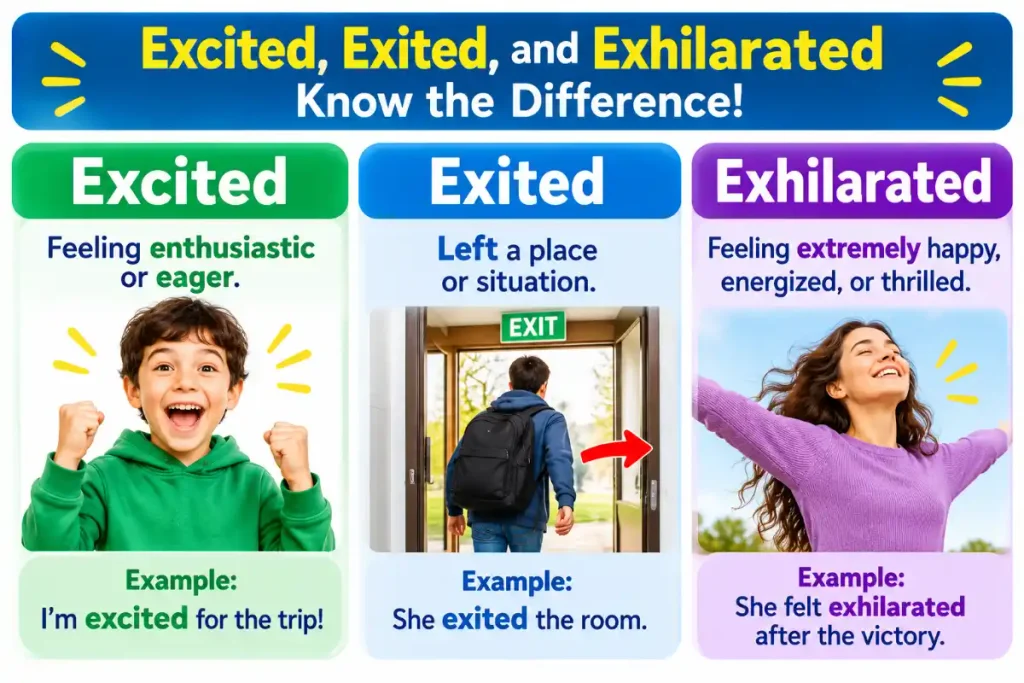
- Excited: Feeling enthusiastic or eager.
- Exited: Left a place or situation.
- Exhilarated: Feeling extremely happy, energized, or thrilled.
| Word | Meaning | Example |
|---|---|---|
| Excited | Enthusiastic or eager | I am excited about the trip. |
| Exited | Left a place | We exited the theater. |
| Exhilarated | Extremely happy and energized | She felt exhilarated after the performance. |
Consider these sentences:
- I am excited about my first hiking trip.
- We exited the park before sunset.
- I felt exhilarated after reaching the mountain summit.
These words are not interchangeable because they express different meanings.
What Are the Synonyms of Excited?
Several words can replace excited, depending on the situation and the strength of the emotion. Some alternatives express mild interest, while others communicate intense enthusiasm or happiness.
Common Synonyms for Excited
| Synonym | Meaning | Tone | Example |
|---|---|---|---|
| Happy | Feeling pleasure | Everyday | I am happy about the news. |
| Eager | Looking forward to something | Neutral | She is eager to begin. |
| Enthusiastic | Showing strong interest | Professional | The team is enthusiastic about the project. |
| Thrilled | Extremely pleased | Strong | We are thrilled about the results. |
| Delighted | Very pleased | Polite | I am delighted to meet you. |
| Glad | Feeling pleased | Casual | I’m glad you’re coming. |
| Ecstatic | Extremely happy | Very strong | They were ecstatic about the victory. |
| Overjoyed | Extremely joyful | Strong | Her parents were overjoyed. |
| Elated | Feeling great happiness | Formal | He was elated by the announcement. |
| Animated | Full of energy | Neutral | The audience became animated. |
| Inspired | Feeling motivated | Positive | She felt inspired by the speech. |
| Passionate | Showing strong enthusiasm | Professional | He is passionate about teaching. |
| Optimistic | Expecting a positive outcome | Neutral | We are optimistic about the future. |
| Keen | Very interested | Neutral | She is keen to participate. |
| Pumped | Very enthusiastic | Casual | I’m pumped for the game. |
| Stoked | Extremely excited | Informal | We’re stoked about the concert. |
| Eagerly awaiting | Looking forward to something | Neutral | We are eagerly awaiting the results. |
| Enthralled | Completely interested | Formal | The children were enthralled by the show. |
| Fascinated | Extremely interested | Neutral | He was fascinated by the discovery. |
| Jubilant | Showing great happiness | Formal | The crowd was jubilant after the win. |
Not every synonym fits every sentence. For example, thrilled and ecstatic suggest stronger emotions than glad or happy.
Synonyms for Excited by Intensity
You can also choose an alternative based on how strongly someone feels.
Mild enthusiasm:
- Interested
- Glad
- Happy
- Curious
- Pleased
Moderate enthusiasm:
- Eager
- Enthusiastic
- Keen
- Delighted
- Inspired
Strong enthusiasm:
- Thrilled
- Ecstatic
- Elated
- Overjoyed
- Exhilarated
For everyday American English, excited, happy, eager, and thrilled are especially useful choices.
What Are the Synonyms of Exited?
Exited means left or moved out of a place or situation. Its alternatives depend on the context. For example, you can say someone left a building, departed from an airport, or withdrew from a competition.
| Alternative | Meaning | Tone | Example |
|---|---|---|---|
| Left | Went away from a place | Everyday | She left the office. |
| Departed | Went away | Formal | The passengers departed the station. |
| Went out | Moved outside | Casual | He went out through the back door. |
| Walked out | Left on foot | Everyday | They walked out of the room. |
| Stepped out | Briefly left | Casual | She stepped out for a moment. |
| Withdrew | Removed oneself from something | Formal | He withdrew from the competition. |
| Evacuated | Left an unsafe place | Safety-related | Residents evacuated the building. |
| Cleared | Moved away from an area | Context-specific | The visitors cleared the room. |
| Disembarked | Got off a vehicle or vessel | Formal | The passengers disembarked from the ship. |
| Departed from | Left a particular location | Formal | The train departed from the station. |
These alternatives have different meanings and should be selected according to the situation. For instance, evacuated is appropriate when people leave an area because of a safety concern. It is not a natural replacement for exited in every ordinary sentence.
How to Use Excited and Exited in Professional Writing
Both words are useful in workplace communication, but their meanings must remain clear.
Using Excited in Professional Emails
Excited is commonly used to express enthusiasm about a project, opportunity, partnership, or new position.
Examples:
- I am excited to discuss the next steps with your team.
- We are excited about the opportunity to work together.
- I am excited to contribute to this project.
- Our department is excited to introduce the new program.
In professional writing, excited communicates a positive and welcoming attitude.
However, if you want a more formal tone, you can use pleased, enthusiastic, or looking forward to.
For example:
- I am pleased to accept the position.
- We look forward to working with your organization.
- Our team is enthusiastic about the proposed changes.
Using Exited in Professional Emails
Exited is appropriate when explaining that someone left a meeting, office, system, or business situation.
Examples:
- The employee exited the building after completing the shift.
- The client exited the online meeting before the discussion ended.
- The company exited the international market in 2025.
- The user exited the application without submitting the form.
In business writing, exited can also describe a company’s departure from an industry, market, or investment. The important point is to use excited for enthusiasm and exited for departure.
How to Remember the Difference Between Excited and Exited
If you regularly confuse these words, a simple memory trick can help.
1. Remember the Letter C
The word exCited contains the letter C, just like the word cheerful. Think of the C as a reminder of positive feelings.
- Excited about a birthday.
- Excited about a vacation.
- Excited about a new opportunity.
2. Connect Exited With Exit
The word exited comes directly from exit.
An exit is a way to leave a place. Therefore, exited means someone left.
- Exited the building.
- Exited the bus.
- Exited the room.
3. Ask Yourself One Simple Question
Before choosing a word, ask:
Am I describing a feeling or someone leaving?
- If you are describing enthusiasm, use excited.
- If you are describing departure, use exited.
This simple question works in almost every everyday writing situation.
Common Mistakes to Avoid
Even though the difference is straightforward, several mistakes occur frequently.
Mistake 1: Using Exited to Describe Happiness
Incorrect: I am exited about my new job.
Correct: I am excited about my new job.
Why? The sentence describes enthusiasm about a career opportunity, so excited is the correct adjective.
Mistake 2: Using Excited to Describe Leaving
Incorrect: She excited the classroom after the lesson.
Correct: She exited the classroom after the lesson.
Why? The sentence describes an action. Exited is the past tense of exit.
Mistake 3: Confusing Excited With Exciting
Incorrect: The movie was very excited.
Correct: The movie was very exciting.
Why? The movie creates excitement, so exciting describes it.
Mistake 4: Using Exited After the Wrong Verb
Incorrect: He has excited the building.
Correct: He has exited the building.
Why? The present perfect tense of exit uses has exited.
Mistake 5: Choosing Words Based Only on Pronunciation
Incorrect spelling can happen when someone writes a word based on how it sounds. The best solution is to consider the sentence’s meaning rather than relying only on pronunciation.
For example:
- I am excited to see my friends.
- I exited the room to answer the phone.
Both sentences are correct because they communicate different ideas.
What Is the Opposite of Excited and Exited?
The antonyms of these words depend on their meanings.
Opposites of Excited
Since excited describes enthusiasm or positive anticipation, its opposites include:
- Bored
- Uninterested
- Indifferent
- Unenthusiastic
- Unexcited
- Apathetic
- Disappointed
Examples:
- I was excited about the event, but my brother was bored.
- She felt uninterested in the discussion.
- The employees seemed unenthusiastic about the new proposal.
Opposites of Exited
Exited means leaving, so its opposite depends on the action being described.
Possible alternatives include:
- Entered
- Arrived
- Stayed
- Remained
- Joined
Examples:
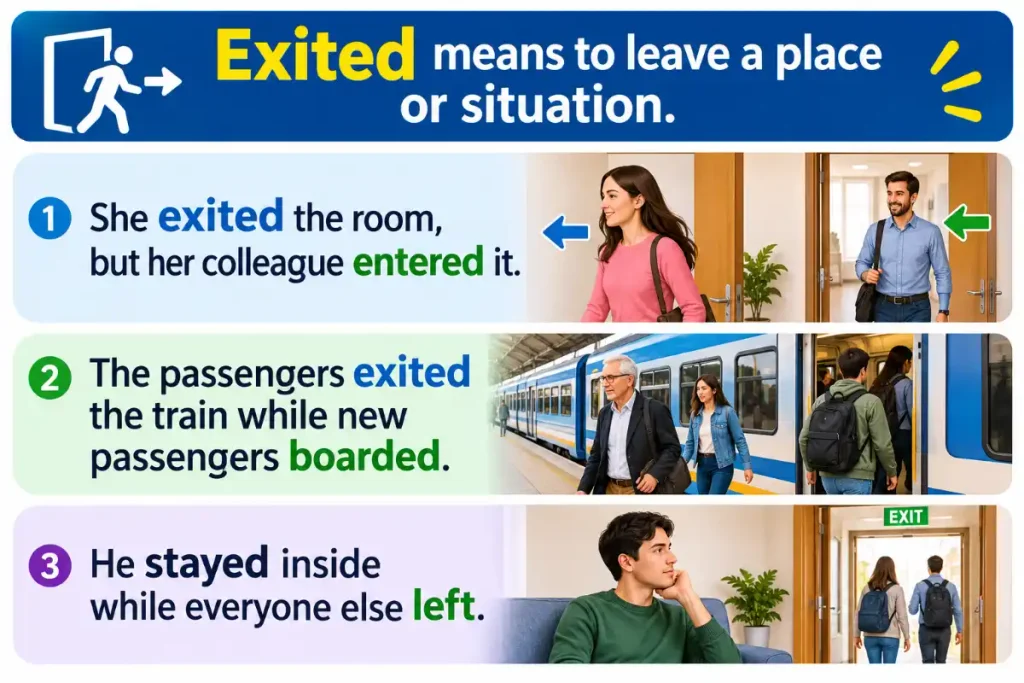
- She exited the room, but her colleague entered it.
- The passengers exited the train while new passengers boarded.
- He stayed inside while everyone else left.
Important: Entered is often the clearest opposite of exited when discussing movement into and out of a place.
Conclusion
Understanding the difference between excited and exited makes your English writing clearer and more accurate. Although these words look and sound similar, they serve different purposes. Excited is an adjective that describes enthusiasm, happiness, or eagerness about something. Exited is the past tense of exit and describes someone leaving a place, building, vehicle, or situation.
When deciding between excited or exited, focus on the meaning of your sentence. If you are talking about a positive feeling, choose excited. If you are describing someone leaving, choose exited. Remember that excited contains the letter C, which can remind you of cheerful feelings, while exited connects directly to the word exit. With these simple rules and examples, you can confidently use both words in emails, school assignments, professional communication, and everyday conversations.
Frequently Asked Questions
1. Which Is Correct, Excited or Exited?
Both excited and exited are correct English words, but they have different meanings. Excited describes enthusiasm or happiness, while exited means someone left a place or situation.
2. Is Exited a Real Word?
Yes, exited is a correct English word. It is the past tense and past participle of the verb exit, meaning to leave a place or situation.
3. Is Excited the Same as Exited?
No, excited and exited are not the same. Excited describes an emotional state, whereas exited describes the action of leaving.
4. How Do You Spell Excited Correctly?
The correct spelling is excited, with the letter C after X. It comes from the verb excite and describes enthusiasm, eagerness, or happiness.
5. Can I Say I Am Exited for My Birthday?
No, the correct expression is “I am excited for my birthday.” Excited communicates happiness and anticipation about an upcoming celebration.
6. What Is the Past Tense of Excite?
The past tense of excite is excited. For example, “The announcement excited the entire audience.” The word can also function as an adjective, as in “The audience was excited.”
7. What Is Another Word for Excited?
Common alternatives include happy, eager, enthusiastic, thrilled, delighted, and overjoyed. The best choice depends on the level of enthusiasm and the tone of your sentence.
2 thoughts on “Excited vs. Exited: How to Use Each Word Correctly”