
Choosing between is there any vs are there any can be confusing, especially when you’re writing an email, completing a school assignment, or having an everyday conversation. Both expressions are grammatically correct, but they serve different purposes. The right choice depends on whether the noun you’re talking about is singular, plural, or uncountable.
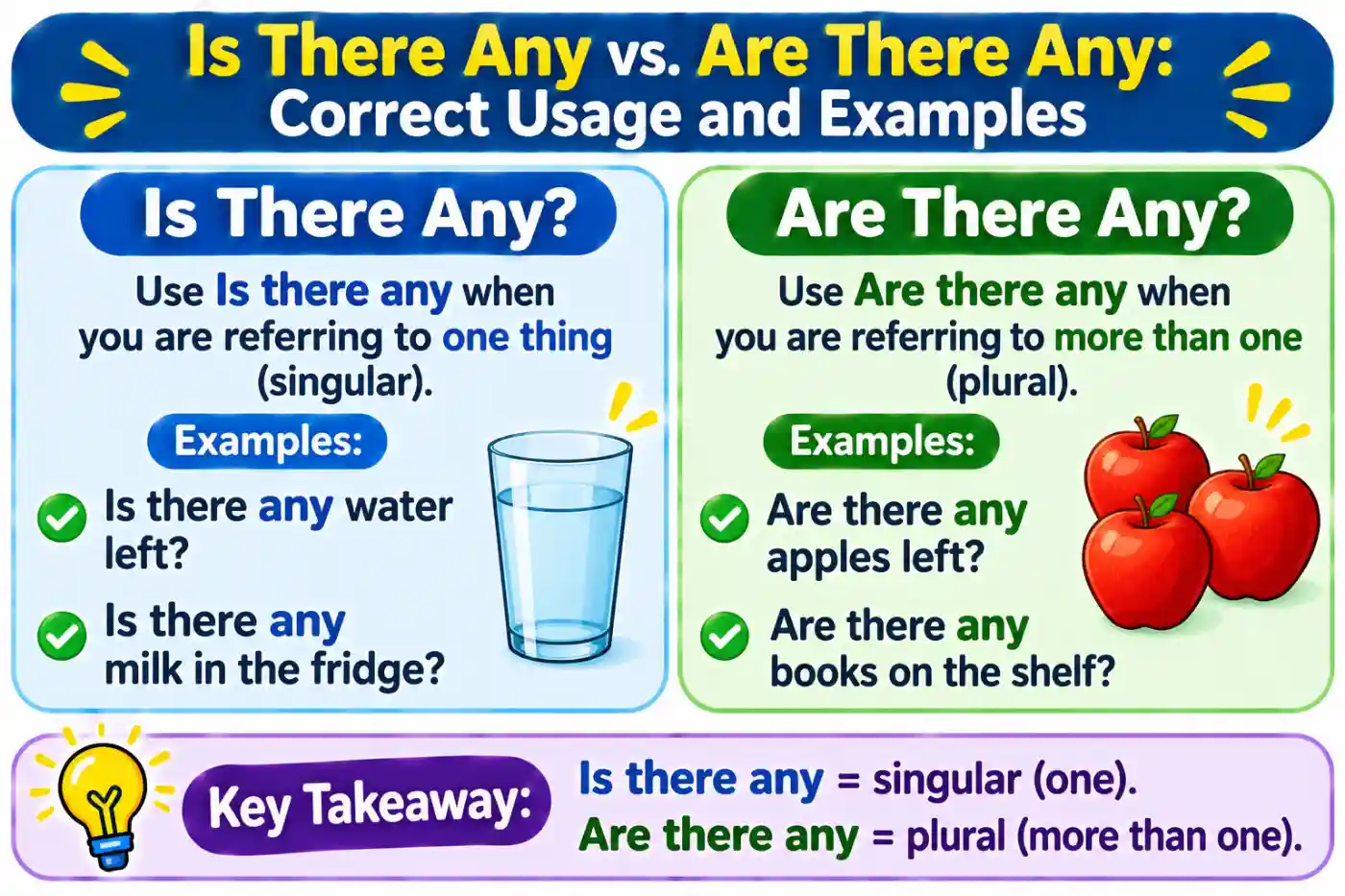
The basic rule is simple: use “is there any” with uncountable nouns and singular nouns when asking about the existence or availability of something. Use “are there any” with plural countable nouns.
Is there any and are there any are both correct expressions. Use “is there any” for uncountable or singular nouns and “are there any” for plural countable nouns.
Understanding this difference will help you ask clearer questions and avoid common subject-verb agreement mistakes. Let’s look at their meanings, grammar rules, examples, and everyday uses.
What Does “Is There Any” Mean?
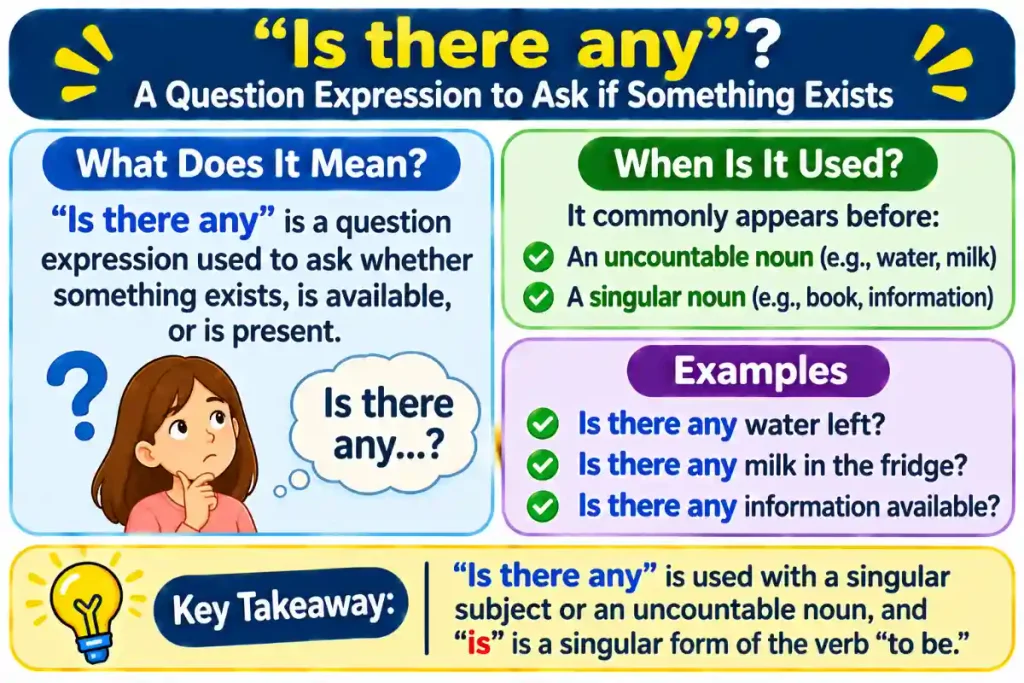
“Is there any” is a question expression used to ask whether something exists, is available, or is present. It commonly appears before an uncountable noun or a singular noun. The word “is” is a singular form of the verb “to be.” It agrees with a singular subject or an uncountable noun.
For example:
- Is there any milk in the refrigerator?
- Is there any information about the meeting?
- Is there any reason to cancel the event?
- Is there any water left in the bottle?
In these sentences, the speaker wants to know whether something is available or exists.
When Should You Use “Is There Any”?
Use “is there any” in the following situations:
1. With uncountable nouns
Uncountable nouns refer to things that are not normally counted individually.
Examples include:
- Water
- Milk
- Money
- Information
- Advice
- Furniture
- Equipment
- Rice
- Sugar
- Traffic
Example sentences:
- Is there any water in the kitchen?
- Is there any money in your wallet?
- Is there any information about the new policy?
- Is there any furniture available for the apartment?
2. With singular countable nouns
You can also use “is there any” with a singular noun when asking whether even one item or person exists or is available.
Examples:
- Is there any reason to worry?
- Is there any chance of rain?
- Is there any possibility of changing the date?
- Is there any problem with my application?
Here, “any” expresses uncertainty about the existence of something.
What Does “Are There Any” Mean?
“Are there any” is a question expression used to ask whether two or more people, objects, or things exist or are available. The word “are” is the plural form of the verb “to be.” It agrees with plural countable nouns.
For example:
- Are there any students in the classroom?
- Are there any apples in the basket?
- Are there any questions about the lesson?
- Are there any restaurants nearby?
Each sentence asks about the existence or availability of multiple countable items or people.
When Should You Use “Are There Any”?
Use “are there any” when the noun is plural and countable.
Common examples include:
| Plural noun | Example question |
|---|---|
| Books | Are there any books on the table? |
| Students | Are there any students absent today? |
| Questions | Are there any questions? |
| Problems | Are there any problems with the plan? |
| Tickets | Are there any tickets available? |
| Restaurants | Are there any restaurants nearby? |
| Jobs | Are there any jobs available? |
| Opportunities | Are there any opportunities for students? |
| Changes | Are there any changes to the schedule? |
| Mistakes | Are there any mistakes in this document? |
The important point is that the noun after “any” determines whether you should use “is” or “are.”
Is There Any vs Are There Any: What’s the Difference?
The main difference between these expressions is subject-verb agreement. Although both ask whether something exists, they are used with different types of nouns.
| Feature | Is There Any | Are There Any |
|---|---|---|
| Verb | Is | Are |
| Noun type | Uncountable or singular | Plural countable |
| Meaning | Does something exist? | Do multiple things exist? |
| Usage | Singular or uncountable nouns | Plural nouns |
| Example | Is there any milk? | Are there any bottles? |
| Grammar | Singular agreement | Plural agreement |
Quick Comparison
Consider these examples:
Correct:
- Is there any food in the refrigerator?
- Are there any vegetables in the refrigerator?
- Is there any information about the event?
- Are there any details about the event?
- Is there any work left to do?
- Are there any assignments left to complete?
Notice how the verb changes according to the noun.
“Food,” “information,” and “work” are uncountable nouns, so they take “is.” “Vegetables,” “details,” and “assignments” are plural countable nouns, so they take “are.”
Why Do People Confuse These Expressions?
Many English learners confuse “is there any” and “are there any” because both expressions contain the word “any.” The word “any” can appear with singular, plural, and uncountable nouns. However, it does not determine whether the sentence needs “is” or “are.” The noun determines the correct verb.
For example:
- Is there any coffee?
- Are there any coffee cups?
- Is there any homework?
- Are there any homework assignments?
The confusion often happens because people focus on “any” instead of looking at the noun that follows it. Another reason is that some nouns look plural or are used differently across languages. English learners may also translate questions directly from their native language, which can lead to incorrect subject-verb agreement. The easiest way to avoid these mistakes is to identify whether the noun is singular, plural, or uncountable before choosing the verb.
How to Use “Is There Any” in Sentences
Let’s examine how this expression works in different everyday situations.
1. With Food and Drinks
Food and drink vocabulary often includes uncountable nouns.
Examples:
- Is there any milk left in the refrigerator?
- Is there any sugar in the kitchen cabinet?
- Is there any rice available for dinner?
- Is there any juice in the bottle?
- Is there any bread at the grocery store?
However, when you use a plural countable noun, change “is” to “are.”
For example:
- Are there any eggs in the refrigerator?
- Are there any sandwiches left?
2. With Information and Advice
“Information” and “advice” are uncountable nouns in standard English.
Examples:
- Is there any information about the scholarship?
- Is there any advice for new employees?
- Is there any news about the school event?
- Is there any guidance available for applicants?
- Is there any feedback on my presentation?
Remember that you normally say “some information” rather than “informations.”
3. With Money and Work
Examples:
- Is there any money in the account?
- Is there any work remaining?
- Is there any extra time for the project?
- Is there any payment due this week?
- Is there any business scheduled for tomorrow?
These nouns are generally treated as uncountable in these contexts.
4. With Singular Countable Nouns
Examples:
- Is there any chance we can finish early?
- Is there any reason for this delay?
- Is there any solution to the problem?
- Is there any possibility of getting a refund?
- Is there any seat available near the window?
Although these nouns can be counted, they appear in the singular form.
How to Use “Are There Any” in Sentences
Use “are there any” when asking about multiple countable things or people. Here are examples from common situations.
1. At School
- Are there any students waiting outside?
- Are there any assignments due tomorrow?
- Are there any books available in the library?
- Are there any exams scheduled this week?
- Are there any teachers in the staff room?
2. At Work
- Are there any meetings scheduled for Monday?
- Are there any updates about the project?
- Are there any documents I need to review?
- Are there any changes to the company policy?
- Are there any new employees joining the team?
3. While Shopping
- Are there any discounts on these shoes?
- Are there any larger sizes available?
- Are there any new products in the store?
- Are there any payment options available?
- Are there any offers on grocery items?
4. During Everyday Conversations
- Are there any good movies playing tonight?
- Are there any buses going downtown?
- Are there any parks near your house?
- Are there any restaurants open right now?
- Are there any friends coming to the party?
15 Practical Examples: Is There Any vs. Are There Any
The following examples show how to choose the correct expression in different real-life situations.
| Situation | Correct sentence |
|---|---|
| Food | Is there any food left for dinner? |
| Shopping | Are there any discounts today? |
| School | Are there any assignments due tomorrow? |
| Workplace | Is there any work I can help with? |
| Travel | Are there any flights available tonight? |
| Home | Is there any water in the refrigerator? |
| Is there any update on my application? | |
| Conversation | Are there any plans for the weekend? |
| Money | Is there any money left in the budget? |
| Technology | Are there any updates available for this app? |
| Healthcare | Is there any information about the appointment? |
| Events | Are there any events happening this weekend? |
| Transportation | Are there any trains to Chicago? |
| Weather | Is there any chance of rain tomorrow? |
| Documents | Are there any missing documents in my application? |
These examples demonstrate that the choice depends on the noun, not the situation or the formality of the question.
Is “Is There Any” Grammatically Correct?
Yes, “is there any” is grammatically correct when followed by an appropriate singular or uncountable noun.
Examples:
- Is there any coffee left?
- Is there any reason to wait?
- Is there any good news?
- Is there any problem with the computer?
- Is there any information available?
However, it is incorrect to use “is” with an ordinary plural noun in this construction.
Incorrect: Is there any books on the shelf?
Correct: Are there any books on the shelf?
The plural noun “books” requires the plural verb “are.”
Is “Are There Any” Grammatically Correct?
Yes, “are there any” is grammatically correct when followed by a plural countable noun.
Examples:
- Are there any tickets available?
- Are there any students in the classroom?
- Are there any questions about the assignment?
- Are there any opportunities for advancement?
- Are there any messages for me?
However, it is generally incorrect to use “are” with an uncountable noun in this construction.
Incorrect: Are there any information about the course?
Correct: Is there any information about the course?
“Information” is uncountable in standard English, so it takes “is.”
Correct vs Incorrect Usage
One of the easiest ways to understand this grammar rule is to compare incorrect sentences with their corrected versions.
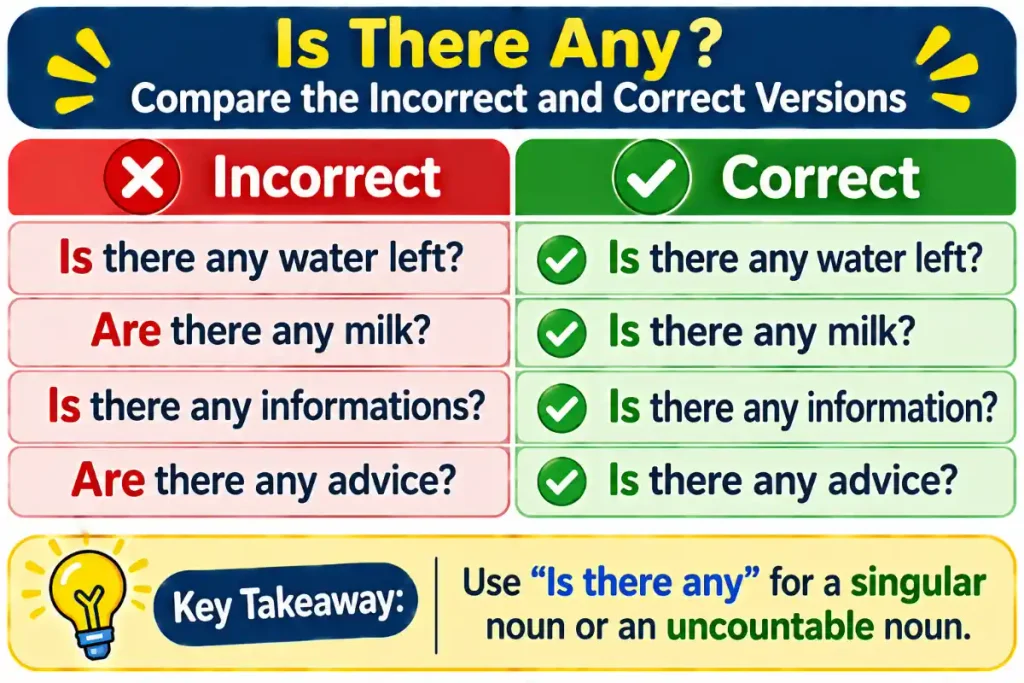
| Incorrect sentence | Correct sentence |
|---|---|
| Is there any students here? | Are there any students here? |
| Are there any water bottles? | Is there any water? |
| Are there any information? | Is there any information? |
| Is there any books available? | Are there any books available? |
| Are there any money left? | Is there any money left? |
| Is there any questions? | Are there any questions? |
| Are there any furniture? | Is there any furniture? |
| Is there any opportunities? | Are there any opportunities? |
| Are there any advice? | Is there any advice? |
| Is there any tickets? | Are there any tickets? |
Why Are These Sentences Incorrect?
Most of these mistakes involve subject-verb agreement.
For example, “students,” “books,” “questions,” “opportunities,” and “tickets” are plural countable nouns. They require “are.”
On the other hand, “water,” “information,” “money,” “furniture,” and “advice” are uncountable nouns. They normally require “is.”
Learning which English nouns are countable and uncountable will make this distinction much easier.
Can You Use “Any” With Singular, Plural, and Uncountable Nouns?
Any With Singular Countable Nouns
“Any” can be used with singular countable nouns to ask whether even one item, possibility, or reason exists.
Examples:
- Is there any solution to this issue?
- Is there any available seat?
- Is there any other option?
- Is there any particular reason for the change?
Any With Plural Countable Nouns
Use “any” with plural nouns when asking about multiple possible items.
Examples:
- Are there any solutions to this issue?
- Are there any available seats?
- Are there any other options?
- Are there any particular reasons for the change?
Any With Uncountable Nouns
Use “any” with uncountable nouns when asking about the existence or availability of an amount.
Examples:
- Is there any information available?
- Is there any coffee left?
- Is there any progress on the project?
- Is there any furniture in the room?
Is There Any vs. Are There Any in Negative Sentences
Both expressions can also appear in negative sentences. The correct form still depends on the noun. Use “there isn’t any” with singular or uncountable nouns.
Examples:
- There isn’t any milk in the refrigerator.
- There isn’t any information about the event.
- There isn’t any reason to worry.
- There isn’t any money left in the account.
Use “there aren’t any” with plural countable nouns.
Examples:
- There aren’t any students in the classroom.
- There aren’t any tickets available.
- There aren’t any questions about the assignment.
- There aren’t any clean towels in the bathroom.
What About “There Is No” and “There Are No”?
You can also use “no” instead of “not any.”
| With any | With no |
|---|---|
| There isn’t any milk. | There is no milk. |
| There aren’t any books. | There are no books. |
| There isn’t any information. | There is no information. |
| There aren’t any tickets. | There are no tickets. |
Both forms are grammatically correct and communicate the absence of something.
Is There Any vs Are There Any in Questions and Answers
These expressions commonly appear in everyday questions. Their answers usually follow the same singular, plural, or uncountable distinction.
Consider these conversations:
Conversation 1: At Home
Person A: Is there any milk in the refrigerator?
Person B: Yes, there is some milk left.
Conversation 2: At School
Person A: Are there any students in the library?
Person B: Yes, there are a few students studying.
Conversation 3: At Work
Person A: Is there any work left to complete?
Person B: No, there isn’t any work remaining.
Conversation 4: Shopping
Person A: Are there any larger sizes available?
Person B: Yes, there are a few larger sizes.
Conversation 5: Traveling
Person A: Are there any flights to New York tonight?
Person B: Yes, there are two available flights.
These conversations show how the expressions fit naturally into spoken American English.
Is There Any vs Are There Any in American English and British English
The basic grammar rule is the same in American and British English. Both varieties use “is there any” with uncountable or singular nouns and “are there any” with plural countable nouns.
Examples in American English:
- Is there any gas in the car?
- Are there any stores open nearby?
- Is there any information about the event?
Examples in British English:
- Is there any petrol in the car?
- Are there any shops open nearby?
- Is there any information about the event?
The main differences in these examples involve vocabulary, such as “gas” versus “petrol” and “stores” versus “shops.” The subject-verb agreement rule remains unchanged. For US readers, both expressions are standard and natural in everyday conversation, school assignments, and professional writing.
Is There Any vs. Are There Any in Formal and Informal Writing
Both expressions work in formal and informal communication. Neither is automatically more professional than the other. The correct choice depends on the noun rather than the tone of the conversation.
In Professional Emails
Use the expression that matches the noun.
Examples:
- Is there any additional information I should provide?
- Are there any documents required to complete the application?
- Is there any update regarding the meeting?
- Are there any changes to the project deadline?
In Academic Writing
Both forms are appropriate for academic questions and discussions.
Examples:
- Is there any evidence supporting this conclusion?
- Are there any differences between the two studies?
- Is there any research available on this topic?
- Are there any factors that could affect the results?
In Everyday Text Messages
Both expressions are also natural in casual messages.
Examples:
- Is there any food left?
- Are there any plans for tonight?
- Is there any chance you’ll come over?
- Are there any tickets left?
You don’t need to change the grammar rule when switching between formal and casual writing.
Common Mistakes to Avoid
Even though the rule is straightforward, some nouns and sentence structures can cause confusion. Here are common mistakes to watch for.
1. Using “Is” With a Plural Noun
Incorrect: Is there any cars outside?
Correct: Are there any cars outside?
“Cars” is a plural countable noun, so it needs “are.”
2. Using “Are” With an Uncountable Noun
Incorrect: Are there any homework?
Correct: Is there any homework?
“Homework” is uncountable in standard English. You can count homework assignments, but you don’t normally count homework itself.
3. Treating “Information” as a Plural Noun
Incorrect: Are there any informations about the program?
Correct: Is there any information about the program?
Another correct option is:
Are there any details about the program?
4. Confusing “Any” With “Many”
“Any” and “many” have different uses.
- Is there any sugar in the bowl?
- Are there many people at the event?
- Are there any people waiting outside?
“Any” asks whether something exists or is available. “Many” asks about a large number.
5. Forgetting the Noun’s Countable Form
Some nouns have both countable and uncountable meanings, depending on context.
For example:
- Is there any chicken left? (Chicken as food.)
- Are there any chickens in the yard? (Individual animals.)
The noun’s meaning changes its grammatical form, so the verb changes too.
Special Cases: Nouns That Can Be Countable or Uncountable
Some English nouns can be countable in one situation and uncountable in another. These examples are especially useful because they show why you should consider meaning, not just the word itself.
| Uncountable usage | Countable usage |
|---|---|
| Is there any chicken left? | Are there any chickens outside? |
| Is there any paper available? | Are there any papers on the desk? |
| Is there any glass in the cabinet? | Are there any glasses on the table? |
| Is there any coffee left? | Are there any coffees on the order? |
| Is there any experience required? | Are there any experiences you want to share? |
| Is there any room in the car? | Are there any rooms available? |
| Is there any light in the hallway? | Are there any lights turned on? |
| Is there any hair on the floor? | Are there any hairs on your jacket? |
Why Does the Verb Change?
The same noun can refer to a substance, general idea, or mass in one sentence and separate countable items in another. For example, “room” can mean available space or a separate part of a building.
- Is there any room in the car? (Space)
- Are there any rooms available at the hotel? (Separate rooms)
This is why understanding the meaning of a noun is just as important as knowing its spelling.
What Is the Difference Between “Is There Any” and “Is There Some”?
Both expressions ask about the existence or availability of something, but they have slightly different uses. “Is there any” is especially common in questions when the speaker does not know whether something exists or is available.
Example:
– Is there any coffee left?
“Is there some” can be used when the speaker expects or assumes that at least a certain amount exists.
Example:
– Is there some coffee left in the kitchen?
Both questions are grammatically possible, although “is there any coffee left?” is generally more natural when asking whether coffee remains.
What Is the Difference Between “Are There Any” and “Are There Some”?
“Are there any” and “are there some” are both used with plural countable nouns. However, “any” is common in general questions, while “some” often suggests that the speaker expects a positive answer or has a particular amount or number in mind.
Examples:
- Are there any seats available?
- Are there some seats available near the entrance?
The first question is neutral. The second may suggest that the speaker expects seats to be available. In everyday American English, “are there any” is usually the more natural choice for general questions.
Quick Tips to Remember the Correct Expression
Choosing between these two expressions becomes easier when you follow a few simple rules.
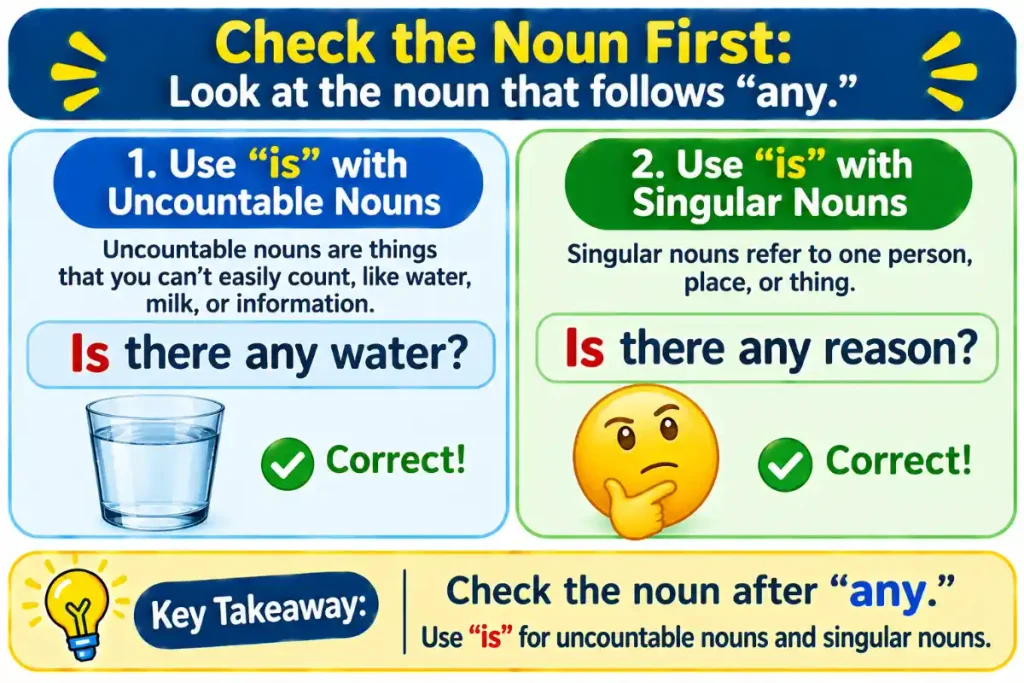
- Check the noun first: Look at the noun that follows “any.”
- Use “is” with uncountable nouns: Is there any water?
- Use “is” with singular nouns: Is there any reason?
- Use “are” with plural nouns: Are there any books?
- Learn common uncountable nouns: Information, advice, furniture, homework, and money usually take “is.”
- Think about the meaning: Some nouns can be countable or uncountable depending on context.
- Don’t let “any” confuse you: It can appear with both singular and plural nouns.
A helpful memory trick is to replace the noun with a simple subject.
- Is there any information? → Is the information available?
- Are there any documents? → Are the documents available?
If the noun is plural, use “are.” If it is singular or uncountable, use “is.”
Conclusion
Understanding is there any vs are there any comes down to one simple grammar rule: subject-verb agreement. Both expressions are correct, but you must choose the one that matches the noun in your sentence.
Use “is there any” when asking about singular countable nouns or uncountable things such as water, money, information, and advice. Use “are there any” when asking about plural countable nouns such as books, students, questions, and opportunities.
Remember that the word “any” does not decide whether you need “is” or “are.” The noun does. Once you recognize whether a noun is singular, plural, or uncountable, choosing the correct expression becomes much easier. Practice with everyday questions, and you’ll naturally use both forms in conversations, emails, and academic writing.
Frequently Asked Questions
1. Which is correct, “is there any” or “are there any”?
Both expressions are correct, but they are used with different nouns. Use “is there any” with singular or uncountable nouns and “are there any” with plural countable nouns.
2. Is there any water or are there any water?
“Is there any water?” is correct because water is an uncountable noun. However, “Are there any water bottles?” is correct because bottles are countable and plural.
3. Should I say “is there any information” or “are there any information”?
“Is there any information?” is correct because information is uncountable in standard English. You can also say “Are there any details?” when referring to multiple pieces of information.
4. Can I use “any” with singular nouns?
Yes, “any” can be used with singular countable nouns in questions. For example, “Is there any reason to leave early?” is grammatically correct.
5. Is “are there any questions” grammatically correct?
Yes, “Are there any questions?” is completely correct because questions is a plural countable noun. It is commonly used in classrooms, meetings, and presentations.
6. Is “is there any problems” correct?
No, “Is there any problems?” is grammatically incorrect. The correct sentence is “Are there any problems?” because problems is plural.
7. What is the negative form of “is there any” and “are there any”?
Use “there isn’t any” with singular or uncountable nouns and “there aren’t any” with plural countable nouns. For example, “There isn’t any milk” and “There aren’t any apples.”
1 thought on “Is There Any vs Are There Any: Correct Usage and Examples”