
Have you ever written a sentence about a rosy future, rosy cheeks, or a positive outlook and wondered whether the correct spelling is rosey or rosy? The two forms look similar, so it’s easy to see why people confuse them. However, only one is the standard spelling in American English.
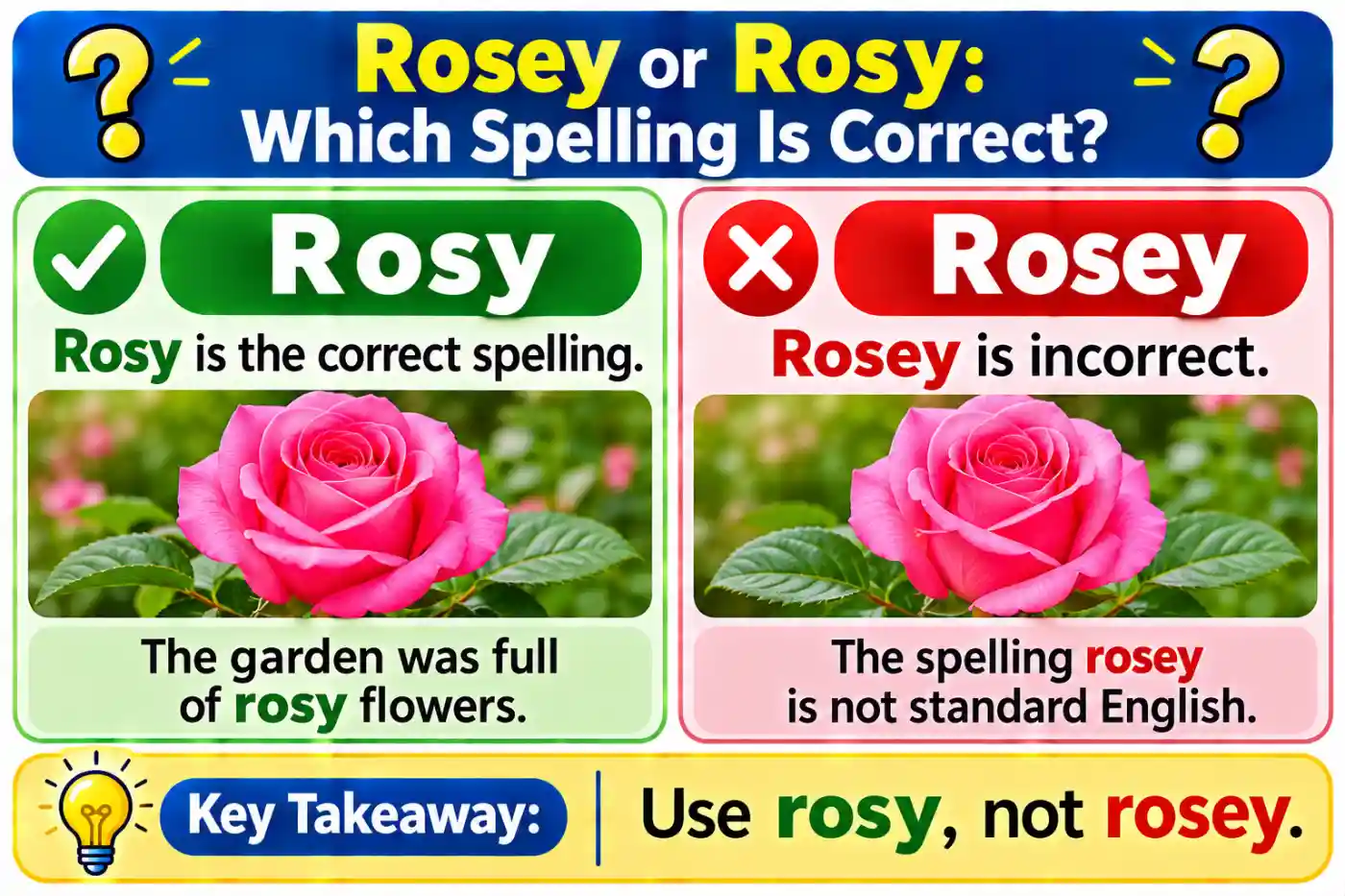
The correct spelling is rosy. It is an adjective that describes something pink, reddish, healthy-looking, cheerful, hopeful, or promising. The spelling rosey is generally considered a misspelling when you intend to use the common adjective.
Rosy is the correct spelling in standard American English, while rosey is incorrect in ordinary descriptive writing. You should write rosy cheeks, a rosy outlook, and a rosy picture rather than rosey cheeks, a rosey outlook, or a rosey picture.
Although the difference comes down to one letter, understanding the word’s meaning, pronunciation, and common expressions can help you use it correctly. This guide explains the difference between rosey and rosy, provides natural examples, explores related words, and shares practical spelling tips.
Rosey or Rosy: Which Spelling Is Correct?
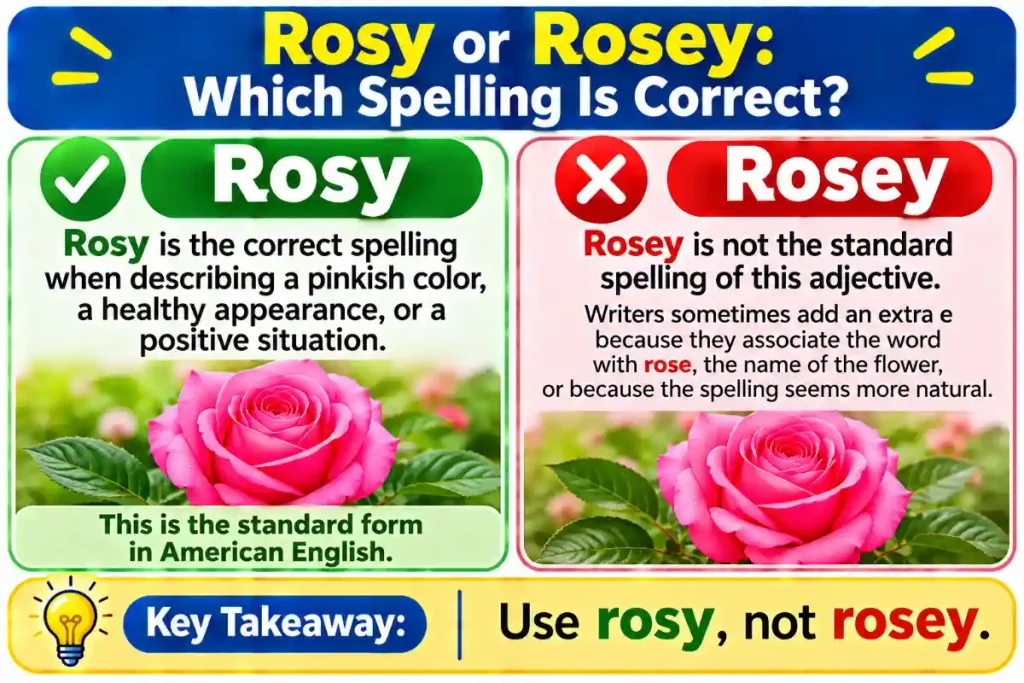
Rosy is the correct spelling when describing a pinkish color, a healthy appearance, or a positive situation. It is the standard form used in American English dictionaries and everyday writing. Rosey is not the standard spelling of this adjective. Writers sometimes add an extra e because they associate the word with rose, the name of the flower, or because the spelling seems more natural.
Here is a quick comparison:
| Spelling | Correct or Incorrect? | Meaning | Example |
|---|---|---|---|
| Rosy | Correct | Pink, reddish, healthy, or hopeful | Her cheeks looked rosy. |
| Rosey | Generally incorrect | Nonstandard spelling of the adjective | Her cheeks looked rosey. |
The easiest way to remember the correct form is to use rosy whenever you describe someone’s complexion, a hopeful situation, or a positive impression.
For example:
- Correct: The morning sun gave the clouds a rosy glow.
- Incorrect: The morning sun gave the clouds a rosey glow.
- Correct: They have a rosy outlook for the coming year.
- Incorrect: They have a rosey outlook for the coming year.
The spelling rosy works across casual conversations, professional communication, academic assignments, and creative writing.
What Does Rosy Mean?
Rosy is an adjective with several related meanings. It commonly describes a pink or reddish color, a healthy-looking appearance, or something that seems positive and promising. The meaning depends on the context in which you use it.
1. Rosy Means Pink or Reddish
The most direct meaning of rosy relates to the color of a rose. It describes a soft pink, reddish, or warm pinkish shade. People often use this meaning when describing cheeks, skin, sunsets, flowers, and other colorful objects.
Examples:
- The little girl’s cheeks turned rosy after playing outside.
- A rosy sunset appeared over the quiet lake.
- She wore a rosy pink sweater to the family gathering.
- The cold weather gave his face a rosy appearance.
In these examples, rosy describes a visible color rather than an emotion or situation.
2. Rosy Means Healthy-Looking
Rosy can also describe a person’s healthy appearance, especially when their cheeks have a natural pink or reddish color.
For example:
- After spending time in the garden, her face looked rosy.
- The baby had soft skin and rosy cheeks.
- His rosy complexion made him look refreshed.
- A little exercise left her cheeks rosy.
This meaning often appears in descriptions of children, outdoor activities, and healthy-looking complexions.
3. Rosy Means Positive or Hopeful
Another common meaning of rosy is optimistic, encouraging, or likely to produce a good result. Writers frequently use the word when discussing someone’s future, career, financial outlook, or personal circumstances.
Examples:
- The company has a rosy future after its successful launch.
- She feels optimistic about her rosy career prospects.
- The latest report presents a rosy outlook for the economy.
- Their plans for the summer look quite rosy.
In this context, rosy does not describe an actual color. Instead, it suggests that something appears promising or favorable.
4. Rosy Can Describe an Idealized Situation
Sometimes, rosy describes a situation that appears better than it really is. For example, someone might describe an overly positive account of a difficult situation as a rosy picture.
Examples:
- The advertisement paints a rosy picture of life in the city.
- His description of the project was more rosy than the actual results.
- The report presents a rosy view of the company’s financial position.
This usage can carry a slightly critical meaning because it suggests that someone may be overlooking problems or focusing only on positive details.
Why Do People Confuse Rosey and Rosy?
The confusion between rosey and rosy mainly comes from their similar appearance and pronunciation. Both spellings look reasonable at first glance. Since the noun rose contains an e, some writers assume that the adjective should also contain an e before the final y. However, English spelling does not always follow that pattern. The established adjective is rosy, not rosey. Its spelling has remained standard even though the related noun is spelled rose. Here are some common reasons people make this mistake:
- Association with rose: Writers connect the adjective with the flower and copy its spelling pattern.
- Visual confusion: The two forms differ by only one letter.
- Unfamiliarity: Some people encounter the word more often in conversation than in formal writing.
- Typing mistakes: Fast typing can lead to an unnecessary extra letter.
- Autocorrect habits: Spell-checking tools may not always recognize names or unusual word choices correctly.
The best solution is to remember that the standard adjective has four letters: R-O-S-Y.
How Do You Spell Rosy Correctly?
The correct spelling is R-O-S-Y.
It contains four letters and does not include an e between the s and the y.
| Letter | Position |
|---|---|
| R | 1 |
| O | 2 |
| S | 3 |
| Y | 4 |
A useful way to remember the spelling is to connect rosy with the phrase rosy cheeks. This common expression always uses the four-letter spelling.
Compare these examples:
| Incorrect | Correct |
|---|---|
| Rosey cheeks | Rosy cheeks |
| Rosey future | Rosy future |
| Rosey complexion | Rosy complexion |
| Rosey picture | Rosy picture |
| Rosey outlook | Rosy outlook |
| Rosey glow | Rosy glow |
Whenever you use the adjective in standard writing, choose rosy.
Examples of Rosy in Real Sentences
Understanding a word becomes easier when you see how people use it in everyday situations. The following examples show how rosy works in different contexts.
Everyday Conversation
- Weather: The morning sunlight gave the sky a beautiful rosy color.
- Appearance: Her cheeks looked rosy after the long walk.
- Family: Grandma always says that the children have rosy cheeks.
- Personal feelings: I have a rosy outlook on the opportunities ahead.
- Home: The room looked warm and inviting with its rosy curtains.
Workplace and Business
- Business: The company expects a rosy future after securing several new clients.
- Financial report: The manager presented a rosy picture of the business’s performance.
- Career: She believes her new position offers rosy career prospects.
- Planning: The team has a rosy outlook for the next quarter.
- Investment discussion: The analyst described the market outlook as relatively rosy.
School and Academic Writing
- Essay: The author uses a rosy description to express the character’s optimism.
- Literature: The poem creates a rosy image of childhood memories.
- Class discussion: Students discussed why the writer presented such a rosy view of the future.
- Assignment: The passage describes a rosy sunset across the countryside.
Social Media and Texting
- Instagram caption: Enjoying the rosy colors of another beautiful sunset.
- Text message: I hope everything looks rosy for you this week.
- Personal update: Feeling positive about the rosy possibilities ahead.
- Photo caption: A rosy glow and a peaceful evening make the perfect combination.
These examples demonstrate that rosy can describe physical colors, personal appearances, positive expectations, and overly optimistic descriptions.
Rosey vs Rosy: What’s the Difference?
The main difference between rosey and rosy is spelling. Rosy is the accepted adjective, while rosey is a nonstandard spelling when used with the same meaning.
| Feature | Rosy | Rosey |
|---|---|---|
| Standard spelling | Yes | No |
| Part of speech | Adjective | Not the standard adjective form |
| Describes color | Yes | No, not in standard usage |
| Describes appearance | Yes | No, not in standard usage |
| Describes optimism | Yes | No, not in standard usage |
| Suitable for formal writing | Yes | No |
| Suitable for everyday writing | Yes | No |
Consider these sentences:
- Correct: The children returned home with rosy cheeks.
- Incorrect: The children returned home with rosey cheeks.
- Correct: She believes her future looks rosy.
- Incorrect: She believes her future looks rosey.
- Correct: The artist used rosy shades in the painting.
- Incorrect: The artist used rosey shades in the painting.
There is one important exception: Rosey may appear as a person’s name, nickname, business name, or other proper noun. In those cases, its spelling depends on the official name. That does not make it a standard alternative spelling of the adjective rosy.
What Part of Speech Is Rosy?
Rosy is an adjective. An adjective describes or gives more information about a noun or pronoun. It helps readers understand the appearance, condition, or qualities of something.
For example:
- Rosy cheeks: Describes the appearance of someone’s cheeks.
- Rosy future: Describes an encouraging future.
- Rosy sunset: Describes the color of a sunset.
- Rosy outlook: Describes an optimistic expectation.
- Rosy complexion: Describes someone’s pinkish appearance.
How Rosy Works in a Sentence
An adjective can appear before a noun or after a linking verb.
Before a noun:
- She wore a rosy dress.
- The children had rosy cheeks.
- They discussed their rosy future.
After a linking verb:
- Her cheeks looked rosy.
- The sky became rosy at sunset.
- The company’s prospects seem rosy.
In each example, rosy describes a noun or subject.
Is Rosy an Adverb?
No. Rosy is an adjective, not an adverb. If you want to describe how someone performs an action, you generally need a different expression.
For example:
- Adjective: She has a rosy complexion.
- Adverb: The word rosy does not have a commonly used adverb form for this meaning.
You should not automatically add -ly to create rosily in ordinary writing. Although rosily exists, it is uncommon and usually unnecessary.
Rosy vs Pink: What’s the Difference?
Rosy and pink are related because both can describe a color. However, they do not always communicate exactly the same thing. Pink is a general color name, while rosy often suggests a warm, soft, or reddish-pink appearance.
| Feature | Rosy | Pink |
|---|---|---|
| Main meaning | Rose-like pink or reddish color | A broad color category |
| Tone | Often warm and descriptive | Neutral and general |
| Appearance | Can suggest a natural blush | Can describe many shades |
| Figurative meaning | Can mean hopeful or promising | Usually does not carry this meaning |
| Example | Her cheeks looked rosy. | She bought a pink jacket. |
Examples:
- The cold air gave his cheeks a rosy color.
- She painted her bedroom walls light pink.
- The sunset created a rosy glow across the mountains.
- He selected a pink notebook for school.
You can use pink when you simply want to name a color. Choose rosy when you want a softer, warmer, or more expressive description.
Rosy vs Rose-Colored: What’s the Difference?
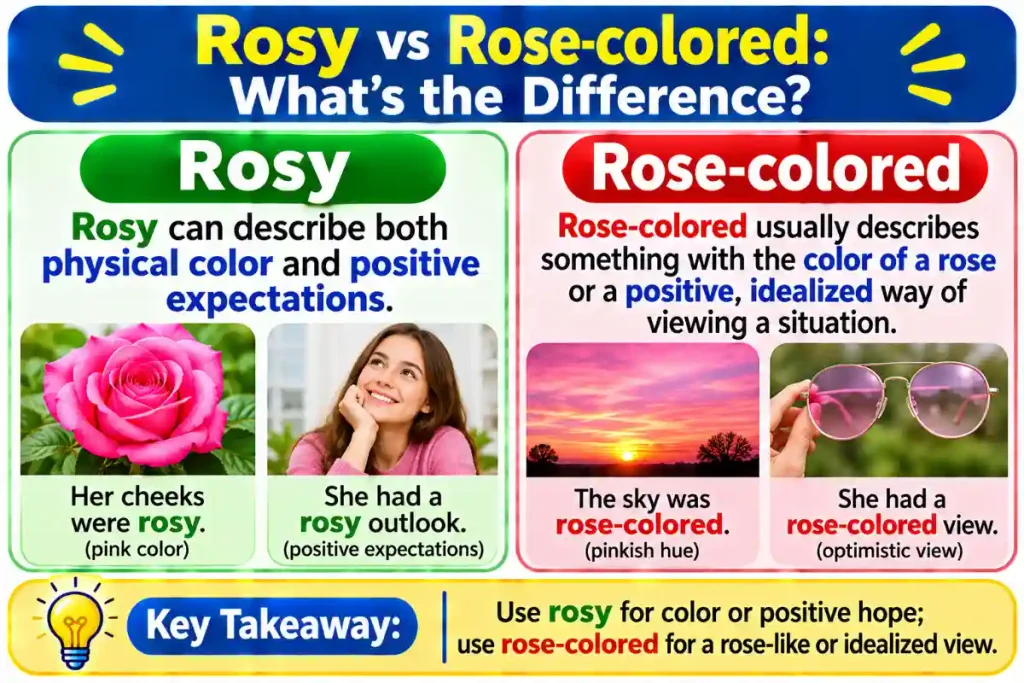
Rosy can describe both physical color and positive expectations. Rose-colored usually describes something with the color of a rose or a positive, idealized way of viewing a situation.
| Feature | Rosy | Rose-Colored |
|---|---|---|
| Color meaning | Pinkish or reddish | The color of a rose |
| Figurative meaning | Positive or promising | Idealistic or overly positive |
| Common expression | Rosy future | Rose-colored glasses |
| Example | They have a rosy outlook. | He sees the world through rose-colored glasses. |
The expression rose-colored glasses describes an overly optimistic way of viewing situations, sometimes without recognizing their problems.
For example:
- She has a rosy view of her new career.
- He looks at the situation through rose-colored glasses.
Both expressions relate to optimism, but rose-colored glasses often suggests that someone is ignoring negative details.
Common Expressions That Use Rosy
The word rosy appears in several familiar English expressions. Learning these phrases can help you understand the adjective in different contexts.
Rosy Cheeks
This expression describes cheeks that have a natural pink or reddish color.
Example: The children came inside with rosy cheeks after playing in the snow.
Rosy Future
A rosy future means a future that appears positive, successful, or promising.
Example: With her education and experience, she has a rosy future ahead.
Rosy Outlook
A rosy outlook describes an optimistic expectation about a situation.
Example: The new sales figures have given the business a rosy outlook.
Rosy Picture
A rosy picture is a description of something that makes it appear especially positive.
Example: The presentation painted a rosy picture of the company’s plans.
Rosy Glow
A rosy glow refers to a soft pinkish or reddish light or appearance.
Example: The evening sun created a rosy glow across the clouds.
Rosy Prospects
Rosy prospects are favorable possibilities or promising opportunities.
Example: The graduates have rosy prospects in their chosen fields.
What Are the Best Synonyms for Rosy?
The best synonym for rosy depends on its meaning in a sentence. When describing color, words such as pinkish, reddish, and rose-colored may work. When describing a positive situation, hopeful, promising, and optimistic are often better choices. Here are useful alternatives grouped by meaning.
| Word/Phrase | Meaning | Tone | Example |
|---|---|---|---|
| Pink | A light red color | Everyday | She wore a pink scarf. |
| Pinkish | Slightly pink | Neutral | The clouds looked pinkish. |
| Reddish | Somewhat red | Neutral | His cheeks had a reddish tone. |
| Rose-colored | Having the color of a rose | Descriptive | She selected rose-colored fabric. |
| Blush | A soft pink shade | Descriptive | The walls had a blush finish. |
| Peachy | A soft orange-pink shade | Casual | The sunset looked peachy. |
| Ruddy | Having a healthy reddish color | Descriptive | He had a ruddy complexion. |
| Flush | A temporary reddish appearance | Neutral | A flush appeared on her cheeks. |
| Coral | A pinkish-orange color | Descriptive | She chose a coral dress. |
| Florid | Having a noticeably red complexion | Formal | His face had a florid appearance. |
Synonyms for Rosy as Positive or Hopeful
| Word/Phrase | Meaning | Tone | Example |
|---|---|---|---|
| Optimistic | Expecting good results | Neutral | She remains optimistic about the future. |
| Hopeful | Feeling that something good may happen | Everyday | We are hopeful about the project. |
| Promising | Showing signs of future success | Professional | The results look promising. |
| Positive | Favorable or encouraging | Everyday | The meeting ended on a positive note. |
| Favorable | Likely to produce a good result | Formal | The company received favorable feedback. |
| Encouraging | Giving reasons for confidence | Neutral | The early results are encouraging. |
| Bright | Suggesting a successful future | Everyday | He has a bright future ahead. |
| Prosperous | Financially successful | Formal | The town enjoyed a prosperous period. |
| Advantageous | Providing a benefit | Formal | The agreement offers advantageous terms. |
| Cheerful | Happy and positive | Everyday | She maintained a cheerful attitude. |
| Upbeat | Positive and enthusiastic | Casual | The manager sounded upbeat. |
| Reassuring | Making someone feel more confident | Neutral | The latest update was reassuring. |
| Favorable-looking | Appearing likely to go well | Conversational | The situation looks favorable. |
| Buoyant | Confident and positive | Professional | Consumer confidence remained buoyant. |
| Constructive | Helpful and focused on improvement | Professional | The discussion was constructive. |
Synonyms for Rosy as an Idealized Description
Sometimes rosy suggests that a description is too positive. In this case, these alternatives may be more accurate:
| Word/Phrase | Meaning | Tone | Example |
|---|---|---|---|
| Idealized | Presented as better than reality | Neutral | The film shows an idealized childhood. |
| Overly optimistic | More positive than circumstances justify | Neutral | His forecast seems overly optimistic. |
| Unrealistic | Not based on practical conditions | Neutral | The proposal includes unrealistic expectations. |
| Glowing | Extremely positive in description | Descriptive | She gave a glowing review. |
| Sugarcoated | Made to sound less negative | Casual | The report was sugarcoated. |
| One-sided | Showing only one perspective | Neutral | The article offers a one-sided account. |
| Romanticized | Presented in an unrealistically attractive way | Neutral | The book romanticizes city life. |
These alternatives are not interchangeable in every sentence. Always choose a word that matches the intended meaning.
Rosy Synonyms by Intensity
When describing optimism, you can choose different words depending on how positive or confident you want to sound.
| Intensity | Word | Meaning |
|---|---|---|
| Mild | Hopeful | Some reason to expect a good outcome |
| Mild | Encouraging | Showing positive signs |
| Mild | Positive | Generally favorable |
| Moderate | Optimistic | Expecting a good result |
| Moderate | Promising | Showing potential for success |
| Moderate | Favorable | Likely to produce a good result |
| Strong | Bright | Suggesting a very positive future |
| Strong | Excellent | Extremely good |
| Strong | Prosperous | Likely to bring financial success |
For example, a project might have an encouraging beginning, a promising outlook, or a bright future. The right choice depends on how confident you want your statement to sound.
What Are the Antonyms of Rosy?
Antonyms are words with opposite or contrasting meanings. The best opposite of rosy depends on whether you are describing a color, an appearance, or a situation.
Antonyms for Rosy as Positive or Hopeful
- Pessimistic: Expecting negative results.
- Bleak: Showing little hope for the future.
- Gloomy: Dark, depressing, or discouraging.
- Unpromising: Showing little potential for success.
- Unfavorable: Not likely to produce a good result.
- Negative: Expressing an unfavorable view.
- Troubled: Experiencing difficulties.
- Uncertain: Not clearly predictable.
Examples:
- Rosy outlook: The business expects strong growth.
- Bleak outlook: The business expects serious challenges.
- Rosy future: She expects many opportunities.
- Unpromising future: She sees few opportunities ahead.
Antonyms for Rosy as a Color
There is no single exact opposite of rosy because it describes a range of pinkish or reddish shades. Depending on the context, contrasting colors may include:
- Gray
- Blue
- Green
- Pale
- Colorless
For example, a rosy sunset might contrast with a gray, cloudy sky.
Is Rosy American or British English?
Rosy is the standard spelling in both American and British English. There is no standard US-versus-UK spelling difference for this adjective.
| English Variety | Correct Spelling | Example |
|---|---|---|
| American English | Rosy | She has rosy cheeks. |
| British English | Rosy | She has rosy cheeks. |
| Canadian English | Rosy | They have a rosy outlook. |
| Australian English | Rosy | The future looks rosy. |
The spelling does not change based on the country. American writers should use rosy in school assignments, workplace emails, business reports, articles, and everyday communication. Although rosey may appear in personal names or creative branding, it is not the standard spelling of the adjective in these varieties of English.
Should You Use Rosy in Formal or Casual Writing?
Yes. Rosy is suitable for both formal and casual writing. However, its meaning and tone should fit the situation.
Rosy in Professional Emails
In professional communication, rosy can describe encouraging expectations or positive business conditions.
Examples:
- The latest figures provide a rosy outlook for the next quarter.
- We are optimistic about the project’s future prospects.
- The new agreement gives the company a promising opportunity.
For highly formal reports, favorable, promising, or positive may sound more precise.
Rosy in Academic Writing
You can use rosy in essays and academic assignments, particularly when discussing descriptions, opinions, literature, or expectations.
Examples:
- The author presents a rosy image of rural life.
- The character maintains a rosy outlook despite several challenges.
- The passage offers an idealized view of the past.
If you are writing an analytical essay, explain why the description is rosy rather than simply labeling it positive.
Rosy in Everyday Conversation
The word sounds natural in ordinary conversations.
Examples:
- Things are looking rosy for the team.
- She always has a rosy outlook on life.
- Your cheeks look rosy after that walk.
Rosy in Social Media Posts
Rosy is also useful for captions and personal updates.
Examples:
- A little rosy glow makes the evening special.
- Looking forward to a bright and rosy future.
- Beautiful skies and rosy sunset colors.
Common Mistakes to Avoid When Using Rosy
Even though rosy is a simple adjective, several mistakes can affect spelling and word choice.
1. Adding an Unnecessary E
Incorrect: She had rosey cheeks after the walk.
Correct: She had rosy cheeks after the walk.
Remember that the standard spelling contains no extra e.
2. Using Rosy When You Mean Pink
Although the words are related, they do not always have identical meanings.
Less precise: I bought a rosy shirt.
More precise: I bought a pink shirt.
Use pink when you mean the general color. Use rosy when you want to suggest a rose-like shade or a warmer, more expressive appearance.
3. Confusing Rosy With Rose-Colored
The expressions are related, but they may communicate different ideas.
Example:
- Rosy outlook: A positive expectation about the future.
- Rose-colored glasses: An idealistic way of viewing the world.
Choose the expression that communicates your intended meaning.
4. Using Rosy for Every Positive Situation
Rosy is not always the best adjective for positive circumstances.
For example:
- Natural: The company’s future looks promising.
- Also natural: The company’s future looks rosy.
- More specific: The company’s future looks financially secure.
Use more precise words when discussing business performance, financial stability, or measurable results.
5. Assuming Rosey Is a Standard Alternative
Some writers believe both spellings are accepted because they look almost identical. However, rosy is the standard descriptive adjective. Use rosey only when reproducing a specific proper name or other official spelling.
Quick Tips to Remember the Correct Spelling
If you often confuse rosey and rosy, these simple techniques can help you remember the correct form.
- Remember the four letters: Rosy contains R, O, S, and Y.
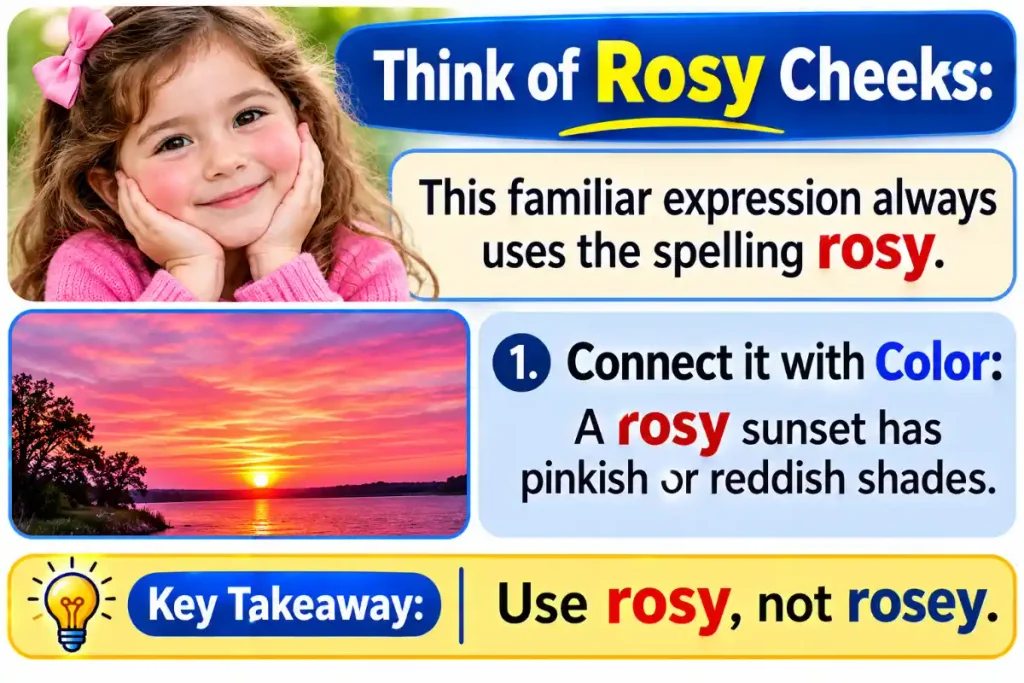
- Think of rosy cheeks: This familiar expression always uses the spelling rosy.
- Connect it with color: A rosy sunset has pinkish or reddish shades.
- Remember the figurative meaning: A rosy future is a hopeful future.
- Avoid adding an extra E: The adjective does not follow the spelling of the noun rose.
- Check your writing: Use a reliable dictionary or spell-checking tool when uncertain.
- Practice with sentences: Write examples such as rosy cheeks, rosy outlook, and rosy future.
A simple memory trick is to remember this sentence: Rosy cheeks make a rosy smile.
Both uses contain the same four-letter spelling.
Conclusion
Choosing between rosey and rosy is simple once you understand the standard spelling. Rosy is the correct adjective in American English, while rosey is generally incorrect when used with the same descriptive meaning. The word can describe pinkish colors, healthy-looking cheeks, promising opportunities, and optimistic expectations.
Remember that rosy works naturally in expressions such as rosy cheeks, rosy future, rosy outlook, and rosy picture. You can use it in everyday conversations, social media captions, school assignments, and professional writing. If you want a more precise alternative, consider words such as pinkish, hopeful, optimistic, or promising, depending on the context. The easiest spelling rule to remember is that rosy has four letters and no extra E. Keep this simple rule in mind, and you will use the correct form confidently.
Frequently Asked Questions
1. Is it rosey or rosy?
Rosy is the correct spelling of the adjective in standard American English. Rosey is generally a misspelling when used to describe a pinkish color, healthy appearance, or positive outlook.
2. How do you spell rosy correctly?
The correct spelling is R-O-S-Y. It has four letters and does not contain an extra e.
3. Is rosey ever a correct word?
Rosey can be correct as a person’s name, nickname, or part of a proper name. However, it is not the standard spelling of the adjective rosy.
4. What does rosy mean?
Rosy means pinkish or reddish in color, healthy-looking, or positive and hopeful. For example, rosy cheeks describes a pinkish appearance, while a rosy future describes promising expectations.
5. What is another word for rosy?
Depending on the context, alternatives include pinkish, reddish, hopeful, optimistic, promising, favorable, and encouraging. The best synonym depends on whether you are describing color or a positive situation.
6. Is rosy the same in American and British English?
Yes. Both American and British English use rosy. There is no regional spelling difference for this adjective.
7. What does a rosy outlook mean?
A rosy outlook means an optimistic or positive expectation about a future situation. It suggests that circumstances are likely to improve or produce favorable results.
2 thoughts on “Rosey or Rosy: Which Spelling Is Correct?”