
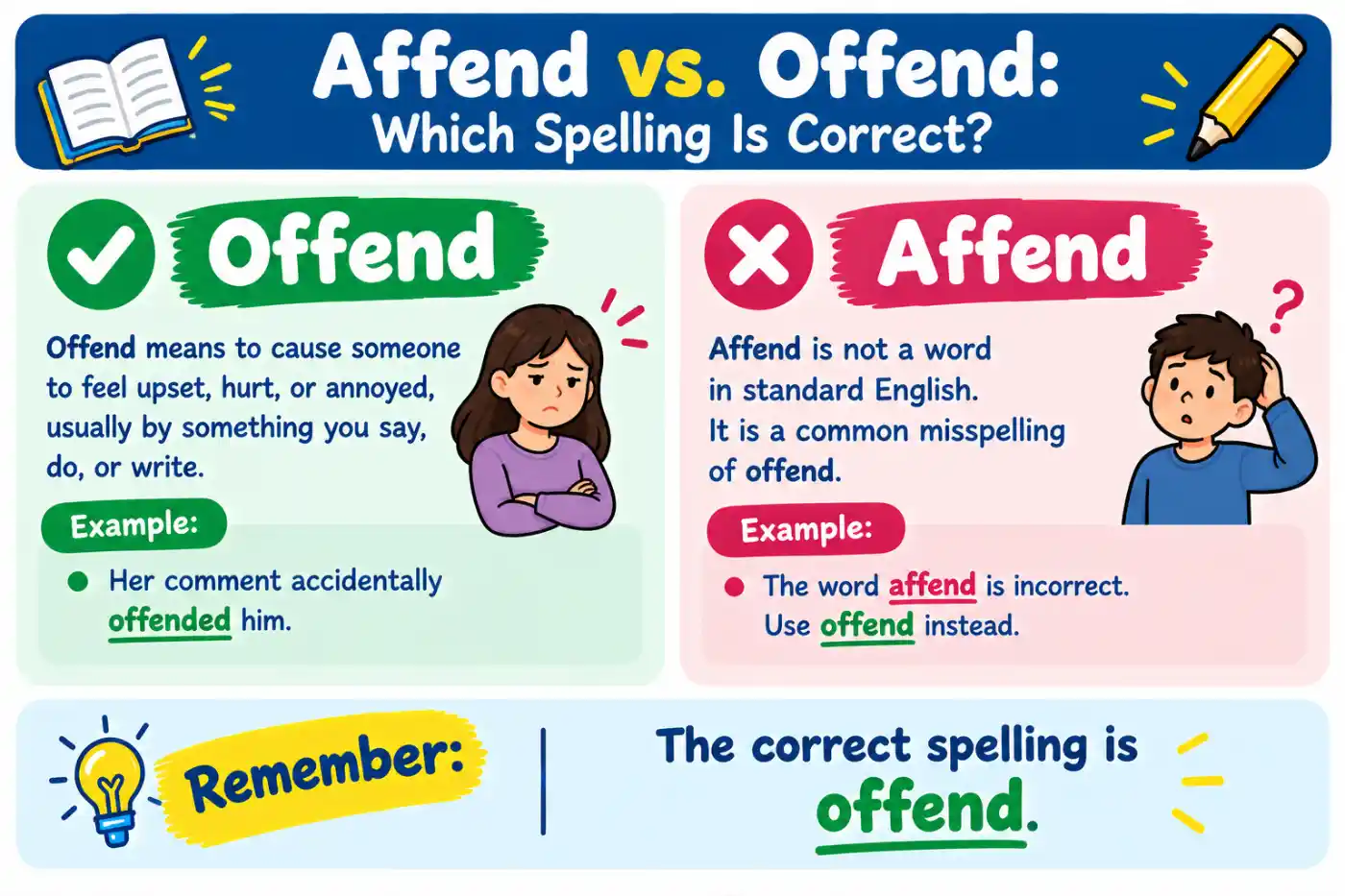
If you’re writing an email, text message, or school assignment, you might wonder whether affend vs. offend is the correct spelling. The two words look similar, but only one is a standard English word. The confusion often comes from their similar sounds and the way English spelling works.
Offend is the correct spelling. It means to upset someone, hurt their feelings, or violate a rule or standard. Affend is a misspelling and should not be used in standard American English.
For example, you can say, “I didn’t mean to offend anyone with my comment.” In this sentence, offend describes the effect a comment might have on another person.
Understanding the meaning of offend, its related forms, and its common synonyms will help you use it correctly in everyday conversations, professional emails, and formal writing.
What Does Affend vs Offend Mean?
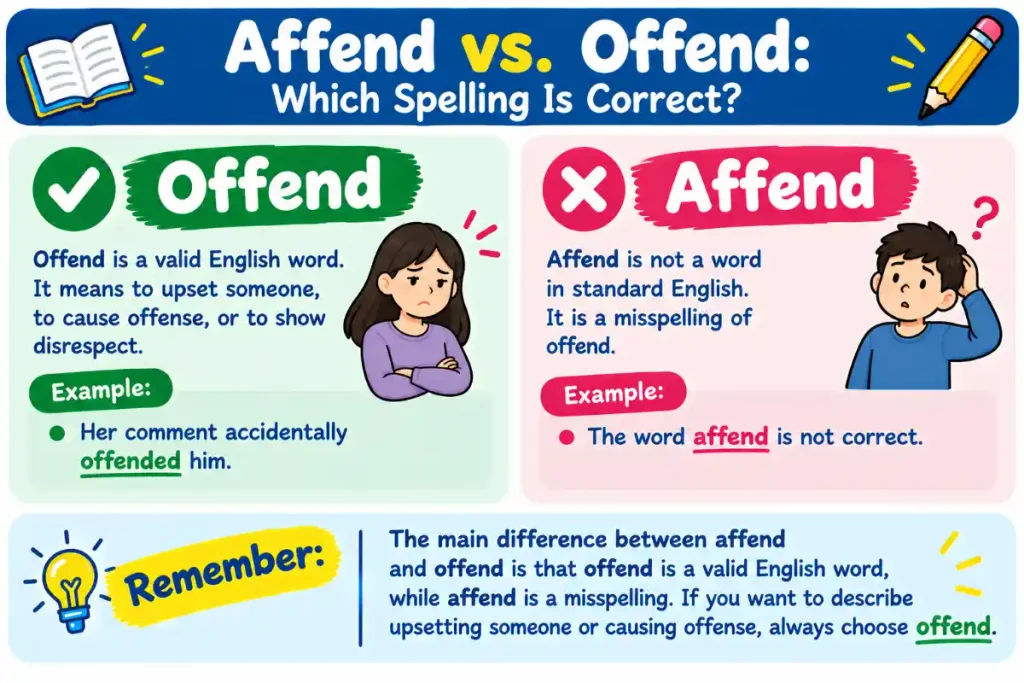
The main difference between affend and offend is that offend is a valid English word, while affend is a misspelling. If you want to describe upsetting someone or causing offense, always choose offend.
| Word | Status | Meaning | Example |
|---|---|---|---|
| Offend | Correct | To upset, insult, or cause someone displeasure | I hope my joke didn’t offend you. |
| Affend | Incorrect | A misspelling of offend | Incorrect: I didn’t mean to affend her. |
The word offend can describe an unintentional mistake, a hurtful remark, or a deliberate insult. It can also refer to breaking a rule or going against someone’s beliefs.
For example:
- “His comment offended several people at the meeting.”
- “I didn’t intend to offend my friend.”
- “The advertisement may offend some viewers.”
- “The company violated a policy that protects customers from offensive conduct.”
In each example, offend communicates that an action, remark, or situation causes displeasure or goes against an accepted standard.
Why Do People Confuse Affend and Offend?
People often confuse affend and offend because the first syllable of offend has a weak vowel sound. The word is pronounced approximately uh-FEND, with the stress on the second syllable. When people hear the word quickly, they may think it begins with an a instead of an o. However, pronunciation does not always make English spelling obvious. Here are three common reasons for the mistake.
1. The First Vowel Sounds Unclear
The first vowel in offend does not sound like a strong “oh.” This can lead writers to guess the wrong letter.
- Correct: offend
- Incorrect: affend
The pronunciation may explain the confusion, but it does not make affend an accepted spelling.
2. People Type Too Quickly
Typing quickly on a phone or computer can lead to spelling errors. Someone might type affend without noticing the mistake, especially when writing an informal message. Proofreading your work and using a spell-check tool can help you catch this error.
3. English Spelling Does Not Always Match Pronunciation
English contains many words whose spelling is not immediately obvious from their sounds. For example, the words write, right, and rite sound alike but have different meanings. The same general challenge applies to offend. You need to learn its standard spelling rather than rely only on its pronunciation.
How to Use Offend Correctly
Offend is a verb. It describes an action that causes someone to feel upset, insulted, or displeased. It can also describe violating a rule, law, or accepted standard.
Common Verb Forms
| Form | Usage | Example |
|---|---|---|
| Offend | Base form | I never intend to offend anyone. |
| Offends | Present tense with he, she, or it | His rude tone offends his coworkers. |
| Offended | Past tense | Her remark offended the audience. |
| Offended | Past participle | I have offended him before. |
| Offending | Present participle | The company removed the offending advertisement. |
These forms all preserve the correct spelling. None uses affend.
Common Sentence Patterns
You can use offend in several natural sentence patterns.
| Pattern | Example |
|---|---|
| Offend someone | I didn’t mean to offend my neighbor. |
| Offend someone with something | He offended his guests with an insensitive joke. |
| Be offended by something | She was offended by the remark. |
| Feel offended | I felt offended by his response. |
| Easily offended | Some readers are easily offended by harsh language. |
| Not mean to offend | I hope this question doesn’t offend you. |
Notice that English normally uses offend someone without adding to before the person.
Correct: “I didn’t mean to offend her.”
Incorrect: “I didn’t mean to offend to her.”
12 Correct Example Sentences With Offend
These examples show how to use offend in everyday conversations, schoolwork, professional communication, and other situations.
- Everyday conversation: I hope I didn’t offend you with my question.
- Workplace: The manager apologized for the comment that offended several employees.
- School: Students should discuss sensitive topics without trying to offend others.
- Email: Please let me know if my message sounded rude or seemed to offend you.
- Friendship: I didn’t mean to offend my friend by declining the invitation.
- Social media: The creator edited the post after learning that it offended some readers.
- Customer service: The company responded quickly after its advertisement offended customers.
- Family: His joke offended his sister, even though he intended it to be funny.
- Formal writing: The author avoided language that might offend the intended audience.
- Public speaking: Speakers should consider how their words might affect different listeners.
- Personal discussion: You can disagree with someone’s opinion without trying to offend them.
- General behavior: A respectful tone can help prevent misunderstandings that offend others.
Each sentence uses offend or one of its correct grammatical forms. Replacing it with affend would introduce a spelling error.
Offend vs Offended vs Offensive: What’s the Difference?
These three words belong to the same word family, but they perform different grammatical roles.
| Word | Part of Speech | Meaning | Example |
|---|---|---|---|
| Offend | Verb | To upset or insult someone | I didn’t want to offend him. |
| Offended | Verb or adjective | Upset or insulted by something | She felt offended by the joke. |
| Offensive | Adjective | Causing or likely to cause offense | The remark was offensive. |
| Offender | Noun | A person who commits an offense | The offender apologized for the misconduct. |
| Offense | Noun | An insult, violation, or feeling of displeasure | His comment caused offense. |
These related words can help you remember the correct spelling of offend.
Offend vs. Offended
Use offend to describe the action of upsetting someone. Use offended when referring to a past action or describing someone’s reaction.
- Offend: I don’t want to offend my teacher.
- Offended: My teacher was offended by the remark.
Offend vs. Offensive
Use offend as a verb and offensive as an adjective.
- Offend: The comment may offend some people.
- Offensive: The comment was offensive.
The first sentence describes what the comment might do. The second describes the comment itself.
Offense vs. Offence
Both offense and offence are accepted spellings of the related noun, but regional preferences differ.
- American English: offense
- British English: offence
The verb remains offend in both American and British English. Neither variety uses affend as the standard spelling of this verb.
Offend vs. Insult: What’s the Difference?
Offend is a broad term for causing displeasure, hurt feelings, or resentment. An action can offend someone even when no insult was intended. Insult usually refers to words or actions that show disrespect or deliberately put someone down.
| Word | Meaning | Tone | Example |
|---|---|---|---|
| Offend | Cause upset or displeasure | Broad | I didn’t mean to offend her. |
| Insult | Show disrespect or belittle someone | More direct | He insulted her by mocking her work. |
| Upset | Cause worry, sadness, or distress | Everyday | The news upset my friend. |
| Annoy | Cause irritation | Usually milder | The constant noise annoyed the neighbors. |
| Hurt | Cause emotional pain | Personal | His words hurt my feelings. |
| Anger | Make someone angry | Stronger in some contexts | The unfair decision angered the team. |
Choose the word that best describes the situation. If someone feels uncomfortable or hurt by an unintentional comment, offend may fit. If someone directly attacks another person’s dignity, insult may be more precise.
Synonyms for Offend
The best synonym depends on what happened and how strongly someone reacted. No single alternative fits every use of offend.
Mild to Moderate Alternatives
| Word or Phrase | Meaning | Tone | Example |
|---|---|---|---|
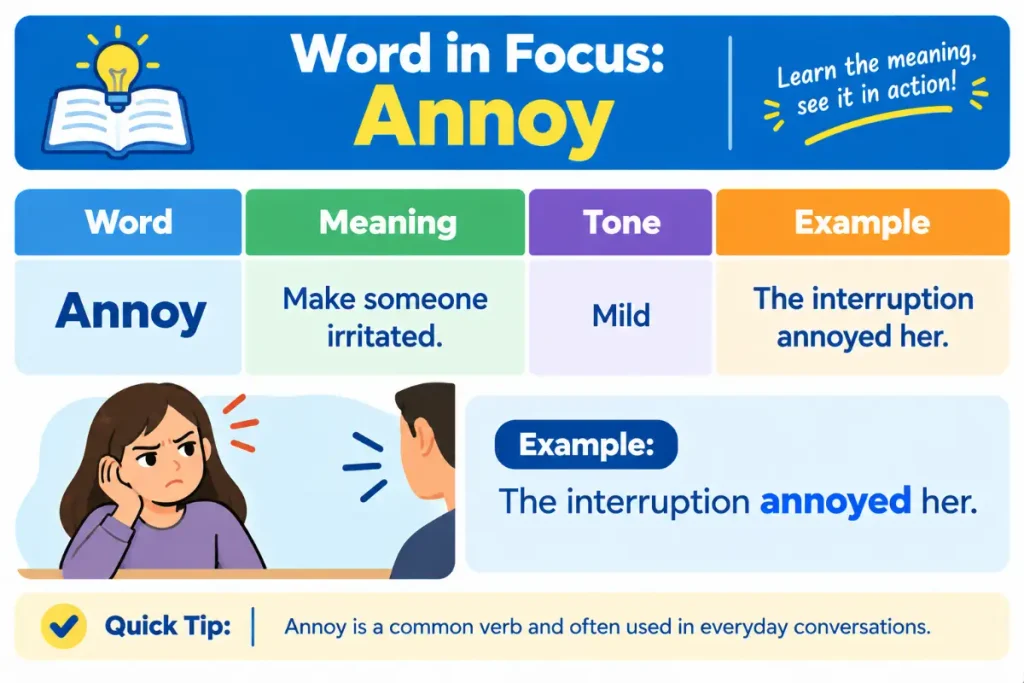
| Annoy | Make someone irritated | Mild | The interruption annoyed her. |
| Bother | Cause discomfort or concern | Mild | I hope my question didn’t bother you. |
| Upset | Cause emotional distress | Everyday | His comment upset his friend. |
| Displease | Cause dissatisfaction | Formal | The decision displeased several customers. |
| Irritate | Make someone impatient or annoyed | Neutral | The remark irritated the audience. |
| Hurt | Cause emotional pain | Personal | Her criticism hurt his feelings. |
| Embarrass | Make someone feel self-conscious | Everyday | The joke embarrassed his coworker. |
Stronger Alternatives
| Word or Phrase | Meaning | Tone | Example |
|---|---|---|---|
| Insult | Show disrespect | Direct | He insulted the speaker. |
| Anger | Make someone angry | Strong | The unfair accusation angered the staff. |
| Outrage | Cause intense anger | Very strong | The decision outraged many residents. |
| Humiliate | Make someone feel deeply ashamed | Strong | The public criticism humiliated the employee. |
| Antagonize | Provoke hostility | Strong | His repeated remarks antagonized the group. |
| Disrespect | Show a lack of respect | Direct | The comment disrespected the entire team. |
| Affront | Insult or offend openly | Formal | She considered the remark an affront to her work. |
These words express different degrees and types of negative reactions. For example, annoy usually suggests irritation, while humiliate suggests a more serious attack on someone’s dignity.
Formal Alternatives
In professional or academic writing, you may want a more precise word or phrase.
| Word or Phrase | Meaning | Tone | Example |
|---|---|---|---|
| Displease | Cause dissatisfaction | Formal | The proposed change displeased the committee. |
| Insult | Show disrespect | Neutral to direct | The statement insulted the recipient. |
| Affront | An action that causes offense | Formal | The refusal was viewed as an affront. |
| Violate | Break a rule or standard | Formal | The conduct violated the organization’s policy. |
| Transgress | Go beyond an accepted limit | Formal | The action transgressed established boundaries. |
Remember that violate and transgress work best when a rule, law, boundary, or standard is involved. They do not always replace offend when the meaning concerns hurt feelings.
What Is the Opposite of Offend?
The best antonym for offend depends on its meaning in the sentence.
| Antonym | Meaning | Example |
|---|---|---|
| Please | Give someone satisfaction or pleasure | Her thoughtful message pleased the recipient. |
| Comfort | Help someone feel better | He comforted his friend after the disagreement. |
| Reassure | Reduce someone’s worry or uncertainty | She reassured him that no offense was intended. |
| Respect | Treat someone with consideration | We should respect other people’s opinions. |
| Apologize | Express regret for an action | He apologized for his hurtful comment. |
Please is a useful opposite when offend means to cause displeasure. Respect works when the issue involves disrespectful behavior. Apologize is a response to an offense rather than a direct opposite, but it is useful in related situations.
Is Offend Spelled Differently in American and British English?
No. The verb offend has the same spelling in American and British English. The difference appears in the related noun:
| American English | British English |
|---|---|
| Offend | Offend |
| Offended | Offended |
| Offensive | Offensive |
| Offense | Offence |
| Offenses | Offences |
For American readers, offense and offenses are the usual noun forms. British writers generally prefer offence and offences. However, affend is not a standard regional variant. Do not use it in American or British writing when you mean offend.
Common Mistakes to Avoid
Understanding the correct spelling is only the first step. You should also choose the right form and use it in the correct sentence structure.
Mistake 1: Writing Affend Instead of Offend
Incorrect: “I didn’t mean to affend anyone.”
Correct: “I didn’t mean to offend anyone.”
The error changes the first vowel. Remember that the correct verb begins with off-.
Mistake 2: Confusing Offend With Offended
Incorrect: “I was offend by his comment.”
Correct: “I was offended by his comment.”
Use offended after was when describing a person’s reaction.
Mistake 3: Using Offend When You Mean Physical Injury
Incorrect: “He offended his knee during the game.”
Correct: “He injured his knee during the game.”
Offend usually concerns emotional reactions, disrespect, or violations of rules. Use hurt or injure for physical harm.
Mistake 4: Adding an Unnecessary To
Incorrect: “She didn’t want to offend to her friend.”
Correct: “She didn’t want to offend her friend.”
The normal pattern is offend someone, without to before the person.
Mistake 5: Confusing Offended With Offensive
Incorrect: “The comment was offended.”
Correct: “The comment was offensive.”
Use offensive to describe the comment and offended to describe the person who felt insulted.
How to Remember the Correct Spelling
Use these simple tips whenever you are unsure about affend vs. offend.
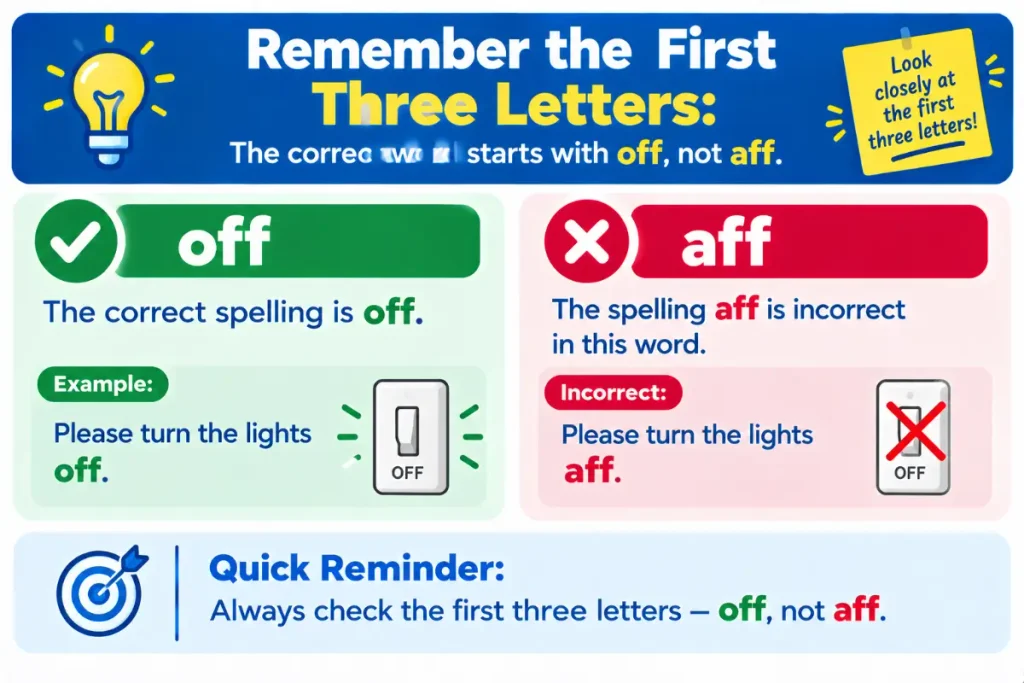
- Remember the first three letters: The correct word starts with off, not aff.
- Connect related words: Think of offend, offended, offensive, and offense. Their spellings reinforce the same word family.
- Read the sentence aloud: Hearing the word can help you identify its meaning, even though pronunciation alone cannot confirm the spelling.
- Use a spelling checker: If you’re writing an important email or assignment, check any word you’re unsure about.
- Practice with a complete sentence: Repeat “I didn’t mean to offend you” to reinforce the correct spelling and usage.
The most useful memory trick is to connect offend with offense. Both begin with off-, making the correct form easier to recall.
Conclusion
In conclusion, affend vs offend comes down to correct spelling. Offend is the correct English word, while affend is a misspelling. Offend means to upset, insult, or hurt someone’s feelings through words or actions.
Use offend when you want to describe making someone feel insulted or upset. For example, “I did not mean to offend anyone with my comments.” This sentence shows how the word works in everyday communication.
To avoid spelling mistakes, remember that offend begins with of, not af. Using the correct spelling helps you communicate clearly and write more accurately in emails, essays, and everyday conversations.
Frequently Asked Questions
Is affend a real English word?
Affend is not a standard English spelling of the verb offend. In ordinary writing, readers will generally interpret it as a spelling mistake.
Which is correct, affend or offend?
Offend is correct. Use it when you mean to upset, insult, or hurt someone’s feelings, or when referring to violating a rule or standard.
How do you spell offend?
Spell it O-F-F-E-N-D. The word begins with off, followed by end.
Why do people spell offend as affend?
People may confuse the spellings because the first vowel in offend has a weak sound, often heard as “uh.” That pronunciation can make the initial letter difficult to identify by sound alone.
What is the past tense of offend?
The past tense is offended. For example, “His comment offended several people at the meeting.”
Is offense or offence correct?
Both are correct noun spellings. American English generally uses offense, while British English generally uses offence. The verb is spelled offend in both varieties.
What is another word for offend?
Common alternatives include upset, insult, annoy, hurt, and displease. The best choice depends on the situation and the strength of the reaction.