
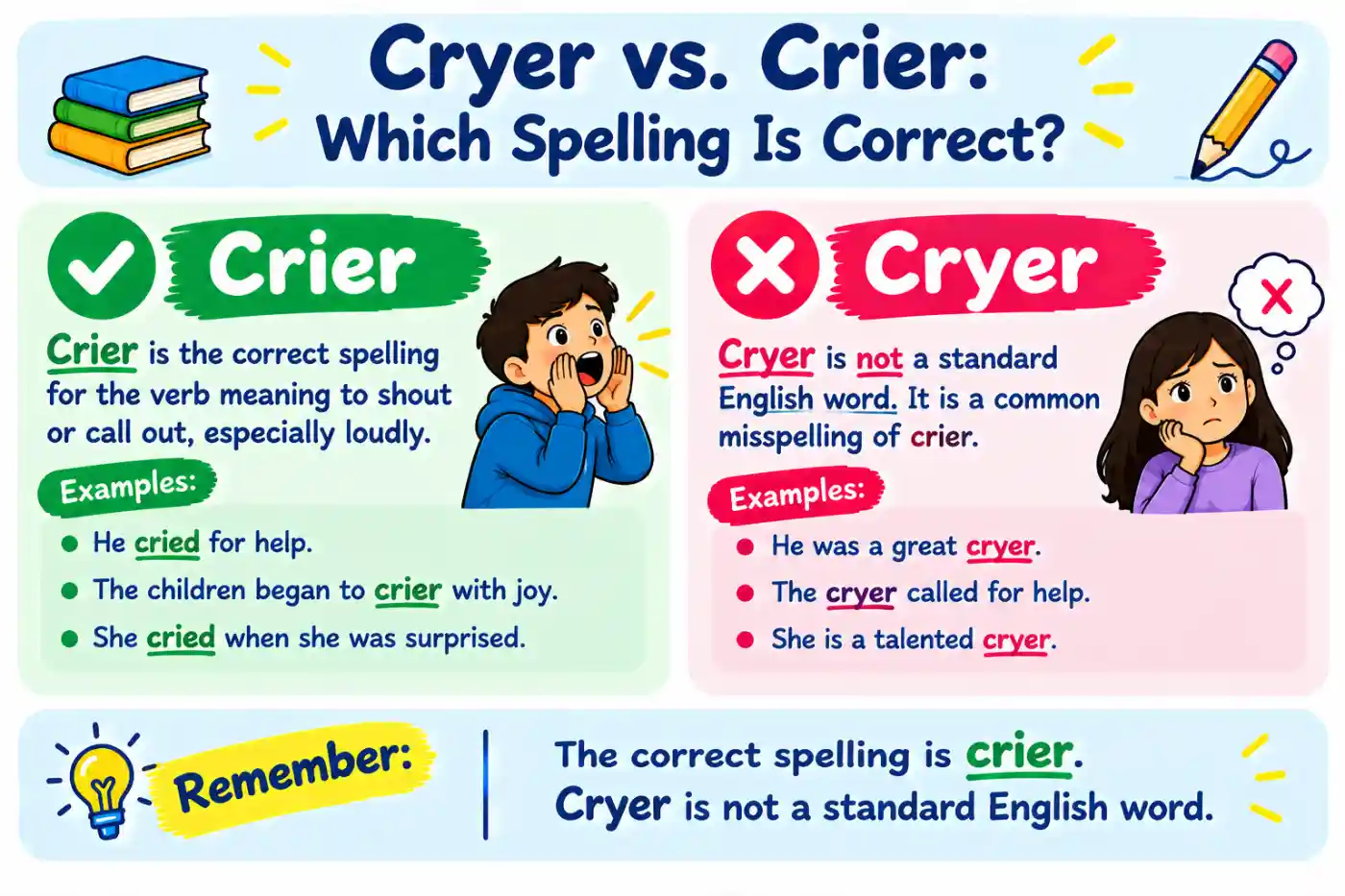
If you’re writing a story, reading an old book, or describing someone who announces news in public, you might wonder about cryer vs crier. The two spellings look similar, but crier is the standard spelling for someone who cries out, makes a public announcement, or weeps. Cryer is a less common variant that also appears as a surname.
Crier is the preferred spelling for the common noun, while cryer is an uncommon variant and a recognized surname. In most everyday writing, choose crier when you mean someone who cries out or announces something.
The confusion comes from the verb cry, which naturally seems to produce cryer when you add the suffix -er. However, English spelling doesn’t always follow that pattern. This guide explains the difference between the two words, shows how to use crier correctly, and provides examples to help you avoid common mistakes.
Cryer vs Crier: What’s the Difference?
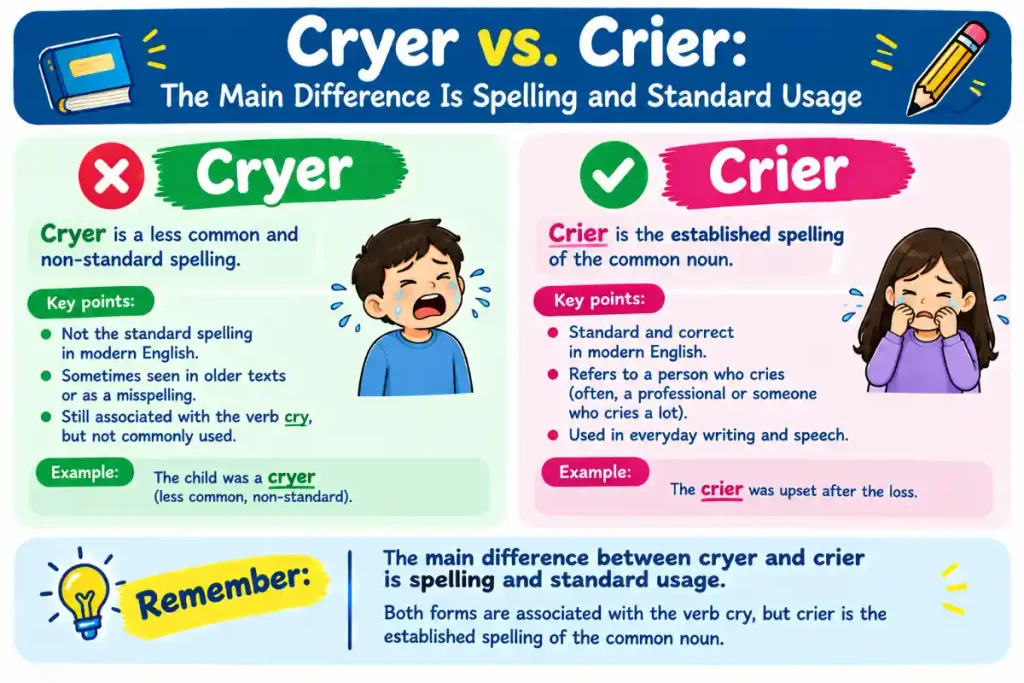
The main difference between cryer and crier is spelling and standard usage. Both forms are associated with the verb cry, but crier is the established spelling of the common noun.
| Word | Meaning | Usage | Example |
|---|---|---|---|
| Crier | Someone who cries out, announces news, or weeps | Standard common noun | The town crier announced the festival. |
| Cryer | A less common spelling variant; also a surname | Uncommon in ordinary writing | Mr. Cryer introduced himself at the meeting. |
Use crier in standard writing when referring to a person who makes announcements or cries. Use Cryer when it is someone’s actual surname, preserving the correct spelling of their name.
What Does Crier Mean?
A crier is a noun that refers to a person who cries out, calls attention to something, makes announcements, or expresses emotion by weeping. The exact meaning depends on the context.
1. A person who makes public announcements
Historically, a town crier announced important news, laws, and public events, often by calling out in a town square. Town criers traditionally helped share information before newspapers and modern communication became widespread.
Example: The town crier announced the opening of the annual county fair.
2. A person who cries or weeps
A crier can also refer to someone who cries emotionally. This meaning is less common in everyday conversation than simply saying someone who cries.
Example: My little brother is a frequent crier during sad movies.
3. A person who calls out in a particular role
The word can describe someone whose job involves calling out information or making formal announcements. Historical and ceremonial settings often use this meaning.
Example: The official crier announced the start of the public ceremony.
Why Is Cryer vs Crier Confusing?
The confusion between cryer and crier comes from the way English forms nouns from verbs. The verb cry describes calling out loudly or shedding tears. Many English nouns use the suffix -er to describe someone who performs an action.
For example:
- Teach → teacher
- Sing → singer
- Work → worker
- Play → player
Following this pattern, cryer may seem like the obvious spelling. However, the established spelling of the common noun is crier. The spelling crier reflects an English spelling pattern in which the final y changes to i before certain suffixes. You can see a similar change in words such as hurry and hurried. Although cryer may appear in names and less common written forms, that doesn’t make it the preferred spelling for the ordinary noun.
How Do You Spell Crier Correctly?
The correct standard spelling is C-R-I-E-R. Remember that the word contains ie, not ye. If you’re describing a town crier or someone who cries out, write crier. Here is a quick comparison:
| Spelling | Status | Example |
|---|---|---|
| Crier | Standard spelling | The crier announced the news. |
| Cryer | Uncommon variant; also a surname | The Cryer family attended the event. |
A simple spelling rule
Start with the verb cry. When forming the established noun crier, change the final y to i before adding -er.
- Cry → Crier
- Not the preferred common-noun spelling: Cryer
This is a useful way to remember the spelling, although English has exceptions to many spelling patterns.
Crier vs Cry: What’s the Difference?
Crier and cry are related, but they serve different grammatical purposes.
| Word | Part of speech | Meaning | Example |
|---|---|---|---|
| Cry | Verb or noun | To weep, call out, or make a loud sound; an act of crying | The baby began to cry. |
| Crier | Noun | A person who cries out, announces something, or weeps | The crier announced the results. |
Use cry when describing the action. Use crier when referring to the person.
Examples:
- Correct: The child began to cry.
- Correct: The child was a frequent crier.
- Incorrect for the standard common noun: The town cryer announced the news.
Crier vs Caller: What’s the Difference?
Crier and caller can both describe people who communicate by speaking aloud, but they aren’t interchangeable in every situation.
| Word | Meaning | Typical context | Example |
|---|---|---|---|
| Crier | Someone who cries out or makes public announcements | Historical announcements or ceremonial events | The town crier shared the announcement. |
| Caller | Someone who calls, contacts another person, or announces something | Phone calls, games, and public events | The caller asked to speak with the manager. |
Use caller for someone making a phone call or calling someone’s attention. Use crier when the person fits the specific meaning of the word, particularly in the traditional role of a town crier.
Crier vs Herald: What’s the Difference?
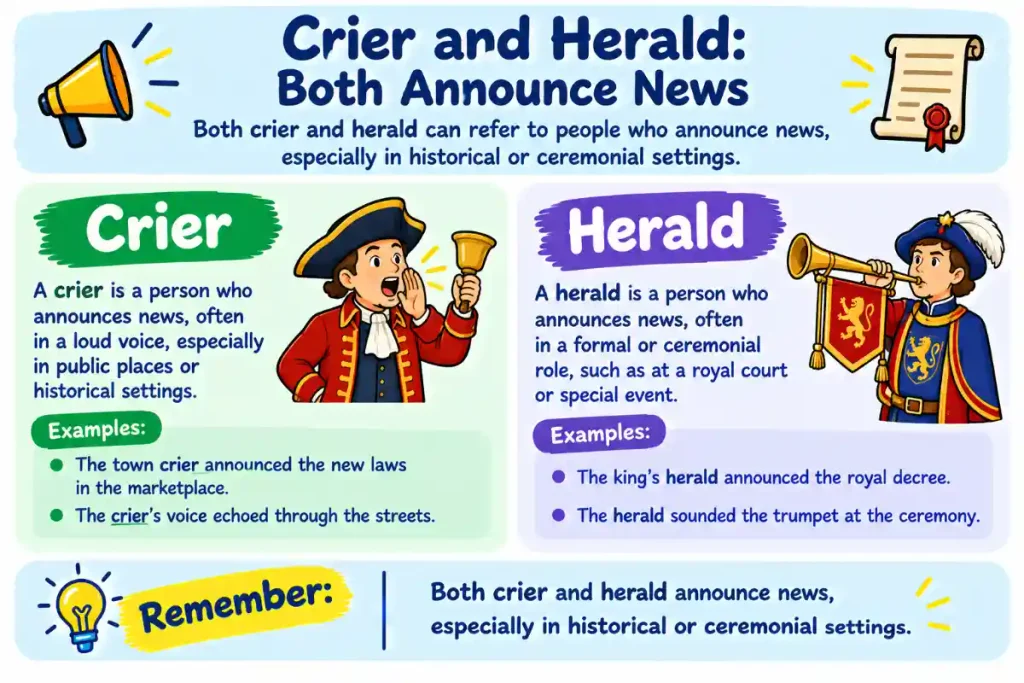
Both crier and herald can refer to people who announce news, especially in historical or ceremonial settings.
| Word | Meaning | Tone | Example |
|---|---|---|---|
| Crier | A person who calls out public announcements | Traditional or historical | The crier announced the king’s arrival. |
| Herald | Someone who announces or signals important news or events | Formal or literary | The herald delivered the royal message. |
A herald may also be a sign or event that signals something to come. A crier more specifically refers to a person who cries out or makes announcements.
10 Examples of Crier in Real Sentences
These examples show how to use crier in different contexts, from historical settings to everyday descriptions.
- Historical event: The town crier announced the new regulations in the village square.
- Community gathering: A local crier invited residents to attend the summer festival.
- School activity: The student played a town crier in the school’s history performance.
- Public ceremony: The crier called the guests to their seats before the ceremony began.
- Historical fiction: In the novel, the crier spread news of the royal wedding.
- Family life: My cousin was a happy baby but became a frequent crier when he was tired.
- Theater: The actor practiced his lines to sound like a town crier from the 18th century.
- Community news: The town crier shared information about the upcoming parade.
- Creative writing: The writer introduced a mysterious crier who warned villagers about an approaching storm.
- Proper name: Jordan Cryer signed the registration form with the correct spelling of the surname.
Notice that crier appears in the first nine examples as a common noun, while Cryer appears as a person’s surname in the final example.
Common Mistakes When Using Cryer and Crier
Writers can avoid confusion by paying attention to spelling, meaning, and context.
Mistake 1: Using cryer for a town crier
Incorrect: The town cryer announced the mayor’s arrival.
Correct: The town crier announced the mayor’s arrival.
Why: Crier is the standard spelling for someone who makes public announcements.
Mistake 2: Assuming every word ending in -er follows the same pattern
Incorrect reasoning: Because cry ends in y, the noun must be cryer.
Correct approach: Learn the established spelling crier rather than relying on a single spelling rule.
English uses several patterns when forming nouns, and not every word follows the same process.
Mistake 3: Changing someone’s surname
Incorrect: Mr. Crier attended the meeting when his surname is actually Cryer.
Correct: Mr. Cryer attended the meeting.
Why: Proper names should retain their official spelling. Cryer can be a valid surname even though crier is the standard common noun.
Mistake 4: Confusing a crier with a caller
Incorrect: The telephone crier left a message.
Better: The caller left a message.
Why: Caller is the natural word for someone who makes a phone call. Crier has a more specific meaning.
Mistake 5: Treating crier as a verb
Incorrect: She crier whenever she watches a sad movie.
Correct: She cries whenever she watches a sad movie.
Why: Crier is a noun, not the present-tense verb form. Use cries to describe the action.
Is Crier Formal or Casual?
Crier is a standard English word, but its tone depends on how you use it.
- Historical or formal: The town crier announced the proclamation.
- Literary: A lonely crier wandered through the streets.
- Everyday description: The baby is a frequent crier.
- Professional communication: The announcer introduced the next speaker.
In ordinary American conversation, people usually say announcer, caller, or someone who cries when those terms communicate the intended meaning more naturally. For example, you would generally describe a person who introduces speakers at a conference as an announcer or host, not a crier.
Is There a Difference Between American and British English?
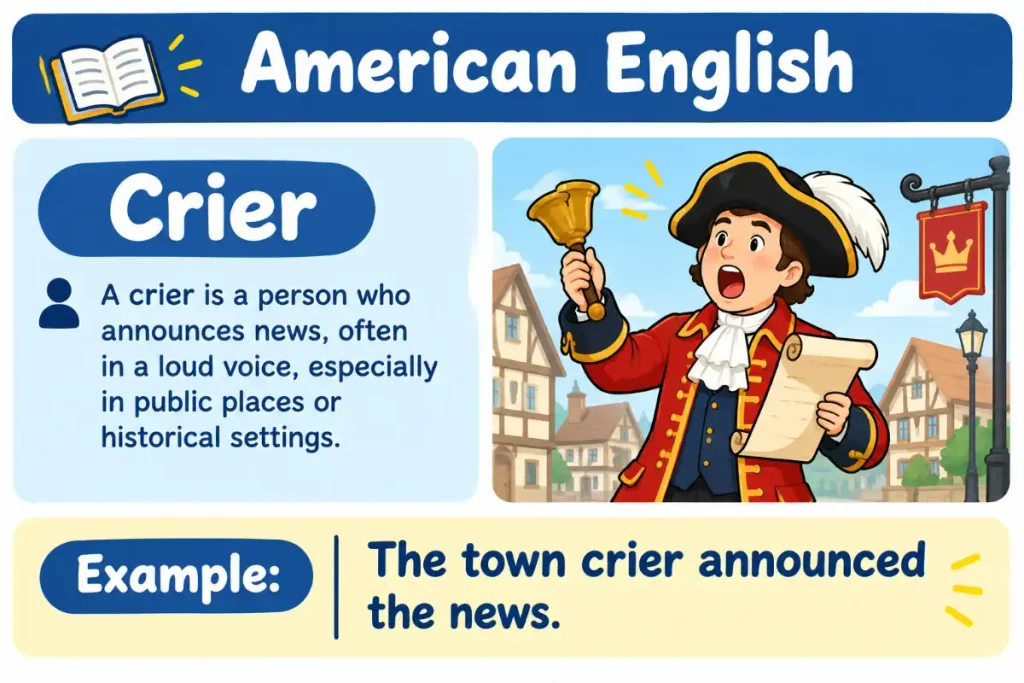
There is no major American-versus-British spelling difference for the standard noun crier. Both varieties use crier.
| Variety | Standard spelling | Example |
|---|---|---|
| American English | Crier | The town crier announced the news. |
| British English | Crier | The town crier announced the news. |
| Proper names | Depends on the person’s name | The surname Cryer retains its spelling. |
The word may appear more often in historical writing, ceremonial contexts, or discussions of traditional public announcements than in everyday conversation. That difference reflects context rather than a regional spelling rule.
Conclusion
The difference between cryer vs crier comes down to standard spelling and context. Crier is the preferred common noun for someone who cries out, announces public news, or weeps. It is the spelling you’ll generally want in essays, stories, school assignments, and everyday writing.
Cryer is less common as a regular noun, but it can be a legitimate surname. Always preserve the spelling of a person’s name rather than changing it to match the common noun.
To remember the difference, connect crier with the traditional town crier who calls out announcements. When you need the ordinary noun, choose crier. This simple distinction will help you write clearly and avoid one of English’s easy-to-miss spelling confusions.
Frequently Asked Questions
Is cryer or crier correct?
Crier is the standard spelling for the common noun referring to someone who cries out, makes announcements, or weeps. Cryer is an uncommon variant and can also be a surname.
How do you spell crier?
Spell it C-R-I-E-R. Use this spelling when referring to a town crier or another person who cries out or makes announcements.
Is Cryer a real word?
Yes, Cryer is a recognized surname and also appears as a less common spelling variant. However, crier is the preferred spelling of the ordinary noun in standard English.
What is a town crier?
A town crier is a person who traditionally announced news, public notices, and important events by calling out in a public place. The role is associated with communities before modern mass communication.
Why is crier spelled with an i instead of a y?
The standard spelling is crier, following an established English spelling pattern in which the final y changes to i before certain suffixes. The spelling crier is the conventional form for the noun.
Is crier a noun or a verb?
Crier is a noun. It identifies a person who cries out, makes announcements, or weeps. The related verb is cry, as in “The child began to cry.”
What is another word for crier?
Depending on the context, alternatives include announcer, herald, caller, and town announcer. For someone who weeps, person who cries is often the clearest everyday expression.
2 thoughts on “Cryer vs Crier: Which Spelling Is Correct?”